Minimal blog theme for Jekyll, centered on content reading
JekyllBlog
rido-emerald — Jekyll Blog Template
By AburridoCode
Emerald is a minimal blog theme for Jekyll that emphasizes mobile-first design and content reading, with the repository under the MIT license.
Explore the design
Compare the page layouts and mobile experience. Open any screenshot for a closer look.
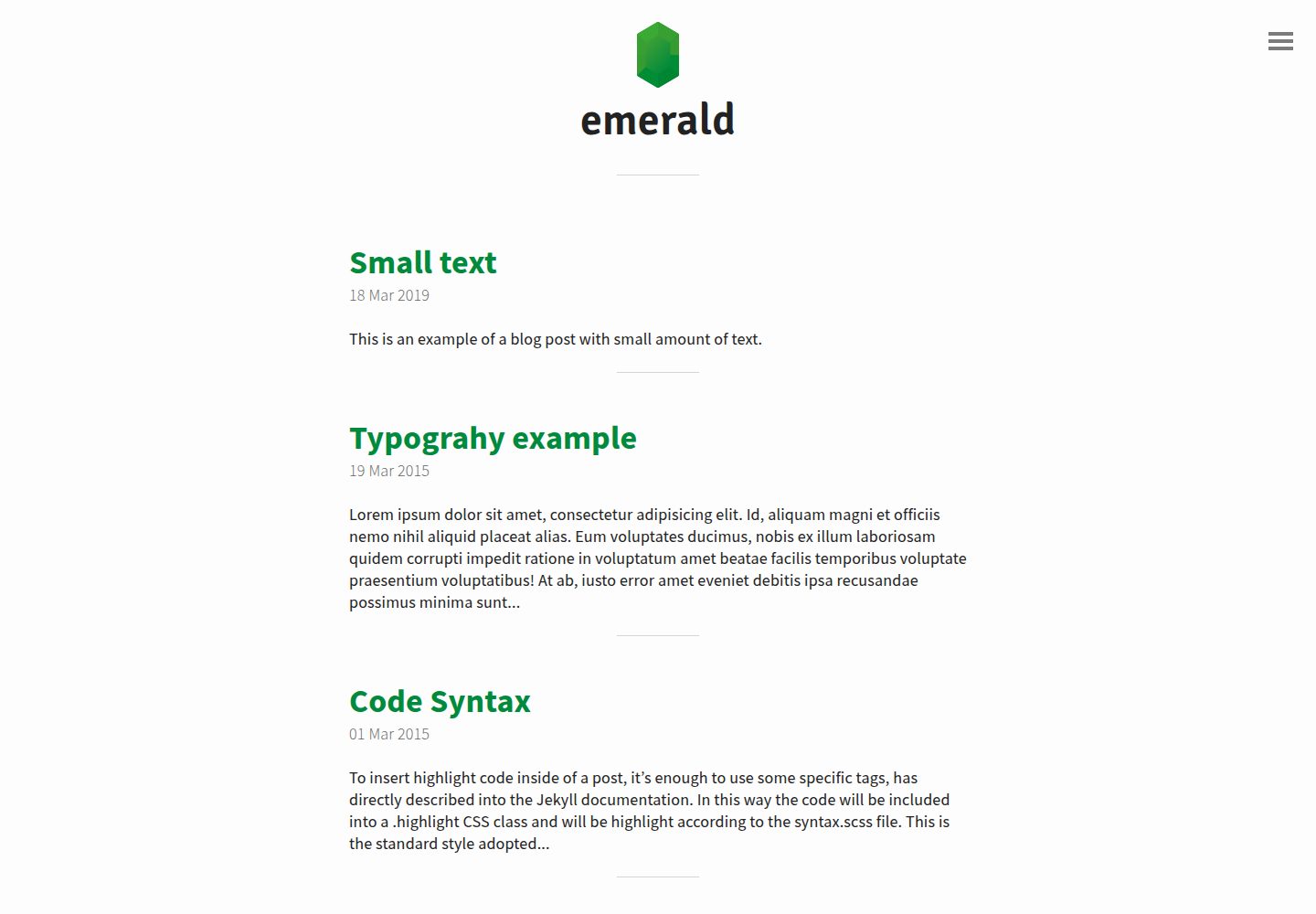
Desktop homepage1 / 3
Desktop captureTop of page
Actual screenshot captured by the server browser.
All pages & views 3
Screenshots show visual appearance; interactive behavior may differ.
Recorded 2026-10-13View source
What stands out
A quick read of the recorded project description.
Mobile-first layout approach
Navigation menu automatically generated from pages with layout set to page, and custom links can also be added in link.html
Base colors centralized in base.scss, adjusted uniformly through three variables
Supports enabling custom header and navigation footer in _config.yml, and moving the navigation menu to the left
Templates use {{ site.baseurl }} in multiple places, facilitating deployment under subpaths such as GitHub project sites
Template Details
Emerald is a minimal blog theme designed for Jekyll, primarily intended to give users a content-centric, mobile-first blog appearance quickly. The theme works based on Jekyll's page and post mechanisms; the navigation menu is automatically generated from pages with the layout set to page, and custom links can also be written in link.html.
For customization, the theme centralizes base colors in base.scss, controlling the colors of the menu, headings, links, footer, background, and body text through three variables: $main-color, $background-color, and $text-color. Values can use HEX, RGB, or other CSS-supported formats. Starting from version 1.1.0, custom header and navigation footer can be enabled in _config.yml, with code placed in header-custom.html and nav-footer-custom.html respectively; a reverse option is also provided to move the navigation menu to the left.
In terms of usage, you can either download the repository's zip package, extract it, and run jekyll serve to view it locally, or fork the repository and host it with GitHub Pages. In the latter case, you need to modify the baseurl in _config.yml according to the project directory name, for example /blog, or set it to / if deployed at the root. The theme uses {{ site.baseurl }} in multiple places in the templates, so it handles subpath deployments such as GitHub project sites accordingly. The repository contains two branches, master and gh-pages; the former is for development, and the latter is only for the demo site.
For typography, the theme uses a modular typographic scale based on a 24px baseline to maintain vertical rhythm. When inserting images, videos, or other content, heights should be referenced to 24px or multiples thereof. Note that the repository materials do not list specific dependency versions, nor do they explain the theme's suitability for production environments; before actual use, you should verify against your own Jekyll environment.
JekyllBlog
Is it right for your project?
Use Cases
- Building a personal blog focused on article reading with Jekyll
- Publishing a blog as a project site on GitHub Pages
- Blog pages that require a mobile-first reading experience
- Quickly adjusting theme colors and navigation layout through a few variables
Suitable For
- Developers using Jekyll who want a ready-made blog appearance
- Writers who prefer minimal, content-first typography
- Users planning to host a blog via GitHub Pages
- Sites that need to control vertical rhythm of text and images based on a 24px baseline
Getting started & customization
Use these recorded setup notes alongside the repository instructions for your chosen version.
- 1
You can download the zip package from the repository, extract it to the target directory, run jekyll serve, and open 0.0.0.0:4000/emerald/ in a browser to view it
- 2
You can also fork the repository and host it with GitHub Pages; in this case, modify the baseurl in _config.yml according to the project directory name, or set it to / if deployed at the root
- 3
To customize the header and navigation footer, first set the corresponding options to true in _config.yml, then edit header-custom.html and nav-footer-custom.html respectively
- 4
Color modifications are made in base.scss by setting the values of $main-color, $background-color, and $text-color
- 5
The repository contains two branches, master and gh-pages; master is for development, and gh-pages is only for the demo site
License & source material
Usage conditions & limitations
Free to use · keep license noticeThis entry covers the free version under the MIT license in the public repository; the free scope is the code of this version and does not imply that external services or third-party assets are free.
Must comply with when using
- Free use, modification, commercial use, and distribution of this version's code are permitted.
- When distributing copies or substantial portions of the code, retain the original author's copyright notice and the full MIT license notice.
- The code is provided as is; warranties and limitations of liability are governed by the original license and applicable law.
Additional costs & items to verify
- Demo images, fonts, icons, and other third-party assets must be checked against their respective licenses and cannot be judged solely by the code's MIT license.
- External services such as domains, hosting, databases, payments, or AI may incur additional charges.
- The repository's gh-pages branch is only for the demo site, while the master branch is for development; for formal use, base on the master branch rather than directly using the demo branch.
- The theme is primarily oriented toward GitHub usage, especially GitHub Pages project site scenarios; when deploying to other hosting environments, you need to adjust configurations such as baseurl yourself.
- To maintain vertical rhythm, when inserting images, videos, or other content, heights should be referenced to 24px or multiples thereof; otherwise, the typographic rhythm may be disrupted.
View Original Text Basis
Permission is hereby granted, free of charge
Original License Text
``master``: is for developing pourpose. - ``gh-pages``: is only for demo site.
Original README
Emerald was thought to be used mainly with Github, in particular into [project site](https://pages.github.com/).
Original README
https://github.com/AburridoCode/rido-emerald/blob/main/LICENSEhttps://github.com/AburridoCode/rido-emerald/blob/main/readme.mdTo maintain this rhythm you need to insert elements like image, video or other contents with a 24px (or multiple) height as refer.
Original README
Compiled by DeepSeek based on repository license and README ·2026-10-13. Results only cover the materials read; dependencies, images, fonts, and subsequent term changes are subject to their respective original texts.
Project checks & description sources
Template Information
- Source platforms
- GitHub
- Documentation and maintenance reference score
- Partly documented · 65 / 100
- Technologies
- Jekyll
- Website type
- Blog
How this score is calculated
Our heuristic uses license records (up to 30), a demo link (12), a preview (10), stars (15), recorded maintenance (15), description completeness (8), feature records (5) and classification data (5). It is not a code, security or performance test, or a Google score. A link does not establish tested functionality.
What to verify for this project
- Repository update recorded
- 2022-07-06
- Screenshot last checked
- 2026-10-13
A demo link is listed. Check it with your own content and viewport sizes; its presence does not confirm that forms, authentication or payments work.
The catalog identifies Jekyll as the primary stack. Check the actual dependency manifest and lockfile for versions and hosting requirements. These notes use recorded metadata, not a code audit or a deployment test.
Use a selection guide →How this description was prepared
AI-assisted description based on catalog records and repository material. Repository authors are not automatically the reviewers of this description.
Review declaration: [email protected] · 2026-10-13
Inspect the recorded source material
SHA-256: 05477df745cd3127669a37b849bb804680b6e8a2268fafb716a6ab0e072b632a
2026-10-13T04:36:32.541Z
Source file / repository## About
Emerald is a minimal theme created for Jekyll. The main purpose of Emerald is to provide a clear theme for those who want a blog ready to use, focused on the content and mobile-first.

## Setup & usage
Emerald may be installed by simply downloading the .zip folder from the [repository on Github](https://github.com/KingFelix/emerald/archive/master.zip).
After extracting the content from the folder into the selected directory, you can type ``jekyll serve`` from the terminal, than open your browser to ``0.0.0.0:4000/emerald/`` and you will find it there.
Additionally it is possible to fork the repository and use Github Pages as hosting. By following this way it will be enough to change the ``baseurl`` value into the ``_config.yml`` file, with the directory name of your project (for example /blog) or simply with a "/" (slash) if you want install Emerald in the root.
### Options
Starting from the 1.1.0 version, you can customize Emerald thanks to a few options. Now it is possible to set a custom header tag by setting the related option in the ``_config.yml`` file to "true". Then insert your custom code into the ``header-custom.html`` file.
In the same way, you can customize the footer of the navigation menu, by setting to "true" the related option and put your code into the ``nav-footer-custom.html`` file.
Moreover it is now possible to select a reverse option that allows to move the navigation menu to the left side, by setting it to "true".
### Colors
The basic colors are set into the ``base.scss`` file:
- $main-color: used for the menu, title, link and footer
- $background-color: used for background and links in the navigation menu
- $text-color: used for text and title in posts and pages
To customize the colors, just set the values in HEX, RGB (or RGBa) or any other format accepted by CSS.
### Navigation menu
Starting from the 1.1.0 version, the links inside the navigation menu are autogenerated from pages having the layout set to ``page``.
You can set custom links, by putting in the ``<a>`` tag into the ``link.html`` file.
### Branch
Emerald has two branch:
- ``master``: is for developing pourpose.
- ``gh-pages``: is only for demo site.
### Baseurl
Emerald was thought to be used mainly with Github, in particular into [project site](https://pages.github.com/). For this reason several tags have been included ``{{ site.baseurl }}`` to refer to the "/emerald/" directory.
You can change the "baseurl" value into the ``config.yml`` file, to match your directory (for example "/blog/") or the root of your project. In that case you must set the "baseurl" value to "/".
### Typography
To maintain the vertical rhythm, it has been applied a **Typographic scale** as a modular scale, with a baseline set to 24px. To maintain this rhythm you need to insert elements like image, video or other contents with a 24px (or multiple) height as refer.
Last but not least: the [Jekyll documentation](http://jekyllrb.com) is the best starting point!
## Author
### Jacopo Rabolini
- Web site: [www.jacoporabolini.com](http://www.jacoporabolini.com)
- Linkedin: [linkedin.com/in/jacopo-rabolini/](https://www.linkedin.com/in/jacopo-rabolini/)
## License
Emerald is released under [MIT License](license.md).
Explore similar templates
Compare previews and descriptions within the same stack and category.

al-folio
A Jekyll academic homepage theme for scholars and researchers, with a clean responsive design and out-of-the-box support for publication lists, project showcases, CVs, and blogs.
Jekyll · Portfolio

minimal-mistakes
Minimal Mistakes is a two-column Jekyll theme for personal sites, blogs, project documentation, or portfolios.
Jekyll · Portfolio

Beautiful Jekyll
Beautiful Jekyll is a mature, easy-to-use Jekyll blog theme maintained by Dean Attali since 2015, with over 50,000 users.
Jekyll · Blog

jekyll-TeXt-theme
A customizable Jekyll theme for personal sites, team sites, blogs, projects, and documentation.
Jekyll · Blog

startbootstrap-clean-blog-jekyll
The official Jekyll version of Start Bootstrap's Clean Blog theme, offering a blog home page, about page, contact page, and sample post pages, with a Formspree-powered contact form.
Jekyll · Blog

So Simple
A minimal reading-oriented Jekyll theme by Michael Rose for personal blogs, portfolios, and long-form reading. It offers multiple layouts, microformat markup, Disqus comments, Google Analytics, Jekyll SEO Tag, three skins, and aggregation by year, category, and tag with a grid view.
Jekyll · Blog