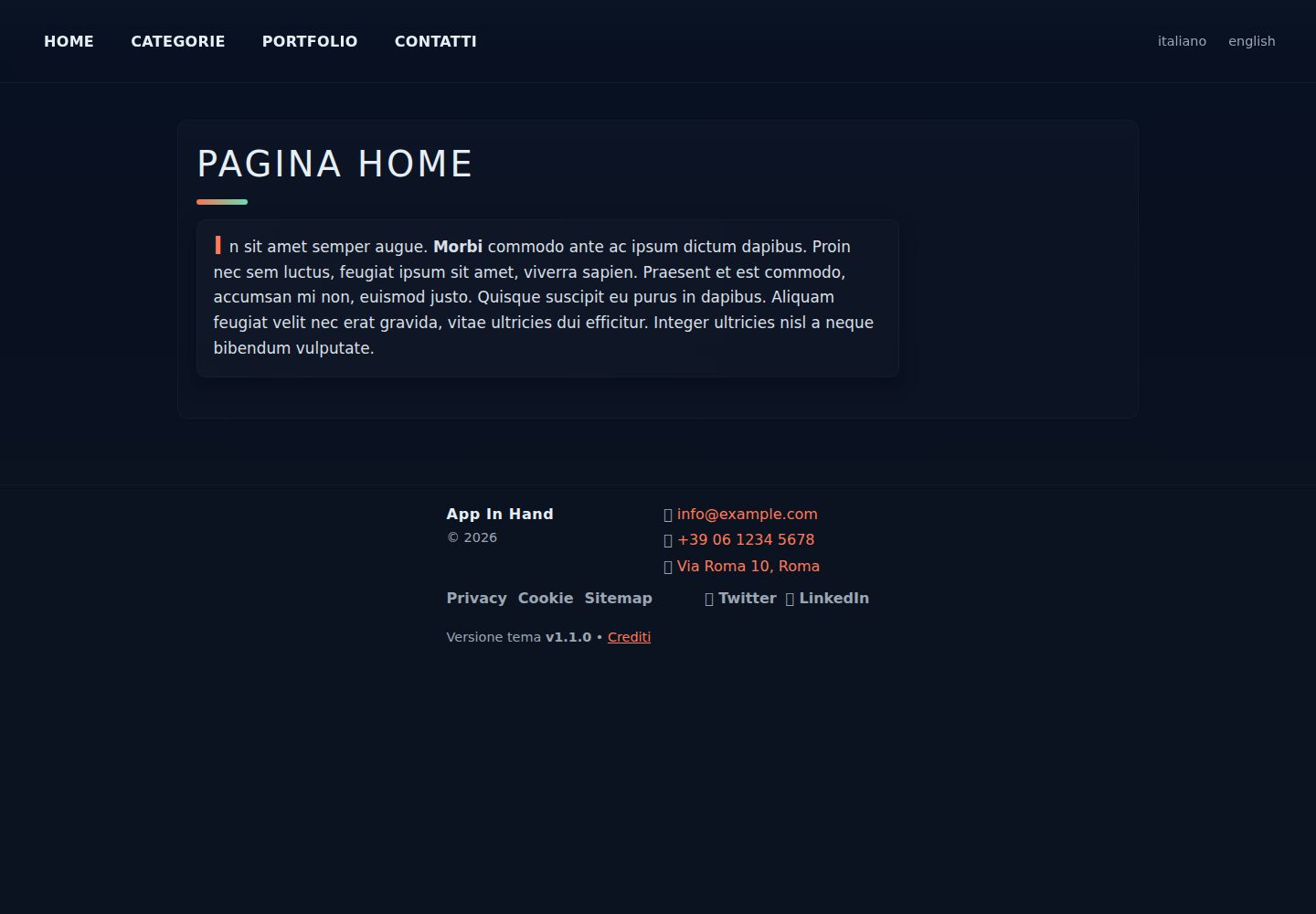
No database, no admin panel, no build step—edit PHP/HTML/CSS files directly and changes take effect
HTMLAdmin dashboardStarter
Kickstart-WebKit — HTML Admin dashboard Template
By AppInHand-Dev
Kickstart-WebKit is a file-based PHP website boilerplate that uses no database, admin panel, or build step. Edit PHP/HTML/CSS directly and see changes immediately. It suits developers building landing pages, portfolios, or small business sites.
Explore the design
Compare the page layouts and mobile experience. Open any screenshot for a closer look.
Desktop homepage1 / 3
Desktop captureTop of page
Actual screenshot captured by the server browser.
All pages & views 3
Screenshots show visual appearance; interactive behavior may differ.
Recorded 2026-10-13View source
What stands out
A quick read of the recorded project description.
Clean file-based routing that generates SEO-friendly URLs without complex .htaccess rules
Configuration-driven theme switching: change one line of configuration to swap the entire site's CSS, images, and other appearance
Caches parsed results per file, supporting file cache, APCu, system temporary directory fallback, and degradation to no persistent cache
Cache writes use a temporary file plus rename atomic approach to avoid partial writes and race conditions
The parser preserves CDATA for known nodes and caches raw HTML strings to retain WYSIWYG content
Template Details
Kickstart-WebKit is a minimalist, file-based PHP website boilerplate aimed at developers who want to edit PHP, HTML, CSS, JS, and XML directly. It relies on no database, admin panel, plugins, or build tools; content and routing are organized in XML files, and page templates and configuration also exist as files. The project provides clean file-based routing that generates SEO-friendly URLs such as /products/my-product without complex .htaccess rules; themes are switched via a configuration file, so changing one line of configuration changes the entire site's CSS, images, and other appearance. A caching layer caches parsed results per file, supporting file cache (PHP/JSON), APCu in-memory cache, system temporary directory fallback, and degradation to no persistent cache when the host disallows writes; route mappings and per-language content files (main menu, pages, footer) are also cached per file, reducing repeated XML parsing and I/O. Cache writes use a temporary file plus rename atomic approach to avoid partial writes and race conditions. Caching can be controlled via the USE_CACHE configuration, the ?nocache=1 parameter, or the force option, making it easy to regenerate during development. The parser preserves CDATA for known nodes (such as pageDescription) and stores raw HTML strings in the cache, so WYSIWYG content is retained without heavy DOM processing on each request. Template routing is also resolved from cache, avoiding repeated parsing of template-routing.xml; when persistent cache is unavailable, an in-request local cache prevents repeated parsing. The project explicitly excludes a database, admin panel, and heavy dependencies, making it suitable for scenarios where content is written directly in code. Before deploying to production, you must read and follow the instructions in docs/migrate-to-production.txt to ensure security and proper functionality. The roadmap includes XML-to-JSON migration (with a conversion script that preserves CDATA/HTML, dual-read compatibility, and documentation and examples for templates consuming JSON), an optional Admin CLI (regenerate cache, clear cache directory, run migration), and optional APCu/Redis integration guides.
HTMLAdmin panelLauncher
Is it right for your project?
Use Cases
- Building a landing page or small business website with content maintained directly in code
- Creating a personal portfolio that needs SEO-friendly URLs and switchable themes
- Quickly switching the entire site's appearance for multiple brand variants or dark/light mode
- Deploying a primarily static-content PHP site in an environment without a database or admin panel
- Controlling cache during development via ?nocache=1 or the force option to see changes in real time
Suitable For
- Developers familiar with PHP, HTML, CSS, JS, and XML who are used to editing files directly
- Projects needing a lightweight website foundation with no database, no admin panel, and no build step
- Projects that want to manage routing, content, and theme configuration as files
- Developers planning to deploy landing pages, portfolios, or small business sites
Getting started & customization
Use these recorded setup notes alongside the repository instructions for your chosen version.
- 1
After cloning or downloading the repository, open assets/config/config.php and modify the configuration variables for your local development environment
- 2
Before deploying to production, be sure to read and follow the instructions in docs/migrate-to-production.txt
- 3
Caching can be controlled via the USE_CACHE configuration, the ?nocache=1 parameter, or the force option; during development you can force regeneration
- 4
The project is MIT licensed; when distributing copies or substantial portions of the code, retain the original author's copyright notice and the full MIT license notice
- 5
Third-party assets such as demo images, fonts, and icons must be checked against their respective licenses; do not judge solely by the code's MIT license
License & source material
Usage conditions & limitations
Free to use · keep license noticeThis entry covers the free version under the MIT license in the public repository; the free scope is that version's code and does not mean external services or third-party assets are free.
Must comply with when using
- You may use, modify, commercialize, and distribute this version's code for free.
- When distributing copies or substantial portions of the code, retain the original author's copyright notice and the full MIT license notice.
- The code is provided as is; warranties and limitations of liability are governed by the original license and applicable law.
Additional costs & items to verify
- Demo images, fonts, icons, and other third-party assets must be checked against their respective licenses; do not judge solely by the code's MIT license.
- External services such as domains, hosting, databases, payments, or AI may incur separate charges.
- Before use, you must open assets/config/config.php and modify the configuration variables for your local development environment, otherwise the site will not run properly.
- Before deploying to production, you must read and follow the instructions in docs/migrate-to-production.txt, otherwise security and proper functionality cannot be guaranteed.
- Aimed at developers with some experience who can directly edit PHP, HTML, CSS, JS, and XML; not suitable for users without relevant technical background.
- No database or admin panel is provided; content must be maintained directly in code files and cannot be edited through a visual admin interface.
View Original Text Basis
Permission is hereby granted, free of charge
Original License Text
**Crucial:** Open the `assets/config/config.php` file and edit the configuration variables to match your local development environment.
Original README
it is **essential** to read and follow the instructions detailed in the `docs/migrate-to-production.txt` file to ensure security and proper functionality.
Original README
This boilerplate is designed for **web developers with some experience** who are comfortable working directly with PHP, HTML, CSS, JS, XML.
Original README
https://github.com/AppInHand-Dev/Kickstart-WebKit/blob/main/LICENSEhttps://github.com/AppInHand-Dev/Kickstart-WebKit/blob/main/README.mdNo databases, no admin panels, no heavy dependencies. This is for content that is edited directly in the code.
Original README
Compiled by DeepSeek based on repository license and README ·2026-10-13. Results only cover the materials read; dependencies, images, fonts, and subsequent term changes are subject to their respective original texts.
Project checks & description sources
Template Information
- Source platforms
- GitHub
- Documentation and maintenance reference score
- More documented · 85 / 100
- Technologies
- HTML
- Website type
- Admin dashboard · Starter
How this score is calculated
Our heuristic uses license records (up to 30), a demo link (12), a preview (10), stars (15), recorded maintenance (15), description completeness (8), feature records (5) and classification data (5). It is not a code, security or performance test, or a Google score. A link does not establish tested functionality.
What to verify for this project
- Repository update recorded
- 2026-06-21
- Screenshot last checked
- 2026-10-13
A demo link is listed. Check it with your own content and viewport sizes; its presence does not confirm that forms, authentication or payments work.
The catalog identifies HTML as the primary stack. Check the actual dependency manifest and lockfile for versions and hosting requirements. These notes use recorded metadata, not a code audit or a deployment test.
Use a selection guide →How this description was prepared
AI-assisted description based on catalog records and repository material. Repository authors are not automatically the reviewers of this description.
Review declaration: [email protected] · 2026-10-13
Inspect the recorded source material
SHA-256: 7bf3a5560c7dff1f770936bba382ff0c516ba7e17f90d6c6bfc4cf4c9b6a0326
2026-10-13T07:24:30.230Z
Source file / repository# Kickstart-WebKit A minimalist, file-based PHP boilerplate for building fast, themeable websites. No bloat. Just fast, just light. <img src="assets/images/screenshot-1.jpg"> [WATCH LIVE](https://www.appinhand.it/sites/kickstart-webkit) --- ### 💡 Philosophy Kickstart-WebKit was born from the need to develop simple websites quickly, without the overhead of large frameworks, complex build processes, or databases. The core principles are: * **No Backend Bloat:** No databases, no admin panels, no heavy dependencies. This is for content that is edited directly in the code. * **Zero Plugins:** The project is intentionally lean to ensure the fastest possible page load times and a minimal footprint. * **Direct Control:** You are in full control. What you edit in the PHP/HTML/CSS files is what you see in the browser. No compilation, no magic. --- ### ✨ Features * **Clean, File-Based Routing:** Create SEO-friendly URLs like `/products/my-product` without complex `.htaccess` rules. * **Config-Driven Theming:** Easily switch the entire look and feel of your site (CSS, images, etc.) by changing a single line in the config file. Perfect for creating multiple brand variations or dark/light modes. * **Zero Dependencies & No Build Step:** Pure PHP and HTML. No `composer install`, no `npm build`. Just edit the files and see the changes instantly. * **Per-file cache layer** — Generic `load_or_cache_xml()` with atomic writes (tmp + rename) that stores parsed results to a fast cache. * **Cache backend fallback** — File cache (PHP/JSON), APCu in-memory, system temp dir fallback, and graceful degradation to no persistent cache when the host disallows writes. * **Routing maps cached** — `page-routing.xml` is parsed into `routingMap` and `routingInverse` and cached per-file to avoid repeated XML parsing. * **Content caching** — Per-language content files (main menu, pages, footer) are cached per-file to reduce I/O and parsing overhead. * **Safe atomic cache writes** — `safe_write_file()` helper to avoid partial writes and race conditions. * **Cache control flags** — `USE_CACHE` config, `?nocache=1` override, and `force` option to regenerate caches in development. * **Lightweight CDATA preservation** — Parser extracts CDATA for known nodes (e.g. `pageDescription`) and stores raw HTML strings in the cache so WYSIWYG content is preserved without heavy DOM processing on every request. * **Template routing from cache** — `get_template_page_name_from_array()` helper resolves template names from cached arrays to avoid re-parsing `template-routing.xml`. * **In-request local cache** — when persistent cache is unavailable, parsed results are kept for the duration of the request to avoid duplicate parsing. --- ### 🎯 Who is this for? This boilerplate is designed for **web developers with some experience** who are comfortable working directly with PHP, HTML, CSS, JS, XML. It is the perfect starting point if you want a no-nonsense foundation for a landing page, a portfolio, or a small business website, and you value speed and simplicity above all else. --- ### 🚀 Getting Started 1. Clone or download this repository. 2. **Crucial:** Open the `assets/config/config.php` file and edit the configuration variables to match your local development environment. 3. Start building your pages! --- ### 📦 Deploying to Production Before deploying your site to a live server, it is **essential** to read and follow the instructions detailed in the `docs/migrate-to-production.txt` file to ensure security and proper functionality. --- ### 🛣️ Roadmap Planned improvements and migration tasks: * **Migration: XML → JSON** — provide migration scripts and tooling to convert existing XML content and routing files to JSON, simplifying parsing and reducing conversion overhead. The migration will include: * a safe conversion script that preserves CDATA/HTML content, * dual-read compatibility (prefer JSON if present, fallback to XML), * documentation and examples for updating templates to consume JSON. * **Optional: Admin CLI** — a small command-line tool to regenerate caches, clear cache directory, and run the XML→JSON migration. * **Optional: APCu/Redis integration guide** — documentation and examples for using APCu or Redis as a hot cache in high‑traffic deployments. --- ### License This project is licensed under the MIT License - see the [LICENSE](LICENSE) file for details.
Explore similar templates
Compare previews and descriptions within the same stack and category.
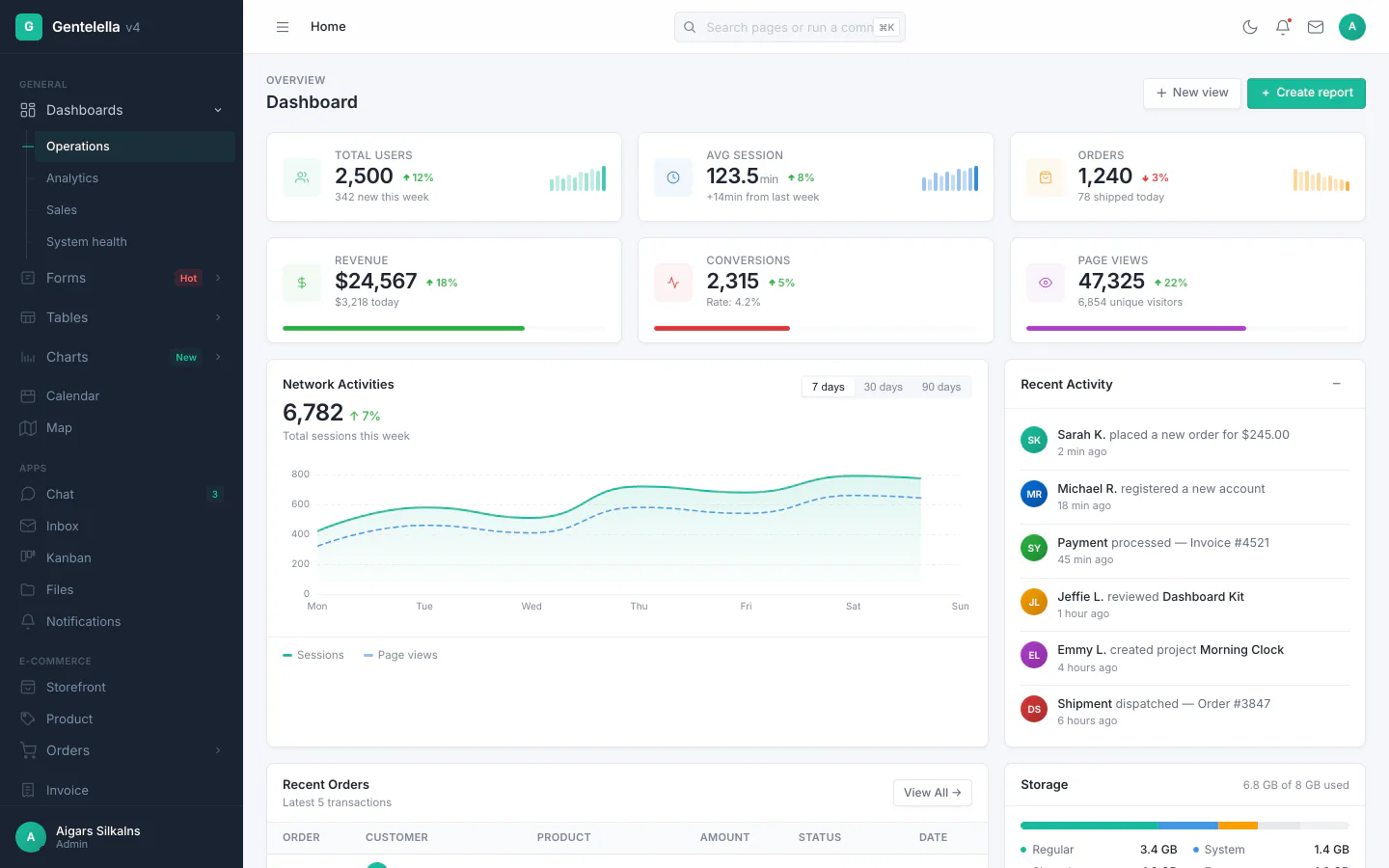
gentelella
Gentelella v4 is a free, open-source admin dashboard template maintained by Colorlib, built with vanilla JavaScript, SCSS, and Vite 8 without Bootstrap or jQuery.
HTML · Admin dashboard
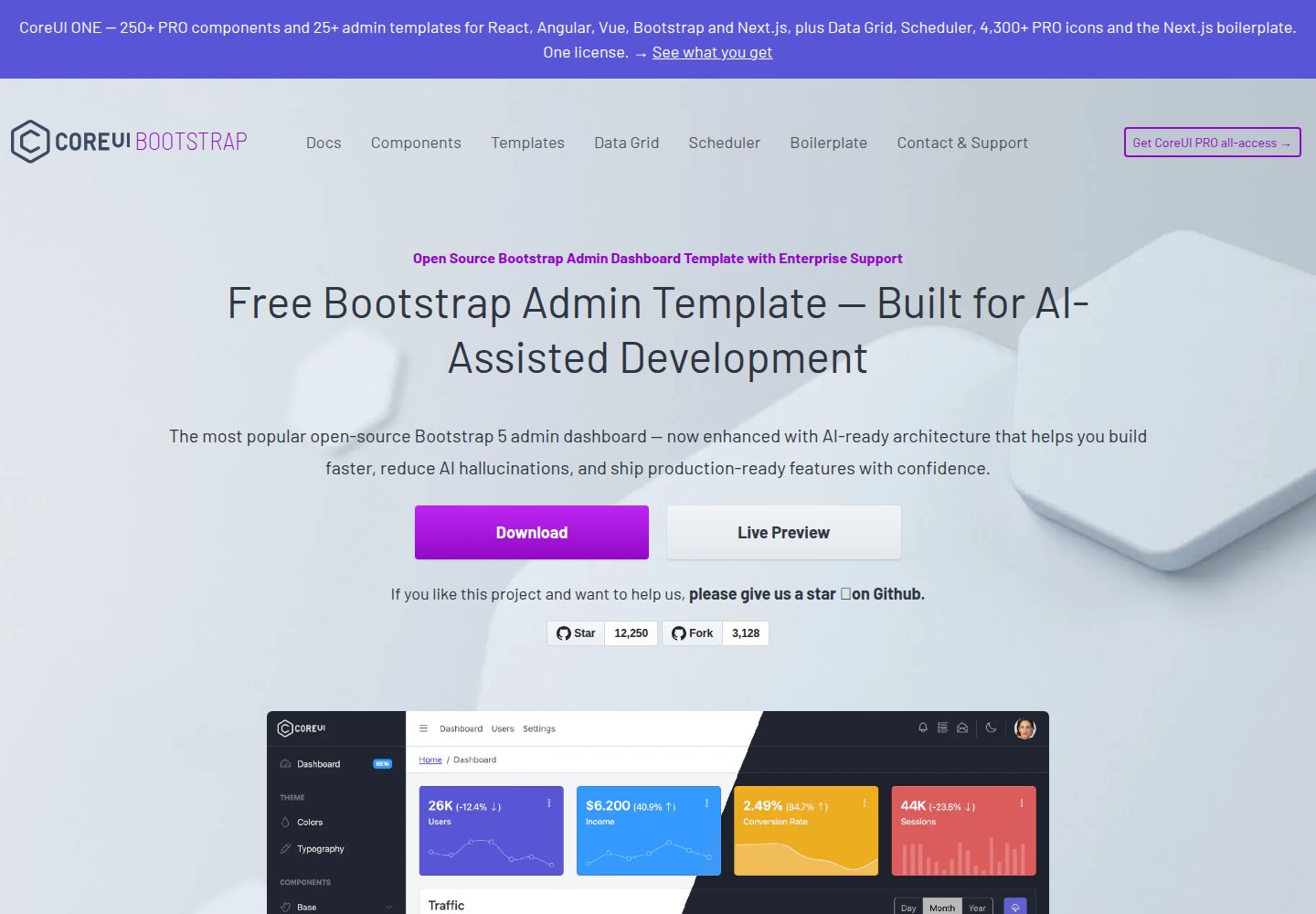
coreui-free-bootstrap-admin-template
A free Bootstrap admin template maintained by CoreUI, built on CoreUI's own UI component library. It provides compiled HTML pages and Pug template source code, covering dashboards, authentication, forms, components, icons, and error pages.
HTML · Admin dashboard
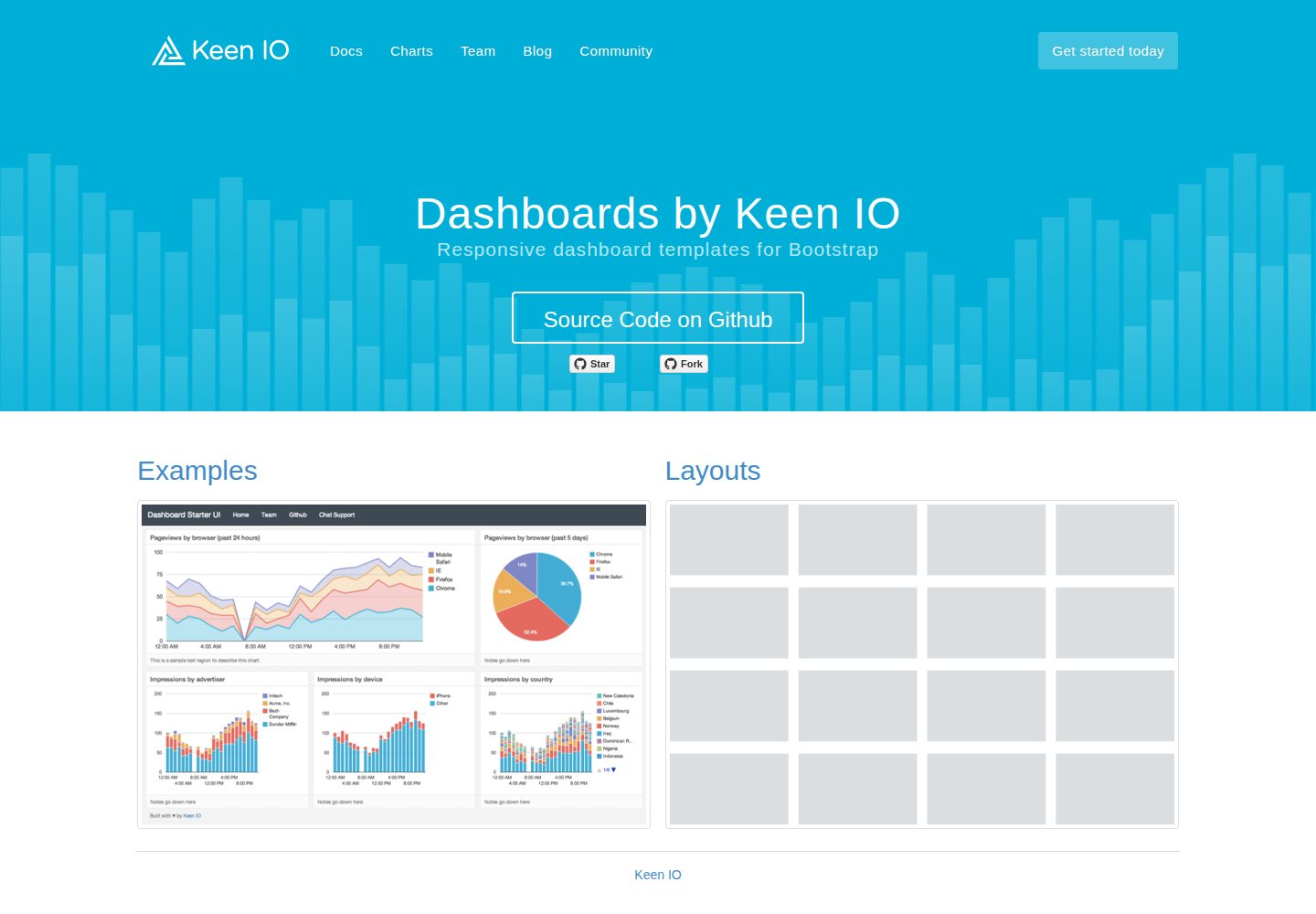
dashboards
A collection of responsive dashboard HTML templates open-sourced by Keen IO, built on CSS Grid, offering multiple prebuilt admin data interface layouts.
HTML · Admin dashboard
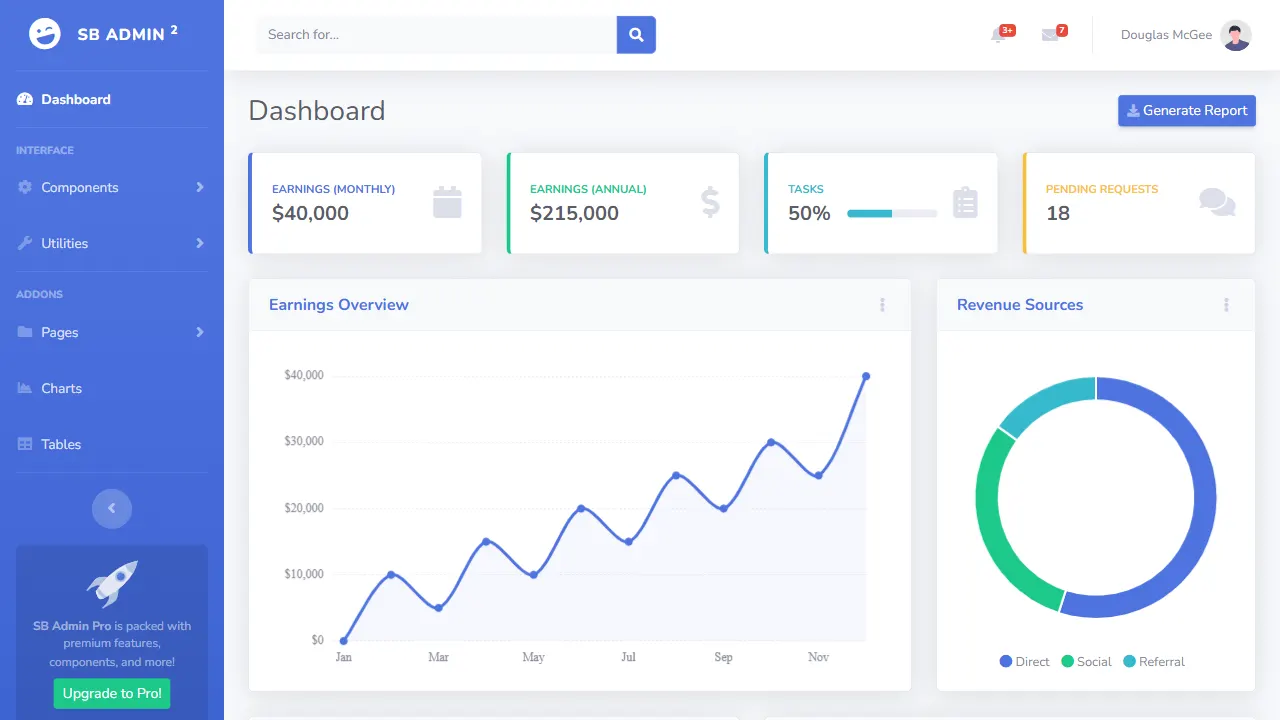
SB Admin 2
SB Admin 2 is a classic Bootstrap admin template from Start Bootstrap, offering dashboards, charts, tables, and common management pages.
HTML · Admin dashboard
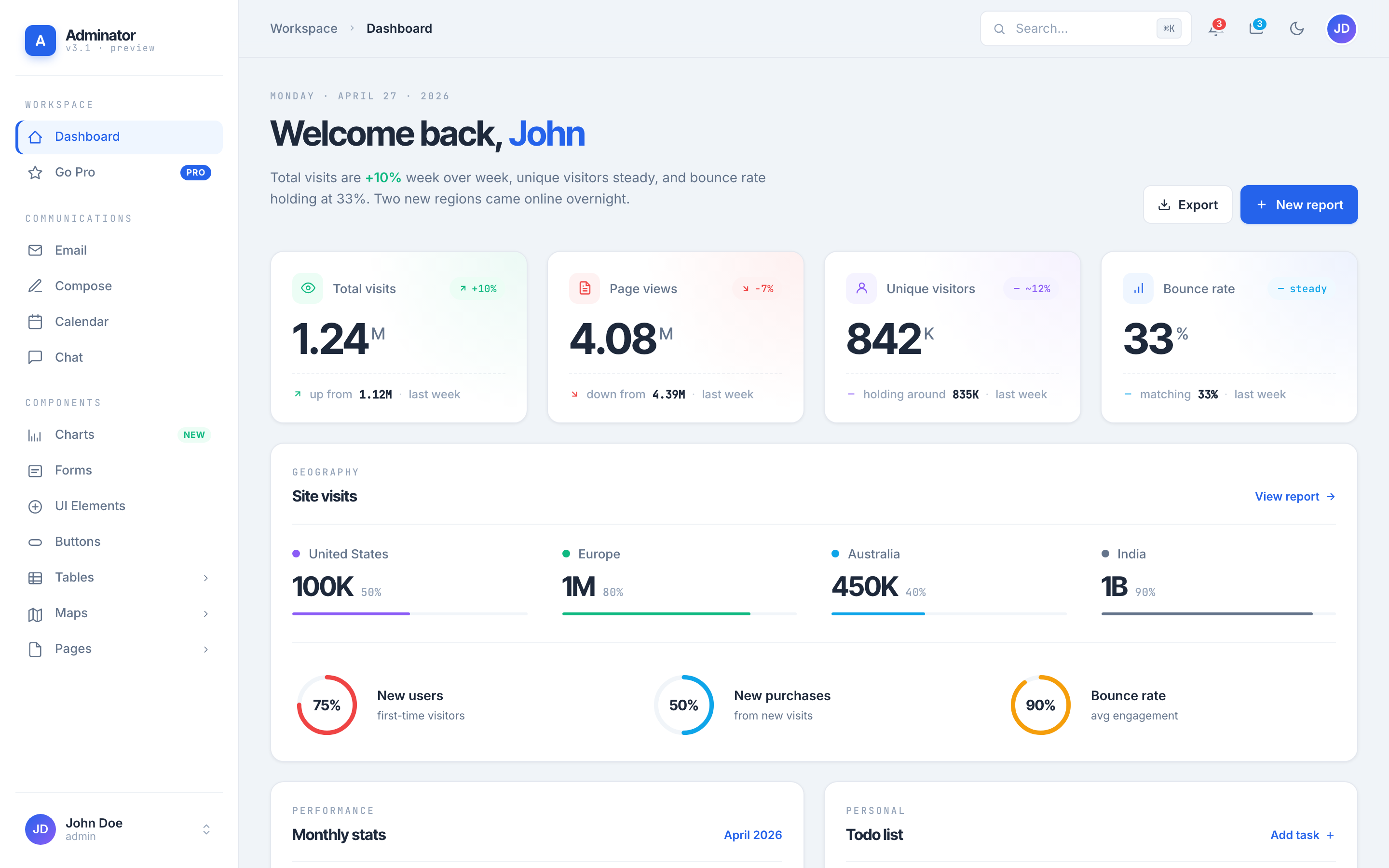
Adminator-admin-dashboard
Adminator 4 is a vanilla HTML, CSS and JavaScript admin dashboard template with a CSS-variable token design system, built-in light and dark themes, no jQuery or Bootstrap dependency, and 18 pages covering dashboards, mail, calendar, charts, forms, tables and error pages.
HTML · Admin dashboard
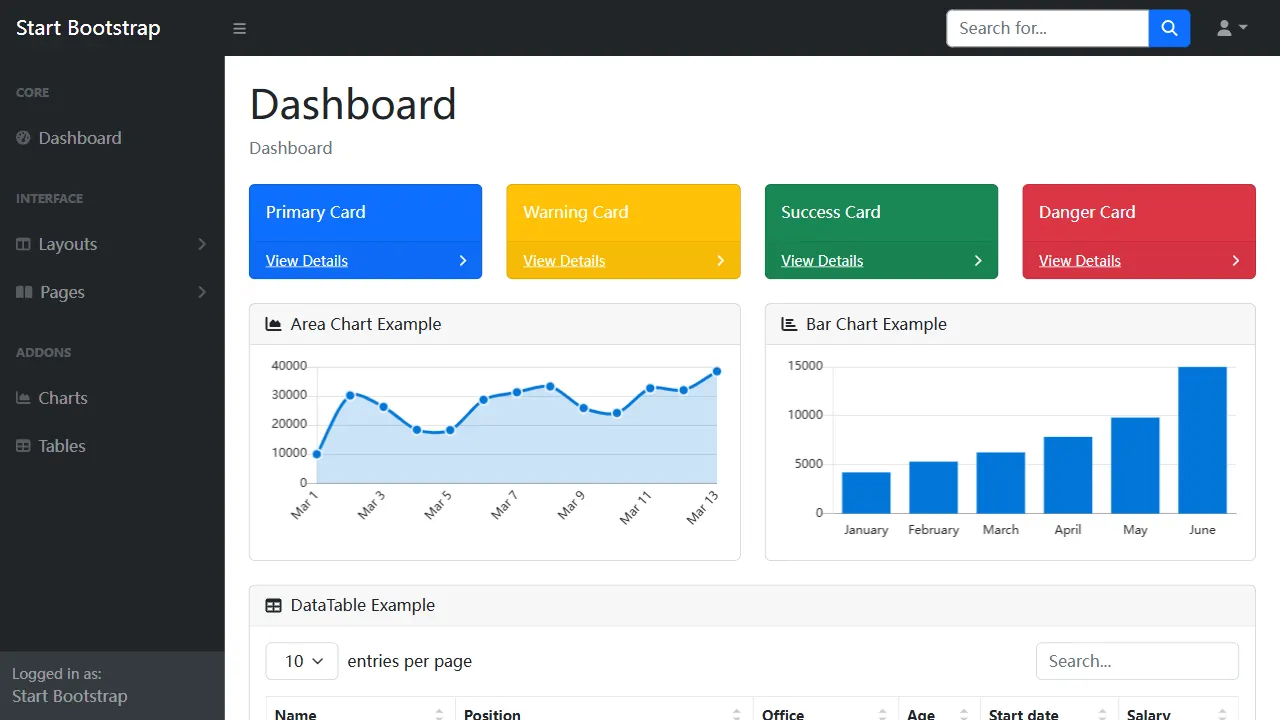
SB Admin
SB Admin is a lightweight, open-source Bootstrap admin template from Start Bootstrap. It offers a sidebar-and-top-bar layout with data tables, forms, and stat cards, plus responsive design.
HTML · Admin dashboard