The Jekyll theme actually used by The Bubblin Blog; the repository is MIT licensed
JekyllBlog
bubblin-jekyll — Jekyll Blog Template
By bookiza
The official Jekyll blog theme used by The Bubblin Blog, rewritten from Minima, suitable for mounting a /blog/ subpath blog alongside an existing site (such as a Rails application).
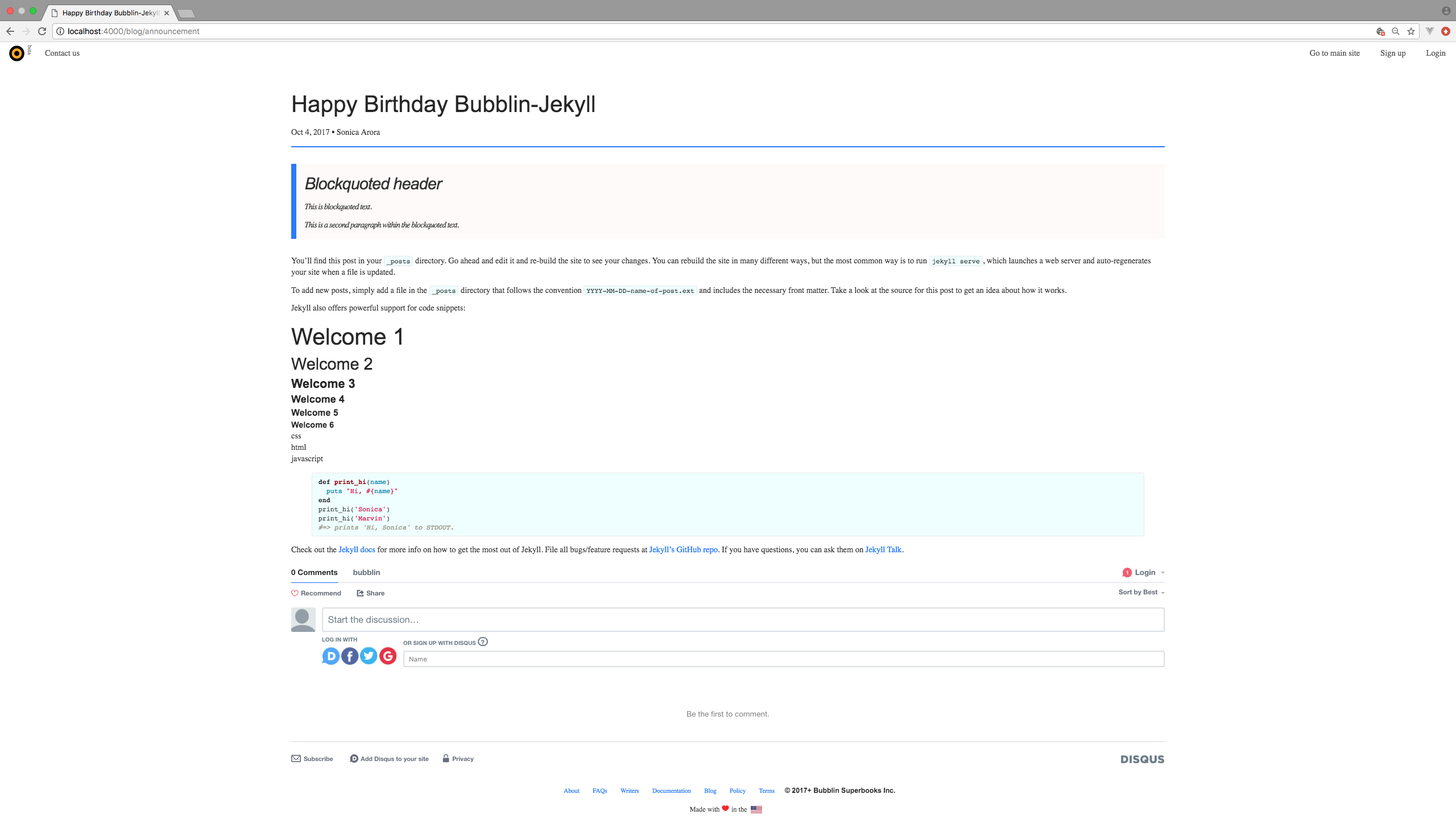
Explore the design
Compare the page layouts and mobile experience. Open any screenshot for a closer look.
Author preview
Author-provided preview
Preview provided in the project README.
One original preview is available. Open the full image to inspect the design.
Screenshots show visual appearance; interactive behavior may differ.
Recorded 2026-10-03View source
What stands out
A quick read of the recorded project description.
Forked from Jekyll's default theme Minima, then rewritten using the Toucaan CSS foundation for theme layouts
Provides four layouts—default, home, page, and post—plus reusable include partials such as header, footer, and head
Includes the jekyll-seo-tag plugin for meta tags and reserves integration points for Disqus comments, Google Analytics, and Heap Analytics
Supports custom date formats via site.bubblin-jekyll.date_format; comment and analytics scripts take effect only in the production environment
Template Details
bubblin-jekyll is the Jekyll theme currently used by The Bubblin Blog. The repository is maintained by bookiza and is MIT licensed. It was originally forked from Jekyll's default theme Minima, but the theme layout has been rewritten using the Toucaan CSS foundation.
The theme targets the scenario of "adding a blog alongside an existing site," such as mounting it beside a Rails application or deploying it under a subpath like https://example.com/blog/. The README provides a link to a tutorial on setting up a Jekyll blog with a Rails application.
The theme provides four layouts: default, home, page, and post, along with include partials for header, footer, head, Disqus comments, Google Analytics, and more. Styles are organized into three parts under _sass: base, layout, and syntax highlighting, compiled into the main stylesheet via assets/main.scss. The built-in jekyll-seo-tag plugin outputs meta tags.
Configurable options include the date format (site.bubblin-jekyll.date_format), the Disqus shortname, and Google Analytics and Heap Analytics identifiers. Comment and analytics scripts appear only when JEKYLL_ENV=production, and comments can be disabled per post via comments: false in the front matter.
Limitations: the repository has not been updated since 2019, has 0 GitHub stars, and the README does not specify browser compatibility, build times, or production performance. Licenses for third-party assets such as demo images, fonts, and icons must be checked separately, and external services such as domains and hosting may incur additional charges.
JekyllBlog
Is it right for your project?
Use Cases
- Adding a blog mounted under a /blog/ subpath to an existing Rails application or static site
- Building an editorial content site focused on post lists and post details with Jekyll
- A personal or team blog that needs Disqus comments below posts and traffic source analytics
- Secondary customization of a Jekyll theme that follows the Minima style but uses a different CSS foundation
Suitable For
- Developers familiar with the Jekyll directory structure who can customize by overriding _includes and assets/main.scss
- Projects that already have a main site and only want to add a blog module on the side or under a subpath
- Users who accept the MIT license terms and will independently verify third-party asset licensing
Getting started & customization
Use these recorded setup notes alongside the repository instructions for your chosen version.
- 1
Add gem "bubblin-jekyll" to the Gemfile, set theme: bubblin-jekyll and search: true in _config.yml, then run bundle
- 2
To override default styles, create assets/main.scss in the site root, add front matter and @import "bubblin-jekyll"; then write custom CSS
- 3
For comments, configure disqus.shortname in _config.yml; for analytics, configure google_analytics or heap_analytics; these output only when JEKYLL_ENV=production
- 4
For local development, run script/bootstrap to initialize the environment, then preview at localhost:4000 with script/server or bundle exec jekyll serve
License & source material
Usage conditions & limitations
Free to use · keep license noticeThis entry covers the free version in the public repository under the MIT license; the free scope is the code of that version and does not mean external services or third-party assets are free.
Must comply with when using
- You may use, modify, commercialize, and distribute the code of this version for free.
- When distributing copies or substantial portions of the code, retain the original author's copyright notice and the full MIT license notice.
- The code is provided as is; warranties and limitations of liability are governed by the original license and applicable law.
Additional costs & items to verify
- Enabling post comments requires your own Disqus account and shortname configuration; this is a third-party external service and may be subject to its terms and fees.
- Using Google Analytics requires applying for and configuring a tracking ID; this is an external service and may involve an account and fees.
- Using Heap Analytics requires applying for and configuring a project ID; this is an external service and may involve an account and fees.
- Comments are enabled by default but are output only when building in the JEKYLL_ENV=production production environment.
- The Google Analytics script is output only when building in the JEKYLL_ENV=production production environment.
- The Heap Analytics script is output only when building in the JEKYLL_ENV=production production environment.
- To disable comments on a single post, you must explicitly set comments: false in that post's front matter.
- Demo images, fonts, icons, and other third-party assets must be checked against their respective licenses; the code's MIT license alone is not sufficient to judge them.
- External services such as domains, hosting, databases, payments, or AI may incur additional charges.
View Original Text Basis
Permission is hereby granted, free of charge
Original License Text
Optionally, if you have a Disqus account, you can tell Jekyll to use it to show a comments section below each post.
Original README
To enable Google Anaytics, add the following lines to your Jekyll site:
Original README
To enable Heap Anaytics, add the following lines to your Jekyll site:
Original README
Comments are enabled by default and will only appear in production, i.e., `JEKYLL_ENV=production`
Original README
Google Analytics will only appear in production, i.e., `JEKYLL_ENV=production`
Original README
Heap will appear only in production, i.e., with `JEKYLL_ENV=production`
Original README
https://github.com/bookiza/bubblin-jekyll/blob/master/LICENSE.txthttps://github.com/bookiza/bubblin-jekyll/blob/master/README.mdIf you don't want to display comments for a particular post you can disable them by adding `comments: false` to that post's YAML Front Matter.
Original README
Compiled by DeepSeek based on repository license and README ·2026-10-03. Results only cover the materials read; dependencies, images, fonts, and subsequent term changes are subject to their respective original texts.
Project checks & description sources
Template Information
- Source platforms
- GitHub
- Documentation and maintenance reference score
- Partly documented · 65 / 100
- Technologies
- Jekyll
- Website type
- Blog
How this score is calculated
Our heuristic uses license records (up to 30), a demo link (12), a preview (10), stars (15), recorded maintenance (15), description completeness (8), feature records (5) and classification data (5). It is not a code, security or performance test, or a Google score. A link does not establish tested functionality.
What to verify for this project
- Repository update recorded
- 2019-10-08
- Screenshot last checked
- 2026-10-03
A demo link is listed. Check it with your own content and viewport sizes; its presence does not confirm that forms, authentication or payments work.
The catalog identifies Jekyll as the primary stack. Check the actual dependency manifest and lockfile for versions and hosting requirements. These notes use recorded metadata, not a code audit or a deployment test.
Use a selection guide →How this description was prepared
AI-assisted description based on catalog records and repository material. Repository authors are not automatically the reviewers of this description.
Review declaration: [email protected] · 2026-10-04
Inspect the recorded source material
SHA-256: 9e9f41b92bf7b3dec622a2f0ae0b2ab6a4c15cb2ea25a904c20d454b432b2dbd
2026-10-03T18:01:39.201Z
Source file / repository# bubblin-jekyll
The `Bubblin-Jekyll` is the Jekyll theme in use at [The Bubblin Blog](https://bubblin.io/blog/). It is a particularly useful theme for situations where you want to add a blog to your site, say on the side of your rails app (website) or over a url like this:
> https://example.com/blog/
`Bubblin-Jekyll` was originally a fork off of [Minima](https://github.com/jekyll/minima)—the default gem-theme of Jekyll-but it has been rewritten completely using the [Toucaan CSS](https://github.com/marvindanig/toucaan) fundamentals for its themed layout.
A tutorial on how to setup a jekyll blog using the `bubblin-jekyll` theme alongside your rails app is available [here](https://bubblin.io/blog/).
[Theme preview](https://jekyll.github.io/bubblin-jekyll/)

## Installation
Add this line to your Jekyll site's Gemfile:
```ruby
gem "bubblin-jekyll"
```
And add this line to your Jekyll site:
```yaml
theme: bubblin-jekyll
search: true
```
And then execute:
$ bundle
### Layouts
Refers to files within the `_layouts` directory, that define the markup for your theme.
- `default.html` — The base layout that lays the foundation for subsequent layouts. The derived layouts inject their contents into this file at the line that says ` {{ content }} ` and are linked to this file via [FrontMatter](https://jekyllrb.com/docs/frontmatter/) declaration `layout: default`.
- `home.html` — The layout for your landing-page / home-page / index-page.
- `page.html` — The layout for your documents that contain FrontMatter, but are not posts.
- `post.html` — The layout for your posts.
### Includes
Refers to snippets of code within the `_includes` directory that can be inserted in multiple layouts (and another include-file as well) within the same theme-gem.
- `disqus_comments.html` — Code to markup disqus comment box.
- `footer.html` — Defines the site's footer section.
- `google-analytics.html` — Inserts Google Analytics module (active only in production environment).
- `head.html` — Code-block that defines the `<head></head>` in *default* layout.
- `header.html` — Defines the site's main header section. By default, pages with a defined `title` attribute will have links displayed here.
- `icon-* files` — Inserts github and twitter ids with respective icons.
### Sass
Refers to `.scss` files within the `_sass` directory that define the theme's styles.
- `bubblin-jekyll.scss` — The core file imported by preprocessed `main.scss`, it defines the variable defaults for the theme and also further imports sass partials to supplement itself.
- `bubblin-jekyll/_base.scss` — Resets and defines base styles for various HTML elements.
- `bubblin-jekyll/_layout.scss` — Defines the visual style for various layouts.
- `bubblin-jekyll/_syntax-highlighting.scss` — Defines the styles for syntax-highlighting.
### Assets
Refers to various asset files within the `assets` directory.
Contains the `main.scss` that imports sass files from within the `_sass` directory. This `main.scss` is what gets processed into the theme's main stylesheet `main.css` called by `_layouts/default.html` via `_includes/head.html`.
This directory can include sub-directories to manage assets of similar type, and will be copied over as is, to the final transformed site directory.
### Plugins
Bubblin-jekyll comes preinstalled with the [`jekyll-seo-tag`](https://github.com/jekyll/jekyll-seo-tag) plugin to make sure your website gets the most useful meta tags. See [usage](https://github.com/jekyll/jekyll-seo-tag#usage) to know how to set it up.
## Usage
### Customization
To override the default structure and style of bubblin-jekyll, simply create the concerned directory at the root of your site, copy the file you wish to customize to that directory, and then edit the file.
e.g., to override the [`_includes/head.html `](_includes/head.html) file to specify a custom style path, create an `_includes` directory, copy `_includes/head.html` from minima gem folder to `<yoursite>/_includes` and start editing that file.
The site's default CSS has now moved to a new place within the gem itself, [`assets/main.scss`](assets/main.scss). To **override the default CSS**, the file has to exist at your site source. Do either of the following:
- Create a new instance of `main.scss` at site source.
- Create a new file `main.scss` at `<your-site>/assets/`
- Add the frontmatter dashes, and
- Add `@import "bubblin-jekyll";`, to `<your-site>/assets/main.scss`
- Add your custom CSS.
- Download the file from this repo
- Create a new file `main.scss` at `<your-site>/assets/`
- Copy the contents at [assets/main.scss](assets/main.scss) onto the `main.scss` you just created, and edit away!
- Copy directly from Bubblin-Jekyll gem
- Go to your local bubblin-jekyll gem installation directory ( run `bundle show bubblin-jekyll` to get the path to it ).
- Copy the `assets/` folder from there into the root of `<your-site>`
- Change whatever values you want, inside `<your-site>/assets/main.scss`
--
### Change default date format
You can change the default date format by specifying `site.bubblin-jekyll.date_format`
in `_config.yml`.
```
# Bubblin-Jekyll date format
# Refer to http://shopify.github.io/liquid/filters/date/ to customize
bubblin-jekyll:
date_format: "%b %-d, %Y"
```
--
### Enabling comments (via Disqus)
Optionally, if you have a Disqus account, you can tell Jekyll to use it to show a comments section below each post.
To enable it, add the following lines to your Jekyll site:
```yaml
disqus:
shortname: my_disqus_shortname
```
You can find out more about Disqus' shortnames [here](https://help.disqus.com/customer/portal/articles/466208).
Comments are enabled by default and will only appear in production, i.e., `JEKYLL_ENV=production`
If you don't want to display comments for a particular post you can disable them by adding `comments: false` to that post's YAML Front Matter.
--
### Enabling Google Analytics
To enable Google Anaytics, add the following lines to your Jekyll site:
```yaml
google_analytics: UA-NNNNNNNN-N
```
Google Analytics will only appear in production, i.e., `JEKYLL_ENV=production`
--
### Enabling Heap Analytics
To enable Heap Anaytics, add the following lines to your Jekyll site:
```yaml
heap_analytics: NN-NNNNNNNNN
```
Heap will appear only in production, i.e., with `JEKYLL_ENV=production`
## Contributing
Bug reports and pull requests are welcome on GitHub at . This project is intended to be a safe, welcoming space for collaboration, and contributors are expected to adhere to the [Contributor Covenant](http://contributor-covenant.org) code of conduct.
## Development
To set up your environment to develop this theme, run `script/bootstrap`.
To test your theme, run `script/server` (or `bundle exec jekyll serve`) and open your browser at `http://localhost:4000`. This starts a Jekyll server using your theme and the contents. As you make modifications, your site will regenerate and you should see the changes in the browser after a refresh.
## License
The theme is available as open source under the terms of the [MIT License](http://opensource.org/licenses/MIT).
Explore similar templates
Compare previews and descriptions within the same stack and category.

al-folio
A Jekyll academic homepage theme for scholars and researchers, with a clean responsive design and out-of-the-box support for publication lists, project showcases, CVs, and blogs.
Jekyll · Portfolio

minimal-mistakes
Minimal Mistakes is a two-column Jekyll theme for personal sites, blogs, project documentation, or portfolios.
Jekyll · Portfolio

Beautiful Jekyll
Beautiful Jekyll is a mature, easy-to-use Jekyll blog theme maintained by Dean Attali since 2015, with over 50,000 users.
Jekyll · Blog

jekyll-TeXt-theme
A customizable Jekyll theme for personal sites, team sites, blogs, projects, and documentation.
Jekyll · Blog

startbootstrap-clean-blog-jekyll
The official Jekyll version of Start Bootstrap's Clean Blog theme, offering a blog home page, about page, contact page, and sample post pages, with a Formspree-powered contact form.
Jekyll · Blog

So Simple
A minimal reading-oriented Jekyll theme by Michael Rose for personal blogs, portfolios, and long-form reading. It offers multiple layouts, microformat markup, Disqus comments, Google Analytics, Jekyll SEO Tag, three skins, and aggregation by year, category, and tag with a grid view.
Jekyll · Blog