Loads hugo-theme-stack via Hugo Modules, so the theme is not written directly into the repository
HugoBlogStarter
hugo-theme-stack-starter — Hugo Blog Template
By CaiJimmy
A blog quickstart template that loads hugo-theme-stack via Hugo Modules, with built-in GitHub Actions for automatic deployment to GitHub Pages.
Explore the design
Compare the page layouts and mobile experience. Open any screenshot for a closer look.
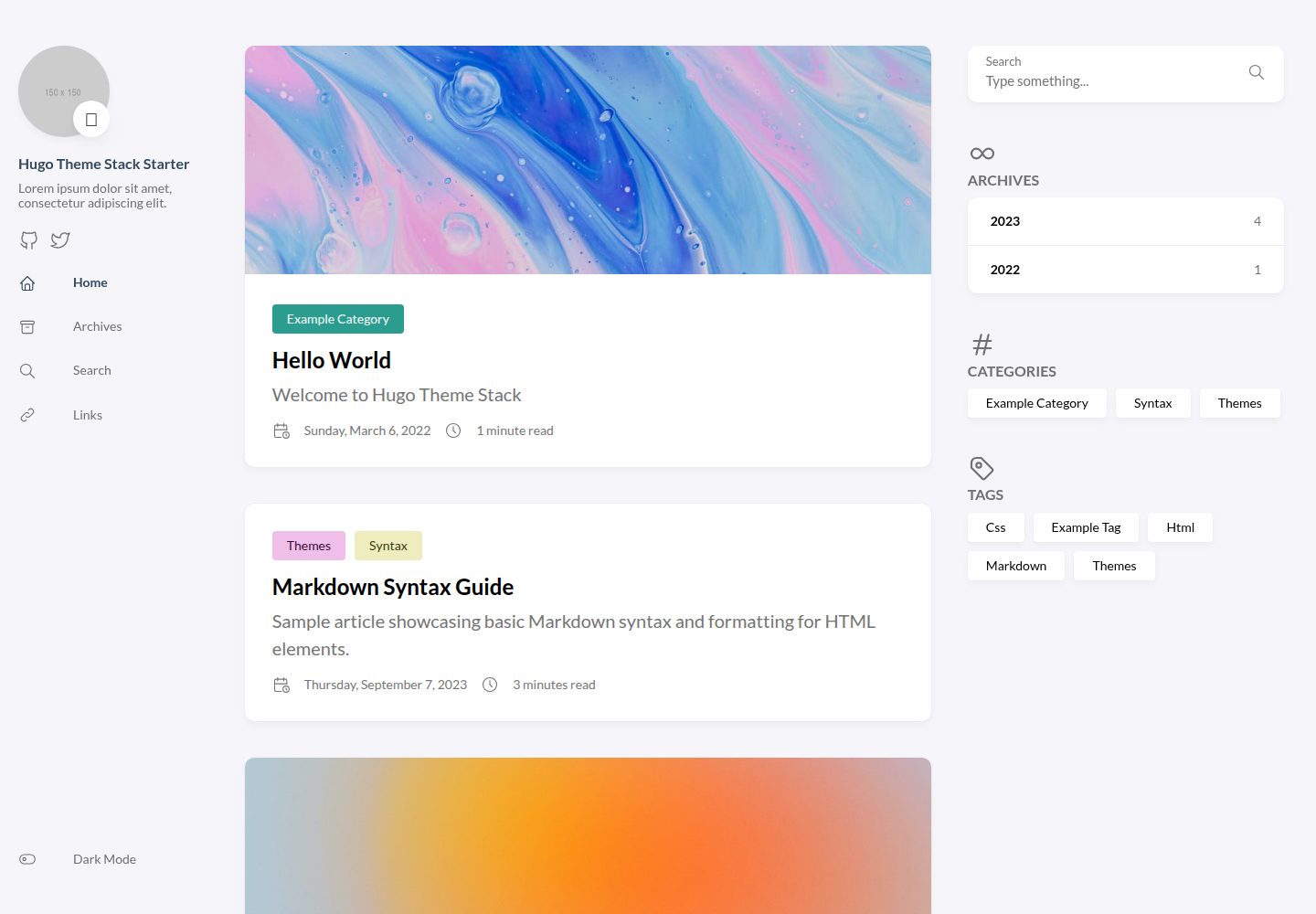
Desktop homepage1 / 2
Desktop captureTop of page
Actual screenshot captured by the server browser.
All pages & views 2
Screenshots show visual appearance; interactive behavior may differ.
Recorded 2026-09-30View source
What stands out
A quick read of the recorded project description.
Includes a preconfigured GitHub Actions workflow that automatically deploys to GitHub Pages after a push
Includes a scheduled task that automatically updates the theme daily
Configuration is centralized in the config directory, making it easy to modify for site needs
Provides illustrated steps and a video tutorial from creating the repository to deployment
Template Details
This is a quickstart template for creating a Hugo blog. The theme is hugo-theme-stack, loaded through the Hugo Modules feature rather than placing the theme source directly in the repository. The template includes the basic theme structure and configuration files. Configuration is centralized in the config directory, where the baseurl in config/_default/config.toml must be changed to the site's actual address.
The repository comes with a preconfigured GitHub Actions workflow that can automatically deploy the site to the GitHub Pages associated with that repository; there is also a scheduled task that automatically updates the theme daily. The README provides complete steps from clicking Use this template to create a repository, running hugo server in GitHub Codespaces for preview, to committing and pushing to trigger deployment, and includes a video tutorial.
The template is configured for the theme's v4 version by default. Due to limitations in the Go module mechanism, versions v4 and above require manual theme updates after release, either by running hugo mod get -u and hugo mod tidy locally, or by modifying config/module.toml. If you do not want to use Codespaces, you can also run it locally, but you need to install Git, Go, and Hugo extended in advance. In addition to GitHub Pages, the template can also be deployed to other static hosting services; refer to Hugo's official hosting documentation for details.
HugoBlogStarter
Is it right for your project?
Use Cases
- Quickly set up a Hugo blog with a GitHub repository and publish it to GitHub Pages
- Edit and preview the site online in GitHub Codespaces without a local environment
- Run and debug the site locally after installing Git, Go, and Hugo extended
- Deploy the same site configuration to static hosting services other than GitHub Pages
Suitable For
- Individuals who want to start blogging with Hugo and hugo-theme-stack
- Developers who prefer to manage site builds and publishing with GitHub repositories and Actions
- Users who need a clearly structured blog starter configuration that can follow theme updates
Getting started & customization
Use these recorded setup notes alongside the repository instructions for your chosen version.
- 1
Click Use this template on GitHub to create a repository; the repository name is recommended to be <username>.github.io, otherwise the site address will include the repository name path
- 2
In the repository's Settings -> Pages, set the Build and deployment Source to GitHub Actions
- 3
Change baseurl in config/_default/config.toml to the site's actual URL
- 4
Running locally requires installing Git, Go, and Hugo extended; in Codespaces you can run hugo server directly for preview
- 5
After theme v4 and above are released, manual updates are required: run hugo mod get -u github.com/CaiJimmy/hugo-theme-stack/v4 and hugo mod tidy, or modify config/module.toml
License & source material
Usage conditions & limitations
Free to use · keep license noticeThis entry covers the free version under the MIT license in the public repository; the free scope is the code of that version and does not mean external services or third-party assets are free.
Must comply with when using
- You may use, modify, commercially use, and distribute the code of this version for free.
- When distributing copies or substantial portions of the code, retain the original author's copyright notice and the complete MIT license notice.
- The code is provided as is; warranties and limitations of liability are governed by the original license and applicable law.
Additional costs & items to verify
- Running this template locally requires installing Git, Go, and Hugo extended yourself; otherwise you cannot build and preview the site locally.
- After theme v4 and above are released, automatic upgrades are not possible; you must manually run hugo mod get -u and hugo mod tidy or modify config/module.toml to update the theme.
- If the repository name is not <username>.github.io, the site will be published under an address with the repository name subpath, and baseurl must be adjusted accordingly.
- Demo images, fonts, icons, and other third-party assets must be checked against their respective licenses; the code's MIT license alone is not sufficient to determine this.
- External services such as domains, hosting, databases, payments, or AI may incur separate charges.
View Original Text Basis
Permission is hereby granted, free of charge
Original License Text
You need to install Git, Go and Hugo extended locally.
Original README
you need to update the theme manually
Original README
https://github.com/CaiJimmy/hugo-theme-stack-starter/blob/master/LICENSEhttps://github.com/CaiJimmy/hugo-theme-stack-starter/blob/master/README.mdcreate your repository as `<username>.github.io` on GitHub
Original README
Compiled by DeepSeek based on repository license and README ·2026-10-02. Results only cover the materials read; dependencies, images, fonts, and subsequent term changes are subject to their respective original texts.
Project checks & description sources
Template Information
- Source platforms
- GitHub
- Documentation and maintenance reference score
- More documented · 96 / 100
- Technologies
- Hugo
- Website type
- Blog · Starter
How this score is calculated
Our heuristic uses license records (up to 30), a demo link (12), a preview (10), stars (15), recorded maintenance (15), description completeness (8), feature records (5) and classification data (5). It is not a code, security or performance test, or a Google score. A link does not establish tested functionality.
What to verify for this project
- Repository update recorded
- 2026-05-26
- Screenshot last checked
- 2026-10-02
A demo link is listed. Check it with your own content and viewport sizes; its presence does not confirm that forms, authentication or payments work.
The catalog identifies Hugo as the primary stack. Check the actual dependency manifest and lockfile for versions and hosting requirements. These notes use recorded metadata, not a code audit or a deployment test.
Use a selection guide →How this description was prepared
AI-assisted description based on catalog records and repository material. Repository authors are not automatically the reviewers of this description.
Automatically checked against source and license rules; no manual editorial review.
Inspect the recorded source material
SHA-256: c3195c3c623227d5e0d8ddfcbf2b506ea2a8a93544c52ac72a92cac36cf2674b
2026-10-02T15:29:21.812Z
Source file / repository<img align="right" width="150" alt="logo" src="https://user-images.githubusercontent.com/5889006/190859553-5b229b4f-c476-4cbd-928f-890f5265ca4c.png"> # Hugo Theme Stack Starter Template This is a quick start template for [Hugo theme Stack](https://github.com/CaiJimmy/hugo-theme-stack). It uses [Hugo modules](https://gohugo.io/hugo-modules/) feature to load the theme. It comes with a basic theme structure and configuration. GitHub action has been set up to deploy the theme to a public GitHub page automatically. Also, there's a cron job to update the theme automatically everyday. ## Video Tutorial In case you got lost during the setup process, here's a video tutorial that setups a new Hugo site using this template, and deploys it to GitHub Pages: https://www.youtube.com/watch?v=8qDdQQ6Ifxo ## Get started 1. Click *Use this template*, and create your repository as `<username>.github.io` on GitHub. (You can also use a different repository name, but then the resulting website will be available at `https://<username>.github.io/<repository-name>`. )  2. Once the repository is created, create a GitHub codespace associated with it.  3. While waiting for the codespace to be created, go to `Settings` -> `Pages` of your newly created repository, and set `Build and deployment` -> `Source` to `GitHub Actions`.  4. After the codespace is created, you can test that the site is built successfully by running `hugo server` in the terminal and see your new site in action. 5. Check `config` folder for the configuration files. You can edit them to suit your needs. Make sure to update the `baseurl` property in `config/_default/config.toml` to your site's URL. For example, if your new repository is named `my-blog`, then the `baseurl` should be `https://<username>.github.io/my-blog/`. 6. Once you're done editing the site, just commit it and push it. GitHub action will deploy the site automatically to GitHub page asociated with the repository. --- In case you don't want to use GitHub codespace, you can also run this template in your local machine. **You need to install Git, Go and Hugo extended locally.** For more information, check official Hugo documentation: https://gohugo.io/installation/ ## Update theme manually Run: ```bash hugo mod get -u github.com/CaiJimmy/hugo-theme-stack/v4 hugo mod tidy ``` > This starter template has been configured with `v4` version of theme. Due to the limitation of Go module, once the `v4` or up version of theme is released, you need to update the theme manually. (Modifying `config/module.toml` file) ## Deploy to another static page hostings Check official Hugo documentation: https://gohugo.io/host-and-deploy/
Explore similar templates
Compare previews and descriptions within the same stack and category.

hugo-PaperMod
A fast, clean, responsive Hugo theme for blogs and lightweight portfolios, with three layout modes (Regular, Home-Info, Profile), automatic and manual light/dark themes, Fuse.js client-side search, multilingual support, and built-in Open Graph, Twitter Cards, and Schema.org data.
Hugo · Portfolio

LoveIt
LoveIt is a clean, elegant, and feature-rich Hugo blog theme derived from LeaveIt and KeepIt, MIT-licensed. It offers light/dark modes, responsive layout, multilingual support, and search via Lunr.js or Algolia.
Hugo · Blog

hugo-coder
hugo-coder is a minimalist Hugo blog theme maintained by luizdepra under the MIT license. It provides a clean, text-focused blog appearance, configuration documentation in the docs directory, and a complete exampleSite with hugo.toml.
Hugo · Blog

blowfish
Blowfish is a Hugo personal website and blog theme built with Tailwind CSS 4, focused on lightness, simplicity, and content-first presentation.
Hugo · Blog

hugo-paper
hugo-paper is a simple, clean, and customizable Hugo blog theme configured through config.toml or hugo.toml.
Hugo · Blog

hextra
Hextra is a Hugo theme for documentation and blog sites, built on Hugo and Tailwind CSS with design referencing Nextra.
Hugo · Documentation