Hard performance budgets in CI: JS bundle size, individual image size, number of font preloads, and mobile/desktop Lighthouse scores; exceeding them fails the build
AstroStarter
astro-performance-starter — Astro Starter Template
By clownware
An Astro-based starter template with a zero-JS baseline by default, built-in design tokens, and CI performance budget gates, plus layered AI collaboration rules.
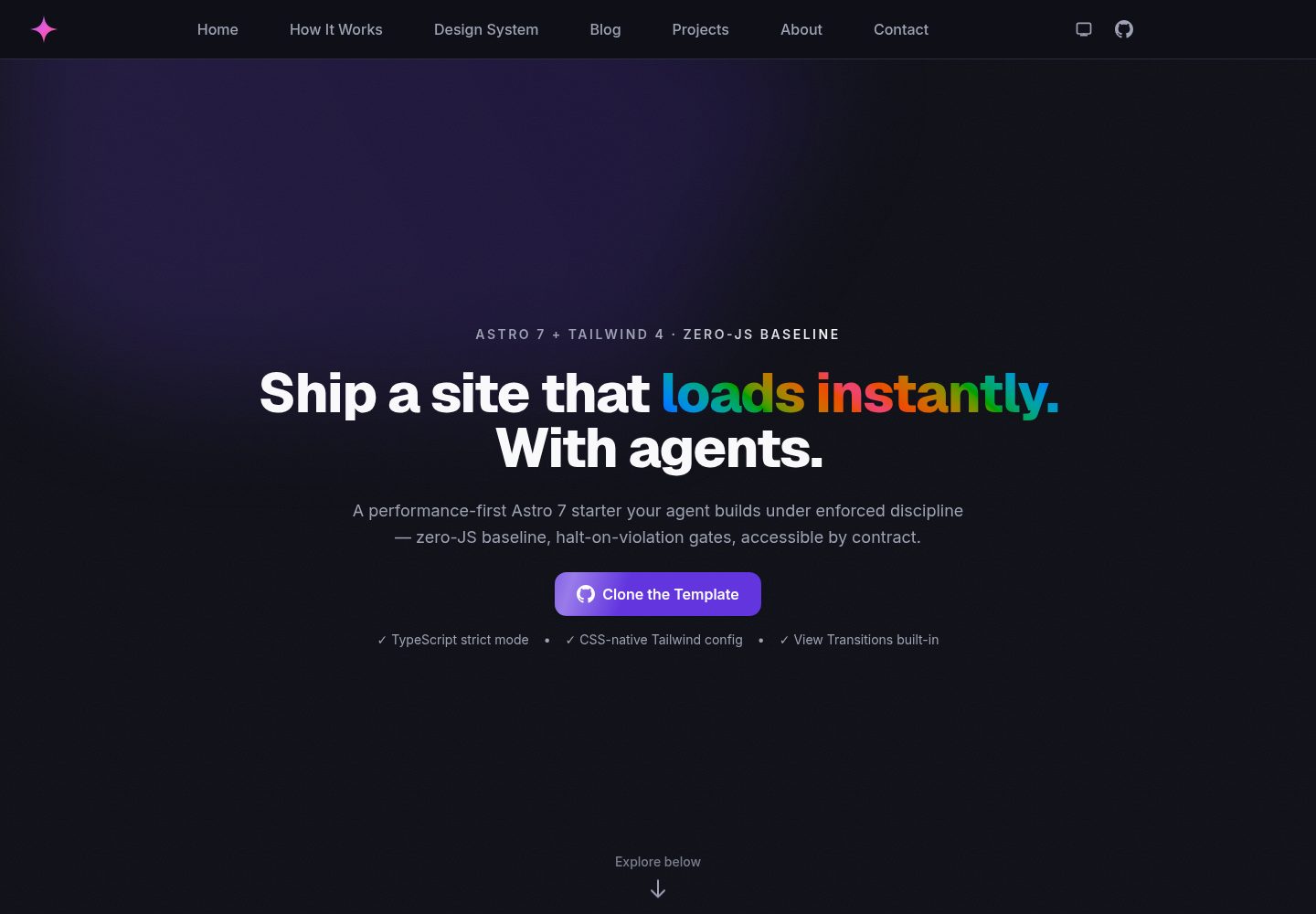
Explore the design
Compare the page layouts and mobile experience. Open any screenshot for a closer look.
Desktop homepage1 / 3
Desktop captureTop of page
Actual screenshot captured by the server browser.
All pages & views 3
Screenshots show visual appearance; interactive behavior may differ.
Recorded 2026-10-03View source
What stands out
A quick read of the recorded project description.
Images output AVIF by default with responsive srcset; raster image source files and build artifacts are both checked against a 200KB cap
Zero-JS baseline; interactive components are hydrated as late as possible in the order client:visible → client:idle → client:media → client:load
Design token system using CSS-native @theme, paired with an atomic component directory structure
Built-in layered AI collaboration rules (CLAUDE.md and .claude/), and generates AGENTS.md for multiple AI tools to read
Provides Playwright end-to-end test and Vitest unit test configurations
Template Details
This template is an Astro starter for site projects that need to hard-code performance constraints into the development workflow. It outputs a zero-JS baseline by default and uses island components only when interactivity is required; it also provides a CSS-native design token system and content collections (including MDX).
The template writes performance budgets into CI: hard thresholds are set for JS bundle size, individual raster image size (source files and build artifacts), the number of font preloads, and Lighthouse scores on mobile and desktop. Exceeding them fails the build. The image pipeline outputs AVIF by default with responsive srcset, raster images have a 200KB cap, and font preloads are limited to no more than 2 per page.
The repository also includes a layered AI collaboration rule set (CLAUDE.md and the .claude/ directory) and generates AGENTS.md for multiple AI tools to read; the rules are bound to quality gates in a halt-on-violation manner. In the docs directory, only docs/adr/ enters the build and renders under the /adr/ path.
Before use, note: the template depends on Node.js and pnpm (with versions pinned via Corepack), and the first dev or build automatically compiles design tokens. The licenses for third-party assets such as demo images, fonts, and icons must be checked separately; the code itself is MIT licensed.
AstroStarter
Is it right for your project?
Use Cases
- Creating a new Astro site and wanting CI to guard performance budgets from the first commit
- Comparing an existing site against this template's ADRs and budgets for performance audits and regression investigation
- Keeping Lighthouse gates and image, font, and JS size checks for a personal site while removing the heavier collaboration workflow
- Needing a set of engineering rules and quality gates that multiple AI coding tools can read
Suitable For
- Developers using Astro and accepting the Node.js and pnpm toolchain
- Teams or individuals who want performance budgets written as CI gates rather than documentation suggestions
- Content-oriented sites that need content collections and MDX support
- Maintainers willing to maintain ADRs and AI rule files according to the template's conventions
Getting started & customization
Use these recorded setup notes alongside the repository instructions for your chosen version.
- 1
Create a project via GitHub's Use this template or by specifying this template with pnpm create astro
- 2
Requires Node.js and pnpm; if pnpm is not available, run corepack enable first
- 3
The first run of dev or build automatically compiles design tokens
- 4
After cloning, modify files such as src/config.ts, package.json, LICENSE.txt, navigation and bio content, logo and favicon, and tokens/base.json according to the README table
- 5
The licenses for third-party assets such as demo images, fonts, and icons must be checked separately; do not judge solely by the code's MIT license
License & source material
Usage conditions & limitations
Free to use · keep license noticeThis entry covers the free version under the MIT license in the public repository; the free scope is the code of that version and does not mean external services or third-party assets are free.
Must comply with when using
- You may use, modify, commercialize, and distribute the code of this version for free.
- When distributing copies or substantial portions of the code, retain the original author's copyright notice and the full MIT license notice.
- The code is provided as is; warranties and limitations of liability are governed by the original license and applicable law.
Additional costs & items to verify
- Before use, the Node.js and pnpm toolchain is required; if pnpm is not installed, run corepack enable first to enable the package manager, otherwise dependencies cannot be installed and scripts cannot be run.
- The first run of dev or build automatically compiles design tokens as part of the build process; this step must be able to execute normally.
- Running the Lighthouse performance report command requires starting the local development server first; otherwise the command cannot produce a report.
- Mutation testing (Stryker) is an optional advanced feature, not on the critical clone path or in quality:ci; it runs slowly and is rarely executed locally, and can be removed as needed.
- In the docs/ directory, only docs/adr/ enters the build and renders under the /adr/ path; other documents are not packaged or published.
- After cloning, you must manually modify files such as src/config.ts, package.json, LICENSE.txt, navigation and bio content, logo and favicon, and tokens/base.json according to the README table to complete personalized configuration.
- Demo images, fonts, icons, and other third-party assets must be checked against their respective licenses; do not judge solely by the code's MIT license.
- External services such as domains, hosting, databases, payments, or AI may incur additional charges.
View Original Text Basis
Permission is hereby granted, free of charge
Original License Text
**No pnpm?** Run `corepack enable` first
Original README
Token compilation happens automatically on first `dev` or `build` command.
Original README
`pnpm run perf:lighthouse` | Lighthouse HTML report (requires running dev server)
Original README
**Mutation testing** — remove `.github/workflows/mutation.yml`, the `test:mutate` script, and Stryker from devDependencies
Original README
Only `docs/adr/` is published (rendered at `/adr/` — ADR-062); everything else stays out of the build.
Original README
https://github.com/clownware/astro-performance-starter/blob/master/LICENSE.txthttps://github.com/clownware/astro-performance-starter/blob/master/README.mdupdate these files to make the template yours
Original README
Compiled by DeepSeek based on repository license and README ·2026-10-03. Results only cover the materials read; dependencies, images, fonts, and subsequent term changes are subject to their respective original texts.
Project checks & description sources
Template Information
- Source platforms
- GitHub
- Documentation and maintenance reference score
- More documented · 83 / 100
- Technologies
- Astro
- Website type
- Starter
How this score is calculated
Our heuristic uses license records (up to 30), a demo link (12), a preview (10), stars (15), recorded maintenance (15), description completeness (8), feature records (5) and classification data (5). It is not a code, security or performance test, or a Google score. A link does not establish tested functionality.
What to verify for this project
- Repository update recorded
- 2026-09-30
- Screenshot last checked
- 2026-10-03
A demo link is listed. Check it with your own content and viewport sizes; its presence does not confirm that forms, authentication or payments work.
The catalog identifies Astro as the primary stack. Check the actual dependency manifest and lockfile for versions and hosting requirements. These notes use recorded metadata, not a code audit or a deployment test.
Use a selection guide →How this description was prepared
AI-assisted description based on catalog records and repository material. Repository authors are not automatically the reviewers of this description.
Review declaration: [email protected] · 2026-10-04
Inspect the recorded source material
SHA-256: f6c7c6cfafc3b6a2d01804c496269d90b6cd2d923db1218ccce5bd0592078787
2026-10-03T16:29:40.795Z
Source file / repository# Astro Performance Starter **Hard performance budgets, enforced on every PR • Zero-JS baseline • Astro 7** [](https://github.com/clownware/astro-performance-starter/actions/workflows/ci.yml) [](./LICENSE.txt) [](https://nodejs.org/) [](#-performance-budgets) **[🚀 Live Demo](https://clownware.github.io/astro-performance-starter/)** • [Quick Start](#-quick-start) • [Documentation](#-documentation) • [Contributing](#-contributing) ---  ## Why This Starter? Most Astro templates hand you a fast first commit and no way to keep it fast. This one ships a **performance ratchet** — hard budgets wired into CI that fail the build when a change regresses them. The Lighthouse score is the _evidence_; the enforcement is the point. - **Enforced, not aspirational** — halt-on-violation CI gates on JS bundle size, per-image size (source _and_ build output), font-preload count, and Lighthouse on **both mobile and desktop**. A regression fails the PR — it doesn't ship. ([ADR-039](./docs/adr/039-halt-on-violation-enforcement.md)) - **Images can't sink you** — the #1 real-world perf killer is gated: Astro `<Image>` → AVIF with responsive `srcset`, plus a 200KB-per-raster ceiling checked in CI (details in the next section). - **Agentic discipline built in** — Layered AI constitution (`CLAUDE.md` + `.claude/`), role-separated workflow. Your agent clears the same gates you do. - **Fast by default, measured** — ~48KB raw JS (~17KB gzipped) _total_ across the site; ~19–21KB gzipped CSS per page; 99 Performance / CLS 0 on home and blog, **desktop and mobile**. - **Modern stack** — Astro 7.x · TypeScript 5.x (strict) · Tailwind 4.x · Biome 2.x · Node 24.x · pnpm 11.x - **Accessible** — WCAG AA via semantic HTML, ARIA, and validated contrast; accessibility gated ≥ 95 in CI (most routes score 100). ## 🖼️ The image pipeline (the #1 perf killer) One oversized hero image can cost more Lighthouse points than every other issue combined — it's the single most common regression adopters hit. So images are a first-class, gated concern here, not an afterthought: - **Modern formats by default** — [`src/components/atoms/Image.astro`](./src/components/atoms/Image.astro) wraps Astro's `<Image>`, emitting **AVIF** with responsive `srcset` and lazy loading. Raw `<img>` for raster is discouraged; SVG passes through untouched. ([ADR-030](./docs/adr/030-image-optimisation-defaults.md)) - **A hard per-image ceiling** — **200KB per raster file**, enforced in CI on both source (`public/`, `src/`) _and_ build output (`dist/`) — so a heavyweight PNG, including an accidental fallback emitted alongside AVIF/WebP, fails the build. Override with `IMAGE_BUDGET_KB`. ([ADR-057](./docs/adr/057-image-budget-gate.md)) - **Font preloads capped** — ≤ 2 preloaded fonts per page, so preloads don't crowd out the LCP image. ([ADR-058](./docs/adr/058-font-preload-budget.md)) ## ⚡ Quick Start ### Use as a GitHub template Click **Use this template** on GitHub, then: ```bash git clone https://github.com/YOUR_USERNAME/your-site.git cd your-site pnpm install pnpm run dev ``` ### Or scaffold with the Astro CLI ```bash pnpm create astro@latest my-site -- --template clownware/astro-performance-starter cd my-site pnpm run dev ``` Open **<http://localhost:4321/>** — you're up and running. > **First build?** Token compilation happens automatically on first `dev` or `build` command. > > **No pnpm?** Run `corepack enable` first, or see the [onboarding guide](https://docs.clownware.org/astro/getting-started/onboarding/). ### One-click deploy [](https://deploy.workers.cloudflare.com/?url=https://github.com/clownware/astro-performance-starter) [](https://app.netlify.com/start/deploy?repository=https://github.com/clownware/astro-performance-starter) [](https://vercel.com/new/clone?repository-url=https://github.com/clownware/astro-performance-starter) ## 🛠️ Personalization After cloning, update these files to make the template yours: | File | What to change | |------|---------------| | `src/config.ts` | Site title, author, GitHub URL, docs URL, social links | | `package.json` | `name`, `description`, `author`, `repository`, `homepage`, `bugs` | | `LICENSE.txt` | Copyright year and holder name | | `src/content/navigation/header.json` | Navigation links and GitHub URL | | `src/content/bio/default.mdx` | Name, title, social links, bio text | | `public/logo.svg` | Your logo / wordmark | | `public/favicon.svg` | Your favicon | | `tokens/base.json` | Brand colors | | `.github/CODEOWNERS` | Uncomment and set your GitHub username | | `CHANGELOG.md` | Start fresh for your project | | `README.md` | CI badge URL, deploy buttons, `--template` command | ## ✨ What's Inside - **Astro** 7.x with zero-JS by default (islands when needed) - **TypeScript** 5.x in strict mode for type safety - **Tailwind CSS** 4.x with CSS-native `@theme` design token system - **Biome** 2.x for formatting and linting (20x faster than ESLint+Prettier) - **Node.js** 24.x (locked via `.nvmrc`) - **pnpm** 10.x (pinned via `packageManager` + Corepack; `engines` declares the floor) - Atomic design structure in `src/components/` - Content collections with MDX support - GitHub Actions CI/CD (build, lint, type-check, security audit) - Pre-commit hooks for code quality - E2E tests with Playwright, unit tests with Vitest ## 📚 Documentation Everything you need to customize and extend lives in `docs/`: - **[Onboarding Guide](https://docs.clownware.org/astro/getting-started/onboarding/)** — Detailed setup and concepts - **[Launch Demo](https://docs.clownware.org/astro/getting-started/launch-demo/)** — Get running in 5-10 minutes - **[Quick Deploy](https://docs.clownware.org/astro/getting-started/quick-deploy/)** — Ship to production in under an hour - **[Implementation Roadmap](./docs/README.md#implementation-roadmap)** — Phased development guide - **[AI Context Guides](./docs/ai-context/)** — Optimized for AI assistants > The `docs/` folder contains extensive reference material. Only `docs/adr/` is published (rendered at `/adr/` — ADR-062); everything else stays out of the build. ## 🎨 Progressive Implementation One path, three natural stopping points: - **Foundation (Phases 0–4)** — Working site skeleton with design system, content schemas, and CI pipeline — pre-configured in template - **Build (Phases 5–8)** — Components, pages, content, and QA — scope each phase to Essential / Recommended / Advanced - **Polish (Phases 9–12)** — Performance budgets, deployment, documentation, monitoring — stop when goals are met See the **[Implementation Guide](./docs/README.md#implementation-roadmap)** for details. ## 🤖 Working with AI Agents This template is a reference implementation of the **layered AI constitution** pattern — agent-readable rules with halt-on-violation enforcement. Drop Claude (or any agent) into the repo and it works under the same rules you do. The constitution layers responsibility: - **[`CLAUDE.md`](./CLAUDE.md)** — top-level entry: stack, scope boundaries, halt conditions - **`.claude/engineering.md`** — components, design system, TypeScript, testing discipline ([ADR-037](./docs/adr/037-testing-philosophy.md)) - **`.claude/workflow.md`** — three-pass Architect → Coder → Reviewer ([ADR-038](./docs/adr/038-agent-roles.md)), quality gate ([ADR-039](./docs/adr/039-halt-on-violation-enforcement.md)) - **`.claude/stack.md`** — tooling, versions, performance budgets - **`.claude/roles/`** — per-pass prompts (architect, coder, reviewer) Every rule names its halt condition with a stated reason — no soft guidance. `pnpm quality:ci` halts on broken tests, lint, types, or markdown — the same gate your agent must clear before claiming done. ```bash pnpm quality:ci # the halt-on-violation gate — agent must clear this before claiming done ``` Pattern source: Robert C. Martin and Justin Martin's _Clean AI: Agentic Discipline_ series. Layered-constitution precedent: [`unclebob/swarm-forge`](https://github.com/unclebob/swarm-forge). ### Multi-tool AI Context The constitution is the canonical source. The same rules ship in multiple formats so the discipline is tool-agnostic: | Tool | File(s) | What it does | |------|---------|-------------| | All modern AI tools | `AGENTS.md` (root) | Cross-tool spine — read natively by Cursor, Codex CLI, Copilot, Windsurf, Aider, Devin, Zed, Continue, Amp, Amazon Q | | Claude Code | `CLAUDE.md` + `.claude/` | Constitution, layered engineering/workflow/stack files, skills, subagents | | Maintenance | `pnpm agents:build` | Regenerates `AGENTS.md` from the layered source files; CI fails on drift | One source of truth, every tool stays in sync. Edit the layered files in `.claude/` (or `CLAUDE.md` for halt-on-violation rules) and run `pnpm agents:build`. See [ADR-045](docs/adr/045-cross-tool-agents-spine.md) for the cross-tool spine rationale and [ADR-036](docs/adr/036-layered-constitution.md) for the layering. Entry points: - **Agent workflow**: `.claude/workflow.md` — three-pass pattern, quality gate, ADR discipline - **Architectural constraints**: `docs/adr/` — every Accepted ADR is a rule the agent must respect - **Performance limits**: budgets in `.claude/stack.md`, checked before adding dependencies - **Zero config**: no MCP server, no API — well-structured markdown any agent can read See [AI Context Setup Guide](docs/ai-context/ai-rules-setup.md) for the multi-tool sync workflow. ## 🔍 Use as an audit reference You don't have to _build on_ this template to benefit from it — you can point an agent at an **existing** site and use this repo as the standard to audit against. In one real case that workflow took a personal site from **Lighthouse 73 to 100** (desktop) by surfacing exactly the regressions these gates encode. The workflow: 1. Clone this repo next to your project (or open both side by side). 2. Tell your agent: _"Audit this site against the norms in the astro-performance-starter repo — its ADRs, `.claude/stack.md` budgets, and CI gates. Report deviations ranked by performance impact."_ 3. Have it check what this template treats as non-negotiable: - **Images** — modern formats, responsive `srcset`, every raster under the 200KB ceiling (source _and_ shipped). Usually the single biggest win. - **Islands** — Preact for interactive islands ([ADR-001](./docs/adr/001-preact-island-usage-policy.md)), hydrated as late as possible up the ladder **`client:visible` → `client:idle` → `client:media` → `client:load`** (`client:load` only with ADR justification). - **Fonts** — subset `woff2`, ≤ 2 preloads per page so preloads don't fight the LCP image ([ADR-053](./docs/adr/053-fonts-via-astro-fonts-api.md)). - **Budgets & gates** — JS/CSS/image/font budgets and Lighthouse floors, run on every PR so nothing silently regresses. Because each norm has an ADR behind it, the agent can justify every recommendation from the _why_ rather than cargo-culting it. ## 🎚️ Minimum viable gate (solo / personal sites) The full apparatus is built for a template that must never regress. A personal site rarely needs all of it. **Keep the ratchet, drop the ceremony** — this is subtraction from one config, not a second maintained tier: **Keep** — this _is_ the performance ratchet, and it's cheap to run: - `lighthouserc.json` + `lighthouserc.mobile.json` — the Lighthouse gates - the JS bundle-size step, `images:gate`, and `fonts:gate` in CI - `pnpm test:e2e` as a smoke test that pages actually render **Safe to drop** for less overhead: - **Mutation testing** — remove `.github/workflows/mutation.yml`, the `test:mutate` script, and Stryker from devDependencies ([ADR-042](./docs/adr/042-mutation-testing-with-stryker.md)). - **The full ADR apparatus** — `docs/adr/` and the `docs:count` guard keep a _shared_ template honest; a solo project can keep a lightweight `DECISIONS.md` (or nothing) and drop `docs:count` from `quality:ci`. - **Cross-tool agent spine** — if you use only one agent, drop `agents:build` / `agents:check` and keep just `CLAUDE.md`. - **Template-invariant guards** — `version:check` and `og:check` protect template-specific invariants; trim them from `quality:ci` as needed. ## 🔧 Key Commands ```bash pnpm run dev # Start dev server pnpm run build # Production build pnpm run preview # Serve already-built dist/ locally pnpm run quality # Full quality check (format + lint + type-check) pnpm run test:unit # Unit tests (Vitest) pnpm run test:e2e # E2E tests (Playwright) pnpm run test:a11y # Accessibility tests (axe-core) pnpm run tokens:build # Rebuild design tokens (rarely needed) ``` <details> <summary><strong>All Scripts Reference</strong></summary> **Development** | Command | Description | |---------|-------------| | `pnpm run dev` | Start dev server on port 4321 | | `pnpm run dev:host` | Dev server exposed to LAN | | `pnpm run dev:debug` | Dev server with verbose logging | | `pnpm run preview` | Serve already-built `dist/` locally | | `pnpm run preview:build` | Build then preview | **Code Quality** | Command | Description | |---------|-------------| | `pnpm run quality` | Format + lint + markdown lint + type-check (auto-fixes format) | | `pnpm run quality:ci` | Same checks, no auto-fix (CI mode) | | `pnpm run format` | Format with Biome | | `pnpm run format:check` | Check formatting without writing | | `pnpm run lint` | Lint with Biome | | `pnpm run lint:md` | Lint markdown files | | `pnpm run check` | Astro diagnostics | | `pnpm run check:types` | TypeScript type-check | **Testing** | Command | Description | |---------|-------------| | `pnpm run test:unit` | Vitest (single run) | | `pnpm run test:coverage` | Vitest with coverage report | | `pnpm run test:e2e` | Playwright (all browsers) | | `pnpm run test:e2e:ui` | Playwright with interactive UI | | `pnpm run test:a11y` | Accessibility tests (axe-core via Playwright) | **Advanced / optional** — not on the clone critical path; not in `quality:ci`. | Command | Description | |---------|-------------| | `pnpm run test:mutate` | Mutation testing (Stryker). Slow; runs monthly in CI, rarely run locally. See [ADR-042](docs/adr/042-mutation-testing-with-stryker.md). | **Build & Deploy** | Command | Description | |---------|-------------| | `pnpm run build` | Validate env + build tokens + Astro build | | `pnpm run build:ci` | Same with verbose output | | `pnpm run tokens:build` | Compile design tokens from `tokens/` | | `pnpm run clean` | Remove `dist/`, `.astro/`, `tokens/dist/` | | `pnpm run clean:all` | Clean + clear `node_modules/.cache` | **Performance & Validation** | Command | Description | |---------|-------------| | `pnpm run perf:lighthouse` | Lighthouse HTML report (requires running dev server) | | `pnpm run perf:budgets` | Track JS/CSS budget violations | | `pnpm run perf:baseline` | Establish performance baseline | | `pnpm run bundle:analyze` | Build + analyze bundle composition | | `pnpm run design:validate` | Validate semantic color contrast ratios | | `pnpm run budgets:validate` | Validate budget override configuration | | `pnpm run images:analyze` | Analyze image sizes and formats | | `pnpm run images:gate` | Fail on any raster image over the per-file budget (CI gate, ADR-057) | | `pnpm run fonts:gate` | Fail on any built page over the font-preload budget (CI gate, ADR-058) | | `pnpm run images:optimize` | Interactive image optimization | **Release & Maintenance** | Command | Description | |---------|-------------| | `pnpm run release:changelog` | Generate CHANGELOG from commits | | `pnpm run audit` | pnpm audit (production deps) | | `pnpm run roadmap:update` | Update implementation roadmap status | </details> ## 🚀 Performance Budgets Budgets (see `.claude/stack.md`): - **JavaScript**: < 160KB raw total - **CSS**: < 50KB (advisory — tracked, not CI-gated) - **Images**: < 200KB per raster file, source + build output — enforced in CI ([ADR-057](./docs/adr/057-image-budget-gate.md)); override with `IMAGE_BUDGET_KB` - **Font preloads**: ≤ 2 per page — enforced in CI ([ADR-058](./docs/adr/058-font-preload-budget.md)); override with `MAX_FONT_PRELOADS` - **Lighthouse**: gated on **desktop _and_ mobile** — Performance ≥ 90, Accessibility ≥ 95, Best-Practices ≥ 95, SEO ≥ 90 (CI floors; see `lighthouserc.json` + `lighthouserc.mobile.json`) The default starter ships well under budget — measured on a production build: - **JavaScript**: ~48KB raw (~17KB gzipped) _total_ across the whole site; a typical page loads only the view-transition router plus a tiny page script. - **CSS**: ~19–21KB gzipped per page — a ~17.6KB shared stylesheet plus 1–3.5KB of inlined critical styles (fonts, view transitions); ≈23–24KB on pages with code blocks. - **Lighthouse**: 99 Performance / CLS 0 on home and blog — **desktop and mobile** (measured; desktop re-verified at 100/CLS 0 on home, blog index, and a post, July 2026); accessibility 96–100 across all gated routes. ## 🤝 Contributing Contributions welcome! See [CONTRIBUTING.md](./CONTRIBUTING.md) for guidelines. ## 📄 License Licensed under the [MIT License](./LICENSE.txt). --- **Status**: Active development • v0.9.0
Explore similar templates
Compare previews and descriptions within the same stack and category.

astrowind
AstroWind is a free, open-source Astro starter theme using Astro and Tailwind CSS, released under the MIT license.
Astro · Blog
accessible-astro-starter
An accessibility-focused Astro 6 starter template with WCAG 2.2 AA practices, Tailwind CSS 4, TypeScript, Prettier, ESLint, form validation, blog and portfolio examples, and preference toggles for dark mode, high contrast, and reduced motion.
Astro · Blog

astro-erudite
astro-erudite is an opinionated, unstyled static blog template built with Astro and native CSS, with no UI or CSS framework and minimal dependencies.
Astro · Portfolio

astro-shopify
A lightweight Shopify headless ecommerce starter template built with Astro and Svelte, integrating the Shopify Storefront API for product and inventory data, with built-in cart state management and basic add-to-cart and checkout flow.
Astro · E-commerce
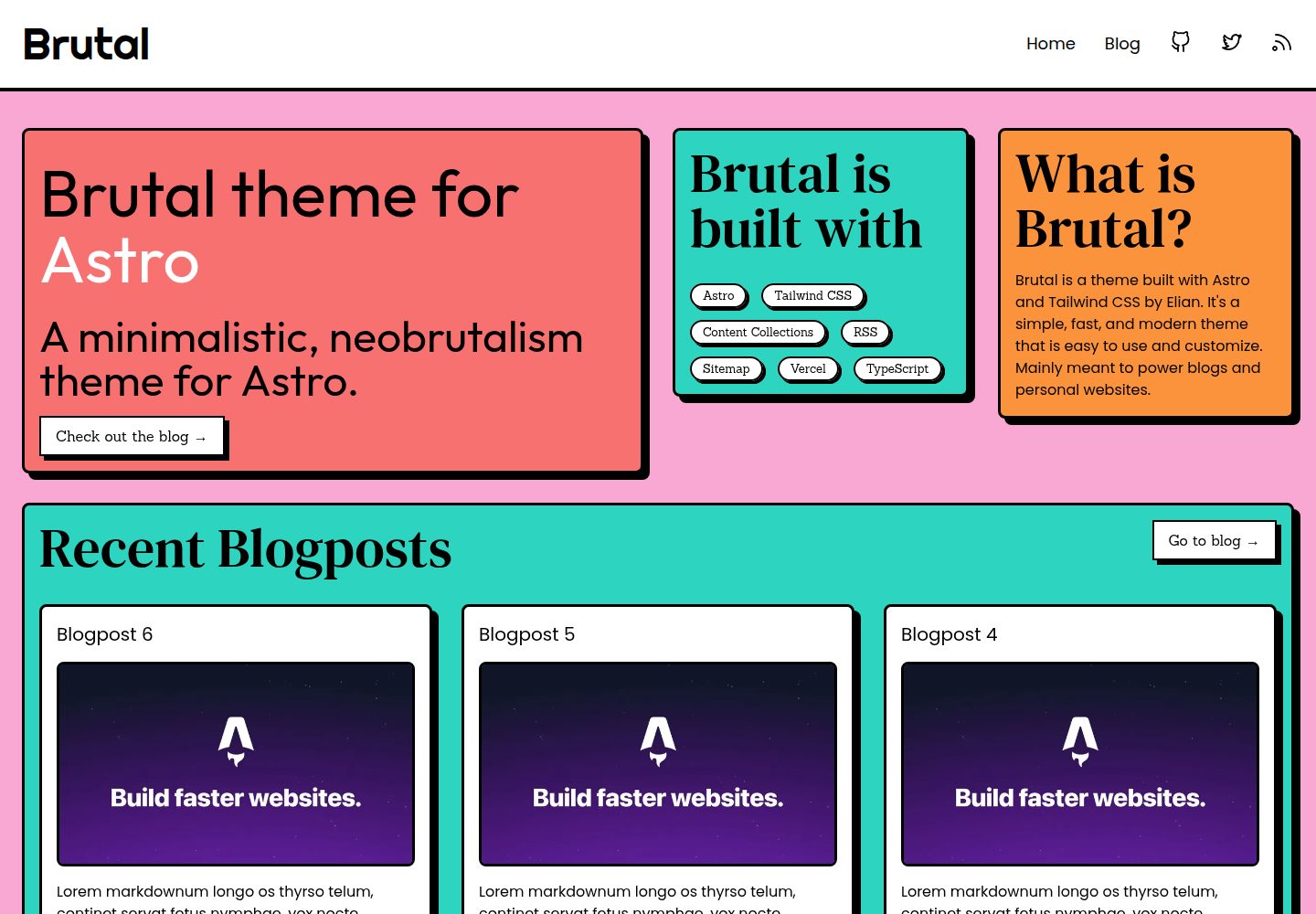
brutal
Brutal is a neobrutalism Astro starter theme from ElianCodes, derived from the author's personal site and generalized. It includes a Markdown blog collection, build-time RSS and sitemap, image optimization, Tailwind CSS styling, and Biome checks, with no JavaScript by default.
Astro · Starter

qwind
Qwind is a free and open-source website template built on Qwik and Tailwind CSS, featuring directory-based routing via QwikCity, a Markdown blog, dark mode, and static deployment configuration.
Astro · Tool Site