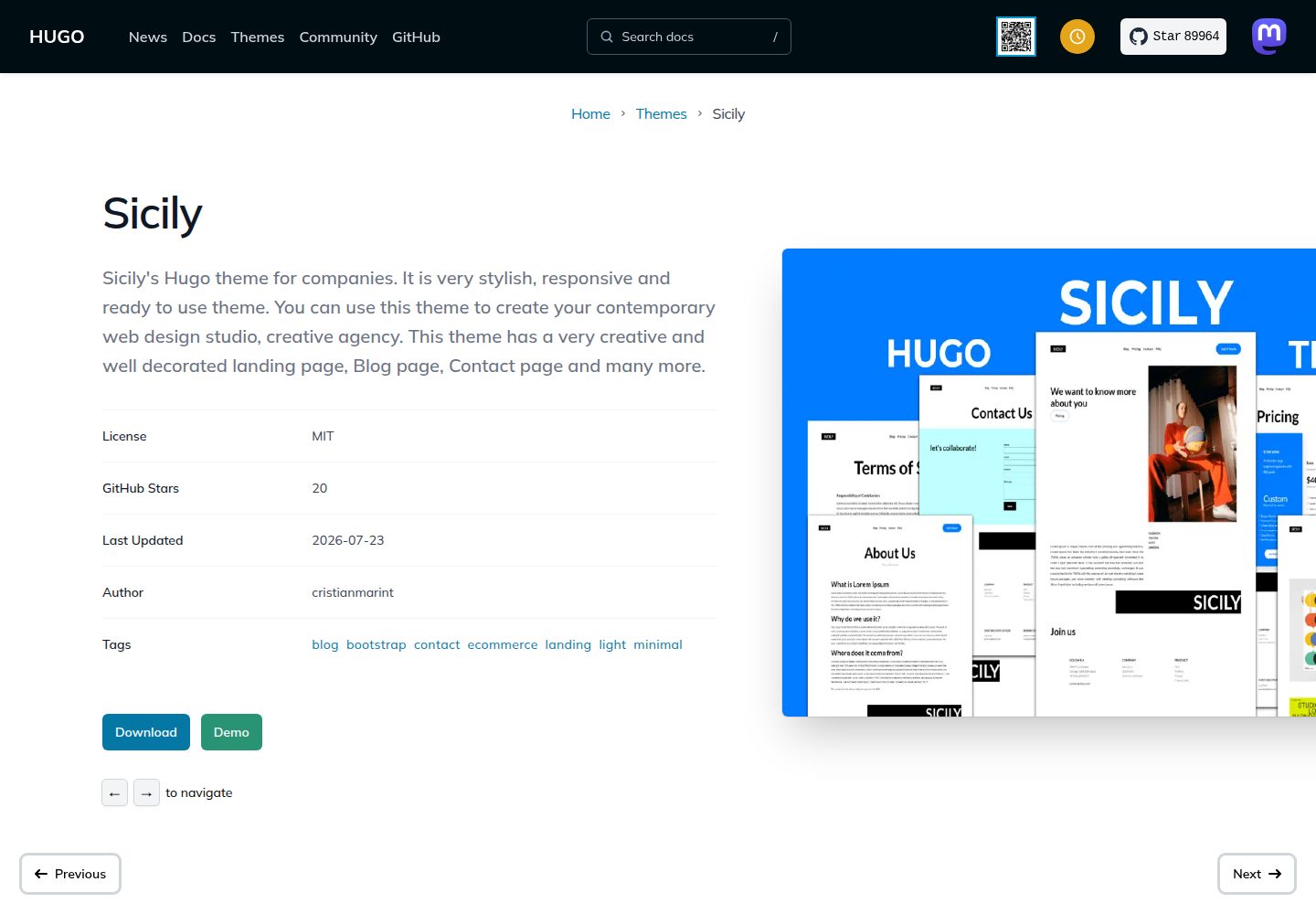
Minimalist black-and-white editorial style covering landing page, blog, pricing, FAQ, and contact form pages
HugoBlogTool Site
sicily-hugo-theme — Hugo Blog Template
By cristianmarint
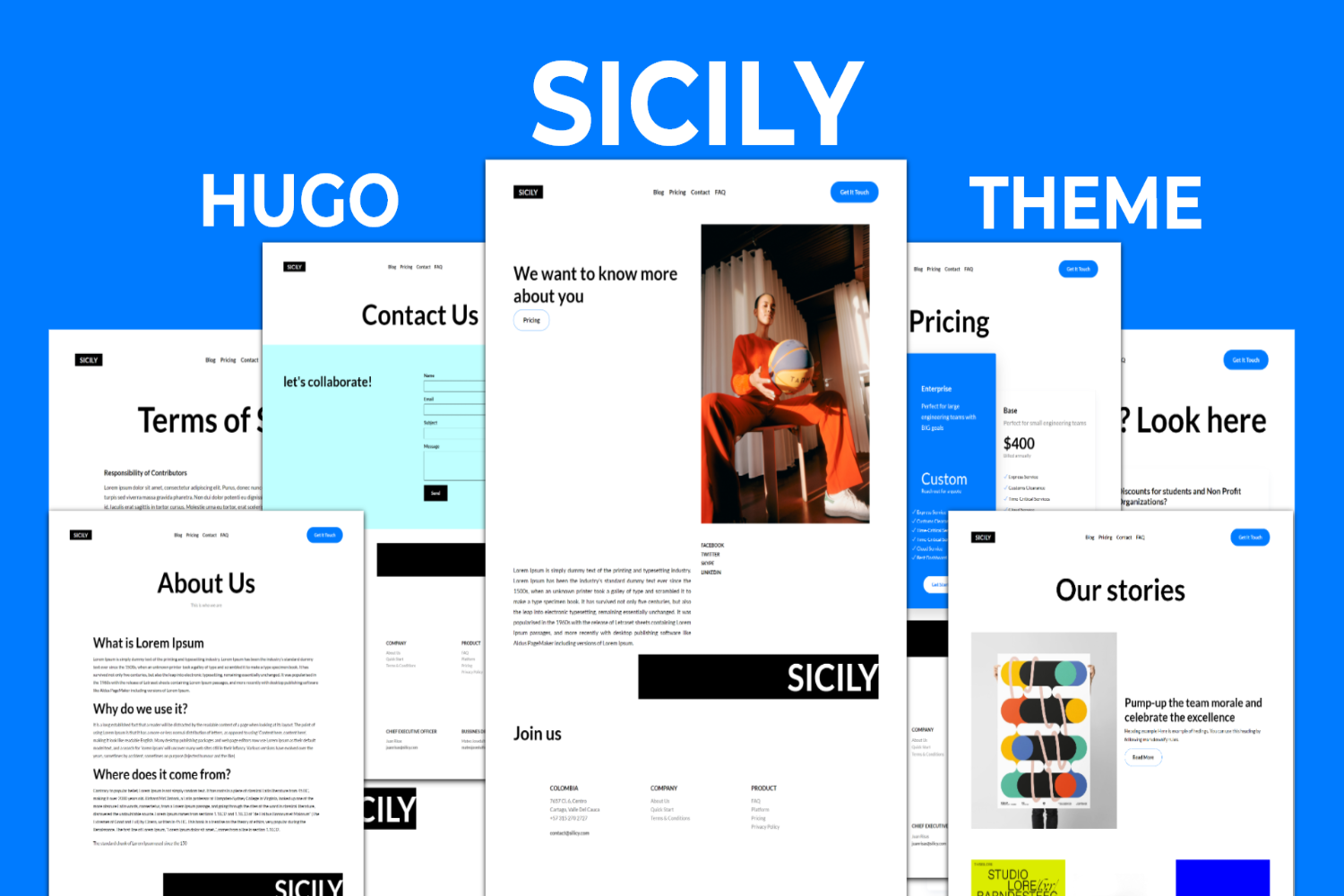
Sicily is a minimalist black-and-white editorial-style Hugo theme that provides landing page, blog, pricing, FAQ, and contact form pages, with no JavaScript framework dependency and no additional build steps beyond Hugo itself.
Explore the design
Compare the page layouts and mobile experience. Open any screenshot for a closer look.
Desktop homepage1 / 3
Desktop captureTop of page
Actual screenshot captured by the server browser.
All pages & views 3
Screenshots show visual appearance; interactive behavior may differ.
Recorded 2026-10-02View source
What stands out
A quick read of the recorded project description.
No JavaScript framework dependency and no additional build steps beyond Hugo itself
Configuration centralized in config.toml, supporting Disqus comments, contact form submission URL, navigation buttons, preloading, and footer contact card
Content maps to layouts by top-level directory; blog supports a featured type promoted to a wide card, and FAQ uses the faq shortcode
Color scheme centrally controlled via SCSS variables; changing $primary-color affects buttons, links, pagination, and other elements
Released under the MIT license, permitting free use, modification, commercial use, and distribution of this version of the code
Template Details
Sicily is a minimalist editorial-style Hugo theme with a black-and-white color scheme, maintained by cristianmarint and released under the MIT license. The theme covers common pages such as landing page, blog, pricing, FAQ, and contact form, with no JavaScript framework dependency and no additional build steps beyond Hugo itself.
The theme requires the Hugo extended version because it uses css.Sass to compile SCSS, which standard Hugo does not include. Configuration is centralized in config.toml, allowing you to set the site title, summary length, pagination count, Disqus comments, contact form submission URL, navigation buttons, preloading, footer company information, footer contact card, social links, and globally loaded CSS/JS assets. Menus use Hugo's standard menus, divided into three groups: main, company, and product.
Content maps to layouts by top-level directory: content/blog/ generates a paginated article list and single pages, content/pricing/_index.md generates a three-column pricing table, content/faq/_index.md generates a two-column FAQ grid, content/contact/_index.md generates a contact form, and other _index.md files render as regular pages. Blog posts support image, description, and type fields; setting type to featured promotes the post to a wide layout at the top of the list. FAQ uses the faq shortcode. The homepage banner and 404 illustration come from data/homepage.yml.
Design customization is done through SCSS variables in assets/scss/_variables.scss; changing $primary-color affects elements such as buttons, links, pagination, blockquotes, and list markers. Styles are split by purpose into _typography.scss, _buttons.scss, _common.scss, and templates/ files, and you can also override theme files by placing files with the same names in the project root using Hugo's override mechanism. The repository provides netlify.toml, which by default builds exampleSite and publishes exampleSite/public.
Usage limitations: the contact form requires you to configure your own POST target (such as Netlify Forms or Formspree), and its quotas and fees must be checked separately; third-party assets such as demo images, fonts, and icons must be confirmed under their respective licenses; external services such as domains and hosting may incur additional charges. The README does not describe the theme's full behavior in production, nor does it provide deployment examples other than Netlify.
HugoBlogTool Site
Is it right for your project?
Use Cases
- Building an article-focused personal or team blog that needs a paginated list and single reading pages
- Creating a product or service introduction site with a landing page, pricing table, FAQ, and contact form
- Static site projects that want to use Hugo without introducing a JavaScript framework
- Sites that need a minimalist black-and-white visual style and want to quickly adjust the primary color via SCSS variables
- Projects planning to deploy to Netlify and wanting to reuse the repository's netlify.toml configuration directly
Suitable For
- Developers familiar with basic Hugo concepts (config.toml, content directory, menus, and shortcodes)
- Sites that prefer a minimalist black-and-white editorial style and do not need complex front-end interactions
- Projects that need a common page combination such as blog, pricing, FAQ, and contact form
- Users who accept configuring their own form submission endpoint and verifying third-party asset licenses
Getting started & customization
Use these recorded setup notes alongside the repository instructions for your chosen version.
- 1
Requires the Hugo extended version because the theme uses css.Sass to compile SCSS, which standard Hugo does not include.
- 2
When using it in your own site, add the theme via git submodule, set theme = "sicily" in the config, then copy exampleSite's config.toml, content/, and data/ as a starting point.
- 3
The contact form requires configuring params.contact_form_action to point to an actual POST target (such as Netlify Forms or Formspree); its usage quotas and fees must be checked separately.
- 4
Demo images, fonts, icons, and other third-party assets must be checked under their respective licenses; the code's MIT license alone is not sufficient to determine this.
- 5
The repository's netlify.toml by default builds exampleSite and publishes exampleSite/public; when used for your own site, point the build to the project root.
License & source material
Usage conditions & limitations
Free to use · keep license noticeThis entry covers the free version under the MIT license in the public repository; the free scope is this version of the code and does not mean external services or third-party assets are free.
Must comply with when using
- Permits free use, modification, commercial use, and distribution of this version of the code.
- When distributing copies or substantial portions of the code, retain the original author's copyright notice and the full MIT license notice.
- The code is provided as is; warranties and limitations of liability are governed by the original license and applicable law.
Additional costs & items to verify
- Must use the Hugo extended version (v0.128.0 or newer); standard Hugo does not include css.Sass and cannot compile the theme's SCSS.
- The comment feature depends on the third-party Disqus service and requires you to provide a shortname; its account, quotas, and terms are set separately by Disqus.
- The contact form requires you to configure an external POST endpoint (such as Netlify Forms or Formspree); related accounts, quotas, and fees must be checked separately.
- The repository's netlify.toml targets Netlify deployment; using other hosting platforms requires adjusting the build configuration yourself.
- Donations are voluntary and do not affect free use under the MIT license.
- The README mentions the Formspree form service; real submissions require configuring a service endpoint, and its usage quotas and fees must be checked separately.
- Demo images, fonts, icons, and other third-party assets must be checked under their respective licenses; the code's MIT license alone is not sufficient to determine this.
- External services such as domains, hosting, databases, payments, or AI may incur additional charges.
View Original Text Basis
Permission is hereby granted, free of charge
Original License Text
Hugo **extended** v0.128.0 or newer — the theme compiles SCSS with `css.Sass`, which the standard build does not include.
Original README
`[services.disqus] shortname` | Enables comments on posts; remove the block to disable
Original README
`params.contact_form_action` | POST target of the contact form (Netlify Forms, Formspree, etc.)
Original README
Netlify needs the extended binary; the version above includes it.
Original README
https://github.com/cristianmarint/sicily-hugo-theme/blob/master/LICENSEhttps://github.com/cristianmarint/sicily-hugo-theme/blob/master/README.mdIf the theme saved you time, you can [buy me a coffee](https://www.paypal.me/cristianmarint/10USD).
Original README
Compiled by DeepSeek based on repository license and README ·2026-10-02. Results only cover the materials read; dependencies, images, fonts, and subsequent term changes are subject to their respective original texts.
Project checks & description sources
Template Information
- Source platforms
- GitHub
- Documentation and maintenance reference score
- More documented · 84 / 100
- Technologies
- Hugo
- Website type
- Blog · Tool Site
How this score is calculated
Our heuristic uses license records (up to 30), a demo link (12), a preview (10), stars (15), recorded maintenance (15), description completeness (8), feature records (5) and classification data (5). It is not a code, security or performance test, or a Google score. A link does not establish tested functionality.
What to verify for this project
- Repository update recorded
- 2026-07-23
- Screenshot last checked
- 2026-10-02
A demo link is listed. Check it with your own content and viewport sizes; its presence does not confirm that forms, authentication or payments work.
The catalog identifies Hugo as the primary stack. Check the actual dependency manifest and lockfile for versions and hosting requirements. These notes use recorded metadata, not a code audit or a deployment test.
Use a selection guide →How this description was prepared
AI-assisted description based on catalog records and repository material. Repository authors are not automatically the reviewers of this description.
Automatically checked against source and license rules; no manual editorial review.
Inspect the recorded source material
SHA-256: 4215762fe6bab1f13db741bbee64c05edc564d36d864c38f4c959e526d4991b7
2026-10-02T10:08:45.012Z
Source file / repository# Sicily
A minimal editorial Hugo theme in black and white. Landing page, blog, pricing, FAQ and contact — no JavaScript framework, no build step beyond Hugo itself.
[**Live demo**](https://sicily-hugo-theme.netlify.app/)
## Requirements
Hugo **extended** v0.128.0 or newer — the theme compiles SCSS with `css.Sass`, which the standard build does not include.
```
hugo version # must contain "+extended"
```
## Run the demo site
```
git clone https://github.com/cristianmarint/sicily-hugo-theme.git
cd sicily-hugo-theme/exampleSite
hugo server --themesDir ../..
```
Open http://localhost:1313.
## Use it in your own site
```
cd your-site
git submodule add https://github.com/cristianmarint/sicily-hugo-theme.git themes/sicily
```
Then set `theme = "sicily"` in your config and copy `exampleSite/config.toml`, `exampleSite/content/` and `exampleSite/data/` as your starting point.
## Configuration
Everything lives in `config.toml`. The parameters the theme actually reads:
| Key | What it does |
| --- | --- |
| `title` | Site name — also rendered as the black brand block in the header and footer |
| `summaryLength` | Words shown in blog post summaries |
| `[pagination] pagerSize` | Posts per page on the blog list |
| `[services.disqus] shortname` | Enables comments on posts; remove the block to disable |
| `params.logo` | Favicon path, relative to `static/` |
| `params.author`, `params.description` | Default meta tags |
| `params.contact_form_action` | POST target of the contact form (Netlify Forms, Formspree, etc.) |
| `params.navigation_button` | `enable`, `label` and `link` for the header call-to-action |
| `params.preloader` | `enable` and image path for the loading screen |
| `params.company` | Address block in the footer |
| `[[params.footer]]` | Repeatable — one contact card per person (`rol_name`, `rol_representative`, `rol_email`) |
| `[[params.social]]` | Repeatable — social links on the homepage (`title`, `link`, `icon`) |
| `[[params.plugins.css]]`, `[[params.plugins.js]]` | Vendored assets loaded on every page |
Menus are standard Hugo menus. Three are used: `main` (header), `company` and `product` (footer columns).
## Content
Each top-level section maps to a layout:
| Path | Renders as |
| --- | --- |
| `content/blog/` | Post list with pagination, plus single post pages |
| `content/pricing/_index.md` | Three-column pricing table, driven by the `intro`, `enterprise` and `base` front matter keys |
| `content/faq/_index.md` | Two-column FAQ grid, built with the `faq` shortcode |
| `content/contact/_index.md` | Contact form |
| Any other `_index.md` | Plain page — title, optional `subtitle`, and the markdown body |
Blog posts accept `image`, `description` and `type`. Setting `type: "featured"` promotes a post to the wide layout at the top of the list; anything else renders as a regular card.
FAQ entries use a shortcode:
```
{{< faq "Question goes here?" >}}
Answer in **markdown**.
{{</ faq >}}
```
The homepage banner and the 404 illustration come from `data/homepage.yml` (`banner`, `description` and `error404` keys).
## Customizing the design
The theme is built on a small set of SCSS variables in `assets/scss/_variables.scss`:
```scss
$primary-color: #000000; // accent: links, hovers, active states
$text-color: #000000;
$body-color: #FFFFFF;
$light: #F4F4F4; // pagination and muted backgrounds
$primary-font: 'Lato', sans-serif;
```
Changing `$primary-color` re-colors the whole theme — buttons, links, pagination, blockquotes and list bullets all derive from it. Partials are split by concern under `assets/scss/`: `_typography.scss`, `_buttons.scss`, `_common.scss` and `templates/`.
Overriding from your own site works the usual Hugo way: drop a file with the same path in your project root and it wins over the theme's.
## Deploy
`netlify.toml` is ready to use — it builds `exampleSite` and publishes `exampleSite/public`. For your own site, point the build at your project root instead:
```toml
[build]
publish = "public"
command = "hugo --gc --minify"
[build.environment]
HUGO_VERSION = "0.164.0"
```
Netlify needs the extended binary; the version above includes it.
## Issues and questions
Search [existing issues](https://github.com/cristianmarint/sicily-hugo-theme/issues) first, then [open a new one](https://github.com/cristianmarint/sicily-hugo-theme/issues/new). Pull requests welcome.
## License
[MIT](https://github.com/cristianmarint/sicily-hugo-theme/blob/master/LICENSE) — free for personal and commercial use.
Built by [cristianmarint](https://www.flexyflow.co/), originally derived from [Bigspring](https://github.com/themefisher/bigspring-hugo-startup-theme) by Themefisher.
If the theme saved you time, you can [buy me a coffee](https://www.paypal.me/cristianmarint/10USD).
Explore similar templates
Compare previews and descriptions within the same stack and category.

hugo-PaperMod
A fast, clean, responsive Hugo theme for blogs and lightweight portfolios, with three layout modes (Regular, Home-Info, Profile), automatic and manual light/dark themes, Fuse.js client-side search, multilingual support, and built-in Open Graph, Twitter Cards, and Schema.org data.
Hugo · Portfolio

LoveIt
LoveIt is a clean, elegant, and feature-rich Hugo blog theme derived from LeaveIt and KeepIt, MIT-licensed. It offers light/dark modes, responsive layout, multilingual support, and search via Lunr.js or Algolia.
Hugo · Blog

hugo-coder
hugo-coder is a minimalist Hugo blog theme maintained by luizdepra under the MIT license. It provides a clean, text-focused blog appearance, configuration documentation in the docs directory, and a complete exampleSite with hugo.toml.
Hugo · Blog

blowfish
Blowfish is a Hugo personal website and blog theme built with Tailwind CSS 4, focused on lightness, simplicity, and content-first presentation.
Hugo · Blog

hugo-paper
hugo-paper is a simple, clean, and customizable Hugo blog theme configured through config.toml or hugo.toml.
Hugo · Blog

hextra
Hextra is a Hugo theme for documentation and blog sites, built on Hugo and Tailwind CSS with design referencing Nextra.
Hugo · Documentation