Uses plain-text .phile files as article sources, with frontmatter followed by the body, supporting ANSI escape sequences and a custom ink block syntax
AstroBlog
entropic — Astro Blog Template
By CuB3y0nd
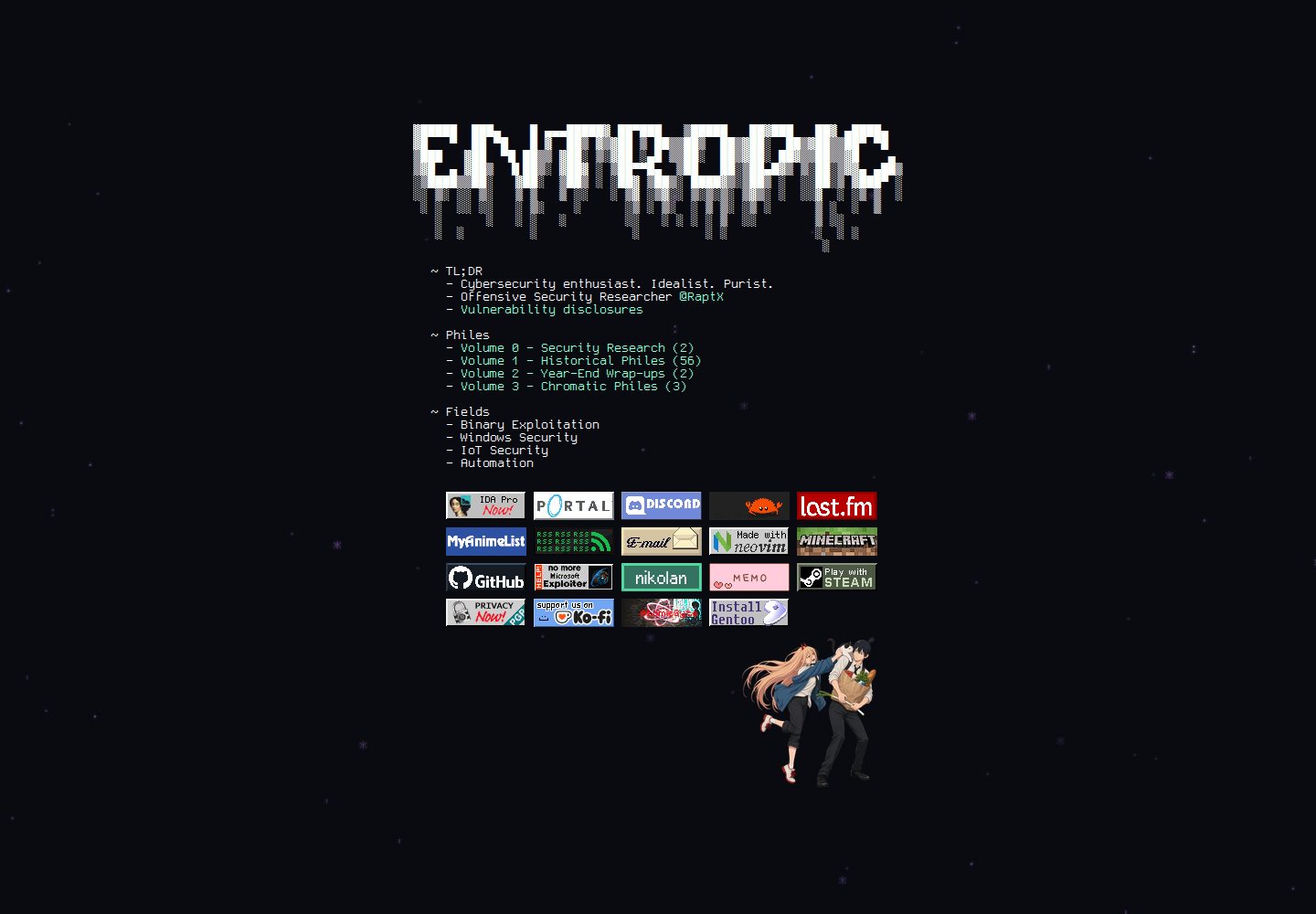
Entropic is an Astro blog theme for retro textmode enthusiasts, rendering articles with fixed-width text, ASCII borders, ANSI colors, and bitmap CJK glyphs.
Explore the design
Compare the page layouts and mobile experience. Open any screenshot for a closer look.
Desktop homepage1 / 2
Desktop captureTop of page
Actual screenshot captured by the server browser.
All pages & views 2
Screenshots show visual appearance; interactive behavior may differ.
Recorded 2026-10-02View source
What stands out
A quick read of the recorded project description.
Article header decoration effects are determined by the public URL; the default pool includes life, maze, sort, bits, asm, and reorder, adjustable in config or per-article frontmatter
Volume decorations provide four themed illustrations—circuit, archive, study, and prism—while retaining the original life frames
redacted: true discards the article body from the content store and renders a redacted view; a pre-commit hook prevents it from entering commits
With math: true, Temml converts LaTeX to native MathML at build time, and formulas retain textmode fonts and colors
88x31 buttons and decorative art rotate daily according to the Asia/Shanghai timezone, so all visitors see the same combination on a given date
Template Details
Entropic is a retro textmode blog theme built with Astro. It renders article bodies as textmode content, preserving typography, wrapping at a configured width, and supporting images, ANSI escape sequences, and a custom ink block syntax. Articles are stored as .phile files under src/content/philes/volume-*/**/*.phile; frontmatter requires title and date, with optional order, slug, redacted, lang, decoration, math, and other fields. The volume number comes from the directory name, and public routes are /volume/<n>/ and /volume/<n>/<phile-name>/.
Site identity, homepage sections, 88x31 buttons, decorative art, colors, effects, volume metadata, CVE records, analytics, and optional WKD publication are all configured in entropic.config.ts at the repository root, with no need to modify files under src/. The config file is a plain TypeScript object with as const satisfies EntropicConfig, so editors can provide field descriptions and completions. Omitted settings inherit internal defaults; objects merge at the leaves documented in the docs, while arrays replace the defaults.
Article header decoration effects are determined by the article's public URL. The default pool includes life, maze, sort, bits, asm, and reorder. You can configure the effect pool, animation, and speed via philes.decoration, or pin an effect in an individual article's frontmatter with decoration, or set it to false to remove it. Volume decorations support four themed illustrations—circuit, archive, study, and prism—as well as the original life frames.
Articles with redacted: true have their body discarded from the content store, and the public page renders a redacted view; a pre-commit hook parses staged YAML and unstages redacted philes. This marker is a publication flag, not secret storage, and does not erase files from existing Git history.
Math formulas require math: true in frontmatter. Use $...$ or \(...\) for inline formulas and $$...$$ or \[...\] for display formulas; they are converted to native MathML at build time. Unsupported commands cause the build to fail. Temml requires browser support for native MathML, and \ref and \eqref are not yet wired into the rendering pipeline.
AstroBlog
Is it right for your project?
Use Cases
- Building a personal blog whose visual language is fixed-width text, ASCII borders, and ANSI colors
- Publishing technical articles or security research notes maintained as plain-text .phile files that need to preserve original typography
- Configuring textmode decoration animations stably assigned by URL, with per-volume themed illustrations
- Writing scenarios that use LaTeX formulas in articles and want native MathML output at build time
- A publication workflow that needs to mark some articles as redacted, exposing only a redacted view rather than the body
Suitable For
- Bloggers who prefer a retro textmode interface and are willing to write in plain-text files
- Developers using Astro who accept centralized configuration via entropic.config.ts at the repository root
- Site maintainers who need to organize articles by volume and set different decorative illustrations for each volume
- Authors who use LaTeX formulas in articles and target browsers that support native MathML
Getting started & customization
Use these recorded setup notes alongside the repository instructions for your chosen version.
- 1
Articles go in src/content/philes/volume-*/**/*.phile; frontmatter requires title and date, and the volume number comes from the directory name
- 2
Site identity, homepage sections, buttons, decorations, volume metadata, CVE, analytics, and more are configured in entropic.config.ts at the repository root, with no need to modify src/
- 3
You can validate config values, decoration choices, and optional public key input with pnpm check:config; pnpm check additionally checks unknown fields/types, source boundaries, and formatting; pnpm dev previews config changes locally
- 4
In a new clone, run git config core.hooksPath scripts/hooks to enable hooks; install dependencies before use
- 5
redacted is a publication flag, not secret storage, and does not erase files from existing Git history; keep confidential source material outside Git
License & source material
Usage conditions & limitations
Free to use · keep license noticeThis entry covers the free version in the public repository under the MIT license; the free scope is that version's code and does not mean external services or third-party assets are free.
Must comply with when using
- You may use, modify, commercialize, and distribute this version's code for free.
- When distributing copies or substantial portions of the code, retain the original author's copyright notice and the full MIT license notice.
- The code is provided as is; warranties and limitations of liability are governed by the original license and applicable law.
Additional costs & items to verify
- At build time, you can optionally set the GITHUB_TOKEN environment variable to increase GitHub API request quota; without it, cached data is used as a fallback.
- The uv tool is only needed if you want to regenerate math fonts; normal builds and page visits use the committed fonts and do not require network access to upstream.
- fonttools is only needed if you want to regenerate font subsets and CJK atlases; normal production builds use the committed font assets and do not require local font tools.
- The config checked into the repository is the author's personal site config, with WKD and CVE pages enabled by default; a new site must modify identity, email, and public key paths in entropic.config.ts.
- Deploying pnpm 12 on Vercel requires setting ENABLE_EXPERIMENTAL_COREPACK=1 in the build environment to enable Corepack version pinning.
- Enabling WKD publication requires configuring the openpgpkey subdomain, DNS records, and hosting platform response headers, and handling external service settings such as Cloudflare browser integrity checks.
- The built-in math font is derived from STIX Two Math, whose license is stored separately in fonts/STIXTwoMath.LICENSE and differs from the project code's MIT license; using that font requires complying with its own license.
- Demo images, fonts, icons, and other third-party assets must be checked against their respective licenses and cannot be judged solely by the code's MIT license.
- External services such as domains, hosting, databases, payments, or AI may incur separate charges.
View Original Text Basis
Permission is hereby granted, free of charge
Original License Text
An optional build-time GITHUB_TOKEN increases the API request allowance.
Original README
Run `pnpm fonts:math` to regenerate from the latest upstream release (requires `uv`).
Original README
Regenerating these assets requires `fonttools`.
Original README
This personal site enables WKD for `[email protected]` in `entropic.config.ts`.
Original README
For pnpm 12 on Vercel, use the pinned `packageManager` via Corepack (`ENABLE_EXPERIMENTAL_COREPACK=1` in the build environment).
Original README
For Vercel, deploy the configured public key and attach `openpgpkey.<mail-domain>` directly to that environment, without a domain redirect.
Original README
https://github.com/CuB3y0nd/entropic/blob/master/LICENSEhttps://github.com/CuB3y0nd/entropic/blob/master/READMEThe bundled Entropic Math font derives from STIX Two Math's CFF font: https://github.com/stipub/stixfonts/releases/latest Its license is included in `fonts/STIXTwoMath.LICENSE`.
Original README
Compiled by DeepSeek based on repository license and README ·2026-10-02. Results only cover the materials read; dependencies, images, fonts, and subsequent term changes are subject to their respective original texts.
Project checks & description sources
Template Information
- Source platforms
- GitHub
- Documentation and maintenance reference score
- More documented · 87 / 100
- Technologies
- Astro
- Website type
- Blog
How this score is calculated
Our heuristic uses license records (up to 30), a demo link (12), a preview (10), stars (15), recorded maintenance (15), description completeness (8), feature records (5) and classification data (5). It is not a code, security or performance test, or a Google score. A link does not establish tested functionality.
What to verify for this project
- Repository update recorded
- 2026-09-27
- Screenshot last checked
- 2026-10-02
A demo link is listed. Check it with your own content and viewport sizes; its presence does not confirm that forms, authentication or payments work.
The catalog identifies Astro as the primary stack. Check the actual dependency manifest and lockfile for versions and hosting requirements. These notes use recorded metadata, not a code audit or a deployment test.
Use a selection guide →How this description was prepared
AI-assisted description based on catalog records and repository material. Repository authors are not automatically the reviewers of this description.
Automatically checked against source and license rules; no manual editorial review.
Inspect the recorded source material
SHA-256: d870cc6f43c00916c3d873f5a78ae1a5475b2f8d518690903671be45a4a5193e
2026-10-02T16:48:55.896Z
Source file / repositoryEntropic
========
Entropic is a retro textmode blog theme for purists.
The implementation uses Astro, Vite, and Tailwind CSS utilities. The surface
uses fixed-width text, ASCII frames, volume indexes, ANSI colors, bitmap CJK
glyphs, and plain `.phile` documents.
Configuration
-------------
Edit `entropic.config.ts` at the repository root. It is the single entry for
site identity, home sections, 88x31 buttons, decorative artwork, colors,
effects, volume metadata, CVE records, analytics, and optional WKD publishing.
You do not need to edit files inside `src/` to customize these settings.
The checked-in file is also the personal site configuration. `home.asciiArt`
inherits the banner from `src/config/defaults.ts` unless overridden; WKD and
the CVE page are explicitly enabled.
Set `cves.enabled: false` to omit the CVE page, its homepage links, and its sitemap
entry; the records can remain in `cves.records` for later use.
Article inspection and fragment links are enabled by default. Select article
text to inspect a value or prepare a link to that passage, then copy with your
browser's native Copy action. Fragment links locate the quoted text and briefly
highlight it; repeated passages need enough context to identify one match.
Set `philes.inspect: false` or `philes.fragmentLinks: false` to disable either
tool. Disabling fragment links also disables incoming passage navigation.
The file is a plain TypeScript object with `as const satisfies EntropicConfig`.
Your editor provides field descriptions and completion, including artwork
preset names and rotation modes. Omitted settings inherit internal defaults;
objects merge at documented leaves and arrays replace their defaults.
pnpm check:config
validate values, artwork selection, and optional public key input
pnpm check
also check unknown fields/types, source boundaries, and formatting
pnpm dev
preview configuration edits locally
Field comments in `entropic.config.ts` describe supported values, examples,
and default inheritance. The configuration types live in `src/config/types.ts`.
Directory Layout
----------------
entropic.config.ts the user-editable configuration
src/config/ internal types, defaults, validation, and projections
src/content/philes/ article source files
src/pages/ Astro file routes and HTTP output adapters
src/features/ home, site-badges, philes, volumes, cves, seo, and wkd
src/shared/textmode/ text cells, ANSI, bitmap CJK, and browser behaviors
src/shared/browser/ browser lifecycle helpers
src/layouts/ shared page shells
src/styles/ foundation, layer ordering, and responsive rules
src/assets/decorations/ original artwork grouped by series
src/generated/ generated glyph metadata
scripts/ font generation, checks, and Git hooks
tests/ configuration, content, browser, and security regressions
Features own their data access, rendering, components, and styles. Shared
textmode primitives have separate pure, server, and browser entry points.
Cross-feature imports use public entries; `pnpm check:boundaries` verifies
these interfaces and keeps server dependencies out of browser modules.
Tailwind handles common layout and spacing. Pixel typography, ANSI/CJK output,
and animation rules live in native CSS. Theme utilities use the typed
configuration; Preflight is not enabled. Astro bundles styles from their owning
components and modules instead of loading every feature's CSS on every page.
Content
-------
Articles are `.phile` files under:
src/content/philes/volume-*/**/*.phile
A phile is a frontmatter block followed by plain text.
Required fields:
title
date
Optional fields:
order
slug
redacted
lang
decoration
math
Credits come from each file's Git history, including renames and
Co-authored-by trailers. The original author appears first, followed by
contributors in order of first participation. GitHub nicknames are preferred;
accounts without a nickname use their login. Unlinked identities keep their
Git author name. A new, uncommitted article has no credits yet.
Names are resolved once per production build and embedded in the static pages.
No GitHub requests run in the browser. Builds restore shallow history before
reading credits; Vercel checkouts without an origin use its Git system variables.
An optional build-time GITHUB_TOKEN increases the API request allowance. Cached
profiles provide a fallback when GitHub is unavailable.
The body is rendered as textmode content. It preserves layout, wraps to the
configured article width, renders images, accepts ANSI escape sequences, and
supports the custom ink block syntax.
Set `math: true` in an article's frontmatter to render LaTeX formulas with
Temml. Use `$...$` or `\(...\)` inline, and `$$...$$` or `\[...\]` for display
equations. Standalone tall expressions also receive display space. Math is
converted to native MathML at build time; unsupported
commands fail the build. Code spans and fenced code keep their TeX literal.
The bundled Entropic Math font derives from STIX Two Math's CFF font:
https://github.com/stipub/stixfonts/releases/latest
Its license is included in `fonts/STIXTwoMath.LICENSE`.
Radical size variants have their short horizontal caps trimmed so
MathML's overbar joins directly to the diagonal without a pixel step. Other
glyph outlines are unchanged. Fraction, radical, overbar and underbar rule
thicknesses use 0.05em to avoid two-pixel bars at the article's 16/17px sizes.
Run `pnpm fonts:math` to regenerate from the latest upstream release (requires
`uv`). The script checks the radical geometry before replacing the font and
records the resolved source URL and SHA-256 in the font's metadata. Normal
builds and page visits use the bundled font without fetching upstream.
Temml requires a browser with native MathML support. Equation references
(`\ref` and `\eqref`) are not wired into the site's rendering pipeline yet.
Math articles retain the textmode font and colors, with unframed equations
aligned to the body. Prose wraps to the viewport; long equations scroll within
their own region instead of shrinking the entire article. Articles without
`math: true` retain the original text rendering, including literal dollar signs.
Ink style reference:
https://www.cubeyond.net/volume/3/ansi-ink-phile/
Article header artwork is chosen from the article's public URL. It stays the
same across reloads, rebuilds, and adding/removing other articles. Renaming its
slug or moving it to another volume can choose a different effect. The default
pool is `life`, `maze` (depth-first maze carving), `sort` (insertion sort),
`bits` (four byte registers), `asm` (a small assembly loop), and `reorder`
(out-of-order execution with in-order retirement). No extra controls interrupt
the reading layout.
Configure the pool and playback in `entropic.config.ts`:
philes: {
decoration: {
effects: ["life", "maze", "sort", "bits", "asm", "reorder"],
animated: true,
speed: 1
}
}
Omitted options inherit these defaults. `effects` must contain at least one
unique algorithm; use a single item to show the same effect everywhere.
Reordering the pool does not reshuffle articles. For the new effects, `speed`
ranges from 0.25 to 4 and `animated: false` keeps a still frame. The new artwork
also stays visible without JavaScript. Life uses its original renderer, grid,
color, and timing; these playback options do not change it. All effects
pause offscreen, in hidden tabs, and for reduced motion.
Set `decoration: maze` (or any other effect name) in an article's frontmatter
to pin its effect, including one outside the global pool. `decoration: false`
removes that article's artwork and closes the unused header space.
`philes.decoration: false` disables all article artwork, including overrides.
The processor illustrations use native Gohu text at the article's font size.
`bits` highlights the bits changed by XOR, rotate, and shift operations. `asm`
shows an executed instruction with its resulting registers and flags. `reorder`
shows dependency waits and two execution slots; completed instructions remain
in the queue until all earlier instructions can retire.
Example:
---
title: "Example"
date: 2026-05-31
---
--[ Summary ]-------------------------------------------------------------
target : ...
primitive : ...
--[ ink ]--
| 00400000-00401000 r--p 00000000 ./a.out ; ELF headers
~ BBBBBBBB.BBBBBBBB GGKK KKKKKKKK MMMMMMM
| 00401000-00402000 r-xp 00001000 ./a.out ; executable text
~ BBBBBBBB.BBBBBBBB GGRR KKKKKKKK MMMMMMM
#[B|B] address range
#[G|G] readable permission
#[R|R] executable permission
#[K|K] offset / padding
#[M|M] mapped object
Volumes
-------
Volume numbers come from the directory name:
volume-0
volume-1
volume-2
The public routes are:
/volume/<n>/
/volume/<n>/<phile-name>/
Per-volume behavior is configured in `entropic.config.ts` under `volumes`.
Only the fields supplied for a volume override its generated defaults.
Set `decoration` to `circuit`, `archive`, `study`, or `prism` for a themed header
illustration. `life` keeps the original Game of Life frame and is the default
for unconfigured volumes; `false` removes the decoration. For example:
volumes: {
0: { title: "Security Research", decoration: "circuit" },
1: { title: "Historical Philes", decoration: "archive" }
}
The four illustrations also accept an options object:
decoration: {
kind: "study",
animated: true,
speed: 1,
calendar: { month: 12, day: 31 }
}
`animated: false` keeps a static illustration. `speed` is a playback multiplier
from 0.25 to 4: 0.5 is half speed, 2 is double speed. These optional settings
default to `true` and `1`. `calendar` is only for `study` and defaults to December
31; use a numeric month and a valid day (February 29 is supported). The original
`life` frame uses the string shorthand. Every CPU transfer independently samples
an 8-bit value, including 00 and FF; consecutive random values may repeat.
The new illustrations remain visible without JavaScript. Their motion pauses
offscreen, in hidden tabs, and when reduced motion is requested. Article
headers use the separate `philes.decoration` settings described above.
Redactions
----------
A redacted phile uses:
redacted: true
The loader discards redacted bodies from the content store and the public page
renders the redacted screen. The pre-commit hook parses staged YAML with the
same parser and unstages redacted philes, leaving the worktree untouched.
Install dependencies before using the hook. Invalid frontmatter blocks the
commit before the hook changes the index.
Redaction is a publishing flag, not secret storage: it does not erase files
from existing Git history. Keep confidential source material outside Git.
Enable hooks in a fresh clone:
git config core.hooksPath scripts/hooks
Site Badges and Artwork
-----------------------
`entropic.config.ts` groups links and decoration under `buttons`. The default
rotates through all 25 presets daily in `Asia/Shanghai`:
buttons: {
items: [/* your 88x31 links or copy controls */],
shuffleOnBuild: true,
artwork: {
mode: "daily",
timeZone: "Asia/Shanghai",
seed: "entropic-artwork-v1",
fallback: "nagaraNozomi"
}
}
All visitors with the same date see the same composition, including after a
refresh. Each cycle shuffles every selected preset once and avoids repeats at
the cycle boundary. The date is checked on load and when returning to a tab or
cached page; a continuously open page does not swap on a timer.
No daily rebuild, endpoint, cookie, or browser storage is needed.
Use `artwork: false` for links alone, or
`artwork: { mode: "fixed", preset: "nagaraNozomi" }` for a fixed image.
An empty `items` array hides the panel. The inline configuration comments cover
custom images, preset pools, interval/visit modes, and the no-JavaScript fallback.
`shuffleOnBuild: true` shuffles buttons once per production build and keeps
that order across visits and artwork changes. Local development uses items order.
Each item supplies `label`, `imageSrc`, and either `href` or `copyText`.
Artwork originals live under `src/assets/decorations/<series>/`. Presets retain
the approved display sizes, overlap, and companion placement. Astro builds 1x
and 2x WebP images with lossless encoding; originals remain unchanged. Inert HTML
templates keep unselected compositions from fetching images. The shareable
animated site badge stays at `/assets/88x31/button.gif` for other sites to link to.
CSS grid and container queries own layout. Overlapped badges appear above the
artwork on hover or keyboard focus; touch devices show them immediately.
Artwork is decorative and cannot intercept link activation.
Commands
--------
Use Node.js 24 or newer and the pinned pnpm 12.3.4. `pnpm check:types` runs
Astro diagnostics with the official TS 6 compatibility API and the native
TypeScript 7 checker. Keep both aliases until Astro supports the new API.
pnpm install --frozen-lockfile
install dependencies
pnpm dev
run the local development server
pnpm check
run Astro and TypeScript diagnostics, formatting/lint, and module boundaries
pnpm format
format TS/JS/CSS/JSON with Biome and Astro templates with Prettier
pnpm lint
lint the files covered by Biome
pnpm build
build the static site
pnpm test
run content, textmode, redaction-hook, and WKD regression tests
pnpm exec playwright install chromium firefox
install the browser revisions used by this Playwright version
pnpm test:browser http://127.0.0.1:4329
check fitting, animation lifecycle, and site badges against a production preview
set PLAYWRIGHT_BROWSER=firefox to use Firefox
pnpm test:wkd
verify optional WKD generation and key handling
pnpm assets:fonts
regenerate font subsets and CJK atlases
Font assets are committed. Normal production builds do not require local font
tooling.
Run `pnpm assets:fonts` only when the committed font outputs need to change:
after editing font source files under `fonts/`
after changing CJK glyph coverage or bitmap atlas generation
after changing text that introduces new CJK glyphs which must render via
the bitmap CJK atlas
after changing the font subset scripts themselves
The command regenerates:
public/assets/fonts/gohu-subset.woff
public/assets/cjk/wqy-cjk-body.png
public/assets/cjk/wqy-cjk-link.png
src/generated/cjk-atlas.ts
Regenerating these assets requires `fonttools`. If `pyftsubset` is already on
`PATH`, the scripts use it directly. Otherwise, with `uv` installed, the
scripts resolve `fonttools` automatically and keep the uv cache under `/tmp`.
Branches
--------
`master` is stable. `dev` is integration.
Feature and fix work should branch from `dev`. Pull requests should be
squash-merged. Commits should be signed and should use Conventional Commits.
Public Key Discovery
--------------------
This personal site enables WKD for `[email protected]` in `entropic.config.ts`.
A new site that omits WKD settings leaves publication disabled. To configure it:
wkd: {
enabled: true,
email: "[email protected]",
publicKeyPath: "public/assets/pgp/public-key.asc"
}
Set `wkd.enabled: false` to disable publication while retaining the email and path. Replace the referenced file with your
public key export; its manual download URL also works without WKD. Key changes
require replacing only that file and rebuilding.
The configuration check rejects missing settings, private keys, and public
keys whose UIDs do not match the email. The development server watches the
configured public key file. Production requires a new deployment.
Migration: move the former `WKD_EMAIL` and `WKD_PUBLIC_KEY_PATH` values from
`.env.local` or the hosting environment into this object. Those old environment
variables no longer configure WKD; there is one source of truth. The email and
public-key path are public publishing settings, not credentials.
The build derives the mail domain and lookup hash, then generates the policy
and binary public key under `dist/.well-known/openpgpkey/`. Generated WKD
files are not committed. The Vercel header rules work with any mail domain.
For pnpm 12 on Vercel, use the pinned `packageManager` via Corepack
(`ENABLE_EXPERIMENTAL_COREPACK=1` in the build environment). Confirm the actual
Node.js and pnpm versions in the deployment log; Vercel's default package-manager
detection is not the same as honoring this pin. Local builds do not verify the
remote environment.
For Vercel, deploy the configured public key and attach
`openpgpkey.<mail-domain>` directly to that environment, without a domain
redirect. Redeploy after changing the configuration. In Cloudflare DNS, add a
CNAME named `openpgpkey` using Vercel's displayed target, with Proxied (orange
cloud) and TTL Auto. Use Full (strict) for the connection to Vercel and wait
for domain verification, HTTPS certificates, and DNS caches to update.
Preserve Vercel's proxy prerequisites for certificate issuance and renewal:
allow HTTP access to `/.well-known/acme-challenge/*` without redirects or
browser checks, and leave `/.well-known/vercel/*` uncached. See:
https://vercel.com/docs/security/reverse-proxy
The proxy setting reflects deployment testing: direct Vercel connections
failed during TLS 1.3 shutdown with GnuPG 2.5.21 / GnuTLS 3.8.13, while the
same WKD lookup succeeded through Cloudflare with default TLS settings.
Other static hosts need equivalent WKD response headers and their own live
discovery checks.
WKD clients need public access without authentication or browser challenges.
Cloudflare's Browser Integrity Check can reject non-browser clients with
HTTP 403 / error 1010 even when GnuPG succeeds. Add a scoped exception:
1. Select your domain in Cloudflare, then open Rules > Overview.
2. Select Create rule > Configuration Rule and name it `WKD public access`.
3. Under When incoming requests match, choose a custom filter expression
and open Edit expression. Replace the example hostname with your WKD
hostname:
(http.host eq "openpgpkey.example.org"
and starts_with(http.request.uri.path, "/.well-known/openpgpkey/")
and http.request.method in {"GET" "HEAD"})
4. Under Then the settings are, add Browser Integrity Check and set it to
Off. This exception applies only to WKD GET/HEAD requests on that host.
5. Select Deploy.
Cloudflare documents configuration rules and selective BIC exceptions here:
https://developers.cloudflare.com/rules/configuration-rules/create-dashboard/
https://developers.cloudflare.com/waf/tools/browser-integrity-check/#disable-selectively
After DNS changes have propagated, verify discovery with a fresh keyring:
gpg --homedir "$(mktemp -d)" --auto-key-locate clear,wkd \
--locate-keys [email protected]
Use your configured email and compare the complete primary fingerprint with
your trusted public key export. Check that policy and key URLs accept both
GET and HEAD with the expected content types and CORS headers. Test generic
HTTP clients too: a successful GnuPG lookup alone does not rule out a
Cloudflare browser check blocking another client. Local builds cannot
verify production DNS, HTTPS, or the hosting provider's access rules.
Explore similar templates
Compare previews and descriptions within the same stack and category.

astrowind
AstroWind is a free, open-source Astro starter theme using Astro and Tailwind CSS, released under the MIT license.
Astro · Blog

astro-paper
AstroPaper is a minimal, responsive, accessible, and SEO-friendly Astro blog theme. Articles are stored as Markdown/MDX in src/content/posts/, with subdirectories affecting URLs.
Astro · Blog

fuwari
Fuwari is a static blog template built with Astro and Tailwind CSS for personal blogs. It manages posts as Markdown files in src/content/posts/, with frontmatter for title, date, description, cover, tags, categories, draft status, and language.
Astro · Blog

Firefly
Firefly is a clean personal blog theme forked from Astro and Fuwari, offering four background modes, single/double sidebar and list/grid layouts, Pagefind client-side full-text search, and a six-language UI.
Astro · Blog

astro-theme-cactus
Astro Cactus is an Astro-based blog and portfolio theme that uses Markdown/MDX content collections to manage posts, notes, and tags, with frontmatter type-checked by a schema.
Astro · Portfolio

astrofy
Astrofy is a free and open-source personal portfolio website template built with Astro and TailwindCSS, with built-in blog, CV timeline, project showcase, store, and RSS feed modules.
Astro · Portfolio