Uses GitHub Issues as a content management system; publish by writing in an Issue
HugoBlog
issues-blog — Hugo Blog Template
By imfing
A blog template that uses GitHub Issues as a content source and automatically builds and publishes to GitHub Pages via Hugo and GitHub Actions.
Explore the design
Compare the page layouts and mobile experience. Open any screenshot for a closer look.
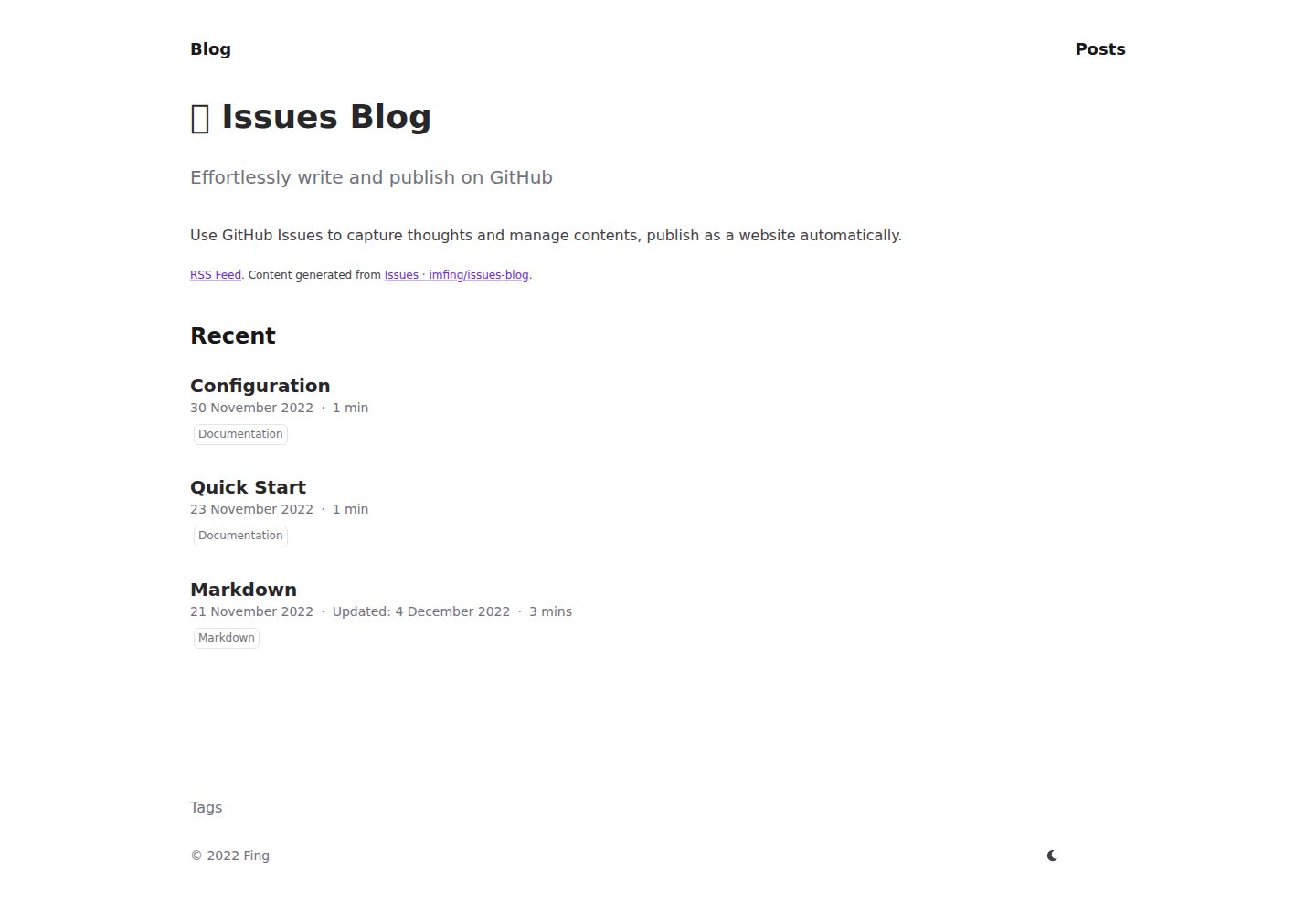
Desktop homepage1 / 3
Desktop captureTop of page
Actual screenshot captured by the server browser.
All pages & views 3
Screenshots show visual appearance; interactive behavior may differ.
Recorded 2026-10-03View source
What stands out
A quick read of the recorded project description.
Generates a static site with Hugo, automatically built and deployed by GitHub Actions
Hosted on GitHub Pages, leveraging GitHub's CDN to display images and videos from Issues
Provides a clean, responsive blog theme that adapts to desktop and mobile browsing
Includes Quick Start and Configuration documents covering setup and customization
Template Details
This is a blog template that uses GitHub Issues as its CMS. The author writes ideas, notes, or articles in a GitHub Issue, and the repository triggers a Hugo build through GitHub Actions, rendering the Issue content into a static site and publishing it to GitHub Pages. The template includes a clean, responsive blog theme and provides two documents—Quick Start and Configuration—covering setup and customization.
It suits users who want to keep their writing workflow inside GitHub: you can write Issues directly on the GitHub website or mobile app, organize content using Issue labels, search, and open/closed status, and display images and videos via GitHub's CDN. The README lists use cases including blogs, newsletters, notes/TIL, and jotting down scattered ideas.
Boundaries to note: the repository materials do not specify dependency versions beyond Hugo and GitHub Actions, nor do they provide performance, concurrency, or large-scale content behavior data. The template's availability depends on external services—GitHub Issues, Actions, and Pages—whose free tiers and policies are determined by GitHub. Third-party assets such as demo images, fonts, and icons require separate license verification.
HugoBlog
Is it right for your project?
Use Cases
- Using a GitHub Issue as the writing entry point to publish personal blog posts
- Organizing Issue content into newsletter-style updates
- Recording notes or Today I Learned (TIL) entries
- Jotting down scattered thoughts and ideas that automatically become a site
Suitable For
- People accustomed to writing within the GitHub website or mobile app
- Users who want to organize content using Issue labels, search, and open/closed status
- Developers who accept GitHub Issues, Actions, and Pages as the publishing pipeline and are willing to follow the documentation for configuration
Getting started & customization
Use these recorded setup notes alongside the repository instructions for your chosen version.
- 1
Setup and configuration steps are covered in the Quick Start and Configuration documents linked in the README
- 2
Site builds depend on GitHub Actions, and publishing depends on GitHub Pages; these features must be enabled in the repository
- 3
The repository uses the MIT license; when distributing copies or substantial portions of the code, retain the copyright notice and the full license notice
- 4
Licenses for third-party assets such as demo images, fonts, and icons must be verified separately and cannot be assumed from the code's MIT license alone
- 5
External services such as domains and hosting may incur additional costs; confirm them yourself
License & source material
Usage conditions & limitations
Free to use · keep license noticeThis entry covers the free version of the public repository under the MIT license; the free scope applies to that version's code and does not imply that external services or third-party assets are free.
Must comply with when using
- Free use, modification, commercial use, and distribution of this version's code are permitted.
- When distributing copies or substantial portions of the code, retain the original author's copyright notice and the full MIT license notice.
- The code is provided as-is; warranties and liability limitations are governed by the original license and applicable law.
Additional costs & items to verify
- The template depends on GitHub Issues as the content source, GitHub Actions for builds, and GitHub Pages for hosting; using it requires a GitHub account and enabling these external services in the repository. Their free tiers and policies are determined by GitHub and may change with platform adjustments.
- Images and videos in Issues are displayed via GitHub's CDN, which is an external service dependency; availability and bandwidth are subject to GitHub's policies.
- Demo images, fonts, icons, and other third-party assets must be verified under their respective licenses and cannot be assumed from the code's MIT license alone.
- External services such as domains, hosting, databases, payments, or AI may incur separate charges.
View Original Text Basis
Permission is hereby granted, free of charge
Original License Text
It uses [GitHub Issues](https://docs.github.com/en/issues/tracking-your-work-with-issues/quickstart) as [CMS](https://en.wikipedia.org/wiki/Content_management_system), [Hugo](https://gohugo.io/) and [GitHub Actions](https://docs.github.com/en/actions) for building the site. Hosted on [Pages](https://docs.github.com/en/pages/getting-started-with-github-pages/about-github-pages) for free.
Original README
https://github.com/imfing/issues-blog/blob/main/LICENSEhttps://github.com/imfing/issues-blog/blob/main/README.md- free GitHub CDN for displaying images and videos
Original README
Compiled by DeepSeek based on repository license and README ·2026-10-03. Results only cover the materials read; dependencies, images, fonts, and subsequent term changes are subject to their respective original texts.
Project checks & description sources
Template Information
- Source platforms
- GitHub
- Documentation and maintenance reference score
- More documented · 81 / 100
- Technologies
- Hugo
- Website type
- Blog
How this score is calculated
Our heuristic uses license records (up to 30), a demo link (12), a preview (10), stars (15), recorded maintenance (15), description completeness (8), feature records (5) and classification data (5). It is not a code, security or performance test, or a Google score. A link does not establish tested functionality.
What to verify for this project
- Repository update recorded
- 2025-01-11
- Screenshot last checked
- 2026-10-03
A demo link is listed. Check it with your own content and viewport sizes; its presence does not confirm that forms, authentication or payments work.
The catalog identifies Hugo as the primary stack. Check the actual dependency manifest and lockfile for versions and hosting requirements. These notes use recorded metadata, not a code audit or a deployment test.
Use a selection guide →How this description was prepared
AI-assisted description based on catalog records and repository material. Repository authors are not automatically the reviewers of this description.
Automatically checked against source and license rules; no manual editorial review.
Inspect the recorded source material
SHA-256: 0d4e664886527d5bc46626b457808cd8dea81bf94e3650fcbf6bd988d88f87aa
2026-10-03T04:45:35.436Z
Source file / repository<h1 align="center"> 💭 Issues Blog </h1> <p align="center"> Effortlessly write and publish on GitHub ✏️ </p> <p align="center"> <img alt="GitHub Issue" src="https://user-images.githubusercontent.com/5097752/203450000-350d643a-dcef-40cc-91c5-b5cd7998a63f.png" width="40%"> <img alt="Published Website" src="https://user-images.githubusercontent.com/5097752/203450036-0f06fdc4-6409-4032-9421-210a2d6b78b5.png" width="40%"> </p> ## Overview [](https://opensource.org/licenses/MIT) 🌎 [**Demo**](https://imfing.github.io/issues-blog/) Jog down ideas, notes or blog posts, publish it as website automatically. It uses [GitHub Issues](https://docs.github.com/en/issues/tracking-your-work-with-issues/quickstart) as [CMS](https://en.wikipedia.org/wiki/Content_management_system), [Hugo](https://gohugo.io/) and [GitHub Actions](https://docs.github.com/en/actions) for building the site. Hosted on [Pages](https://docs.github.com/en/pages/getting-started-with-github-pages/about-github-pages) for free. ## Features - Easy to setup (see [Quick Start](https://imfing.github.io/issues-blog/posts/quick-start/)) - Blazing fast build and deploy ⚡ - Write from anywhere with GitHub web or [mobile](https://github.com/mobile) - Clean and responsive blog theme 🫧 ## Setup - [Quick Start](https://imfing.github.io/issues-blog/posts/quick-start/) - [Configuration](https://imfing.github.io/issues-blog/posts/configuration/) ## Use Cases - Blogging ✍️ - Newsletter 📰 - Notes / Today I Learned (TIL) 📒 - Quick thoughts and ideas 💡 ❓ **Why not just manage contents using markdown files in a repository?** While storing and editing Markdown files in a GitHub repository is typical for building blog websites, using GitHub Issues brings these benefits: - more user-friendly interface with built-in labelling and search 🔍 - accessible from mobile app and website, good for capturing thoughts 📱 - streamlined workflow by leveraging [GitHub Projects](https://docs.github.com/en/issues/planning-and-tracking-with-projects/learning-about-projects/quickstart-for-projects) and Issue status (open/closed) - free GitHub CDN for displaying images and videos
Explore similar templates
Compare previews and descriptions within the same stack and category.

hugo-PaperMod
A fast, clean, responsive Hugo theme for blogs and lightweight portfolios, with three layout modes (Regular, Home-Info, Profile), automatic and manual light/dark themes, Fuse.js client-side search, multilingual support, and built-in Open Graph, Twitter Cards, and Schema.org data.
Hugo · Portfolio

LoveIt
LoveIt is a clean, elegant, and feature-rich Hugo blog theme derived from LeaveIt and KeepIt, MIT-licensed. It offers light/dark modes, responsive layout, multilingual support, and search via Lunr.js or Algolia.
Hugo · Blog

hugo-coder
hugo-coder is a minimalist Hugo blog theme maintained by luizdepra under the MIT license. It provides a clean, text-focused blog appearance, configuration documentation in the docs directory, and a complete exampleSite with hugo.toml.
Hugo · Blog

blowfish
Blowfish is a Hugo personal website and blog theme built with Tailwind CSS 4, focused on lightness, simplicity, and content-first presentation.
Hugo · Blog

hugo-paper
hugo-paper is a simple, clean, and customizable Hugo blog theme configured through config.toml or hugo.toml.
Hugo · Blog

hextra
Hextra is a Hugo theme for documentation and blog sites, built on Hugo and Tailwind CSS with design referencing Nextra.
Hugo · Documentation