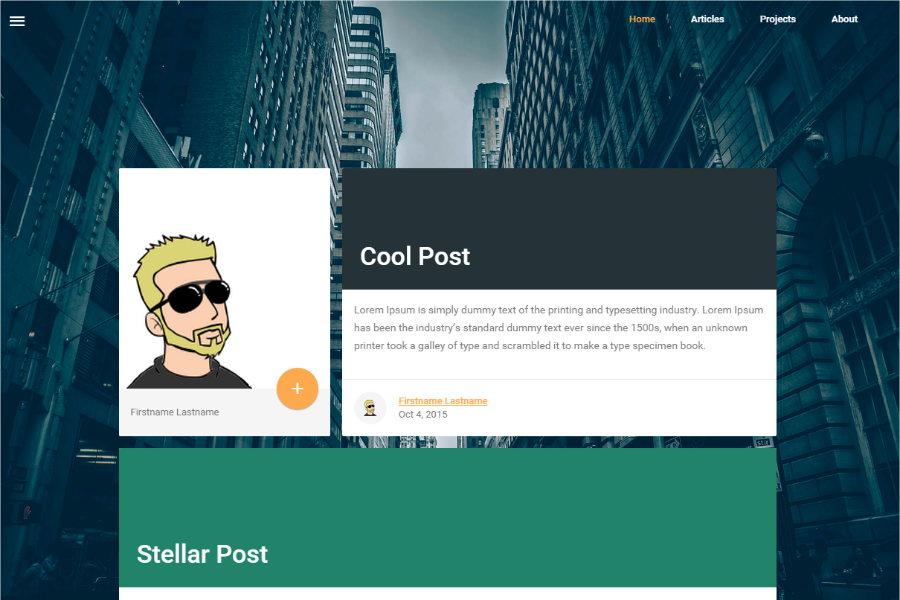
Hugo theme built on the Material Design Lite example blog layout
HugoBlog
HugoMDL — Hugo Blog Template
By jchatkinson
HugoMDL is a multi-page responsive blog and portfolio theme for Hugo based on the Material Design Lite example blog layout, released under the Apache-2.0 license.
Explore the design
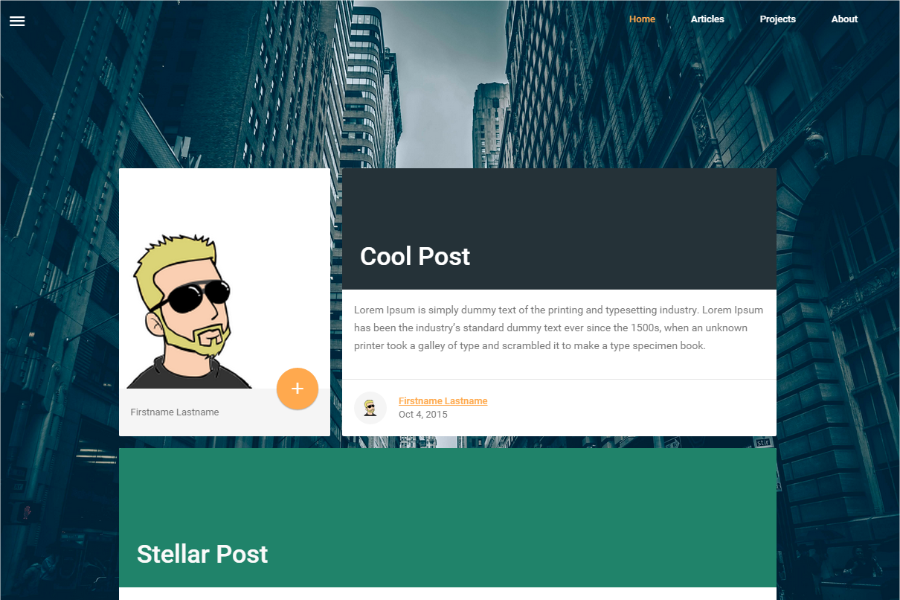
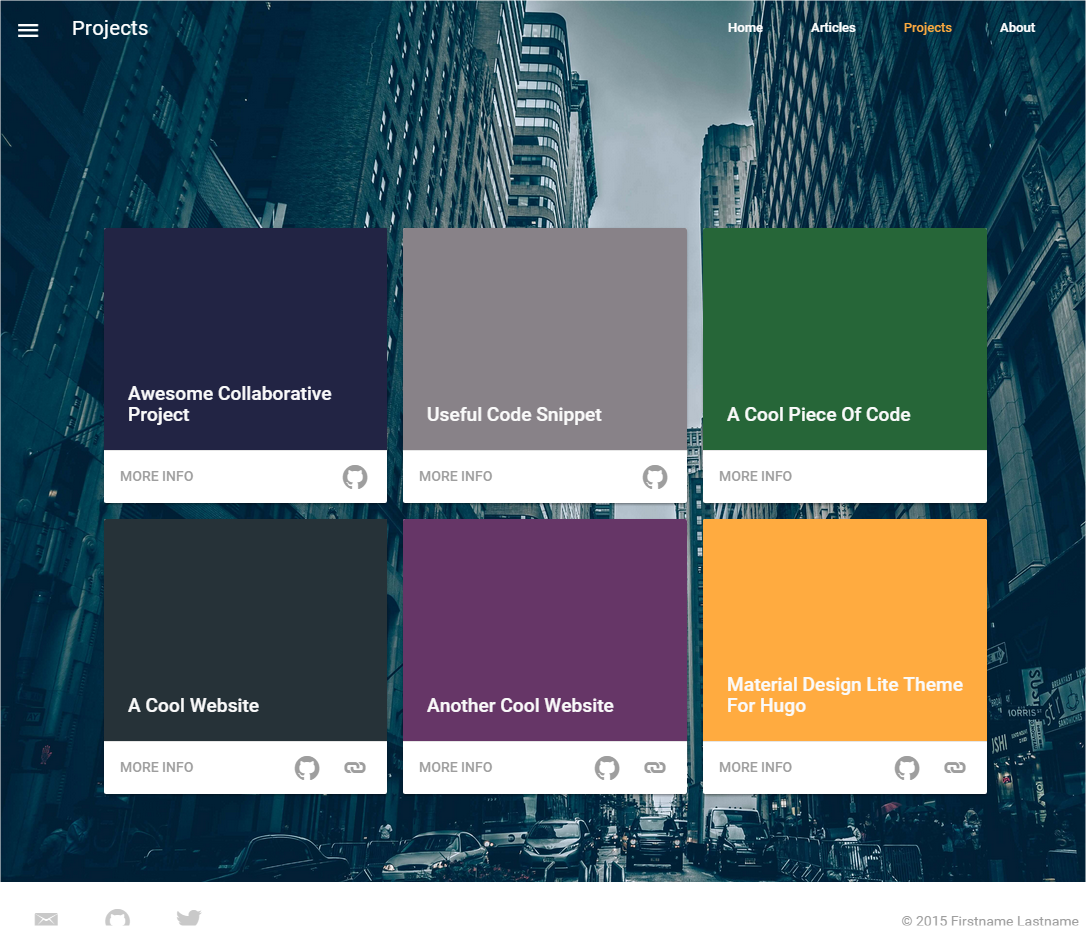
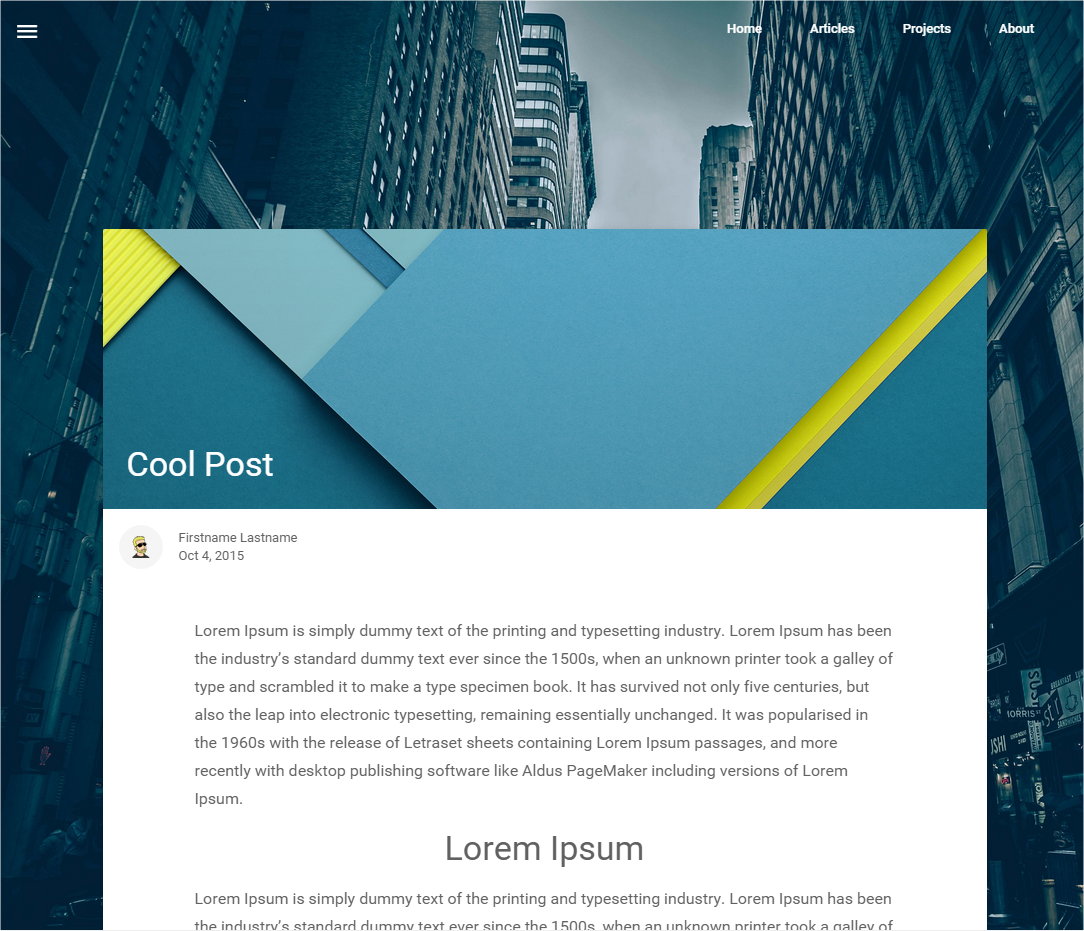
Compare the page layouts and mobile experience. Open any screenshot for a closer look.
Author preview
Author-provided previewTop of page
Preview provided in the project README.
One original preview is available. Open the full image to inspect the design.
Screenshots show visual appearance; interactive behavior may differ.
Recorded 2026-09-30View source
What stands out
A quick read of the recorded project description.
Supports both blog posts and projects/portfolio content types
Card-based layout on the homepage and post pages, with configurable thumbnail, header image, background color, and title color
Site background, author information, and navigation menu configured through exampleSite/config.toml
Post and project front matter support author information and repo and web link fields
Released under the Apache-2.0 license
Template Details
HugoMDL is a multi-page responsive blog/portfolio theme for Hugo, built on Google's Material Design Lite example blog layout. The theme provides two content types: blog posts and projects (portfolio). The homepage displays content as cards, and cards can be configured with a thumbnail, header image, background color, and title color.
The theme is configured at the site level through exampleSite/config.toml, including background, author name and contact information, and top-level navigation menu entries can be defined in that file. Posts and projects use similar front matter: posts support title, description, date, categories, tags, and optional cardthumbimage, cardheaderimage, cardbackground, cardtitlecolor, and author information; projects additionally support repo and web link fields, and the corresponding icons are not displayed when these are not set. The repository README also provides an About page example and development and startup commands for a c9 environment.
The theme was last updated in 2018. The README states that it currently meets the author's own needs and welcomes improvements via fork and pull request. The repository does not list the specific framework versions it depends on in the provided information, so it is advisable to verify Hugo version compatibility before use.
HugoBlog
Is it right for your project?
Use Cases
- Building a personal blog with Hugo and wanting a Material Design style
- Showcasing personal projects or a portfolio alongside a blog
- Sites that need a card-based homepage layout with customizable card images and colors
- Scenarios where site navigation and author information are managed centrally through a configuration file
Suitable For
- Developers building personal blogs with Hugo
- Personal sites that need to present both articles and a project portfolio
- Users who prefer the Material Design Lite visual style
- Users who can read and adjust Hugo theme configuration themselves
Getting started & customization
Use these recorded setup notes alongside the repository instructions for your chosen version.
- 1
Create a themes folder in the Hugo site directory, then run git clone https://github.com/jchatkinson/HugoMDL inside it
- 2
Refer to exampleSite/config.toml to configure the site background, author information, and navigation menu
- 3
Posts and projects must be filled in according to the front matter fields in the README; cardthumbimage, cardheaderimage, cardbackground, and cardtitlecolor are all optional
- 4
The repo and web fields in project front matter do not display the corresponding icons when unset
- 5
The repository was last updated in 2018; it is advisable to verify Hugo version compatibility before use
License & source material
Usage conditions & limitations
Free to use · keep license noticeThis entry covers the free version in the public repository under the Apache-2.0 license; the free scope is the code of that version and does not mean that external services or third-party assets are free.
Must comply with when using
- Free use, modification, commercial use, and distribution are permitted; the Apache-2.0 license must be included when distributing.
- Modified files must carry prominent notices of changes, and relevant copyright, patent, trademark, and attribution notices must be retained.
- If the original project includes a NOTICE file, applicable attribution notices in it must be retained when distributing derivative works.
- The license includes an applicable contributor patent grant; initiating patent litigation as described in the license terminates that patent grant, and no trademark rights are granted.
- The code is provided as is; warranties and limitations of liability are governed by the original license and applicable law.
Additional costs & items to verify
- Demo images, fonts, icons, and other third-party assets must be checked against their respective licenses; they cannot be judged solely by the code's Apache-2.0 license.
- External services such as domains, hosting, databases, payments, or AI may incur separate charges.
View Original Text Basis
https://github.com/jchatkinson/HugoMDL/blob/master/LICENSEhttps://github.com/jchatkinson/HugoMDL/blob/master/README.mdno-charge, royalty-free, irrevocable copyright license
Original License Text
Compiled by DeepSeek based on repository license and README ·2026-10-01. Results only cover the materials read; dependencies, images, fonts, and subsequent term changes are subject to their respective original texts.
Project checks & description sources
Template Information
- Source platforms
- GitHub
- Documentation and maintenance reference score
- Partly documented · 72 / 100
- Technologies
- Hugo
- Website type
- Blog
How this score is calculated
Our heuristic uses license records (up to 30), a demo link (12), a preview (10), stars (15), recorded maintenance (15), description completeness (8), feature records (5) and classification data (5). It is not a code, security or performance test, or a Google score. A link does not establish tested functionality.
What to verify for this project
- Repository update recorded
- 2018-12-31
- Screenshot last checked
- 2026-10-01
A demo link is listed. Check it with your own content and viewport sizes; its presence does not confirm that forms, authentication or payments work.
The catalog identifies Hugo as the primary stack. Check the actual dependency manifest and lockfile for versions and hosting requirements. These notes use recorded metadata, not a code audit or a deployment test.
Use a selection guide →How this description was prepared
AI-assisted description based on catalog records and repository material. Repository authors are not automatically the reviewers of this description.
Automatically checked against source and license rules; no manual editorial review.
Inspect the recorded source material
SHA-256: 82374a7560de3ce8c3f5193f73393484b1958eca32d206354f3fe9e7d8594dd0
2026-10-01T15:18:39.451Z
Source file / repository# HugoMDL
HugoMDL is a multipage responsibe blog/portfolio theme for [Hugo](http://gohugo.io). The theme is based on the
[Material Design Lite](http://www.getmdl.io/) sample blog layout.
At present it suits my needs, but feel free to help improve this theme by forking a copy and submitting a pull request.
## Installation
Inside the folder of your Hugo site run:
$ mkdir themes
$ cd themes
$ git clone https://github.com/jchatkinson/HugoMDL
For more information read the official [setup guide](//gohugo.io/overview/installing/) of Hugo.
(Note for myself)
To develop on c9, add the hugo binary to the workspace, then add it to the path using `export PATH=$PATH:/home/ubuntu/workspace/hugo`
To serve the site from c9, cd to site root and use `hugo server --bind="0.0.0.0" --port=8080 --watch --disableLiveReload`
# Configure the Theme
There are a few different places you need to configure. First, check exampleSite/config.toml for an example site
configuration file. Here, you can set site-wide options like background, author name, and contact info.
You can also use this file to configure your site's menu system. The stanzas in this file correspond to the top level
items in the site navigation menus. You may rename, remove, or add any entries as you see fit.
If you use the suggested entry names listed in the example configuration file, your site's pages will inherit this
theme's formatting. The following subsections detail these specialized styles.
### About page
Look at the `exampleSite\about.md` file for an example 'About' page.
### Posts
Posts use the following front-matter:
```
---
title: "First Post"
description: "first post with Hugo website engine"
date: "2015-08-18"
categories:
- "post"
tags:
- "meta"
- "test"
cardthumbimage: "/images/default.jpg" #optional: default solid color if unset
cardheaderimage: "/images/default.jpg" #optional: default solid color if unset
cardbackground: "#263238" #optional: card background color; only shows when no image specified
#cardtitlecolor: "#fafafa" #optional: can be changed to make text visible over card image
"author":
name: "Firstname Lastname"
description: "Writer of stuff"
website: "http://example.com/"
email: "[email protected]"
twitter: "https://twitter.com/"
github: "https://github.com/"
image: "/images/avatar-64x64.png"
---
```
`cardthumbimage` is used as the card media on the front page. If unset, a solid color will be displayed.
`cardheaderimage` is used as the card media on the post page. If unset, a solid color will be displayed.
`cardbackground` is used as the solid color if no image is specified. If unset, the default theme color is displayed.
`cardtitlecolor` is used to modify the default white title color (for instance, if you have a light colored background)
`author` parameters are used to populate the card and post with author's data
### Projects
Projects have similar frontmatter to posts.
```
---
title: "My Project Title"
description: "Description of the sample project" #optional
cardthumbimage: "/images/default.jpg" #optional: default solid color if unset
cardheaderimage: "/images/default.jpg" #optional: default solid color if unset
cardbackground: "#263238" #optional: card background color; only shows when no image specified
#cardtitlecolor: "#fafafa" #optional: can be changed to make text visible over card image
repo: "http://github.com/" #optional: no icon appears if unset
web: "http://github.com/" #optional: no icon appears if unset
date: "2015-08-18"
categories:
- "project"
tags:
- "meta"
- "project"
"author": # used to fill out the project page
name: "Firstname Lastname"
description: "Writer of stuff"
website: "http://example.com/"
email: "[email protected]"
twitter: "https://twitter.com/"
github: "https://github.com/"
image: "/images/avatar-64x64.png"
---
```
## License
This theme is released under the Apache License 2.0. It uses content from Google's material design lite project, also released under Apache License 2.0.Explore similar templates
Compare previews and descriptions within the same stack and category.

hugo-PaperMod
A fast, clean, responsive Hugo theme for blogs and lightweight portfolios, with three layout modes (Regular, Home-Info, Profile), automatic and manual light/dark themes, Fuse.js client-side search, multilingual support, and built-in Open Graph, Twitter Cards, and Schema.org data.
Hugo · Portfolio

LoveIt
LoveIt is a clean, elegant, and feature-rich Hugo blog theme derived from LeaveIt and KeepIt, MIT-licensed. It offers light/dark modes, responsive layout, multilingual support, and search via Lunr.js or Algolia.
Hugo · Blog

hugo-coder
hugo-coder is a minimalist Hugo blog theme maintained by luizdepra under the MIT license. It provides a clean, text-focused blog appearance, configuration documentation in the docs directory, and a complete exampleSite with hugo.toml.
Hugo · Blog

blowfish
Blowfish is a Hugo personal website and blog theme built with Tailwind CSS 4, focused on lightness, simplicity, and content-first presentation.
Hugo · Blog

hugo-paper
hugo-paper is a simple, clean, and customizable Hugo blog theme configured through config.toml or hugo.toml.
Hugo · Blog

hextra
Hextra is a Hugo theme for documentation and blog sites, built on Hugo and Tailwind CSS with design referencing Nextra.
Hugo · Documentation