Built with Astro, Tailwind, and TypeScript, without frontend frameworks
AstroPortfolioBlog
astro-nano — Astro Portfolio Template
By markhorn-dev
Astro Nano is a static, minimalist portfolio and blog template built with Astro, Tailwind, and TypeScript, without frontend frameworks, and includes light/dark themes, RSS, and sitemap generation.
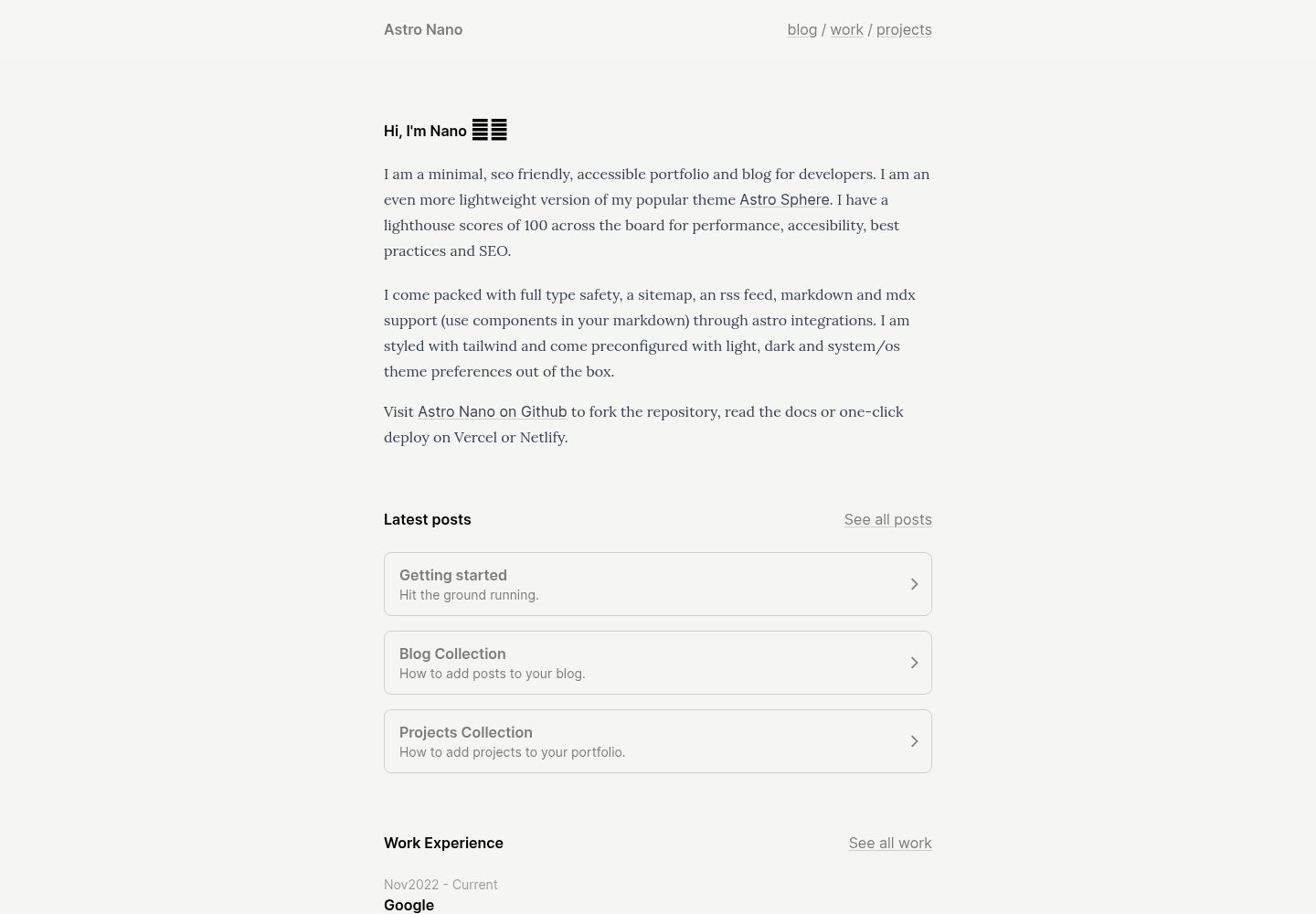
Explore the design
Compare the page layouts and mobile experience. Open any screenshot for a closer look.
Desktop homepage1 / 3
Desktop captureTop of page
Actual screenshot captured by the server browser.
All pages & views 3
Screenshots show visual appearance; interactive behavior may differ.
Recorded 2026-10-05View source
What stands out
A quick read of the recorded project description.
Targets both portfolio and blog content
Includes light/dark themes and animated UI
Automatically generates sitemap and RSS feed
Supports Markdown and MDX, allowing components to be imported in Markdown
Provides one-click deployment entries for Vercel and Netlify
Template Details
Astro Nano is developed by markhorn-dev and is positioned as a static, minimalist portfolio and blog theme; the author describes it as more streamlined than their Astro Sphere. The tech stack is Astro, Tailwind, and TypeScript, with no frontend frameworks. The repository README states it includes responsive layout, accessibility, SEO friendliness, type safety, a minimalist style, light/dark themes, animated UI, Tailwind styling, automatic sitemap and RSS feed generation, and support for Markdown and MDX (components can be imported in Markdown).
The template provides one-click deployment entries for Vercel and Netlify. The README notes that the blog posts in the demo site also serve as documentation and configuration instructions, so configuration must reference the example content in the repository rather than a separate documentation site.
For commands, the project is run from the root directory via npm (or pnpm, yarn, bun, etc.): npm install installs dependencies; npm run dev starts the local development server at localhost:4321, with dev:network for LAN access; npm run sync generates TypeScript types for Astro modules; npm run build outputs the production site to ./dist/; npm run preview and preview:network preview the build locally; npm run astro runs CLI commands such as astro add and astro check; npm run lint and lint:fix run ESLint checks and automatic fixes.
Regarding licensing, the repository uses the MIT license, allowing free use, modification, commercial use, and distribution of this version of the code; when distributing copies or substantial portions of the code, the copyright notice and the full MIT license notice must be retained; the code is provided as is. Third-party assets such as demo images, fonts, and icons must be checked separately under their respective licenses, and external services such as domains and hosting may incur separate charges. The README's claims about perfect Lighthouse scores and local rendering times are the author's own statements and were not independently verified in this material.
AstroPortfolioBlog
Is it right for your project?
Use Cases
- Building a personal portfolio with accompanying blog posts
- Writing and publishing content in Markdown/MDX
- Static sites that need RSS subscription and sitemap
- Lightweight frontend projects where Tailwind is used for custom styling
Suitable For
- Individual developers familiar with Astro and TypeScript
- Freelancers or designers who need a combined portfolio and blog site
- Static site projects that prefer a minimalist style and do not introduce frontend frameworks
Getting started & customization
Use these recorded setup notes alongside the repository instructions for your chosen version.
- 1
Use npm install to install dependencies, and npm run dev to start the development server at localhost:4321
- 2
npm run build outputs the production site to ./dist/, and npm run preview allows local preview of the build result
- 3
For configuration, refer to the demo blog posts in the repository; the README states they serve as documentation
- 4
The code uses the MIT license; when distributing, retain the copyright notice and the full license notice
- 5
Third-party assets such as demo images, fonts, and icons must be checked separately for their licenses
License & source material
Usage conditions & limitations
Free to use · keep license noticeThis entry covers the free version under the MIT license in the public repository; the free scope is the code of this version and does not mean that external services or third-party assets are free.
Must comply with when using
- Free use, modification, commercial use, and distribution of this version of the code are permitted.
- When distributing copies or substantial portions of the code, retain the original author's copyright notice and the full MIT license notice.
- The code is provided as is; warranties and limitations of liability are governed by the original license and applicable law.
Additional costs & items to verify
- Demo images, fonts, icons, and other third-party assets must be checked under their respective licenses and cannot be judged solely by the code's MIT license.
- External services such as domains, hosting, databases, payments, or AI may incur separate charges.
View Original Text Basis
https://github.com/markhorn-dev/astro-nano/blob/main/LICENSEhttps://github.com/markhorn-dev/astro-nano/blob/main/README.mdPermission is hereby granted, free of charge
Original License Text
Compiled by DeepSeek based on repository license and README ·2026-10-05. Results only cover the materials read; dependencies, images, fonts, and subsequent term changes are subject to their respective original texts.
Project checks & description sources
Template Information
- Source platforms
- Astro Themes
- Documentation and maintenance reference score
- More documented · 90 / 100
- Technologies
- Astro
- Website type
- Portfolio · Blog
How this score is calculated
Our heuristic uses license records (up to 30), a demo link (12), a preview (10), stars (15), recorded maintenance (15), description completeness (8), feature records (5) and classification data (5). It is not a code, security or performance test, or a Google score. A link does not establish tested functionality.
What to verify for this project
- Repository update recorded
- 2025-06-16
- Screenshot last checked
- 2026-10-05
A demo link is listed. Check it with your own content and viewport sizes; its presence does not confirm that forms, authentication or payments work.
The catalog identifies Astro as the primary stack. Check the actual dependency manifest and lockfile for versions and hosting requirements. These notes use recorded metadata, not a code audit or a deployment test.
Use a selection guide →How this description was prepared
AI-assisted description based on catalog records and repository material. Repository authors are not automatically the reviewers of this description.
Review declaration: [email protected] · 2026-10-06
Inspect the recorded source material
SHA-256: 0bebf7ad4ce19f95de6e74667603f73a04591f851d7899ad8fe96a55d2370ba8
2026-10-05T18:08:46.993Z
Source file / repository Astro Nano is a static, minimalist, lightweight, lightning fast portfolio and blog theme. Built with Astro, Tailwind and Typescript, an no frameworks. It was designed as an even more minimal theme than my popular theme [Astro Sphere](https://github.com/markhorn-dev/astro-sphere) ## 🚀 Deploy your own [](https://vercel.com/new/clone?repository-url=https://github.com/markhorn-dev/astro-nano) [](https://app.netlify.com/start/deploy?repository=https://github.com/markhorn-dev/astro-nano) ## 📋 Features - ✅ 100/100 Lighthouse performance - ✅ Responsive - ✅ Accessible - ✅ SEO-friendly - ✅ Typesafe - ✅ Minimal style - ✅ Light/Dark Theme - ✅ Animated UI - ✅ Tailwind styling - ✅ Auto generated sitemap - ✅ Auto generated RSS Feed - ✅ Markdown support - ✅ MDX Support (components in your markdown) ## 💯 Lighthouse score  ## 🕊️ Lightweight No frameworks or added bulk ## ⚡︎ Fast Rendered in ~40ms on localhost ## 📄 Configuration The blog posts on the demo serve as the documentation and configuration. ## 💻 Commands All commands are run from the root of the project, from a terminal: Replace npm with your package manager of choice. `npm`, `pnpm`, `yarn`, `bun`, etc | Command | Action | | :------------------------ | :----------------------------------------------- | | `npm install` | Installs dependencies | | `npm run dev` | Starts local dev server at `localhost:4321` | | `npm run dev:network` | Starts local dev server on local network | | `npm run sync` | Generates TypeScript types for all Astro modules.| | `npm run build` | Build your production site to `./dist/` | | `npm run preview` | Preview your build locally, before deploying | | `npm run preview:network` | Preview build on local network | | `npm run astro ...` | Run CLI commands like `astro add`, `astro check` | | `npm run astro -- --help` | Get help using the Astro CLI | | `npm run lint` | Run ESLint | | `npm run lint:fix` | Auto-fix ESLint issues | ## 🏛️ License MIT
Explore similar templates
Compare previews and descriptions within the same stack and category.

astrowind
AstroWind is a free, open-source Astro starter theme using Astro and Tailwind CSS, released under the MIT license.
Astro · Blog

astro-paper
AstroPaper is a minimal, responsive, accessible, and SEO-friendly Astro blog theme. Articles are stored as Markdown/MDX in src/content/posts/, with subdirectories affecting URLs.
Astro · Blog

fuwari
Fuwari is a static blog template built with Astro and Tailwind CSS for personal blogs. It manages posts as Markdown files in src/content/posts/, with frontmatter for title, date, description, cover, tags, categories, draft status, and language.
Astro · Blog

Firefly
Firefly is a clean personal blog theme forked from Astro and Fuwari, offering four background modes, single/double sidebar and list/grid layouts, Pagefind client-side full-text search, and a six-language UI.
Astro · Blog

astro-theme-cactus
Astro Cactus is an Astro-based blog and portfolio theme that uses Markdown/MDX content collections to manage posts, notes, and tags, with frontmatter type-checked by a schema.
Astro · Portfolio

astrofy
Astrofy is a free and open-source personal portfolio website template built with Astro and TailwindCSS, with built-in blog, CV timeline, project showcase, store, and RSS feed modules.
Astro · Portfolio