Redeveloped from the MIT-licensed Lagrange theme, retaining a minimalist positioning
JekyllPortfolioBlog
jekyll-theme-schatten — Jekyll Portfolio Template
By stfab
Schatten is a Jekyll-based blog and personal website theme derived from Len Paul's Lagrange theme under the MIT license, supporting local, Docker, and various static hosting deployments.
Explore the design
Compare the page layouts and mobile experience. Open any screenshot for a closer look.
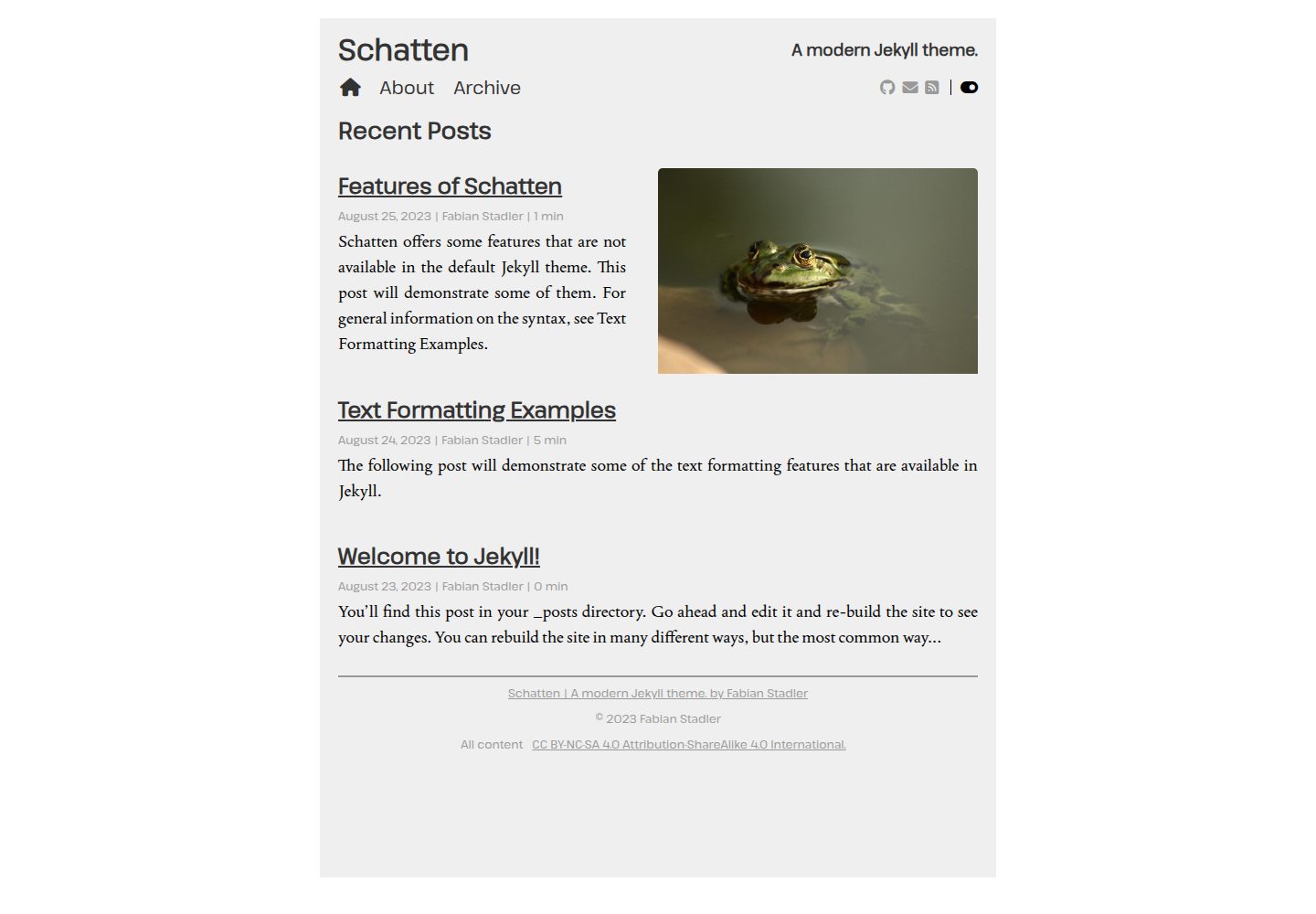
Desktop homepage1 / 3
Desktop captureTop of page
Actual screenshot captured by the server browser.
All pages & views 3
Screenshots show visual appearance; interactive behavior may differ.
Recorded 2026-10-03View source
What stands out
A quick read of the recorded project description.
Supports SASS/SCSS, responsive layout, and a dark mode interface
Provides configurable code highlighting themes
Site settings are centralized in _data/settings.yml, allowing configuration of Disqus comments, Google Analytics, menus, and social media information
Supports local, Docker, and static hosting methods such as DigitalOcean, Netlify, and GitLab Pages
Template Details
Schatten is a Jekyll theme for blogs or personal websites, redeveloped by its author from Len Paul's Lagrange theme (MIT licensed) to add more features and personal style. The theme is positioned as minimalist; the author explicitly states it is not intended to become a feature-heavy theme.
The theme's goals include SEO-related settings, SASS/SCSS support, responsive design, a dark mode interface, and configurable code highlighting themes. For content organization, posts go in the _posts directory, menu pages in the menu directory, site-level configuration in _config.yml, and site settings (such as Disqus comments, Google Analytics, menu items, and social media information) in _data/settings.yml. Posts use YAML front matter to specify layout, title, author, categories, tags, image, and image_title, where tags are used to generate related posts.
The runtime environment requires Ruby and Bundler, with Jekyll version 3.9.3 or higher. Locally, run bundle install then bundle exec jekyll serve; a Docker method is also provided (enter the docker directory and run docker compose up).
Deployment notes: the theme is incompatible with GitHub Pages due to its strict plugin policy; to use it on GitHub Pages, you must avoid using the toc plugin in posts or pages, and the archives plugin will not work. Full functionality requires hosting on platforms such as DigitalOcean App Platform, Netlify, or GitLab Pages, or building and deploying to static storage like S3 or Azure Blob Storage. The README provides an example build command for DigitalOcean App Platform.
JekyllPortfolioBlog
Is it right for your project?
Use Cases
- Building a personal blog and publishing posts with categories, tags, and images
- Creating a personal website with standalone pages maintained through the menu directory
- A writing site that needs dark mode and a responsive reading experience
- Deploying a static site on DigitalOcean App Platform, Netlify, or GitLab Pages
Suitable For
- Users who write with Jekyll and are willing to configure _config.yml and _data/settings.yml themselves
- Personal site authors who need a minimalist blog theme and do not want many built-in features
- Developers who can set up a local build environment using Ruby, Bundler, or Docker
- Users planning to deploy to static hosting platforms other than GitHub Pages
Getting started & customization
Use these recorded setup notes alongside the repository instructions for your chosen version.
- 1
Requires Ruby and Bundler; Jekyll version 3.9.3 or higher is required.
- 2
Local run: after cloning the repository, run bundle install, then bundle exec jekyll serve, accessible by default at http://localhost:4000; adding --incremental enables incremental rebuilds when files change.
- 3
Docker run: enter the docker directory and run docker compose up.
- 4
GitHub Pages is only partially compatible: using the toc plugin causes issues, and the archives plugin does not work; full functionality requires deployment to another platform.
- 5
When starting from scratch, delete the sample files in _posts, assets/img, and menu, and replace README.md and favicon.ico.
License & source material
Usage conditions & limitations
Free to use · keep license noticeThis entry covers the free version in the public repository under the MIT license; the free scope is the code of that version and does not mean external services or third-party assets are free.
Must comply with when using
- Free use, modification, commercial use, and distribution of this version's code are permitted.
- When distributing copies or substantial portions of the code, retain the original author's copyright notice and the full MIT license notice.
- The code is provided as is; warranties and limitations of liability are governed by the original license and applicable law.
Additional costs & items to verify
- The theme is incompatible with GitHub Pages: its plugin policy is strict, using the toc plugin causes issues, and the archives plugin does not work. To use it on GitHub Pages, you must avoid using the toc plugin in posts or pages, and the archives plugin cannot be used.
- To use the theme's full functionality, it must be hosted on a platform other than GitHub Pages, such as DigitalOcean, Netlify, or GitLab Pages, or built and deployed to cloud storage like Amazon S3 or Azure Blob Storage.
- Running the theme requires a local Ruby and Bundler environment, with Jekyll version 3.9.3 or higher; install Ruby first, then run gem install bundler.
- Disqus comments and Google Analytics can be configured in site settings; these are third-party external services that require registering the respective accounts beforehand and may be subject to their terms of service and fee policies.
- Demo images, fonts, icons, and other third-party assets must be checked against their respective licenses and cannot be judged solely by the code's MIT license.
- External services such as domains, hosting, databases, payments, or AI may incur additional charges.
View Original Text Basis
Permission is hereby granted, free of charge
Original License Text
this theme is not compatible with GitHub Pages as they have a very strict plugin policy
Original README
If you want to use this theme to its fullest, you must host your site on another platform
Original README
you need an environment with Ruby and Bundler installed
Original README
https://github.com/stfab/jekyll-theme-schatten/blob/main/LICENSE.mdhttps://github.com/stfab/jekyll-theme-schatten/blob/main/README.mdsetting Disqus comments, Google Analytics
Original README
Compiled by DeepSeek based on repository license and README ·2026-10-03. Results only cover the materials read; dependencies, images, fonts, and subsequent term changes are subject to their respective original texts.
Project checks & description sources
Template Information
- Source platforms
- GitHub
- Documentation and maintenance reference score
- Partly documented · 70 / 100
- Technologies
- Jekyll
- Website type
- Portfolio · Blog
How this score is calculated
Our heuristic uses license records (up to 30), a demo link (12), a preview (10), stars (15), recorded maintenance (15), description completeness (8), feature records (5) and classification data (5). It is not a code, security or performance test, or a Google score. A link does not establish tested functionality.
What to verify for this project
- Repository update recorded
- 2023-09-14
- Screenshot last checked
- 2026-10-03
A demo link is listed. Check it with your own content and viewport sizes; its presence does not confirm that forms, authentication or payments work.
The catalog identifies Jekyll as the primary stack. Check the actual dependency manifest and lockfile for versions and hosting requirements. These notes use recorded metadata, not a code audit or a deployment test.
Use a selection guide →How this description was prepared
AI-assisted description based on catalog records and repository material. Repository authors are not automatically the reviewers of this description.
Review declaration: [email protected] · 2026-10-04
Inspect the recorded source material
SHA-256: bc5dd059adf7f5a372a1c1efa21ceb12ef2acdaa04f08dcec2a5a9aa267a8d6f
2026-10-03T14:20:14.523Z
Source file / repository# jekyll-theme-schatten Schatten is a modern Jekyll theme for blogs or personal websites. See the [demo](https://schatten-ioch6.ondigitalocean.app/) for a live example.  ## Attribution This theme is based on [Len Paul's theme Lagrange](https://github.com/LeNPaul/Lagrange) published under the MIT License. In order to implement more features and add my own style, I developed this theme. ## Intention Schatten's original goal is to offer the following features: * SEO features * SASS/SCSS support * Responsive design * Modern UI with e.g. dark mode * Configurable code themes ## Requirements * Jekyll 3.9.3 or higher ## Supported Platforms * GitHub Pages (only partially, some plugins are not supported) * DigitalOcean App Platform * Netlify * GitLab Pages * Any static site hoster when building locally ## Installation In order to run this theme, you need an environment with Ruby and Bundler installed. If you don't have Ruby installed, you can follow the instructions [here](https://www.ruby-lang.org/en/documentation/installation/). After you have Ruby installed, you can install Bundler with `gem install bundler`. ### Local Installation To install and run this theme locally, clone this repository to your machine, `cd` into the directory, and run `bundle install` to install the necessary dependencies. Then, run `bundle exec jekyll serve` to start the Jekyll server. You should see the site locally at [http://localhost:4000](http://localhost:4000). In order to server this page incrementally, you can run `bundle exec jekyll serve --incremental`. This will rebuild the site when a file is changed. ### Docker You can also run this theme in a Docker container. Clone the repo a machine with Docker installed, `cd` into the docker directory, and run `docker compose up`. You should see the site locally at [http://localhost:4000](http://localhost:4000). ### Cloud Deployment Note that this theme is not compatible with GitHub Pages as they have a very strict plugin policy. If you want to use this theme on GitHub Pages, you must not use the toc plugin in any of your posts/pages and the archives plugin won't work as well. If you want to use this theme to its fullest, you must host your site on another platform, such as DigitalOcean, Netlify, or GitLab Pages. You can also host your blog on a cloud file storage service such as Amazon S3 or Azure Blob Storage. #### DigitalOcean If you want to host your site on DigitalOcean, you can use the [DigitalOcean App Platform](https://www.digitalocean.com/products/app-platform/). Simply create a new app, select your GitHub repository and chose to deploy as a static site. You can then configure the build command to be `bundle exec jekyll build -d public` and the publish directory to be autodiscovered. You can then deploy your site with a single click. Everytime you push to your repository, the site will be rebuilt and redeployed. ### Starting From Scratch To completely start from scratch, simply delete all the files in the `_posts`, `assets/img`, and `menu` folder, and add your own content. You may also replace the `README.md` file with your own README. Everything in the `_data` folder and `_config.yml` file can be edited to suit your needs. You may also add/change the `favicon.ico` file to your own favicon. ## Configuration ### Site Variables To change site build settings, edit the `_config.yml` file found in the root of your repository, which you can tweak however you like. More information on configuration settings and plugins can be found on [the Jekyll documentation site](https://jekyllrb.com/docs/configuration/). This is also where you will be able to customize the title, description, and the author/owner of your site. In the `settings.yml` file found in the `_data` folder, you will be able to customize your site settings, such as setting Disqus comments, Google Analytics, what shows up in your menu, and social media information. ### Adding Menu Pages The menu pages are found in the `menu` folder in the root directory, and can be added to your menu in the `settings.yml` file. ### Posts You will find example posts in your `_posts` directory. Go ahead and edit any post and re-build the site to see your changes. You can rebuild the site in many different ways, but the most common way is to run `jekyll serve`, which launches a web server and auto-regenerates your site when a file is updated. To add new posts, simply add a file in the `_posts` directory that follows the convention of `YYYY-MM-DD-name-of-post.md` and includes the necessary front matter. Take a look at any sample post to get an idea about how it works. ### YAML Front Block Matter The recommended YAML front block is: ``` --- layout: title: author: categories: tags: [] image: image_title: --- ``` `layout` specifies which layout to use, `title` is the page or post title, `categories` can be used to better organize your posts, `tags` are used when generating related posts based on the topic of the post, and `image` specifies which images to use. `image_title` adds a subtitle to the image of the post. ## Jekyll Check out the [Jekyll docs][jekyll-docs] for more info on how to get the most out of Jekyll. File all bugs/feature requests at [Jekyll's GitHub repo][jekyll-gh]. If you have questions, you can ask them on [Jekyll Talk][jekyll-talk]. [jekyll-docs]: http://jekyllrb.com/docs/home [jekyll-gh]: https://github.com/jekyll/jekyll [jekyll-talk]: https://talk.jekyllrb.com/ ## Contributing/Feature Requests If you would like to make a feature request or report a bug or typo in the documentation, submit a GitHub issue. To contribute, create a fork of this repo and make a pull request from a new feature branch to the official repo's main branch. Bug fixing is always welcome, for feature requests please open an issue first to discuss what you would like to add. Since the goal of this theme is to be minimalistic, I do not intend to make it feature rich.
Explore similar templates
Compare previews and descriptions within the same stack and category.

al-folio
A Jekyll academic homepage theme for scholars and researchers, with a clean responsive design and out-of-the-box support for publication lists, project showcases, CVs, and blogs.
Jekyll · Portfolio

minimal-mistakes
Minimal Mistakes is a two-column Jekyll theme for personal sites, blogs, project documentation, or portfolios.
Jekyll · Portfolio

Beautiful Jekyll
Beautiful Jekyll is a mature, easy-to-use Jekyll blog theme maintained by Dean Attali since 2015, with over 50,000 users.
Jekyll · Blog

jekyll-TeXt-theme
A customizable Jekyll theme for personal sites, team sites, blogs, projects, and documentation.
Jekyll · Blog

startbootstrap-clean-blog-jekyll
The official Jekyll version of Start Bootstrap's Clean Blog theme, offering a blog home page, about page, contact page, and sample post pages, with a Formspree-powered contact form.
Jekyll · Blog

So Simple
A minimal reading-oriented Jekyll theme by Michael Rose for personal blogs, portfolios, and long-form reading. It offers multiple layouts, microformat markup, Disqus comments, Google Analytics, Jekyll SEO Tag, three skins, and aggregation by year, category, and tag with a grid view.
Jekyll · Blog