
Turborepo monorepo with apps and packages separated, each application independently deployable
Next.jsReactStarter
next-forge — Next.js Starter Template
By vercel
next-forge is a Turborepo template maintained by Vercel for building Next.js SaaS applications, with multiple independently deployable apps and shared packages built in.
Explore the design
Compare the page layouts and mobile experience. Open any screenshot for a closer look.
Desktop homepage1 / 2
Desktop captureTop of page
Actual screenshot captured by the server browser.
All pages & views 2
Screenshots show visual appearance; interactive behavior may differ.
Recorded 2026-09-30View source
What stands out
A quick read of the recorded project description.
Six built-in applications: web, app, api, docs, email, and storybook
Shared packages cover foundational capabilities such as design system, database, and authentication
Integrates common SaaS services including Clerk authentication, Stripe payments, and Resend email
Includes modules for analytics, observability, security, CMS, SEO, AI, webhooks, and more
MIT licensed, free to use, modify, commercialize, and distribute
Template Details
next-forge is a Turborepo-based Next.js application template positioned as a starting point for building SaaS products. The repository is organized as a monorepo: apps/ contains six independently deployable applications—web (marketing site, port 3001), app (main application, port 3000), api, docs, email, and storybook; packages/ provides shared packages such as design-system, database, and auth for reuse across applications.
Built-in features cover authentication (Clerk), database (type-safe ORM and migrations), payments (Stripe subscriptions), email (Resend with React Email templates), analytics and observability (Google Analytics, PostHog, Sentry, BetterStack), security (Arcjet, rate limiting, security response headers), CMS, SEO, AI tools, webhooks, real-time collaboration, feature flags, scheduled tasks, storage, internationalization, and in-app notifications. The marketing site uses Tailwind CSS and TWBlocks, and the documentation site is powered by Mintlify.
Prerequisites are Node.js 20+ and Bun (or npm/yarn/pnpm); testing Stripe webhooks locally requires the Stripe CLI. Create a project with npx next-forge@latest init, then configure environment variables and register accounts for services such as Clerk, Stripe, and Resend. The code is MIT licensed and may be used, modified, commercialized, and distributed free of charge, provided copyright and license notices are retained; third-party assets such as demo images, fonts, and icons, as well as external services for domains, hosting, databases, payments, and AI, require separate license and cost verification.
Next.jsReactStarter
Is it right for your project?
Use Cases
- Building a SaaS product from scratch that needs authentication, subscription payments, and email capabilities
- Multi-application projects that require separate releases for a marketing site, main application, API, and documentation site
- Projects that want to manage multiple Next.js applications and shared packages under a single Turborepo
- Projects that need pre-integrated analytics, error tracking, rate limiting, and security response headers
Suitable For
- Developers familiar with Next.js and React who are preparing to build a SaaS starting point
- Teams that accept a monorepo structure and are willing to configure external service accounts
- Projects that need independent deployment of multiple applications and a shared design system
- Users who want to freely modify and distribute code under the MIT license
Getting started & customization
Use these recorded setup notes alongside the repository instructions for your chosen version.
- 1
Requires Node.js 20+ and uses Bun or npm/yarn/pnpm as the package manager
- 2
Create a project with npx next-forge@latest init
- 3
Configure environment variables and register service accounts such as Clerk, Stripe, and Resend
- 4
Testing Stripe webhooks locally requires installing the Stripe CLI
- 5
See the official documentation at next-forge.com/docs for detailed steps
License & source material
Usage conditions & limitations
Free to use · keep license noticeThis entry covers the free version in the public repository under the MIT license; the free scope applies to that version's code and does not mean external services or third-party assets are free.
Must comply with when using
- The code of this version may be used, modified, commercialized, and distributed free of charge.
- When distributing copies or substantial portions of the code, retain the original author's copyright notice and the full MIT license notice.
- The code is provided as is; warranties and limitations of liability are governed by the original license and applicable law.
Additional costs & items to verify
- Using the template requires registering and configuring third-party service accounts such as Clerk, Stripe, and Resend, which may incur costs or be subject to their own terms.
- Testing Stripe webhooks locally requires additionally installing the Stripe CLI tool.
- The runtime requires Node.js 20 or later and a package manager such as Bun or npm/yarn/pnpm.
- Demo images, fonts, icons, and other third-party assets must be checked against their respective licenses and cannot be judged solely by the code's MIT license.
- External services for domains, hosting, databases, payments, or AI may incur separate charges.
View Original Text Basis
Permission is hereby granted, free of charge
Original License Text
Set up required service accounts (Clerk, Stripe, Resend, etc.)
Original README
[Stripe CLI](https://docs.stripe.com/stripe-cli) for local webhook testing
Original README
https://github.com/vercel/next-forge/blob/main/license.mdhttps://github.com/vercel/next-forge/blob/main/README.md- Node.js 20+ - [Bun](https://bun.sh) (or npm/yarn/pnpm)
Original README
Compiled by DeepSeek based on repository license and README ·2026-09-30. Results only cover the materials read; dependencies, images, fonts, and subsequent term changes are subject to their respective original texts.
Project checks & description sources
Template Information
- Source platforms
- GitHub
- Documentation and maintenance reference score
- More documented · 100 / 100
- Technologies
- Next.js · React
- Website type
- Starter
How this score is calculated
Our heuristic uses license records (up to 30), a demo link (12), a preview (10), stars (15), recorded maintenance (15), description completeness (8), feature records (5) and classification data (5). It is not a code, security or performance test, or a Google score. A link does not establish tested functionality.
What to verify for this project
- Repository update recorded
- 2026-05-28
- Screenshot last checked
- 2026-09-30
A demo link is listed. Check it with your own content and viewport sizes; its presence does not confirm that forms, authentication or payments work.
The catalog identifies Next.js as the primary stack. Check the actual dependency manifest and lockfile for versions and hosting requirements. These notes use recorded metadata, not a code audit or a deployment test.
Use a selection guide →How this description was prepared
AI-assisted description based on catalog records and repository material. Repository authors are not automatically the reviewers of this description.
Automatically checked against source and license rules; no manual editorial review.
Inspect the recorded source material
SHA-256: fba8418b2e950bce1be84f88399b0e286bd407cba8c62423daff1dca6aab3059
2026-09-30T08:02:55.463Z
Source file / repository# ▲ / next-forge
**Production-grade Turborepo template for Next.js apps.**
<div>
<img src="https://img.shields.io/npm/dy/next-forge" alt="" />
<img src="https://img.shields.io/npm/v/next-forge" alt="" />
<img src="https://img.shields.io/github/license/vercel/next-forge" alt="" />
</div>
## Overview
[next-forge](https://github.com/vercel/next-forge) is a production-grade [Turborepo](https://turborepo.com) template for [Next.js](https://nextjs.org/) apps. It's designed to be a comprehensive starting point for building SaaS applications, providing a solid, opinionated foundation with minimal configuration required.
Built on a decade of experience building web applications, next-forge balances speed and quality to help you ship thoroughly-built products faster.
### Philosophy
next-forge is built around five core principles:
- **Fast** — Quick to build, run, deploy, and iterate on
- **Cheap** — Free to start with services that scale with you
- **Opinionated** — Integrated tooling designed to work together
- **Modern** — Latest stable features with healthy community support
- **Safe** — End-to-end type safety and robust security posture
## Demo
Experience next-forge in action:
- [Web](https://demo.next-forge.com) — Marketing website
- [App](https://app.demo.next-forge.com) — Main application
- [Storybook](https://storybook.demo.next-forge.com) — Component library
- [API](https://api.demo.next-forge.com/health) — API health check
## Features
next-forge comes with batteries included:
### Apps
- **Web** — Marketing site built with Tailwind CSS and TWBlocks
- **App** — Main application with authentication and database integration
- **API** — RESTful API with health checks and monitoring
- **Docs** — Documentation site powered by Mintlify
- **Email** — Email templates with React Email
- **Storybook** — Component development environment
### Packages
- **Authentication** — Powered by [Clerk](https://clerk.com)
- **Database** — Type-safe ORM with migrations
- **Design System** — Comprehensive component library with dark mode
- **Payments** — Subscription management via [Stripe](https://stripe.com)
- **Email** — Transactional emails via [Resend](https://resend.com)
- **Analytics** — Web ([Google Analytics](https://developers.google.com/analytics)) and product ([Posthog](https://posthog.com))
- **Observability** — Error tracking ([Sentry](https://sentry.io)), logging, and uptime monitoring ([BetterStack](https://betterstack.com))
- **Security** — Application security ([Arcjet](https://arcjet.com)), rate limiting, and secure headers
- **CMS** — Type-safe content management for blogs and documentation
- **SEO** — Metadata management, sitemaps, and JSON-LD
- **AI** — AI integration utilities
- **Webhooks** — Inbound and outbound webhook handling
- **Collaboration** — Real-time features with avatars and live cursors
- **Feature Flags** — Feature flag management
- **Cron** — Scheduled job management
- **Storage** — File upload and management
- **Internationalization** — Multi-language support
- **Notifications** — In-app notification system
## Getting Started
### Prerequisites
- Node.js 20+
- [Bun](https://bun.sh) (or npm/yarn/pnpm)
- [Stripe CLI](https://docs.stripe.com/stripe-cli) for local webhook testing
### Installation
Create a new next-forge project:
```sh
npx next-forge@latest init
```
### Setup
1. Configure your environment variables
2. Set up required service accounts (Clerk, Stripe, Resend, etc.)
3. Run the development server
For detailed setup instructions, read the [documentation](https://www.next-forge.com/docs).
## Structure
next-forge uses a monorepo structure managed by Turborepo:
```
next-forge/
├── apps/ # Deployable applications
│ ├── web/ # Marketing website (port 3001)
│ ├── app/ # Main application (port 3000)
│ ├── api/ # API server
│ ├── docs/ # Documentation
│ ├── email/ # Email templates
│ └── storybook/ # Component library
└── packages/ # Shared packages
├── design-system/
├── database/
├── auth/
└── ...
```
Each app is self-contained and independently deployable. Packages are shared across apps for consistency and maintainability.
## Documentation
Full documentation is available at [next-forge.com/docs](https://www.next-forge.com/docs), including:
- Detailed setup guides
- Package documentation
- Migration guides for swapping providers
- Deployment instructions
- Examples and recipes
## Contributing
We welcome contributions! See the [contributing guide](https://github.com/vercel/next-forge/blob/main/.github/CONTRIBUTING.md) for details.
## Contributors
<a href="https://github.com/vercel/next-forge/graphs/contributors">
<img src="https://contrib.rocks/image?repo=vercel/next-forge" />
</a>
Made with [contrib.rocks](https://contrib.rocks).
## License
MIT
Explore similar templates
Compare previews and descriptions within the same stack and category.

Next.js SaaS Starter
The official Next.js SaaS starter template, integrating email/password authentication, Stripe Checkout subscriptions, a dashboard with user/team CRUD, basic Owner/Member RBAC, and activity logging.
Next.js · SaaS

Next.js Commerce
Vercel's officially maintained Next.js App Router ecommerce starter with deep Shopify integration, offering a complete product catalog, cart, and checkout flow. Core logic is modular for swapping backends, and community provider versions exist for BigCommerce, Medusa, and Saleor.
Next.js · E-commerce

Next-js-Boilerplate
A developer-first Next.js 16 starter with Tailwind CSS 4 and TypeScript, supporting both App Router and Page Router.
Next.js · Starter

tailwind-nextjs-starter-blog
A Next.js and Tailwind CSS blog starter template using Contentlayer for Markdown/MDX, with built-in SEO, code highlighting, and tags. It targets personal technical blogs and migration from Jekyll/Hugo to React, and supports one-click Vercel deployment.
Next.js · Blog

SaaS-Boilerplate
SaaS-Boilerplate is an open-source SaaS starter template built with Next.js App Router, React 19, TypeScript, Tailwind CSS, and Shadcn UI.
Next.js · SaaS
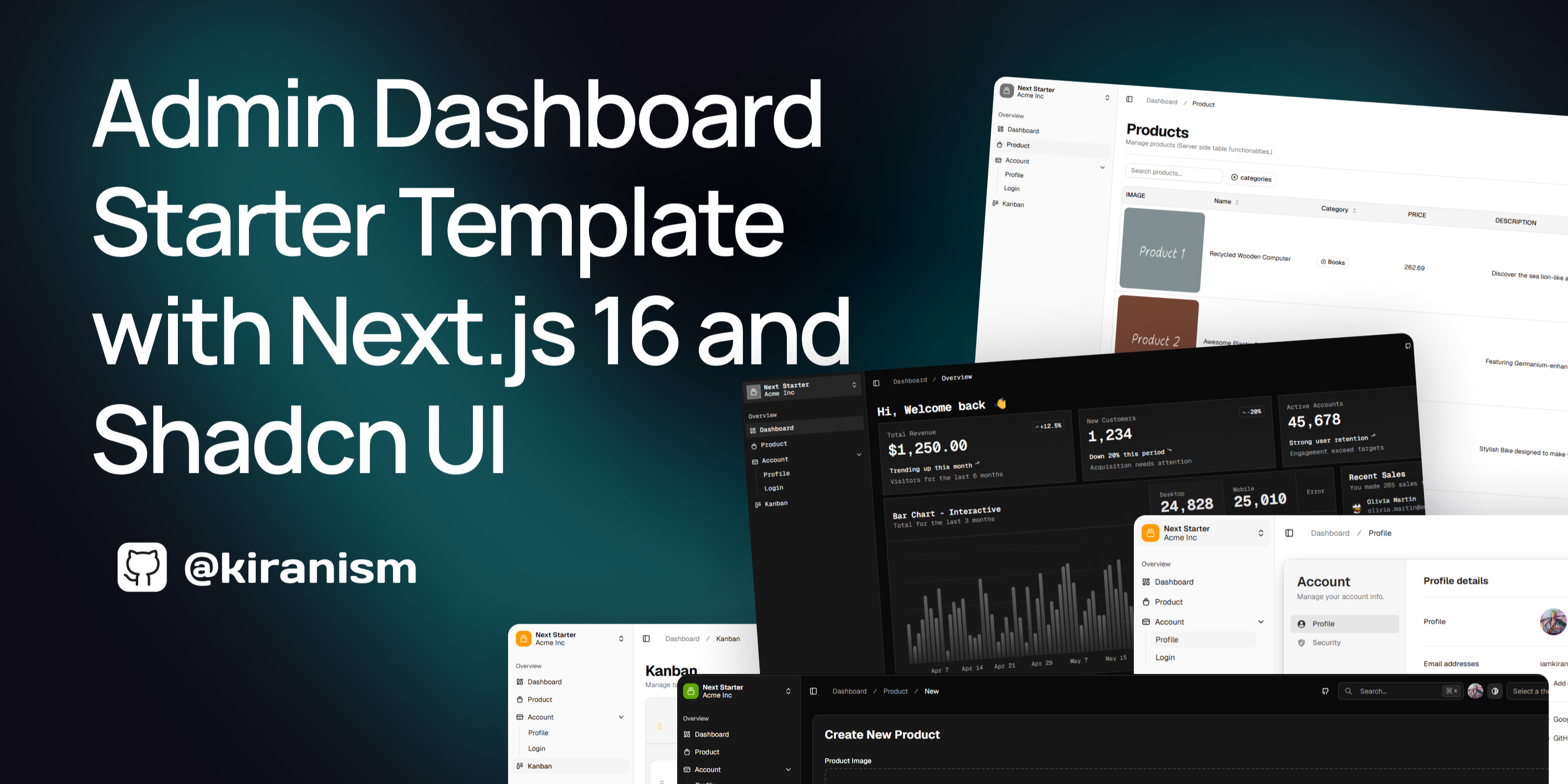
next-shadcn-dashboard-starter
An MIT-licensed admin dashboard starter built with Next.js 16, shadcn/ui, Tailwind CSS v4, and TypeScript.
Next.js · Admin dashboard