Built with Astro and styled using Tailwind CSS
AstroBlog
tamako — Astro Blog Template
By xrafece
tamako is a static blog template built on Astro and the Fuwari theme, released under the MIT license with an accessible online demo.
Explore the design
Compare the page layouts and mobile experience. Open any screenshot for a closer look.
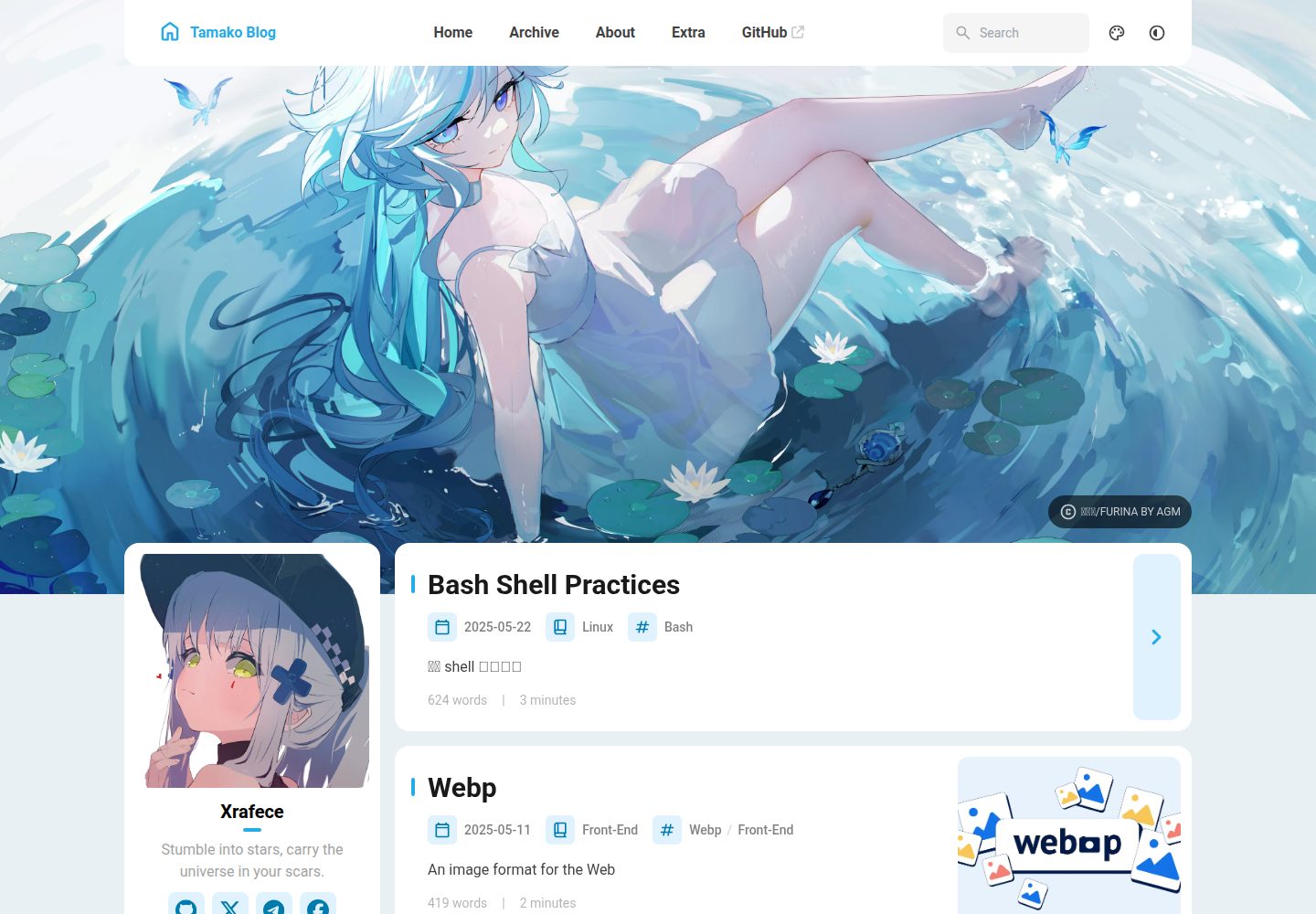
Desktop homepage1 / 3
Desktop captureTop of page
Actual screenshot captured by the server browser.
All pages & views 3
Screenshots show visual appearance; interactive behavior may differ.
Recorded 2026-10-12View source
What stands out
A quick read of the recorded project description.
Follows the Fuwari theme, offering light and dark modes
Supports customizable theme colors and banner images
Includes built-in search; comments and table of contents are not yet complete in the feature list
Posts managed via Markdown frontmatter for title, tags, categories, draft status, and language
Provides online demo pages for desktop and mobile
Template Details
tamako is a static blog template built with Astro, following the Fuwari theme for its visuals and structure. Both the repository description and README state that it is positioned as a personal blog site. The demo is available at tamako-blog.netlify.app, where you can view actual screenshots of the desktop homepage, mobile homepage, and inner pages.
The template uses Astro and Tailwind CSS. The README lists implemented capabilities including smooth animations and page transitions, light/dark mode, customizable theme colors and banners, responsive layout, and search; comments and table of contents (TOC) are marked as incomplete in the feature list. Posts are stored as Markdown content collections in src/content/posts/, with frontmatter declaring title, publication date, description, cover image, tags, categories, draft status, and language.
Usage involves generating a new repository from the Fuwari template or forking this repository, cloning locally and installing dependencies, editing src/config.ts to customize the site, creating posts with pnpm new-post, and modifying the site configuration in astro.config.mjs before deployment. The repository is under the MIT license, allowing free use, modification, commercial use, and distribution of this version of the code, but third-party assets such as demo images, fonts, and icons require separate license verification. The README also mentions the author's plan to release a new theme called Furina, which is a future plan and not included in the current template.
AstroBlog
Is it right for your project?
Use Cases
- Building a personal static blog with Markdown writing
- A blog site requiring light/dark mode and responsive layout
- Customizing further based on the Fuwari theme
- Deploying to static hosting platforms such as Vercel, Netlify, or GitHub Pages
Suitable For
- Front-end developers familiar with Astro or willing to follow the README steps
- Personal blog authors needing customizable theme colors and banners
- Sites organizing posts as Markdown content collections and archiving by tags and categories
- Users who accept that comments and table of contents need to be added themselves or await future updates
Getting started & customization
Use these recorded setup notes alongside the repository instructions for your chosen version.
- 1
Generate a new repository from the Fuwari template or fork this repository
- 2
After cloning, run pnpm install and pnpm add sharp to install dependencies; if pnpm is not installed, first run npm install -g pnpm
- 3
Edit src/config.ts to customize the blog configuration
- 4
Create posts with pnpm new-post <filename> and edit them in src/content/posts/
- 5
Before deployment, modify the site configuration in astro.config.mjs, then publish according to the Astro deployment guide
License & source material
Usage conditions & limitations
Free to use · keep license noticeThis entry covers the free version under the MIT license in the public repository; the free scope applies to this version of the code and does not imply that external services or third-party assets are free.
Must comply with when using
- Free use, modification, commercial use, and distribution of this version of the code are permitted.
- When distributing copies or substantial portions of the code, retain the original author's copyright notice and the full MIT license notice.
- The code is provided as is; warranties and limitations of liability are governed by the original license and applicable law.
Additional costs & items to verify
- Demo images, fonts, icons, and other third-party assets require separate license verification and cannot be judged solely by the code's MIT license.
- External services such as domains, hosting, databases, payments, or AI may incur additional charges.
- Local use requires installing pnpm first and additionally running pnpm add sharp to install the sharp dependency; otherwise, the build will not work properly.
- Before deployment, the site configuration in astro.config.mjs must be manually modified; otherwise, the site information will be incorrect.
- The README mentions an upcoming new theme called Furina, which is a future plan and not included in the current template.
View Original Text Basis
Permission is hereby granted, free of charge
Original License Text
run `pnpm install` AND `pnpm add sharp` to install dependencies
Original README
You need to edit the site configuration in `astro.config.mjs` before deployment.
Original README
https://github.com/xrafece/tamako/blob/main/LICENSEhttps://github.com/xrafece/tamako/blob/main/README.mdA new theme named by `Furina` will comming soon.
Original README
Compiled by DeepSeek based on repository license and README ·2026-10-12. Results only cover the materials read; dependencies, images, fonts, and subsequent term changes are subject to their respective original texts.
Project checks & description sources
Template Information
- Source platforms
- GitHub
- Documentation and maintenance reference score
- More documented · 83 / 100
- Technologies
- Astro
- Website type
- Blog
How this score is calculated
Our heuristic uses license records (up to 30), a demo link (12), a preview (10), stars (15), recorded maintenance (15), description completeness (8), feature records (5) and classification data (5). It is not a code, security or performance test, or a Google score. A link does not establish tested functionality.
What to verify for this project
- Repository update recorded
- 2026-03-09
- Screenshot last checked
- 2026-10-12
A demo link is listed. Check it with your own content and viewport sizes; its presence does not confirm that forms, authentication or payments work.
The catalog identifies Astro as the primary stack. Check the actual dependency manifest and lockfile for versions and hosting requirements. These notes use recorded metadata, not a code audit or a deployment test.
Use a selection guide →How this description was prepared
AI-assisted description based on catalog records and repository material. Repository authors are not automatically the reviewers of this description.
Review declaration: [email protected] · 2026-10-13
Inspect the recorded source material
SHA-256: 74bb1ef8440ed8b37591fc0ee0993ceee807af5430089f43b974ab56c5907a6f
2026-10-12T18:36:34.517Z
Source file / repository# 🍥Tamako-blog A static blog powered by [Astro](https://astro.build) and themed by [Fuwari](https://github.com/saicaca/fuwari). > README version: `2025-05-13` ## ✨ Features - [x] Built with [Astro](https://astro.build) and [Tailwind CSS](https://tailwindcss.com) - [x] Smooth animations and page transitions - [x] Light / dark mode - [x] Customizable theme colors & banner - [x] Responsive design - [ ] Comments - [x] Search - [ ] TOC ## 🚀 How to Use 1. [Generate a new repository](https://github.com/saicaca/fuwari/generate) from this template or fork this repository. 2. To edit your blog locally, clone your repository, run `pnpm install` AND `pnpm add sharp` to install dependencies. - Install [pnpm](https://pnpm.io) `npm install -g pnpm` if you haven't. 3. Edit the config file `src/config.ts` to customize your blog. 4. Run `pnpm new-post <filename>` to create a new post and edit it in `src/content/posts/`. 5. Deploy your blog to Vercel, Netlify, GitHub Pages, etc. following [the guides](https://docs.astro.build/en/guides/deploy/). You need to edit the site configuration in `astro.config.mjs` before deployment. ## ⚙️ Frontmatter of Posts ```yaml --- title: My First Blog Post published: 2023-09-09 description: This is the first post of my new Astro blog. image: ./cover.jpg tags: [Foo, Bar] category: Front-end draft: false lang: jp # Set only if the post's language differs from the site's language in `config.ts` --- ``` ## 🧞 Commands All commands are run from the root of the project, from a terminal: | Command | Action | |:------------------------------------|:-------------------------------------------------| | `pnpm install` AND `pnpm add sharp` | Installs dependencies | | `pnpm dev` | Starts local dev server at `localhost:4321` | | `pnpm build` | Build your production site to `./dist/` | | `pnpm preview` | Preview your build locally, before deploying | | `pnpm new-post <filename>` | Create a new post | | `pnpm astro ...` | Run CLI commands like `astro add`, `astro check` | | `pnpm astro --help` | Get help using the Astro CLI | ## New Theme comming A new theme named by `Furina` will comming soon. Furina Forever!
Explore similar templates
Compare previews and descriptions within the same stack and category.

astrowind
AstroWind is a free, open-source Astro starter theme using Astro and Tailwind CSS, released under the MIT license.
Astro · Blog

astro-paper
AstroPaper is a minimal, responsive, accessible, and SEO-friendly Astro blog theme. Articles are stored as Markdown/MDX in src/content/posts/, with subdirectories affecting URLs.
Astro · Blog

fuwari
Fuwari is a static blog template built with Astro and Tailwind CSS for personal blogs. It manages posts as Markdown files in src/content/posts/, with frontmatter for title, date, description, cover, tags, categories, draft status, and language.
Astro · Blog

Firefly
Firefly is a clean personal blog theme forked from Astro and Fuwari, offering four background modes, single/double sidebar and list/grid layouts, Pagefind client-side full-text search, and a six-language UI.
Astro · Blog

astro-theme-cactus
Astro Cactus is an Astro-based blog and portfolio theme that uses Markdown/MDX content collections to manage posts, notes, and tags, with frontmatter type-checked by a schema.
Astro · Portfolio

astrofy
Astrofy is a free and open-source personal portfolio website template built with Astro and TailwindCSS, with built-in blog, CV timeline, project showcase, store, and RSS feed modules.
Astro · Portfolio