Minimalist blog template built with Astro and Tailwind CSS
AstroBlog
kiri — Astro Blog Template
By yogeshbhutkar
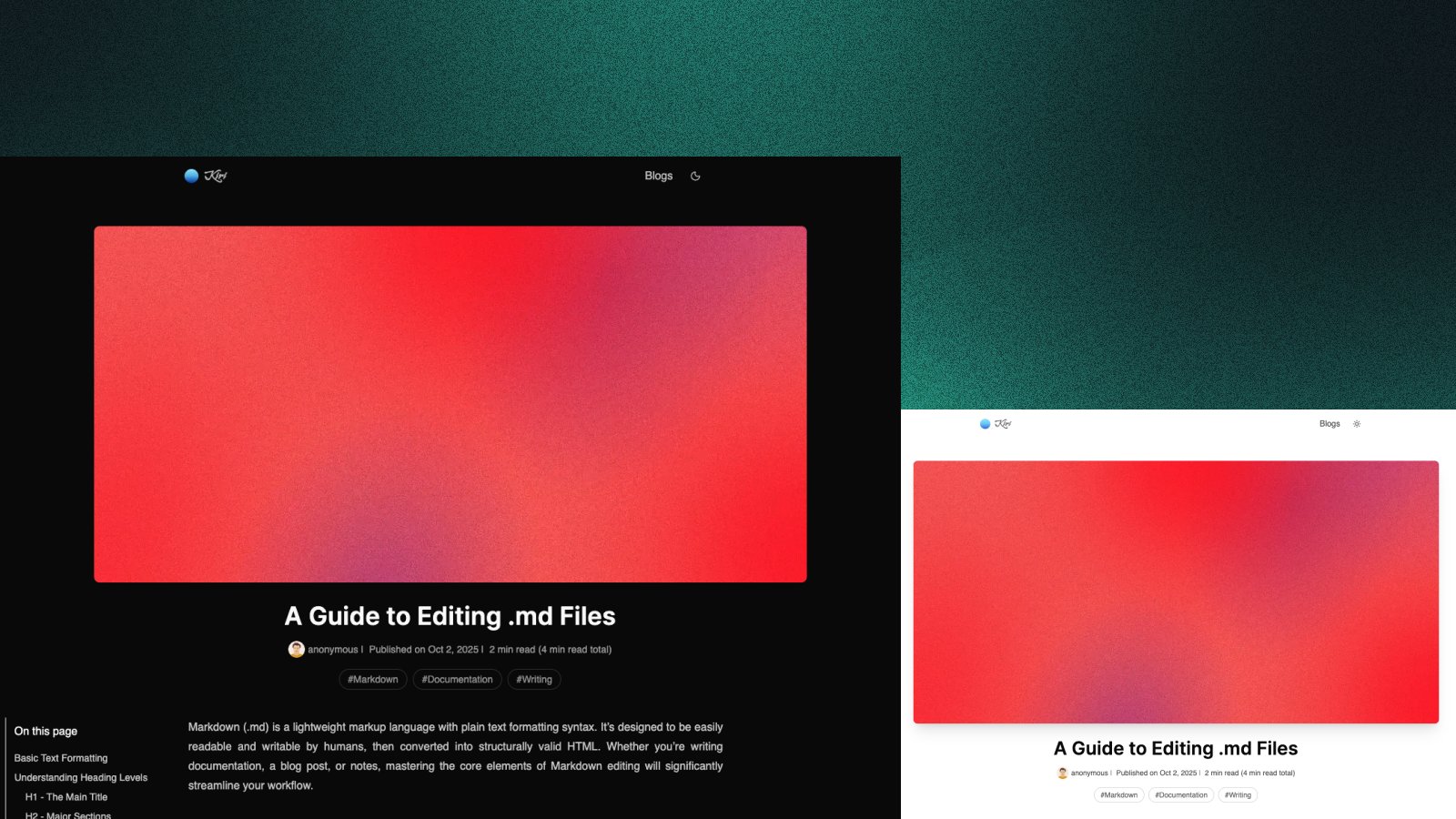
Kiri is a minimalist personal blog template built with Astro and Tailwind CSS, featuring built-in light and dark themes. It is MIT-licensed and available as a public template.
Explore the design
Compare the page layouts and mobile experience. Open any screenshot for a closer look.
Author preview
Author-provided preview
Preview provided in the project README.
One original preview is available. Open the full image to inspect the design.
Screenshots show visual appearance; interactive behavior may differ.
Recorded 2026-10-05View source
What stands out
A quick read of the recorded project description.
Built-in light and dark themes with a theme switcher
Supports RSS subscription and sitemap generation
Provides code syntax highlighting, a table of contents, and a reading progress indicator
Emphasizes accessibility at the markup level, including skip links and ARIA labels
MIT-licensed and available as a public template
Template Details
Kiri is a personal blog template aimed at writing, built with Astro and Tailwind CSS, positioned as a clean, distraction-free space for reading and writing. The template includes light and dark themes with a theme switcher, and provides common blogging capabilities such as RSS subscription, sitemap generation, code syntax highlighting, a table of contents, and a reading progress indicator. It also emphasizes accessibility at the markup level, including skip links, ARIA labels, and semantic structure.
Content is organized as Markdown/MDX files placed in the src/content/blogs/ directory, with the filename serving as the URL path. Each post declares its title, author, avatar, tags, publication date, cover image, and summary via frontmatter; the recommended cover image size is 1024x576 pixels. The project uses Bun as its package manager and provides development and build scripts. The demo site is deployed on Vercel.
Note that the repository is MIT-licensed, and the free scope is limited to this version of the code; third-party assets such as demo images, fonts, and icons must be checked separately under their respective licenses, and external services such as domains and hosting may incur costs. Statements in the README such as Lighthouse scores and "fast, lightweight" are the author's descriptions and were not independently verified in this material.
AstroBlog
Is it right for your project?
Use Cases
- Building a personal writing blog and publishing Markdown/MDX posts
- Writing technical tutorials or notes with code snippets
- A static blog that needs light/dark theme switching and RSS subscription
- A front-end practice project for further customization based on Astro
Suitable For
- Writers who want to write in Markdown without relying on a database
- Developers familiar with or willing to use Astro and Bun
- Personal sites that need a minimalist reading interface and light/dark themes
- Those who accept the MIT license and will independently verify third-party asset licensing
Getting started & customization
Use these recorded setup notes alongside the repository instructions for your chosen version.
- 1
Create a repository via GitHub's Use this template, then clone it locally
- 2
Install dependencies with Bun and run the development server; the default address is http://localhost:4321/
- 3
Build output is written to the .astro directory
- 4
Place posts in the src/content/blogs/ directory as .mdx files, with the filename as the URL path
- 5
Frontmatter must include title, author, avatar, tags, publication date, cover image, and summary; the recommended cover image size is 1024x576 pixels
License & source material
Usage conditions & limitations
Free to use · keep license noticeThis entry covers the free version of the public repository under the MIT license; the free scope applies to this version of the code and does not imply that external services or third-party assets are free.
Must comply with when using
- You may use, modify, commercially use, and distribute this version of the code for free.
- When distributing copies or substantial portions of the code, retain the original author's copyright notice and the full MIT license notice.
- The code is provided as is; warranties and limitations of liability are governed by the original license and applicable law.
Additional costs & items to verify
- Demo images, fonts, icons, and other third-party assets must be checked under their respective licenses and cannot be judged solely by the code's MIT license.
- External services such as domains, hosting, databases, payments, or AI may incur additional costs.
- The project uses Bun as its package manager; installing dependencies and running development/build scripts require the Bun runtime to be installed first, and if it is not installed, obtain it from bun.com.
- The demo site is deployed on Vercel; if you deploy it yourself to Vercel or another hosting platform, it may involve external service accounts and costs.
View Original Text Basis
Permission is hereby granted, free of charge
Original License Text
If you don't have Bun installed, you can get it from [bun.com](https://bun.com/).
Original README
https://github.com/yogeshbhutkar/kiri/blob/main/LICENSEhttps://github.com/yogeshbhutkar/kiri/blob/main/README.mdDeployed with [Vercel](https://vercel.com) at [kiri-ten.vercel.app](https://kiri-ten.vercel.app/)
Original README
Compiled by DeepSeek based on repository license and README ·2026-10-05. Results only cover the materials read; dependencies, images, fonts, and subsequent term changes are subject to their respective original texts.
Project checks & description sources
Template Information
- Source platforms
- Astro Themes
- Documentation and maintenance reference score
- More documented · 77 / 100
- Technologies
- Astro
- Website type
- Blog
How this score is calculated
Our heuristic uses license records (up to 30), a demo link (12), a preview (10), stars (15), recorded maintenance (15), description completeness (8), feature records (5) and classification data (5). It is not a code, security or performance test, or a Google score. A link does not establish tested functionality.
What to verify for this project
- Repository update recorded
- 2025-10-07
- Screenshot last checked
- 2026-10-05
A demo link is listed. Check it with your own content and viewport sizes; its presence does not confirm that forms, authentication or payments work.
The catalog identifies Astro as the primary stack. Check the actual dependency manifest and lockfile for versions and hosting requirements. These notes use recorded metadata, not a code audit or a deployment test.
Use a selection guide →How this description was prepared
AI-assisted description based on catalog records and repository material. Repository authors are not automatically the reviewers of this description.
Review declaration: [email protected] · 2026-10-06
Inspect the recorded source material
SHA-256: 111c8c3b9887d41af5ac6c58400181586c63a3eed0c73fd420f67c71e74a28b0
2026-10-05T15:52:08.643Z
Source file / repository# 🌿 Kiri **Kiri** is a **minimalistic personal blogging space** built with [Astro](https://astro.build) and [Tailwind CSS](https://tailwindcss.com). It’s fast, lightweight, and accessible — designed for writers and developers who want a clean, distraction-free space to share their thoughts. Kiri comes with **light & dark themes**, thoughtful typography, and modern blog essentials. It’s open-source, customizable, and ready to deploy as your personal corner on the web. --- ## ✨ Features - ⚡ **Blazing fast** — optimized with near-perfect Lighthouse scores - 📰 **RSS feed** — keep readers connected to your latest posts - 🌍 **Sitemap generation** — better SEO out of the box - 💻 **Syntax highlighting** — beautiful code snippets for technical posts - 🌗 **Light & dark mode** — built-in theme switcher - 📑 **Table of contents** — easy navigation for long-form articles - 📊 **Reading progress indicator** — know how far you’ve come - ♿ **Accessibility-first** — skip links, ARIA labels, and semantic markup --- ## 🚀 Preview  *Minimal design, thoughtful details, and a space built for writing.* Deployed with [Vercel](https://vercel.com) at [kiri-ten.vercel.app](https://kiri-ten.vercel.app/) --- ## 🛠️ Getting Started 1. **Create a repository with Kiri** Click the "Use this template" button at the top of this page to create a new repository based on Kiri. 2. **Clone your new repository** ```bash git clone https://github.com/your-username/kiri.git cd kiri ``` 3. **Install dependencies** ```bash bun install ``` If you don't have Bun installed, you can get it from [bun.com](https://bun.com/). 4. **Run the development server** ```bash bun run dev ``` The site will be live at `http://localhost:4321/`. 5. **Build for production** ```bash bun run build ``` The output will be in the `.astro` directory. --- ## ✍️ Writing Blog Posts 1. **Create a new Markdown file** Add a new `.mdx` file in the `src/content/blogs/` directory. The filename will be used as the URL slug. 2. **Add frontmatter** At the top of your Markdown file, include the following frontmatter: ```yaml --- title: Your Post Title author: Author Name avatar: ./images/default-avatar.webp tags: ["Tag 1", "Tag 2"] publishedDate: 2025-10-02 coverImage: ./images/default-background.webp excerpt: A brief summary of your post. --- ``` Recommended dimensions for `coverImage` are 1024x576 pixels. 3. **Write your content** Use standard Markdown syntax to write your post. You can also include JSX components if needed. --- ## 📝 License Kiri is open-source under the MIT License. Feel free to fork, tweak, and make it your own. --- ## 💡 Why Kiri? The web is full of heavy, bloated blog engines. Kiri takes a different path — it focuses on the essentials: speed, readability, ease of use, and accessibility. Whether you’re journaling, writing technical tutorials, or just experimenting, Kiri gives you a simple foundation that grows with you. --- ## ✨ Want a feature? Feel free to open an issue or submit a pull request on GitHub. Contributions are welcome! --- ## ❤️ Like Kiri? If you find Kiri useful, please give it a ⭐ on GitHub! It helps others discover the project and motivates me to keep improving it. Thank you!
Explore similar templates
Compare previews and descriptions within the same stack and category.

astrowind
AstroWind is a free, open-source Astro starter theme using Astro and Tailwind CSS, released under the MIT license.
Astro · Blog

astro-paper
AstroPaper is a minimal, responsive, accessible, and SEO-friendly Astro blog theme. Articles are stored as Markdown/MDX in src/content/posts/, with subdirectories affecting URLs.
Astro · Blog

fuwari
Fuwari is a static blog template built with Astro and Tailwind CSS for personal blogs. It manages posts as Markdown files in src/content/posts/, with frontmatter for title, date, description, cover, tags, categories, draft status, and language.
Astro · Blog

Firefly
Firefly is a clean personal blog theme forked from Astro and Fuwari, offering four background modes, single/double sidebar and list/grid layouts, Pagefind client-side full-text search, and a six-language UI.
Astro · Blog

astro-theme-cactus
Astro Cactus is an Astro-based blog and portfolio theme that uses Markdown/MDX content collections to manage posts, notes, and tags, with frontmatter type-checked by a schema.
Astro · Portfolio

astrofy
Astrofy is a free and open-source personal portfolio website template built with Astro and TailwindCSS, with built-in blog, CV timeline, project showcase, store, and RSS feed modules.
Astro · Portfolio