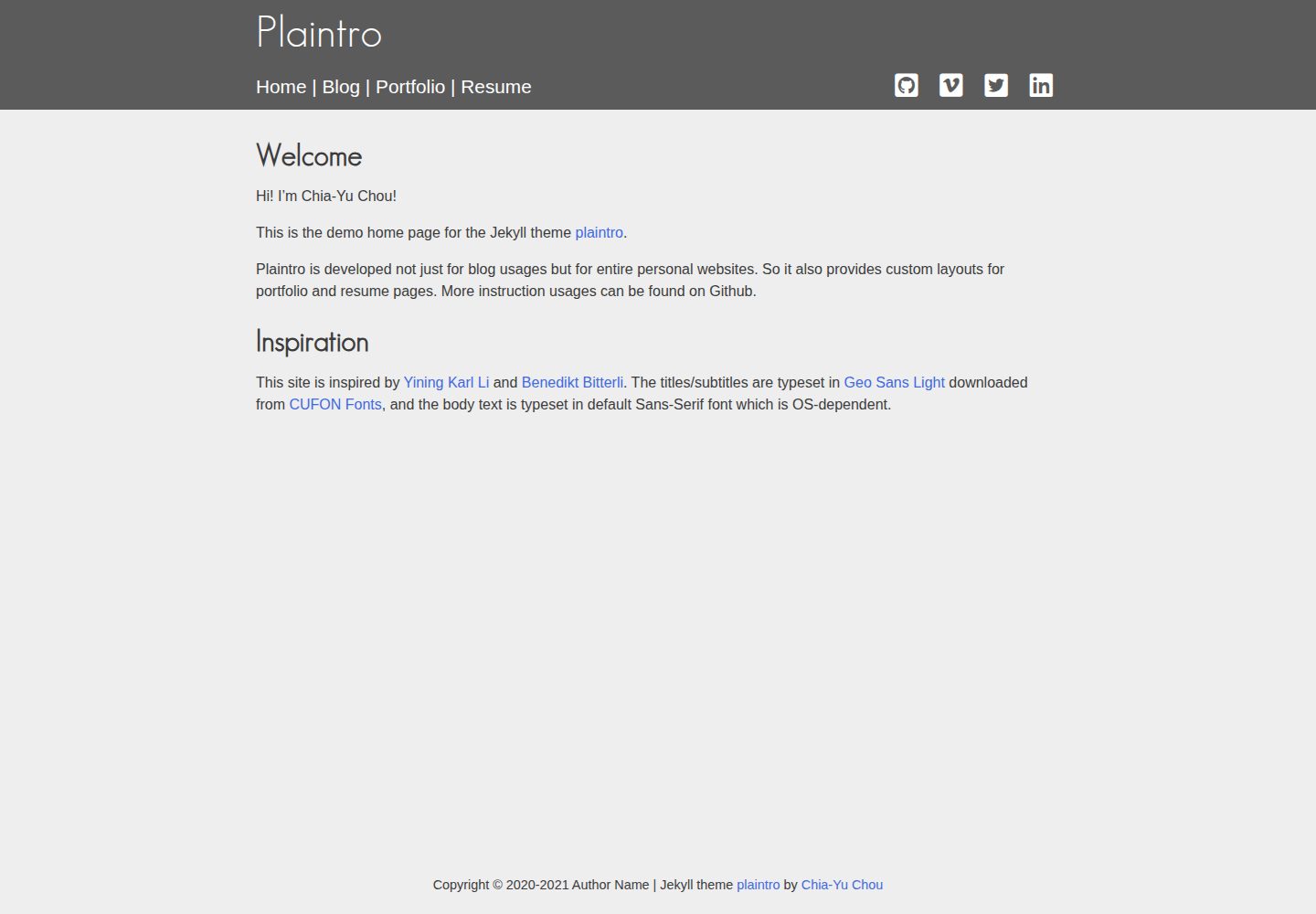
提供 default、blog、post、blog-archive、portfolio、resume 等多种 Jekyll 布局
Jekyll作品集
plaintro — Jekyll 作品集模板
作者 xh5a5n6k6
Plaintro 是一个面向个人网站的响应式 Jekyll 主题,提供博客、作品集、简历与归档等多种页面布局,采用 MIT 许可。
看看你的网站会是什么样
浏览真实页面截图,比较内容排版与手机效果。点击下方缩略图切换,放大查看整页细节。
全部页面与视图 3
截图用于了解视觉与布局,交互效果请以实际项目为准。
采集于 2026-10-03查看来源
值得关注的模板亮点
从已有项目资料中,快速了解它的特点。
顶部导航与社交链接通过 _config.yml 的 menu 和 social 列表配置
作品集页面使用 portfolio-category.html 与 portfolio-section.html 两个 include 模板组织分类和项目
集成 Jekyll Feed、Jekyll Paginate、Jekyll SEO Tag 与 Google Analytics
归档页为纯 Liquid 实现,当前仅支持按年份归档
响应式设计,仓库采用 MIT 许可
模板详细介绍
Plaintro 是一个以个人网站为目标的 Jekyll 主题,仓库描述为“Jekyll theme designed for personal websites”,演示站点部署在 GitHub Pages 上。主题提供多种页面布局:default 作为基础布局,blog 用于分页文章列表,post 用于单篇文章,blog-archive 提供基于年份的纯 Liquid 归档页,portfolio 用于作品集,resume 用于简历页。
在功能上,主题集成了 Normalize.css、Font Awesome、Google Analytics、Jekyll Feed、Jekyll Paginate 和 Jekyll SEO Tag,并采用响应式设计。顶部导航与社交链接均通过 _config.yml 中的 menu 和 social 列表配置,社交图标名称来自 Font Awesome。作品集页面通过两个 include 模板组织:portfolio-category.html 用于分类标题,portfolio-section.html 用于单个项目,需要分别指定描述文件路径、封面图路径和项目页面路径。
安装方式有两种:作为 gem 主题使用,或在 GitHub Pages 上通过 jekyll-remote-theme 引用。由于 GitHub Pages 构建使用 --safe 标志,会禁用自定义插件、磁盘缓存并忽略符号链接,因此不能直接依赖主题中的自定义插件,需要改用远程主题或自行克隆仓库。归档页目前仅支持按年份归档。Google Analytics 支持通过 _config.yml 中的 google_analytics_id 填写 UA 或 G- 开头的跟踪 ID。
许可方面,仓库采用 MIT 许可,允许免费使用、修改、商用和分发该版本代码,分发时需保留版权声明和许可声明。演示图片、字体、图标等第三方素材需按各自许可单独核对,域名、托管等外部服务可能另外收费。
Jekyll作品集
适合你的项目吗?
适用场景
- 搭建包含博客与作品集页面的个人网站
- 在 GitHub Pages 上通过 jekyll-remote-theme 引用该主题
- 以 gem 方式将主题安装到已有 Jekyll 站点
- 为个人简历或项目展示页提供独立布局
适合人群
- 使用 Jekyll 构建个人网站的用户
- 需要博客、作品集与简历页面组合的个人开发者或设计师
- 希望在 GitHub Pages 上托管静态个人站点的用户
上手与定制指南
结合仓库当前版本的说明,按下面的资料检查内容、配置与运行要求。
- 1
gem 方式:在 Gemfile 中添加 gem "plaintro",并在 _config.yml 中设置 theme: plaintro,然后执行 bundle 或 gem install plaintro
- 2
GitHub Pages 方式:添加 github-pages 与 jekyll-remote-theme 依赖,并在 _config.yml 中配置 plugins 与 remote-theme: xh5a5n6k6/plaintro
- 3
站点配置集中在 _config.yml,可复制主题的 _config.yml 后按需修改 menu、social 等字段
- 4
启用博客页时,其 URL 需与 _config.yml 中的 paginate_path 保持一致
- 5
文章需放在 _posts 目录并按 日期-标题.md 命名,归档页当前仅支持按年份归档
授权与来源资料
使用条件与限制
免费使用 · 保留许可声明本次收录的是公开仓库中采用 MIT 许可的免费版本;免费范围为该版本代码,不代表外部服务或第三方素材免费。
使用时需要遵守
- 允许免费使用、修改、商用和分发该版本代码。
- 分发代码副本或实质性部分时,保留原作者版权声明和完整 MIT 许可声明。
- 代码按现状提供;担保与责任限制以原许可证及适用法律为准。
额外费用与待核对事项
- 在 GitHub Pages 上构建时使用 --safe 标志,会禁用自定义插件、磁盘缓存并忽略符号链接,因此无法直接使用主题中的自定义插件,需改用 jekyll-remote-theme 或自行克隆仓库。
- 归档页目前仅支持按年份归档,不支持按月份或分类等其他归档方式。
- 使用 Google Analytics 统计功能需自行注册 Google Analytics 账号并提供跟踪 ID(UA- 或 G- 开头),属于外部服务,可能涉及额外条款与费用。
- 演示图片、字体、图标及其他第三方素材需按各自许可核对,不能仅凭代码的 MIT 许可判断。
- 域名、托管、数据库、支付或 AI 等外部服务可能另外收费。
查看原文依据
Permission is hereby granted, free of charge
许可证原文
Github Pages uses the [--safe flag](https://jekyllrb.com/docs/configuration/options/) to build jekyll websites, which disable custom plugins, caching to disk, and ignore symbolic links.
README 原文
It now only supports yead-based archive.
README 原文
https://github.com/xh5a5n6k6/plaintro/blob/master/LICENSE.txthttps://github.com/xh5a5n6k6/plaintro/blob/master/README.mdTo track your website through [Google Analytics](https://analytics.google.com/analytics/web/), simply set the [Track ID]
README 原文
DeepSeek 根据仓库许可证和 README 整理 ·2026-10-03。结果仅覆盖已读取资料,依赖、图片、字体及后续条款变更以各自原文为准。
项目核对记录与介绍依据
模板资料
- 来源平台
- GitHub
- 资料与维护参考分
- 资料一般 · 68 / 100
- 技术栈
- Jekyll
- 网站类型
- 作品集
这个分数如何计算
本站按许可资料(最高30分)、演示链接(12分)、预览图(10分)、Star数(15分)、记录的维护时间(15分)、描述完整度(8分)、功能记录(5分)和分类资料(5分)计算。它不是代码、安全或性能测试,也不是 Google 评分;有链接不代表已实测可用。
这个项目需要核对什么
- 记录的仓库更新时间
- 2021-08-24
- 截图检查日期
- 2026-10-03
已收录演示链接。请用你的内容与屏幕尺寸检查;有演示不代表表单、认证或支付已经可用。
目录记录的主要技术栈是 Jekyll。请通过依赖清单和锁文件核对实际版本与托管要求。这些说明基于收录资料,不代表代码审计或部署实测。
查看具体选型方法 →介绍的制作与核对状态
介绍由 AI 辅助整理目录与仓库资料。仓库作者不等于这篇介绍的审核者。
审核声明: [email protected] · 2026-10-04
查看当时使用的来源资料
SHA-256: 4e185eec15d5e649c5d780f2730ccae3c10542e532dbf2d580e1261bfa05d46b
2026-10-03T08:50:21.045Z
来源文件 / 仓库# Plaintro
[](https://badge.fury.io/rb/plaintro)
Plaintro is a responsive Jekyll theme aimed at personal websites.
[Live Demo](https://xh5a5n6k6.github.io/plaintro/)
## Table of Contents
- [Features](#features)
- [Installation](#installation)
- [Gem-based theme](#gem-based-theme)
- [Github Pages](#github-pages)
- [Usage](#usage)
- [Configuration](#configuration)
- [Top Header Bar](#top-header-bar)
- [Default Page](#default-page)
- [Blog](#blog)
- [Post](#post)
- [Archive](#archive)
- [Portfolio](#portfolio)
- [Resume](#resume)
- [Google Analytics](#google-analytics)
- [Contributing](#contributing)
- [Development](#development)
- [License](#license)
## Features
- [Normalize.css](https://github.com/necolas/normalize.css)
- [Font Awesome](https://fontawesome.com)
- [Google Analytics](https://analytics.google.com/analytics/web/)
- [Jekyll Feed](https://github.com/jekyll/jekyll-feed)
- [Jekyll Paginate](https://github.com/jekyll/jekyll-paginate)
- [Jekyll SEO Tag](https://github.com/jekyll/jekyll-seo-tag)
- Responsive web design
- Multiple layouts for different pages (see [Usage](#usage) for more details)
- Easy-to-use templates for adding a new project to the portfolio page
## Installation
There are two ways to use plaintro: Gem-based theme and Github Pages.
### Gem-based theme
1. Add this line to your Jekyll site's `Gemfile`:
```ruby
gem "plaintro"
```
2. And add this line to your Jekyll site's `_config.yml`:
```yaml
theme: plaintro
```
3. And then execute:
```
$ bundle
```
4. Or install it yourself as:
```
$ gem install plaintro
```
### Github Pages
Github Pages uses the [--safe flag](https://jekyllrb.com/docs/configuration/options/) to build jekyll websites, which disable custom plugins, caching to disk, and ignore symbolic links. Because of that constraint, you can either fork/clone the repo and customize the theme, or use [jekyll-remote-theme](https://github.com/benbalter/jekyll-remote-theme) instead.
To build Github Pages via [jekyll-remote-theme](https://github.com/benbalter/jekyll-remote-theme), follow the steps below:
1. Add these lines to your Jekyll site's `Gemfile`:
```ruby
gem "github-pages", group: :jekyll_plugins
gem "jekyll-remote-theme"
```
2. And add these lines to your Jekyll site's `_config.yml`:
```yaml
plugins:
- jekyll-remote-theme
remote-theme: xh5a5n6k6/plaintro
```
## Usage
### Configuration
All site configurations are set in the [\_config.yml](./_config.yml). The simplest way to use it is to copy the [\_config.yml](./_config.yml) to your Jekyll site, and then customize it.
### Top Header Bar
There are two main information sections shown in the header bar: navigation and social links.
- #### Navigation
Top navigation are built from the menu list in the `_config.yml`. You can easily arrange the order and modify the contents.
```yaml
menu:
- {name: 'Home', url: '/'}
- {name: 'Blog', url: '/blog/'}
- {name: 'Portfolio', url: '/portfolio/'}
- {name: 'Resume', url: '/resume.html'}
```
**Note**: if you enable the blog page, be sure its url matches the `paginate_path` set in the `_config.yml`. (See [Blog](#blog) for more details)
- #### Social Links
Social networks are built from the social list in the `_config.yml`. You can easily modify the contents and change icons, which can be found on [Font Awesome](https://fontawesome.com).
```yaml
social:
- {icon: 'github-square', link: 'URL/TO/YOUR/GITHUB/ACCOUNT'}
- {icon: 'vimeo-square', link: 'URL/TO/YOUR/VIMEO/ACCOUNT'}
- {icon: 'twitter-square', link: 'URL/TO/YOUR/TWITTER/ACCOUNT'}
- {icon: 'linkedin', link: 'URL/TO/YOUR/LINKEDIN/ACCOUNT'}
```
### Default Page
Default is the most common layout used in plaintro. Every layout is based on it.
To use this layout, add these data in your file:
```yaml
---
layout: default
title: YOUR PAGE TITLE
---
```
And then write contents with Markdown.
### Blog
When using [jekyll-paginate](https://github.com/jekyll/jekyll-paginate), if you specify the `paginate_path` in the `_config.yml`, it will read in `/PATH/TO/YOUR/BLOG/index.html` and write the output to `/PATH/TO/YOUR/BLOG/page:num/`. Please refer to the [Jekyll docs for pagination](https://jekyllrb.com/docs/pagination/).
To use the blog layout, create a file named with `index.html` and add these data inside:
```yaml
---
layout: blog
title: Blog
---
```
### Post
Before using this layout, be sure the conventions in Jekyll when writing a post:
- Put it in the `./_posts` folder
- Name it with the date first like `2021-08-05-My-blog-post.md`
You can refer to the [Jekyll docs for writing posts](https://jekyllrb.com/docs/posts/).
Now to use the post layout, add these data in your post:
```yaml
---
layout: post
title: YOUR POST TITLE
author: POST AUTHOR
tags: [TAG-A, TAG-B, TAG-C]
---
```
And then write down your post contents.
### Archive
Plaintro provides the archive page implemented in pure [Liquid](https://shopify.github.io/liquid/). It now only supports yead-based archive.
To use this, simply create a file and add these data in it:
```yaml
---
layout: blog-archive
title: Archive
---
```
### Portfolio
Porfolio is a feature page with portfolio layout, it contains all include template contents user provided.
To use it in your file like `porfolio.html`, first add these data inside:
```yaml
---
layout: portfolio
title: Portfolio
---
```
Next, add contents to your portfolio page, plaintro provides two include templates to help you achieve it:
- Template for each category, you just need to edit the **title** blank with the category name.
For example, replace "CATEGORY NAME" with "Projects".
```yaml
{% include /portfolio-category.html title="CATEGORY NAME" %}
```
- Template for each section (project), there are three blanks you need to edit:
- **description**: path to the short description of your section shown in the portfolio page.<br>
For example, `/portfolio/section-a.md`. It should be noted that this path MUST be under the `./_includes/` folder, i.e., the actual path of the above example is `./_includes/portfolio/section-a.md`, but you can skip the leading `./includes` as the desciption path.
- **image**: path to the cover image of your section.<br>
For example, `/assets/images/section-a.jpg`.
- **url**: path to your section page.<br>
For example, `/portfolio/section-a.html`.<br><br>
```yaml
{% include /portfolio-section.html
description="/PATH/TO/SECTION/DESCRIPTION"
image="/PATH/TO/SECTION/IMAGE"
url="/PATH/TO/SECTION/PAGE"
%}
```
To correctly use these templates, you can take [./portfolio/index.html](./portfolio/index.html) as a reference.
### Resume
To use resume layout in your file, simply add these data inside:
```yaml
---
layout: resume
title: Resume
---
```
Then you can take [resume.md](./resume.md) as a reference and write down the contents.
### Google Analytics
To track your website through [Google Analytics](https://analytics.google.com/analytics/web/), simply set the [Track ID](https://support.google.com/analytics/answer/7372977?hl=en) in your Jekyll site's `_config.yml`:
```yaml
google_analytics_id: UA-XXXXXXX-X
```
Or if you are using [Google Analytics 4](https://support.google.com/analytics/answer/10089681?hl=en), replace the [Track ID](https://support.google.com/analytics/answer/7372977?hl=en) with the [Measurement ID](https://support.google.com/analytics/answer/7372977?hl=en) in your Jekyll site's `_config.yml`:
```yaml
google_analytics_id: G-XXXXXXXX
```
## Contributing
Bug reports and pull requests are welcome on GitHub at https://github.com/xh5a5n6k6/plaintro. This project is intended to be a safe, welcoming space for collaboration, and contributors are expected to adhere to the [Contributor Covenant](http://contributor-covenant.org) code of conduct.
## Development
To set up your environment to develop this theme, run `bundle install`.
Your theme is setup just like a normal Jekyll site! To test your theme, run `bundle exec jekyll serve` and open your browser at `http://localhost:4000`. This starts a Jekyll server using your theme. Add pages, documents, data, etc. like normal to test your theme's contents. As you make modifications to your theme and to your content, your site will regenerate and you should see the changes in the browser after a refresh, just like normal.
When your theme is released, only the files in `_layouts`, `_includes`, `_sass` and `assets` tracked with Git will be bundled.
To add a custom directory to your theme-gem, please edit the regexp in `plaintro.gemspec` accordingly.
## License
The theme is available as open source under the terms of the [MIT License](https://opensource.org/licenses/MIT).看看同类模板
对比同技术栈与用途的模板,找到更适合的视觉与内容结构。

al-folio
al-folio 是一个面向学者与研究人员的 Jekyll 作品集主题,设计简洁、响应式,适合搭建个人学术主页。
Jekyll · 作品集

minimal-mistakes
:triangular_ruler: Jekyll theme for building a personal site, blog, project documentation, or portfolio.
Jekyll · 作品集

Beautiful Jekyll
Beautiful Jekyll 是一个在 Jekyll 生态中经过长期打磨的博客主题,由 Dean Attali 维护,自 2015 年起积累了超过 5 万用户。
Jekyll · 博客

So Simple
So Simple 是 Michael Rose 开发的 Jekyll 主题,定位清晰:为文字和图片提供一个干净、可读性强的展示框架。
Jekyll · 博客
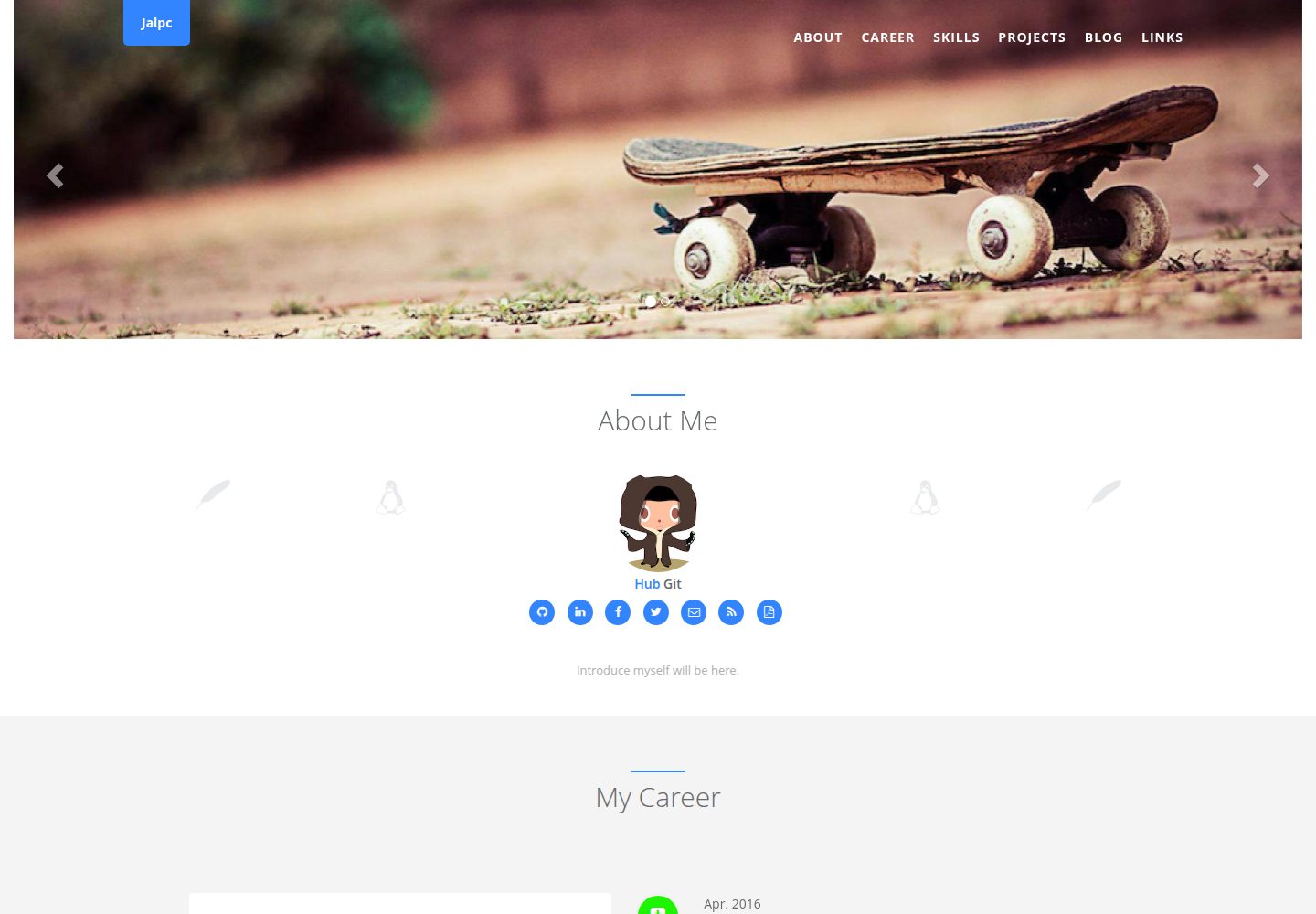
Jalpc
🍎Jalpc -- A flexible Jekyll theme, 3 steps to build your website.
Jekyll · 作品集
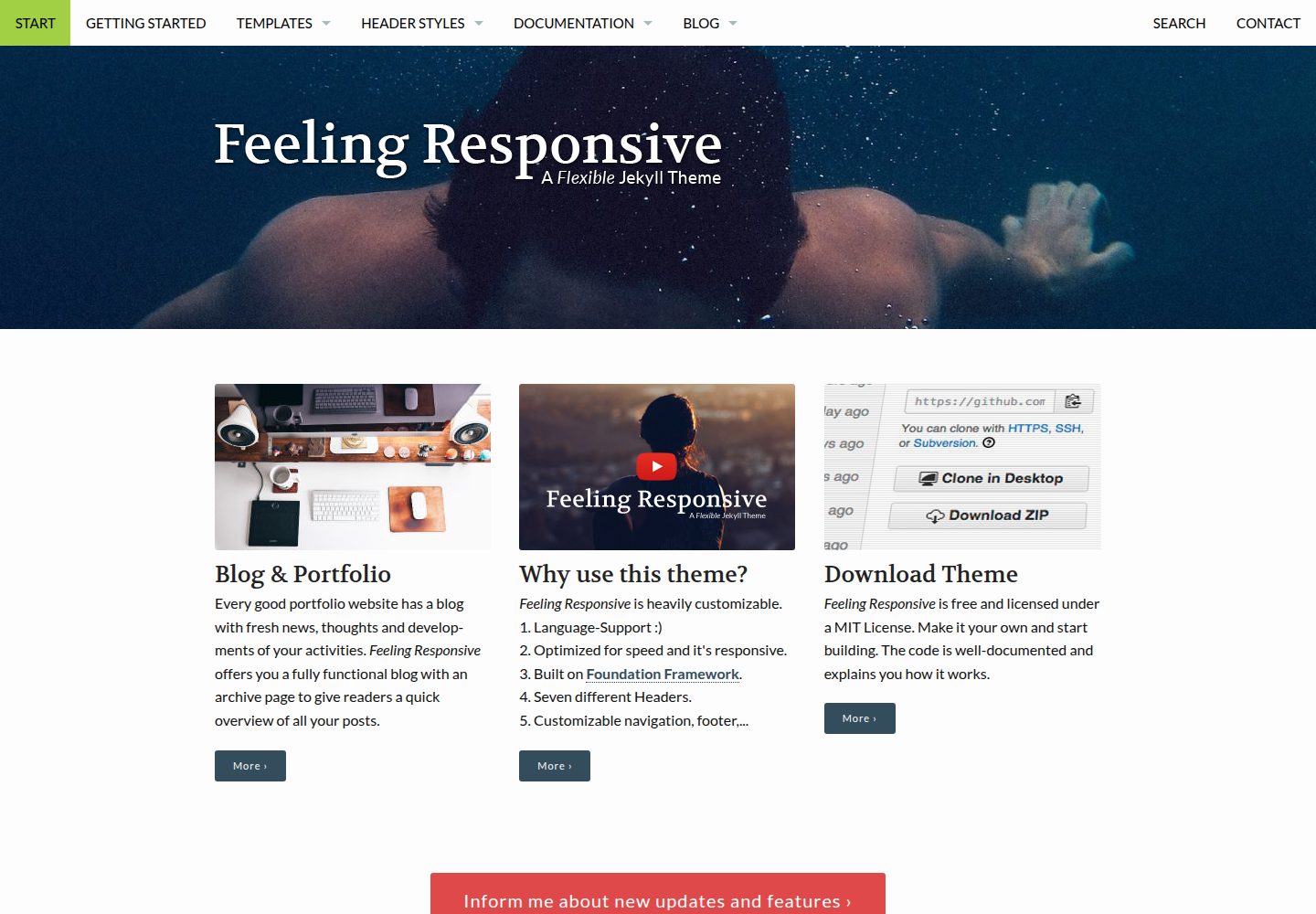
feeling-responsive
»Feeling Responsive« is a free flexible theme for Jekyll built on Foundation framework. You can use it for you…
Jekyll · 作品集