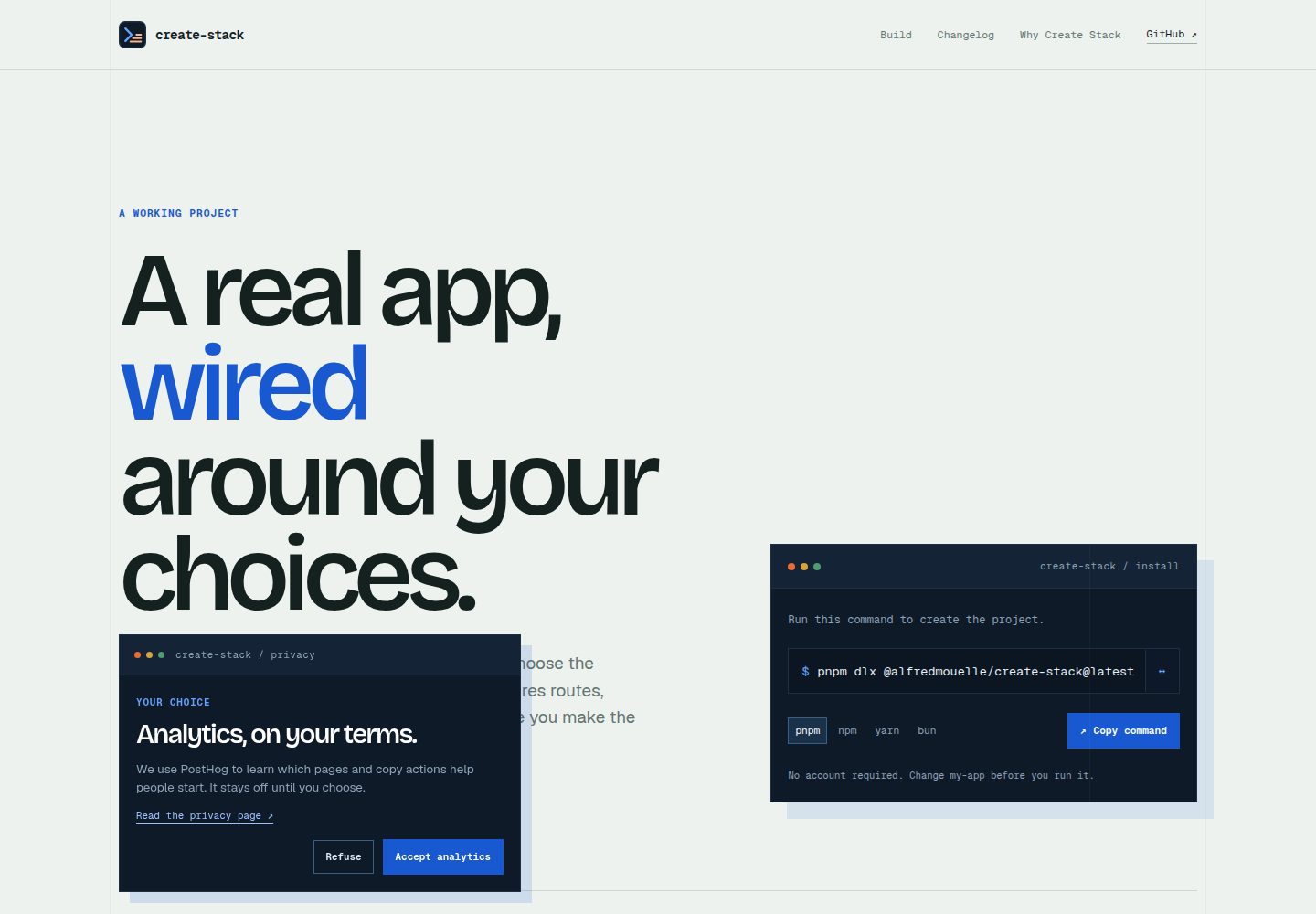
The CLI wizard generates a project based on options such as framework, package manager, database, authentication, tRPC, and email service, and completes dependency installation, validation, and an initial Git commit
Next.jsReactSaaSStarter
create-stack — Next.js SaaS Template
By alfredmouelle
create-stack is a CLI and SaaS base template that generates a Next.js or TanStack Start project based on wizard choices, placing replaceable integrations such as email, storage, cache, logging, and analytics behind ports.
Explore the design
Compare the page layouts and mobile experience. Open any screenshot for a closer look.
Desktop homepage1 / 2
Desktop captureTop of page
Actual screenshot captured by the server browser.
All pages & views 2
Screenshots show visual appearance; interactive behavior may differ.
Recorded 2026-10-08View source
What stands out
A quick read of the recorded project description.
Replaceable integrations are placed behind ports; application code depends only on ports, so switching Resend/Brevo or S3/R2 only changes the composition root in one place
Provides two real starter apps, Next.js App Router and TanStack Start; the CLI forks one based on your choice
Capabilities are organized as packages/<capability>/, each with a capability.json manifest and tests, with a clear distinction between the port and module wiring models
Includes two skills, /create-stack and /add-capability, allowing capabilities to be added to a project after creation
Template Details
create-stack consists of two parts: the published CLI `@alfredmouelle/create-stack`, and the private pnpm + Turborepo monorepo `@alfredmouelle/stack` used to develop the CLI. The CLI asks via a wizard about framework, monorepo orchestrator, package manager, import alias, database, authentication, tRPC, email service, and various capabilities, then forks the corresponding base app and applies these choices, while installing dependencies, running validation, and creating an initial Git commit.
The `apps/next-base` and `apps/tanstack-base` in the repository are real, usable starter apps that contain no business code themselves, only baseline configuration such as strict Biome, the `~/*` import alias, and a typed `env.ts`. Under `packages/<capability>/`, each capability has a `capability.json` manifest and tests; its `kind` field determines the wiring method: a port has multiple adapters and is selected at the composition root; a module has only one provider or no provider and is used directly.
Port-type capabilities include mailer (Resend, Brevo, SES), storage (S3, Cloudflare R2, GCS, local), cache (Redis, Upstash, in-memory), logger (pino, console), and analytics (PostHog, Plausible, noop). Module-type capabilities include jobs (Inngest client and serve wiring), error-tracking (Sentry initialization options and framework files; steps that modify your own files are only printed, not applied automatically), email-ui (React Email components, replaceable themes, and local preview), and http (typed fetch and a Web-standard WebhookHandler).
The repository also provides two skills: `/create-stack` creates a project using the published CLI, and `/add-capability <capability> [adapter]` adds a capability to an existing project; port-type capabilities require an adapter argument, module-type ones do not. Development conventions are pnpm, turbo, tsdown, vitest, Biome v2, with Node version 22 or higher required. The project is inspired by create-t3-app and is MIT licensed.
Next.jsReactSaaSStarter
Is it right for your project?
Use Cases
- Need to build a SaaS project skeleton from scratch with Next.js or TanStack Start, with common integrations such as email, storage, cache, logging, and analytics pre-wired
- Have an existing project and want to introduce capabilities such as email, storage, or cache while keeping providers replaceable via the port/adapter approach
- Team wants to unify the baseline configuration of new projects, including strict Biome, import aliases, and typed env validation
- Need to preview React Email templates locally while keeping email themes replaceable
Suitable For
- Frontend or full-stack developers using pnpm and Node 22 or higher
- Teams that accept port and adapter layering and are willing to choose providers at the composition root
- SaaS projects that need a Next.js App Router or TanStack Start starter skeleton
- Developers who want to reduce repetitive initialization work with a CLI and skill scripts
Getting started & customization
Use these recorded setup notes alongside the repository instructions for your chosen version.
- 1
Create a project with pnpm create @alfredmouelle/stack@latest my-app or pnpm dlx @alfredmouelle/create-stack@latest my-app; npm and yarn create also work
- 2
For repository development, first run pnpm install, then run pnpm test, pnpm typecheck, and pnpm check
- 3
Preview email templates locally: pnpm --filter @alfredmouelle/email-ui email:dev, running on port 3001
- 4
Skills can be symlinked into the agent configuration directory via pnpm link:skills (Claude) or pnpm link:skills:codex (Codex)
- 5
The code is MIT licensed and can be used, modified, commercialized, and distributed for free, but the copyright and license notice must be retained; demo assets, fonts, icons, and external services such as domains, hosting, databases, payments, and AI need separate license and cost verification
License & source material
Usage conditions & limitations
Free to use · keep license noticeThis entry covers the free version in the public repository under the MIT license; the free scope is the code of that version and does not imply that external services or third-party assets are free.
Must comply with when using
- You may use, modify, commercialize, and distribute the code of this version for free.
- When distributing copies or substantial portions of the code, retain the original author's copyright notice and the full MIT license notice.
- The code is provided as is; warranties and limitations of liability are governed by the original license and applicable law.
Additional costs & items to verify
- Demo images, fonts, icons, and other third-party assets must be checked against their respective licenses and cannot be judged solely by the code's MIT license.
- External services such as domains, hosting, databases, payments, or AI may incur separate charges.
- The jobs capability directly depends on Inngest, and error-tracking directly depends on Sentry; using these two capabilities requires integrating the corresponding external services.
- Providers are selected via environment variables; using port-type capabilities requires configuring the corresponding environment variables yourself.
- In error-tracking, steps that modify your own files are only printed and not applied automatically; they must be executed manually.
- The runtime requires Node 22 or higher.
- Skill symlinks are written to the Claude and Codex configuration directories respectively; using skills requires the corresponding agent environment.
View Original Text Basis
Permission is hereby granted, free of charge
Original License Text
Jobs use Inngest directly, and error tracking uses Sentry directly.
Original README
**Provider selection by env var**, with static imports.
Original README
the steps that edit files you own are printed, not applied
Original README
**Node:** >= 22
Original README
https://github.com/alfredmouelle/create-stack/blob/main/LICENSEhttps://github.com/alfredmouelle/create-stack/blob/main/README.mdpnpm link:skills # Claude (~/.claude/skills) pnpm link:skills:codex # Codex (~/.codex/prompts)
Original README
Compiled by DeepSeek based on repository license and README ·2026-10-08. Results only cover the materials read; dependencies, images, fonts, and subsequent term changes are subject to their respective original texts.
Project checks & description sources
Template Information
- Source platforms
- GitHub
- Documentation and maintenance reference score
- More documented · 88 / 100
- Technologies
- Next.js · React
- Website type
- SaaS · Starter
How this score is calculated
Our heuristic uses license records (up to 30), a demo link (12), a preview (10), stars (15), recorded maintenance (15), description completeness (8), feature records (5) and classification data (5). It is not a code, security or performance test, or a Google score. A link does not establish tested functionality.
What to verify for this project
- Repository update recorded
- 2026-08-26
- Screenshot last checked
- 2026-10-08
A demo link is listed. Check it with your own content and viewport sizes; its presence does not confirm that forms, authentication or payments work.
The catalog identifies Next.js as the primary stack. Check the actual dependency manifest and lockfile for versions and hosting requirements. These notes use recorded metadata, not a code audit or a deployment test.
Use a selection guide →How this description was prepared
AI-assisted description based on catalog records and repository material. Repository authors are not automatically the reviewers of this description.
Review declaration: [email protected] · 2026-10-08
Inspect the recorded source material
SHA-256: e8bb121c7408e42f49f5a1194208aef2e14b8fca8ed30446bb73beb50df8d7d4
2026-10-08T02:07:10.985Z
Source file / repository# create-stack > A SaaS foundation and CLI for scaffolding Next.js or TanStack Start projects. > Replaceable integrations live behind ports. Integrations with one useful provider > ship as modules. [](https://www.npmjs.com/package/@alfredmouelle/create-stack) [](./LICENSE) [](https://nodejs.org) [](./CONTRIBUTING.md) This pnpm and Turborepo monorepo keeps replaceable integrations such as email, storage, cache, logging, and analytics behind a **port**. Application code depends on that port. The composition root selects the provider, so switching Resend for Brevo or S3 for R2 stays local to one place. Jobs use Inngest directly, and error tracking uses Sentry directly. Those integrations ship as **modules** with their framework wiring included. > **Two package names, one project.** `@alfredmouelle/create-stack` is the > published CLI you install to scaffold a project. `@alfredmouelle/stack` is this > repo: the private (unpublished) monorepo that develops and ships that CLI. ## Quickstart Scaffold a project with the selected stack, installed dependencies, verification, and an initial Git commit: ```bash pnpm create @alfredmouelle/stack@latest my-app # equivalent, explicit form (npm / yarn create also work): pnpm dlx @alfredmouelle/create-stack@latest my-app ``` The wizard asks for the framework, monorepo orchestrator, package manager, import alias, database, authentication, tRPC, mailer, and capabilities. The CLI forks the matching base app and applies those choices. ## Why Every new SaaS project needs the same early work: clean the boilerplate, configure the checks, install the common libraries, and wire the usual integrations. This repo keeps that work in one place. The defaults are opinionated, while the replaceable integrations stay behind adapters. Fork the base apps or change the defaults to fit your project. ## Capabilities Each `packages/<capability>/` is a self-contained capability with a `capability.json` manifest and tests. Its `kind` field defines the wiring model: a **port** has several adapters selected at the composition root, while a **module** has one provider, or no provider, and is used directly. ### Ports (swappable) `src/port.ts` holds the interface, `src/adapters/<name>.ts` one adapter per provider. | Capability | Port | Adapters | |---|---|---| | **mailer** _reference_ | `send()`: body is always a React Email component, rendered to HTML + text | Resend · Brevo · SES | | **storage** | `put` / `get` / `delete` / `exists` / `getSignedUrl` | S3 · Cloudflare R2 · GCS · local | | **cache** | `get` / `set` / `has` / `delete` / `wrap` | Redis · Upstash · in-memory | | **logger** | `trace`…`error` / `child` | pino · console | | **analytics** | `capture` / `identify` / `flush` | PostHog · Plausible · noop | ### Modules (used directly) | Capability | What it is | Provider | |---|---|---| | **jobs** | the Inngest client plus the serve wiring: durable steps, cron, concurrency, fan-out and typed events stay reachable | Inngest | | **error-tracking** | shared `Sentry.init` options plus the per-framework files (`onRequestError`, instrumentation, `global-error`); the steps that edit files you own are printed, not applied | Sentry | | **email-ui** | composable React Email primitives + **swappable theme** + local preview (`email dev`) | n/a | | **http** | `apiFetch` (typed fetch) + Web-standard `WebhookHandler` | n/a _(for APIs without an SDK)_ | Design rules: - **Pure core.** `packages/*` have zero framework code, except where the framework integration *is* the product (the error-tracking wiring). - **Official SDKs** are always preferred over hand-rolled fetch (except `http`, whose whole job is fetch). - **Provider selection by env var**, with static imports. Use lazy imports and per-adapter subexports only when an edge deployment requires them. - **Abstract a dependency when the abstraction earns its keep.** A single obvious implementation stays a module. Jobs need durable steps, cron, concurrency, fan-out, and typed events, so the SDK remains visible. Sentry needs request hooks, source maps, early instrumentation, and per-request scope isolation, so a small `captureException` wrapper would hide the useful parts. ## Structure ``` packages/ mailer/ email-ui/ storage/ jobs/ cache/ logger/ analytics/ error-tracking/ http/ apps/ next-base/ # real Next.js (App Router) starter, fork for a new project tanstack-base/ # real TanStack Start starter, fork for a new project cli/ # create-stack: the published installer that forks a base app index.mjs lib/ templates/ # (biome.jsonc + # Author footer + wiring variants) skills/ create-stack/ # run the published create-stack CLI to scaffold a project add-capability/ # add a capability into a project behind a port scripts/ link-skills.sh # symlink skills into Claude / Codex capability.schema.json # the manifest schema each capability.json follows ``` `apps/*-base` are **real starter apps**. The CLI forks one of them for each new project. They carry the baseline, including strict Biome, the `~/*` alias, and typed `env.ts`, without application-specific code. `create-stack` selects the framework, monorepo orchestrator, package manager, import alias, and stack axes. `add-capability` adds tools after creation. ## Development Working on the repo itself (capabilities, CLI, bases): ```bash pnpm install pnpm test # all packages pnpm typecheck pnpm check ``` Preview emails locally: ```bash pnpm --filter @alfredmouelle/email-ui email:dev # react-email studio on :3001 ``` ## Skills The skills live here (versioned) and are symlinked into the agent's config, so editing them in this repo updates what the agent uses, no copy step. ```bash pnpm link:skills # Claude (~/.claude/skills) pnpm link:skills:codex # Codex (~/.codex/prompts) ``` - **`/create-stack`**: create a project with the published `@alfredmouelle/create-stack` CLI (framework + stack axes + capabilities, installs & inits git). - **`/add-capability <capability> [adapter]`**: add a capability to the current project (e.g. `/add-capability mailer resend`). Ports take an adapter argument, modules take none. Server capabilities land in `src/server/<cap>/`, pure utils in `src/lib/`, templates in `src/emails/`. See [`skills/README.md`](./skills/README.md) for details. ## Contributing Contributions are welcome. Please read the [Contributing Guidelines](./CONTRIBUTING.md) before opening an issue or PR: they cover the local setup, the ports & adapters rules, and the commit convention. ## Conventions - **Package manager:** pnpm · **Tasks:** turbo · **Build:** tsdown · **Tests:** vitest - **Lint/format:** Biome v2, strict (no semicolons, single quotes, trailing commas, `~/*` import alias) - **Schema validation (apps):** valibot · **Typed env:** `@t3-oss/env-core` - **Node:** >= 22 ## Credits Inspired by [create-t3-app](https://create.t3.gg) and the work of [Theo Browne](https://github.com/t3dotgg). Not affiliated with or endorsed by the T3 project. ## License [MIT](./LICENSE) © Alfred MOUELLE --- # Author Alfred MOUELLE | FullStack Developer [](https://comeup.com/@alfredmouelle) [](https://github.com/alfredmouelle) [](https://www.linkedin.com/in/alfredmouelle) [](https://x.com/alfredmouelle) [](mailto:[email protected]) [](https://alfredmouelle.com)
Explore similar templates
Compare previews and descriptions within the same stack and category.

Next.js SaaS Starter
The official Next.js SaaS starter template, integrating email/password authentication, Stripe Checkout subscriptions, a dashboard with user/team CRUD, basic Owner/Member RBAC, and activity logging.
Next.js · SaaS

Next.js Commerce
Vercel's officially maintained Next.js App Router ecommerce starter with deep Shopify integration, offering a complete product catalog, cart, and checkout flow. Core logic is modular for swapping backends, and community provider versions exist for BigCommerce, Medusa, and Saleor.
Next.js · E-commerce

Next-js-Boilerplate
A developer-first Next.js 16 starter with Tailwind CSS 4 and TypeScript, supporting both App Router and Page Router.
Next.js · Starter

tailwind-nextjs-starter-blog
A Next.js and Tailwind CSS blog starter template using Contentlayer for Markdown/MDX, with built-in SEO, code highlighting, and tags. It targets personal technical blogs and migration from Jekyll/Hugo to React, and supports one-click Vercel deployment.
Next.js · Blog

next-forge
next-forge is a Turborepo-based Next.js template maintained by Vercel, positioned as a starting point for SaaS products.
Next.js · Starter

SaaS-Boilerplate
SaaS-Boilerplate is an open-source SaaS starter template built with Next.js App Router, React 19, TypeScript, Tailwind CSS, and Shadcn UI.
Next.js · SaaS