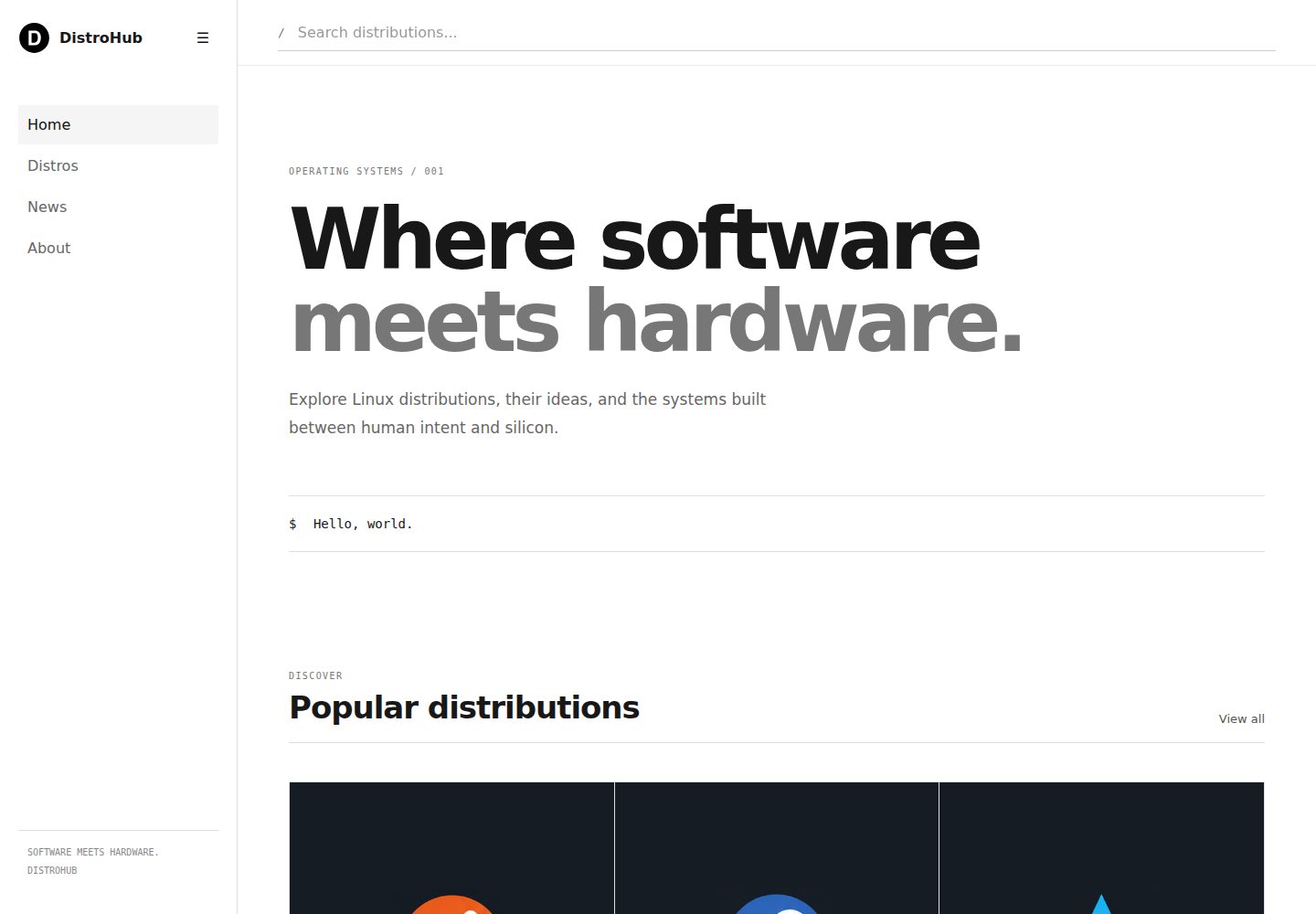
Pure HTML, CSS, and vanilla JavaScript, with no front-end framework and no build step
HTMLDirectory site
distrohub-template — HTML Directory site Template
By armin-syntax
DistroHub is a front-end template for a Linux distribution directory written in HTML, CSS, and vanilla JavaScript. It includes distribution listing, filtering, detail, download, and news pages, and can be deployed statically or connected to a backend later.
Explore the design
Compare the page layouts and mobile experience. Open any screenshot for a closer look.
Desktop homepage1 / 3
Desktop captureTop of page
Actual screenshot captured by the server browser.
All pages & views 3
Screenshots show visual appearance; interactive behavior may differ.
Recorded 2026-10-01View source
What stands out
A quick read of the recorded project description.
Distribution catalog, search, multi-select filtering, details, download, news, and about pages
Filter form uses GET parameters, making it easy to connect to a backend later
Shared styles and page-level styles are separated; shared navigation logic and homepage effects are separated
Responsive layout with mobile sidebar navigation
MIT license, allowing free use, modification, commercial use, and distribution
Template Details
DistroHub is a static front-end template for discovering and browsing Linux distributions, built with HTML, CSS, and vanilla JavaScript. It does not rely on a front-end framework and requires no build tools. The repository notes that it was completed with AI assistance; the author primarily works in back-end development, so the front-end implementation was delegated to AI to leave time for back-end architecture, APIs, and databases.
The template provides interfaces for a distribution catalog, search, multi-select filtering, distribution details, a download page, a news list and article pages, and an about page, along with responsive navigation and a mobile sidebar. The filter form uses ordinary GET parameters, for example /pages/distros.html?desktop=gnome&desktop=xfce, making it easy to connect to a backend later. Styles are split into shared styles and page-level styles, and JavaScript is split into shared navigation logic and a homepage typewriter effect.
The current static version intentionally includes only a small number of distributions to keep the repository lightweight, and distribution cards use local images. The template is explicitly backend-agnostic and can be connected to Django, Django REST Framework, Flask, Laravel, Node.js, and others, but the repository itself contains no backend implementation. The project uses the MIT license, allowing free use, modification, commercial use, and distribution of this version of the code; when distributing, the copyright notice and the full MIT license notice must be retained. Third-party assets such as demo images, fonts, and icons must be checked against their respective licenses.
HTMLDirectory site
Is it right for your project?
Use Cases
- As a front-end starting point for a Linux distribution directory site, later connected to a backend such as Django, Flask, Laravel, or Node.js
- Static deployment to GitHub Pages to directly display distribution lists and details
- For learning or demonstrating the structure of directory-style pages using vanilla HTML, CSS, and JavaScript
- As a reference implementation for directory-style interfaces that need search, multi-select filtering, and detail pages
Suitable For
- Developers who mainly work on the backend and want a usable front-end interface quickly
- Projects that need a Linux distribution directory front end and plan to connect their own backend
- Developers who want a static template with no framework and no build tools
- Teams that need a front-end template under the MIT license that can be modified and used commercially
Getting started & customization
Use these recorded setup notes alongside the repository instructions for your chosen version.
- 1
The project is static HTML and can be opened directly in a browser or deployed to GitHub Pages without a build step
- 2
The homepage is index.html; pages are in the pages/ directory, styles in css/, scripts in js/, and images in images/
- 3
The filter form uses GET parameters; when connecting a backend, the existing parameter structure can be reused
- 4
The current static version contains only a small number of distributions; more data must be added manually or provided by a backend
- 5
Third-party assets such as demo images, fonts, and icons must be checked against their respective licenses and cannot be judged solely by the MIT license
License & source material
Usage conditions & limitations
Free to use · keep license noticeThis entry covers the free version in a public repository under the MIT license; the free scope applies to this version of the code and does not mean that external services or third-party assets are free.
Must comply with when using
- Free use, modification, commercial use, and distribution of this version of the code are permitted.
- When distributing copies or substantial portions of the code, retain the original author's copyright notice and the full MIT license notice.
- The code is provided as is; warranties and limitations of liability are governed by the original license and applicable law.
Additional costs & items to verify
- Demo images, fonts, icons, and other third-party assets must be checked against their respective licenses and cannot be judged solely by the code's MIT license.
- External services such as domains, hosting, databases, payments, or AI may incur separate charges.
View Original Text Basis
https://github.com/armin-syntax/distrohub-template/blob/main/LICENSEhttps://github.com/armin-syntax/distrohub-template/blob/main/README.mdPermission is hereby granted, free of charge
Original License Text
Compiled by DeepSeek based on repository license and README ·2026-10-01. Results only cover the materials read; dependencies, images, fonts, and subsequent term changes are subject to their respective original texts.
Project checks & description sources
Template Information
- Source platforms
- GitHub
- Documentation and maintenance reference score
- More documented · 83 / 100
- Technologies
- HTML
- Website type
- Directory site
How this score is calculated
Our heuristic uses license records (up to 30), a demo link (12), a preview (10), stars (15), recorded maintenance (15), description completeness (8), feature records (5) and classification data (5). It is not a code, security or performance test, or a Google score. A link does not establish tested functionality.
What to verify for this project
- Repository update recorded
- 2026-09-29
- Screenshot last checked
- 2026-10-01
A demo link is listed. Check it with your own content and viewport sizes; its presence does not confirm that forms, authentication or payments work.
The catalog identifies HTML as the primary stack. Check the actual dependency manifest and lockfile for versions and hosting requirements. These notes use recorded metadata, not a code audit or a deployment test.
Use a selection guide →How this description was prepared
AI-assisted description based on catalog records and repository material. Repository authors are not automatically the reviewers of this description.
Automatically checked against source and license rules; no manual editorial review.
Inspect the recorded source material
SHA-256: c18ad131caa6a39ef9dd0c8f68d399e7907a453936a9e4038527203ba50dc40d
2026-10-01T04:11:02.703Z
Source file / repository# DistroHub
A clean, minimal, responsive frontend template for discovering and exploring Linux distributions.
DistroHub is a static HTML, CSS, and JavaScript interface focused specifically on Linux distributions. It provides a simple directory, filtering interface, distribution details, downloads, news, and informational pages, while keeping the frontend lightweight and easy to connect to a backend.
> **AI-assisted project**
>
> DistroHub was created with the assistance of AI. I am primarily a backend developer, so I chose to use AI to build the frontend instead of spending most of my time on frontend implementation. This lets me focus my development time on backend architecture, APIs, databases, and server-side work.
## ✨ Features
- Responsive Linux distribution directory
- Distribution cards with local images
- Search interface using GET parameters
- Multi-select filter interface
- Desktop environment filters
- Architecture filters
- Release model filters
- Family / base filters
- Package manager filters
- Init system filters
- Use-case filters
- Ubuntu detail page
- Ubuntu download page
- Linux news page and article page
- About page
- Responsive navigation with mobile sidebar
- Minimal typewriter effect on the homepage
- Reusable shared CSS and JavaScript
- Separate page-specific CSS files
- No frontend framework required
- No build tools required
- Backend-agnostic static structure
## 🛠 Tech Stack
- HTML5
- CSS3
- Vanilla JavaScript
- SVG
- PNG assets
- No frontend framework
- No build tools
The template can later be connected to Django, Django REST Framework, Flask, Laravel, Node.js, or another backend of your choice.
## 📁 Project Structure
```text
distrohub/
├── index.html
├── 404.html
├── README.md
├── LICENSE
├── css/
│ ├── public.css
│ ├── home.css
│ ├── distros.css
│ ├── detail.css
│ ├── downloads.css
│ ├── news.css
│ └── about.css
├── js/
│ ├── public.js
│ └── home.js
├── images/
│ ├── logo.svg
│ └── distros/
│ ├── ubuntu.png
│ ├── fedora.png
│ ├── debian.png
│ ├── arch-linux.png
│ ├── opensuse.png
│ ├── linux-mint.png
│ ├── manjaro.png
│ └── kali-linux.png
├── pages/
│ ├── distros.html
│ ├── distro-detail.html
│ ├── download-ubuntu.html
│ ├── news.html
│ ├── news-detail.html
│ └── about.html
└── screenshots/
├── home.png
├── distros.png
├── distro-detail.png
└── news.png
```
## 🎨 Design
DistroHub follows a minimal visual direction inspired by software, Linux, and low-level computing:
- Monochrome interface
- Clean typography
- Generous whitespace
- Subtle borders
- Flat cards
- No gradients
- No glow effects
- No unnecessary animations
- Square UI elements with no rounded corners
- Responsive layouts
- Focus on content rather than decoration
The goal is to make the interface feel calm, technical, and easy to extend.
## 🧩 Frontend Architecture
Shared styles and behavior are separated from page-specific code.
`public.css` contains common interface styles such as:
- Header
- Sidebar
- Navigation
- Buttons
- Forms
- Search
- Responsive behavior
- Shared typography
Page-specific styles are kept in separate files such as `home.css`, `distros.css`, `detail.css`, `news.css`, and `about.css`.
`public.js` handles shared navigation behavior, while `home.js` contains the homepage typewriter effect.
## 🔌 Backend Integration
DistroHub is intentionally backend-agnostic.
The current project uses static HTML so it can be opened directly in a browser or deployed to GitHub Pages.
The filter forms already use normal GET parameters, which makes them straightforward to connect to a backend later. For example:
```text
/pages/distros.html?desktop=gnome&desktop=xfce
```
A Django implementation could later replace the static cards and filter options with database-driven data and Django templates without changing the overall visual structure.
A possible backend model could contain fields such as:
```text
Distro
├── name
├── slug
├── description
├── version
├── release_model
├── based_on
├── desktop_environments
├── architectures
├── package_manager
├── init_system
├── use_cases
├── website
└── documentation
```
## 📸 Screenshots
A quick look at the main DistroHub interfaces.
| Home | Distros |
| --- | --- |
|  |  |
| Distro Details | News |
| --- | --- |
|  |  |
## 🤖 Why Was This Made?
I'm primarily a backend developer, and I want to spend most of my development time working on backend systems rather than building frontend interfaces from scratch.
DistroHub was created with the assistance of AI to give the project a clean and usable frontend while keeping my focus on backend development.
The project is also useful as a starting point for developers who want a simple Linux-focused frontend that can later be connected to a real backend.
## 📌 Project Scope
DistroHub focuses on Linux distributions rather than trying to cover every operating system.
The current static version intentionally includes a small set of distributions to keep the repository lightweight. The structure is designed so more distributions can be added later from a database when the project is connected to a backend.
## 🚀 GitHub Pages
Because DistroHub is a static HTML, CSS, and JavaScript project, it can be deployed directly to GitHub Pages without a build step.
The homepage is `index.html`, and the project does not require a server to render its static interface.
## 🤝 Contributing
Contributions are welcome.
If you have an idea for improving the UI, fixing a bug, improving responsiveness, or adding a reusable component, feel free to open an issue or pull request.
## 📄 License
This project is licensed under the MIT License.
See the `LICENSE` file for the complete license text.
Explore similar templates
Compare previews and descriptions within the same stack and category.
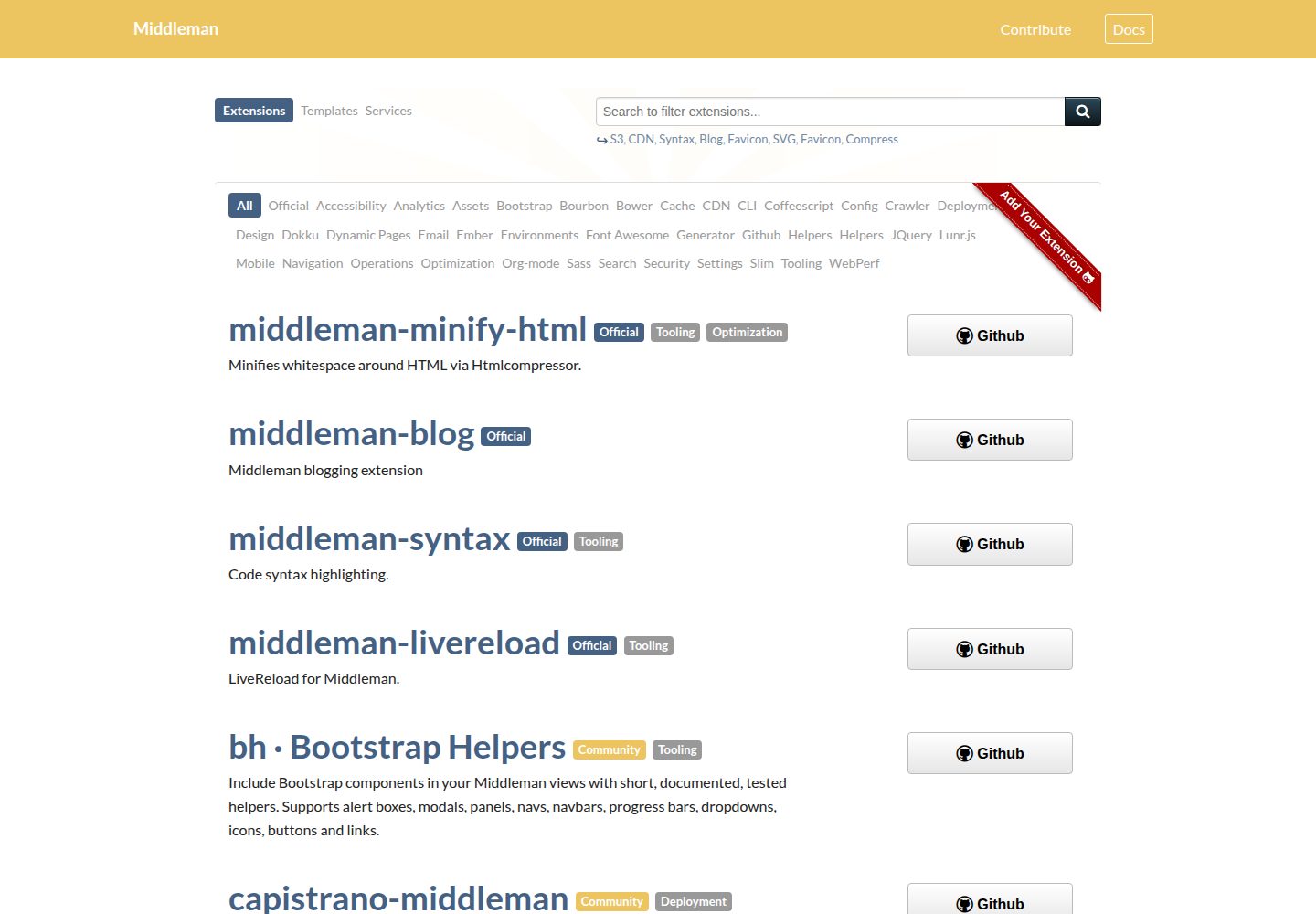
middleman-directory
Source files for the directory.middlemanapp.com directory site, which lists Middleman extensions, templates and services.
HTML · Directory site

classimax-bootstrap
Classimax is a free Bootstrap classified website template by Themefisher under the MIT license, offering over 20 static pages for home, categories, ad listings, stores, user center, and blog, with jQuery and other plugins plus a Gulp build workflow.
HTML · Directory site
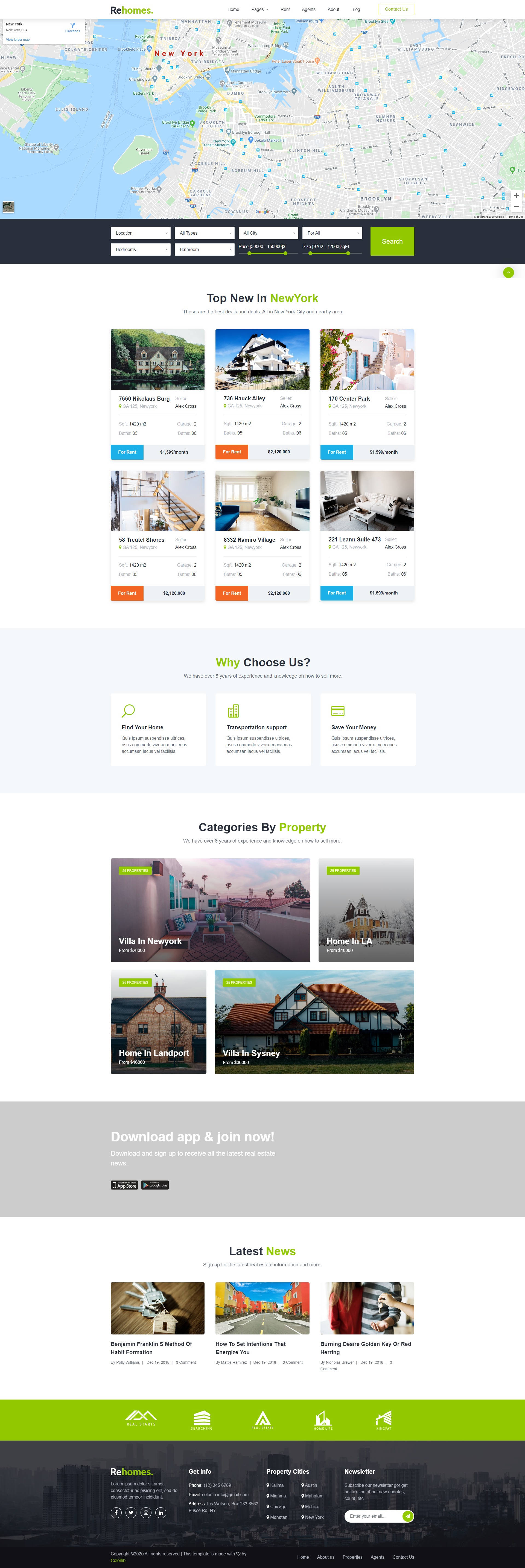
rehomes-colorlib
Rehomes is a Bootstrap-based HTML template for real estate listing websites, originally designed by Colorlib and adapted for October CMS by singdisain.
HTML · Directory site
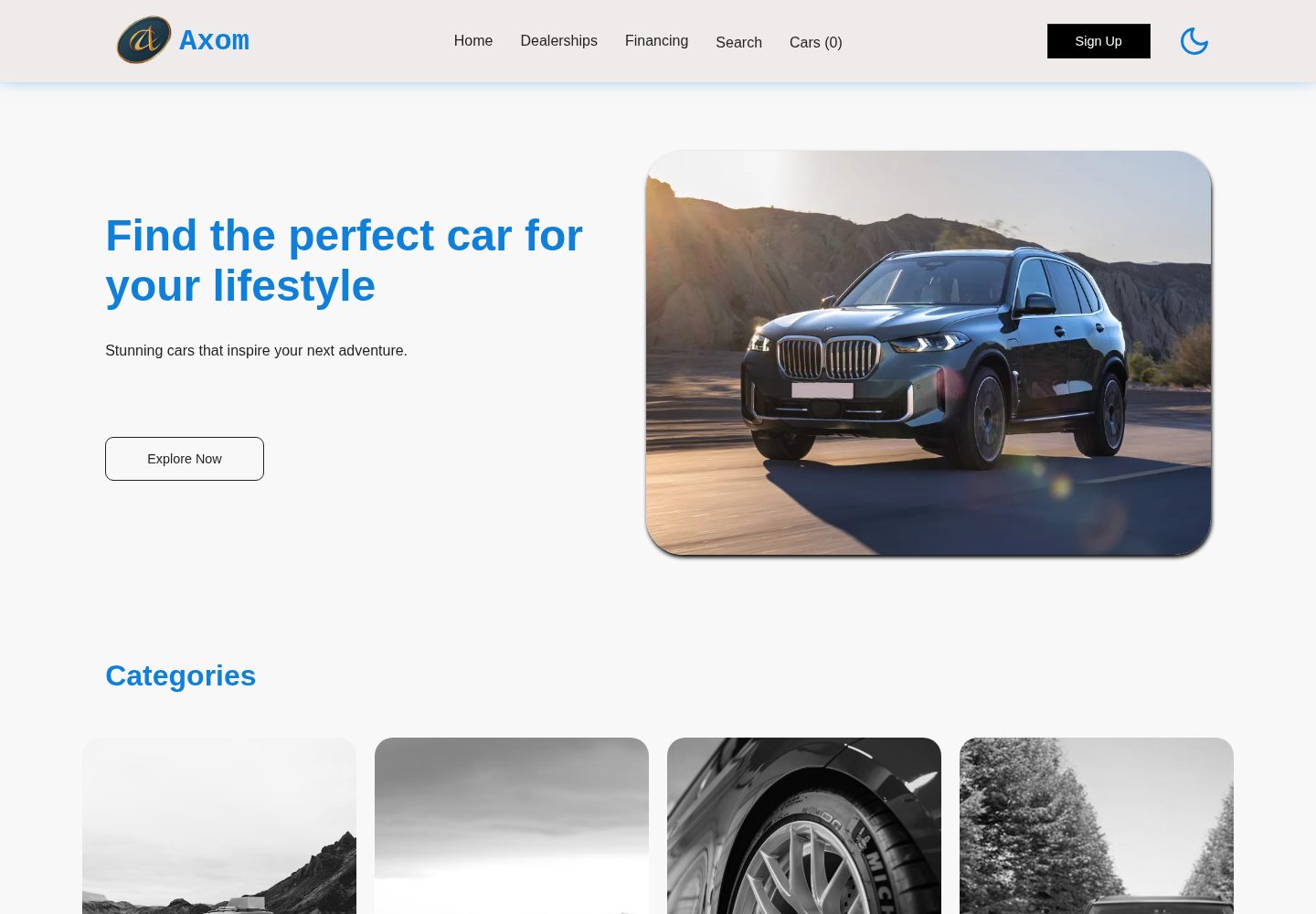
axom-car-dealership-website-html-css-js
Axom is a responsive car dealership website template built with HTML, CSS, and JavaScript.
HTML · Directory site
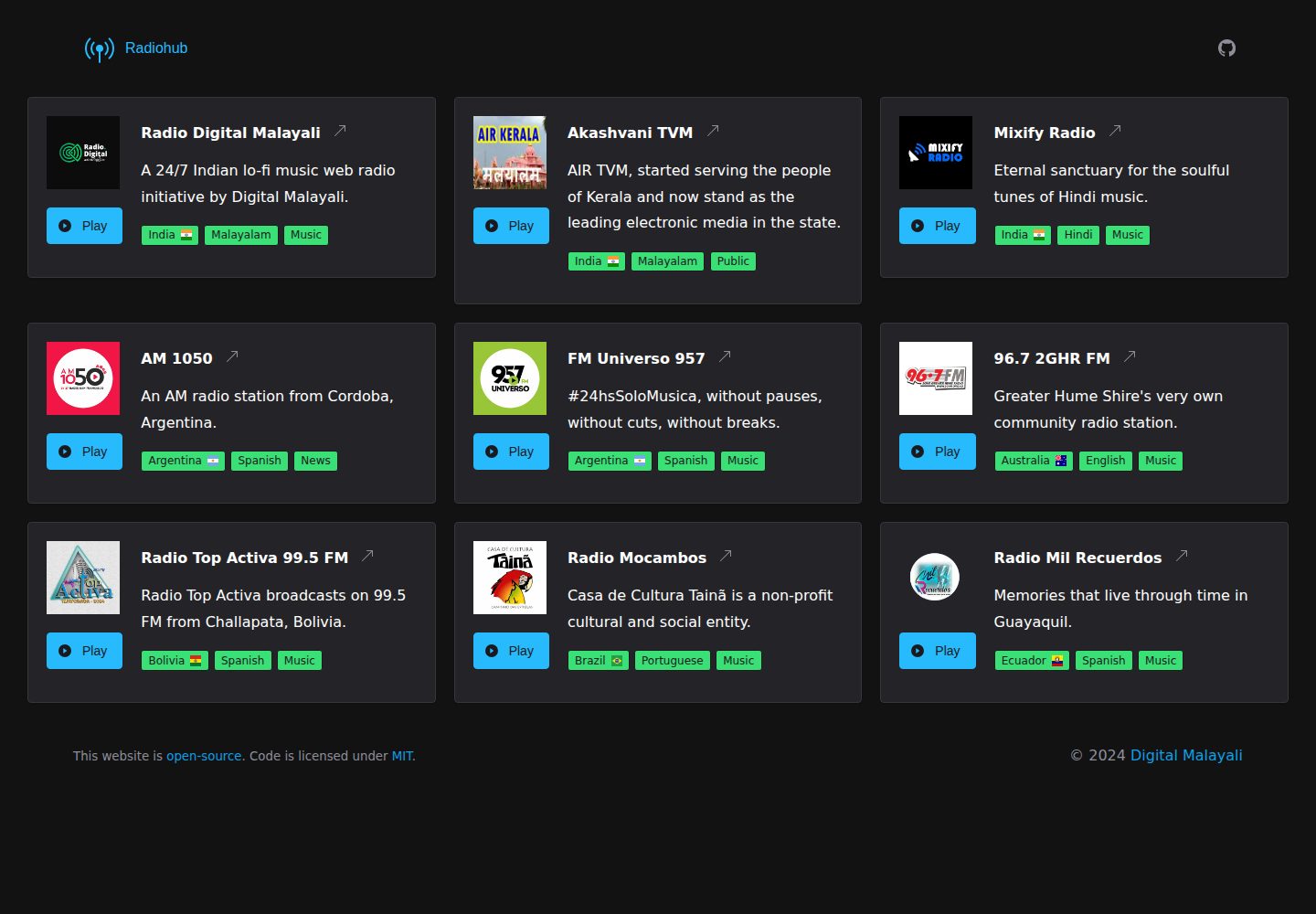
Radiohub
Radiohub is a free, open-source static HTML template for building an online radio directory. It uses the Shoelace component library and Flag Icons, supports playing radio streams directly within the page, and can be installed as a PWA.
HTML · Directory site
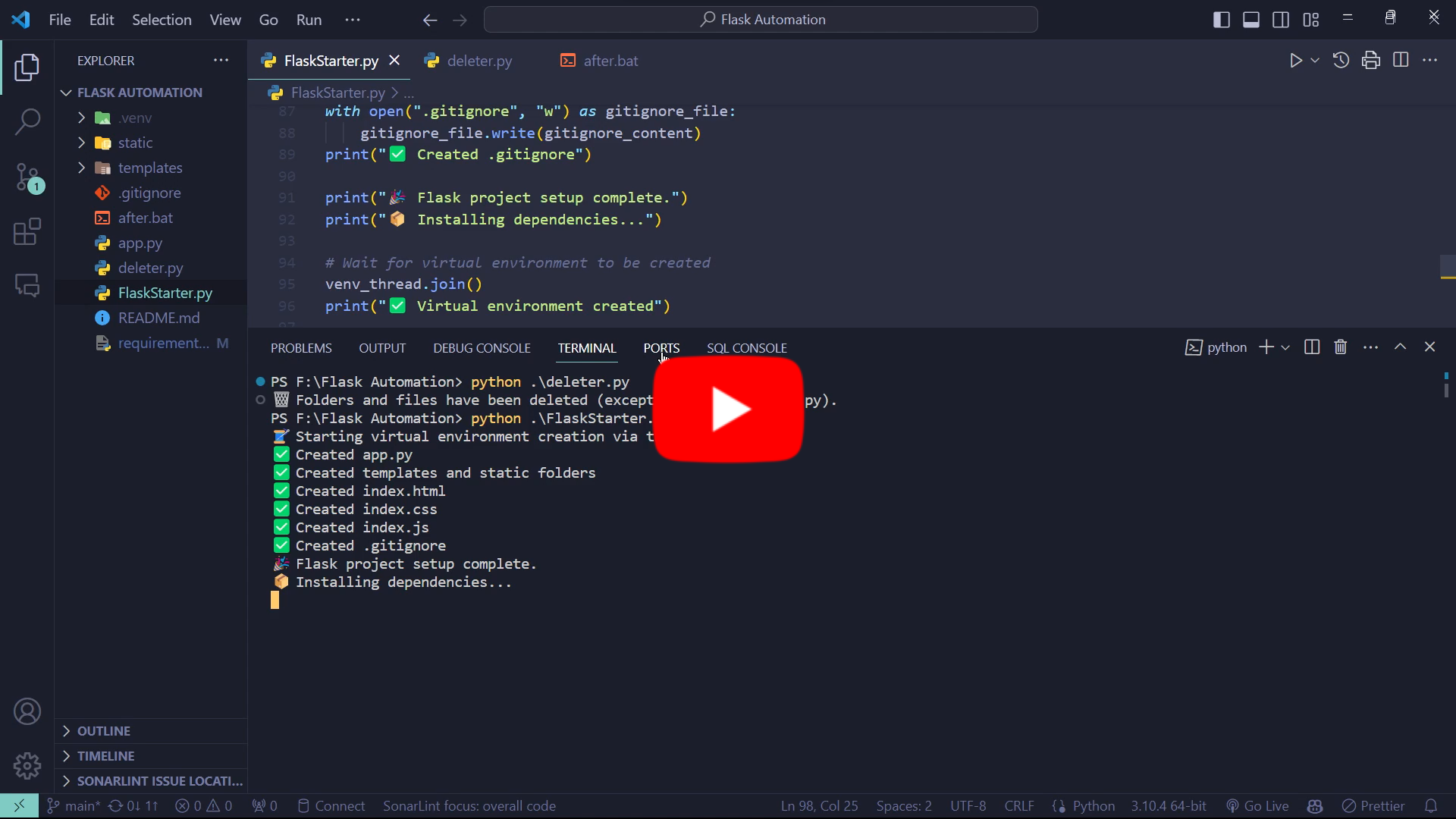
FlaskStarter
FlaskStarter is a PyPI-published command-line tool that generates a Flask project scaffold through a single function call, automatically creating a virtual environment, app.py, templates and static folders, index.html, index.css, index.js, and .gitignore, plus a batch script for installing dependencies and starting the…
HTML · Directory site