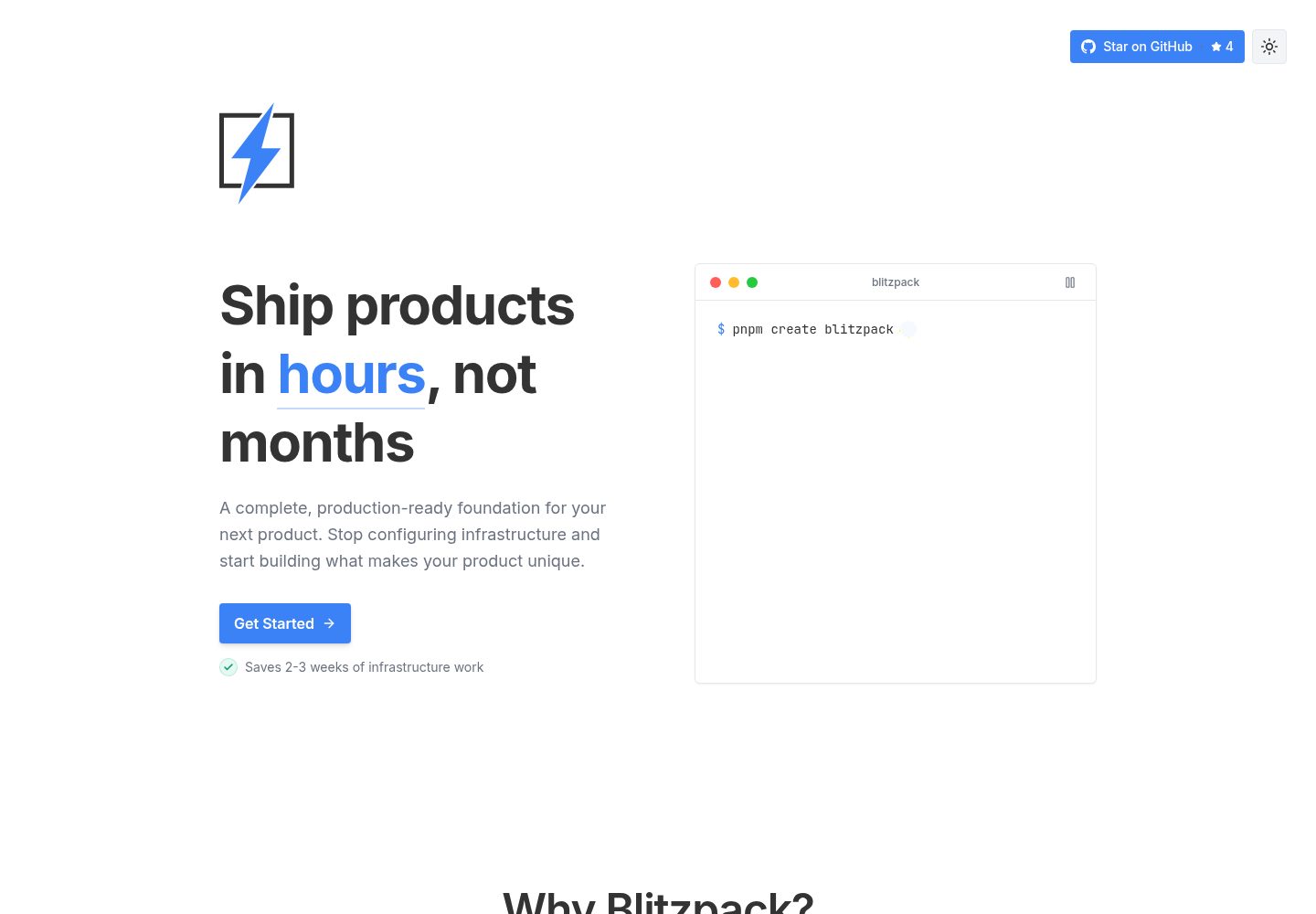
Monorepo structure based on Turborepo and pnpm workspaces, with the frontend in apps/web using Next.js, the API in apps/api using Fastify, and shared packages under packages/
Next.jsReactTool SiteStarter
blitzpack — Next.js Tool Template
By CarboxyDev
Blitzpack is a Turborepo-based full-stack TypeScript monorepo template that includes a Next.js frontend and Fastify API, with built-in modules such as authentication, an admin dashboard, an email system, and API documentation.
Explore the design
Compare the page layouts and mobile experience. Open any screenshot for a closer look.
Desktop homepage1 / 2
Desktop captureTop of page
Actual screenshot captured by the server browser.
All pages & views 2
Screenshots show visual appearance; interactive behavior may differ.
Recorded 2026-10-14View source
What stands out
A quick read of the recorded project description.
Built-in Better Auth authentication system: email/password registration and login, email verification, password reset, Google/GitHub OAuth, role-based access control, session management, and user banning
Provides admin dashboard pages /admin, /admin/users, /admin/sessions, including system monitoring, user CRUD, and session management
The API layer includes Zod validation, Helmet security headers, CORS, role-based rate limiting, Pino structured logging, and Scalar interactive documentation
The email system uses React Email templates integrated with Resend, and supports console preview of emails in the development environment
The development toolchain includes the create-blitzpack CLI, Vitest testing, Husky/lint-staged Git hooks, and Docker Compose for local PostgreSQL
Template Details
Blitzpack is a full-stack TypeScript monorepo template; the repository is https://github.com/CarboxyDev/blitzpack. The README states that it uses Turborepo and pnpm workspaces to organize code, with the frontend in apps/web (Next.js), the API in apps/api (Fastify), and shared code in packages/ under packages such as types, utils, ui, and tailwind-config. The template is initialized with the pnpm create blitzpack command, and the setup wizard offers three configuration options: Recommended, Platform-Agnostic, and Modular; when Modular is selected, features can be customized before scaffolding. The default run addresses listed in the README are Web http://localhost:3000, API http://localhost:8080/api, and API docs http://localhost:8080/docs.
In terms of features, the README describes an authentication and authorization system based on Better Auth, including email/password registration and login, email verification, password reset and change, Google/GitHub OAuth, access control for three roles (user, admin, super_admin), 7-day sessions with automatic refresh, and user banning; the admin dashboard includes three pages: system monitoring, user management, and session management; the API layer provides REST routes for users, sessions, uploads, statistics, metrics, and admin operations, uses Zod for request/response validation, includes Helmet, CORS, role-based rate limiting, and cookie signing, uses Pino structured logging, and generates interactive API documentation via Scalar. The email system uses React Email templates integrated with Resend, and in the development environment emails can be viewed in the console.
In terms of developer experience, the README mentions the create-blitzpack CLI, Vitest testing, Git hooks with Husky and lint-staged, Turborepo caching and parallel execution, Docker Compose for local PostgreSQL, and optional API/Web Dockerfiles and CD workflows. The README does not specify a particular deployment platform, production environment configuration details, performance metrics, or security audit conclusions; the preview screenshots only demonstrate the existence of desktop and mobile page screenshots, not the specific page functionality.
Next.jsReactTool siteLauncher
Is it right for your project?
Use Cases
- Need to quickly set up a full-stack TypeScript project starting point that includes authentication, an admin dashboard, and API documentation
- Want to manage a Next.js frontend, Fastify API, and shared types/utility packages in a unified monorepo
- Need to run PostgreSQL locally via Docker Compose and use Prisma for database migrations
- Need to provide project structure context for AI agents; the README mentions that the repository includes CLAUDE.md documentation
Suitable For
- Developers familiar with TypeScript, Next.js, Fastify, and Prisma
- Full-stack projects that need out-of-the-box authentication and role-based permission control
- Teams that prefer pnpm and Turborepo workflows
- Development environments that want to run PostgreSQL locally using Docker
Getting started & customization
Use these recorded setup notes alongside the repository instructions for your chosen version.
- 1
Use pnpm create blitzpack to initialize the project; the setup wizard guides you through creation and prompts for next steps
- 2
Docker must be installed and running locally to start development services such as PostgreSQL
- 3
During initialization, choose the Recommended, Platform-Agnostic, or Modular configuration; Modular opens feature customization before scaffolding
- 4
Default addresses listed in the README: Web http://localhost:3000, API http://localhost:8080/api, API docs http://localhost:8080/docs
- 5
The README does not provide detailed steps for production deployment platforms, environment variable lists, or CD configuration
License & source material
Usage conditions & limitations
Free to use · keep license noticeThis entry covers the free version under the MIT license in the public repository; the free scope is the code of that version and does not mean that external services or third-party assets are free.
Must comply with when using
- The code of this version may be used, modified, used commercially, and distributed for free.
- When distributing copies or substantial portions of the code, retain the original author's copyright notice and the complete MIT license notice.
- The code is provided as is; warranties and limitations of liability are governed by the original license and applicable law.
Additional costs & items to verify
- Demo images, fonts, icons, and other third-party assets must be checked against their respective licenses and cannot be judged solely by the code's MIT license.
- External services such as domains, hosting, databases, payments, or AI may incur additional charges.
- Local development requires installing and running Docker to start development services such as PostgreSQL.
- Google and GitHub OAuth require configuring the corresponding environment variables before they can be enabled.
- Sending emails in production depends on the Resend API service.
- File storage uses AWS S3 and requires the corresponding external cloud service.
View Original Text Basis
Permission is hereby granted, free of charge
Original License Text
The setup wizard will guide you through project creation and next steps. Make sure you have Docker installed and running on your machine.
Original README
- **OAuth Integration**: Google and GitHub OAuth providers ready to enable with environment variables.
Original README
- **Resend Integration**: Production-ready email sending with Resend API.
Original README
https://github.com/CarboxyDev/blitzpack/blob/main/LICENSEhttps://github.com/CarboxyDev/blitzpack/blob/main/README.md- AWS S3 for file storage
Original README
Compiled by DeepSeek based on repository license and README ·2026-10-14. Results only cover the materials read; dependencies, images, fonts, and subsequent term changes are subject to their respective original texts.
Project checks & description sources
Template Information
- Source platforms
- GitHub
- Documentation and maintenance reference score
- More documented · 88 / 100
- Technologies
- Next.js · React
- Website type
- Tool Site · Starter
How this score is calculated
Our heuristic uses license records (up to 30), a demo link (12), a preview (10), stars (15), recorded maintenance (15), description completeness (8), feature records (5) and classification data (5). It is not a code, security or performance test, or a Google score. A link does not establish tested functionality.
What to verify for this project
- Repository update recorded
- 2026-07-28
- Screenshot last checked
- 2026-10-14
A demo link is listed. Check it with your own content and viewport sizes; its presence does not confirm that forms, authentication or payments work.
The catalog identifies Next.js as the primary stack. Check the actual dependency manifest and lockfile for versions and hosting requirements. These notes use recorded metadata, not a code audit or a deployment test.
Use a selection guide →How this description was prepared
AI-assisted description based on catalog records and repository material. Repository authors are not automatically the reviewers of this description.
Review declaration: codex-user-requested-batch-review-20261015 · 2026-10-15
Inspect the recorded source material
SHA-256: 827ded2c5e8cf3b58e9d8adc3e2239e3000155300626beb65cba7904ba600a5a
2026-10-14T11:39:31.794Z
Source file / repository<div align="center"> <picture> <source media="(prefers-color-scheme: dark)" srcset="assets/logo-dark.svg"> <source media="(prefers-color-scheme: light)" srcset="assets/logo-light.svg"> <img src="assets/logo-light.svg" alt="Blitzpack Logo" height="200"> </picture> <h1>Blitzpack</h1> <p>Full-stack TypeScript monorepo template with Next.js, Fastify, and Turborepo. From zero to production in hours.</p> [](LICENSE) [](https://nodejs.org/) [](https://pnpm.io/) [](https://www.typescriptlang.org/) [](https://github.com/CarboxyDev/blitzpack/actions/workflows/ci.yml) </div> ## Why Blitzpack? Most full-stack templates give you a folder structure and routing. Blitzpack gives you a complete, production-ready application with authentication, admin controls, API infrastructure, observability and several more battle-tested features. You get a solid frictionless foundation to build your next product on. What normally takes 2-3 weeks of infrastructure work is ready in a single command. - **Truly Production-Ready**: Auth flows, rate limiting, structured logging, testing infrastructure and more are configured for production from day one. - **Built for Zero Friction**: Unified tooling, shared packages, monorepo structure and full TypeScript support ensures that all components work seamlessly together. - **No Assembly Required**: Auth flows, email system, admin dashboard, and other core features are already wired up and ready to use. No more wasting time setting up from scratch. - **True full-stack type safety**: Zod schemas validate once, protect everywhere. From API requests to database queries to UI forms. - **Authentication Made Easy**: Login, Sign-up, Email verification, password reset, OAuth (Google/GitHub), role-based access control, session management, and user banning. All wired up and working. Not TODOs but actual implementations. - **Modern UI out of the box** - You get beautiful components with shadcn/ui, Tailwind v4, dark/light mode, theme support and smooth animations. - **Hassle-Free Database** - Prisma ORM with PostgreSQL, easy migrations and Docker setup that just works. - **AI Agent Ready**: The bundled CLAUDE.md documentation gives AI agents instant context about the structure. Ship faster with AI that understands your whole stack. ## Quick Start ```bash pnpm create blitzpack ``` The setup wizard will guide you through project creation and next steps. Make sure you have Docker installed and running on your machine. During setup, choose a profile: - **Recommended**: Core app with everything included. - **Platform-Agnostic**: Core app without dockerfiles. - **Modular**: Core app with features of your choice. If you choose **Modular**, the wizard opens feature customization before scaffolding. **What's running after setup:** - Web: [http://localhost:3000](http://localhost:3000) - API: [http://localhost:8080/api](http://localhost:8080/api) - API Docs: [http://localhost:8080/docs](http://localhost:8080/docs) ## Tech Stack **Web** - Next.js 16 - React 19 - Tailwind CSS v4 for styling - shadcn/ui for UI primitives - TanStack Query for server state - React Hook Form for forms - Recharts for data visualization **API** - Fastify 5 - Prisma 7 and PostgreSQL 17 - Better-auth for authentication - Pino for structured logging - Scalar for API docs - React Email and Resend for emails - AWS S3 for file storage **Monorepo** - Turborepo - pnpm workspaces - Vitest for testing - Husky and lint-staged for git hooks - Shared packages for types, utils, config in `packages/` ## Project Structure ``` blitzpack/ ├── apps/ │ ├── web/ # Next.js frontend (port 3000) │ │ ├── Dockerfile # Web container image (optional deployment) │ │ ├── src/ │ │ │ ├── app/ # Pages and layouts │ │ │ ├── components/ # React components │ │ │ ├── lib/ # API client, utilities │ │ │ ├── hooks/ # Custom React hooks │ │ │ └── store/ # Jotai state atoms │ │ └── public/ # Static assets │ │ │ └── api/ # Fastify API (port 8080) │ ├── Dockerfile # API container image (optional deployment) │ ├── src/ │ │ ├── routes/ # API endpoints │ │ ├── services/ # Business logic │ │ ├── plugins/ # Fastify plugins │ │ ├── hooks/ # Request hooks (auth, validation) │ │ └── config/ # Configuration files │ ├── prisma/ # Database schema & migrations │ └── emails/ # React Email templates │ ├── packages/ │ ├── types/ # Shared types and Zod schemas │ ├── utils/ # Shared utilities │ ├── ui/ # Shared UI components │ └── tailwind-config/ # Shared Tailwind configuration │ ├── deploy/ │ └── docker/ │ └── docker-compose.prod.yml # Local production Docker stack (optional) ├── docker-compose.yml # Development services (PostgreSQL) ├── .github/workflows/cd.yml # Optional CD pipeline for Docker image publishing ├── turbo.json # Turborepo configuration └── pnpm-workspace.yaml # pnpm workspaces configuration ``` ## Features ### Authentication & Authorization Production-ready auth system powered by Better Auth: - **Email/Password Auth**: User signup with email verification, secure password hashing, password reset flow, and password change functionality. - **OAuth Integration**: Google and GitHub OAuth providers ready to enable with environment variables. - **Role-Based Access Control**: Three user roles (user, admin, super_admin) with role-based route protection and API authorization. - **Session Management**: 7-day sessions with automatic refresh, secure cookie-based authentication, and cross-domain support. - **User Banning**: Ban users temporarily or permanently with custom reasons and automatic expiration handling. - **Email Verification**: Send verification emails on signup with resend capability and verification status tracking. **Included pages:** `/login`, `/signup`, `/forgot-password`, `/reset-password` ### Admin Dashboard Complete admin control panel with real-time monitoring and management: - **System Monitoring**: Real-time metrics dashboard with user growth trends, session activity, role distribution, and system health indicators. Auto-refresh functionality with configurable intervals. - **User Management**: Full CRUD operations on users with pagination, sorting, and filtering. Create, edit, ban/unban users with expiration dates, and manage user roles. - **Session Management**: View all active sessions across the platform, inspect session details (IP, device, timestamps), and revoke individual or all user sessions. **Included pages:** `/admin`, `/admin/users`, `/admin/sessions` ### API Infrastructure Battle-tested API architecture: - **Comprehensive Routes**: RESTful API endpoints for users, sessions, uploads, stats, metrics, and admin operations. - **Validation**: Automatic request/response validation with Zod schemas and type-safe route definitions. - **Security**: Helmet security headers, CORS configuration, role-based rate limiting, and cookie signing. - **Logging**: Structured logging with Pino featuring 4 verbosity levels, request ID tracing, and performance metrics. - **Documentation**: Auto-generated OpenAPI specs with interactive Scalar API documentation. ### Developer Experience Optimized workflows and tooling: - **CLI Tool**: `create-blitzpack` interactive setup wizard for instant project scaffolding. - **Comprehensive Scripts**: Development, build, test, lint, and database management commands. - **Testing Suite**: Vitest-powered unit and integration tests with coverage reporting. - **Git Hooks**: Pre-commit linting and formatting, pre-push type checking and testing. - **Turborepo**: Smart caching, parallel execution, and dependency tracking. - **Docker Compose**: PostgreSQL database containerized for consistent local development. - **Optional Deployment Assets**: Dockerfiles for API/Web plus CD workflow for image publishing. ### Email System Transactional email infrastructure with beautiful templates: - **React Email Templates**: Pre-built email templates for verification, password reset, password change, welcome, and account deletion. - **Resend Integration**: Production-ready email sending with Resend API. - **Development Preview**: Console logging of emails in development with React Email dev server.
Explore similar templates
Compare previews and descriptions within the same stack and category.
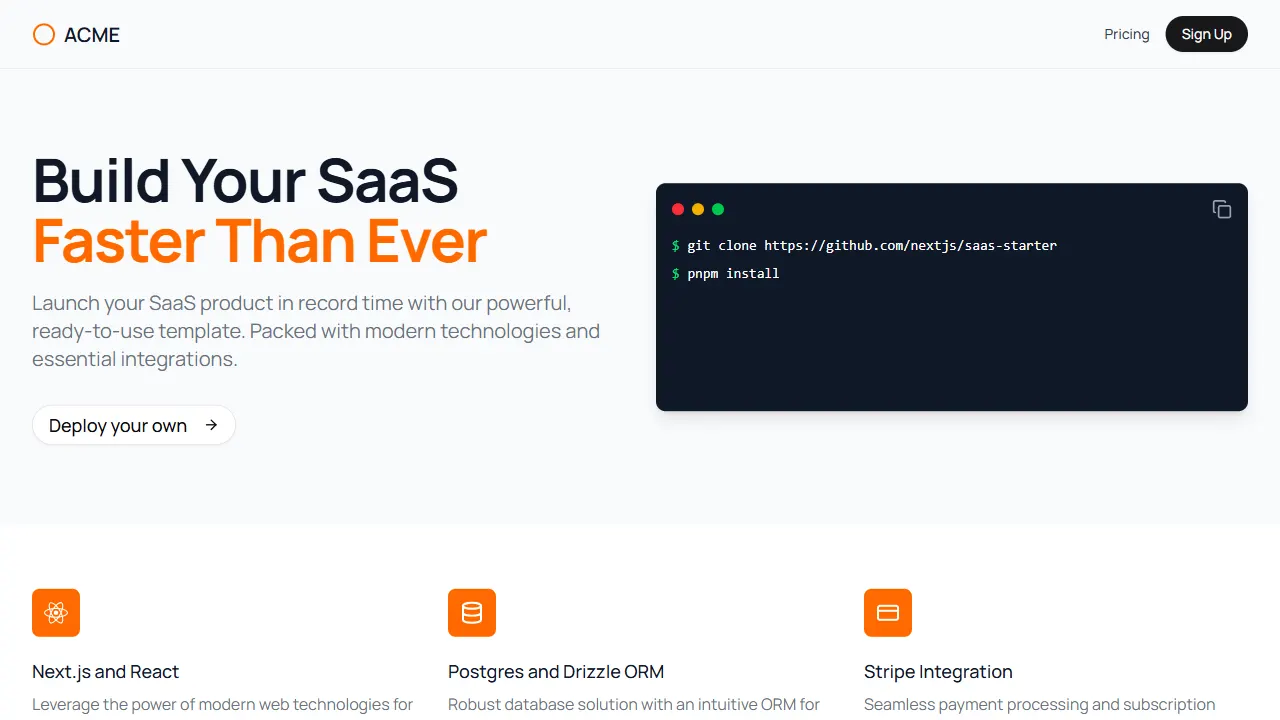
Next.js SaaS Starter
The official Next.js SaaS starter template, integrating email/password authentication, Stripe Checkout subscriptions, a dashboard with user/team CRUD, basic Owner/Member RBAC, and activity logging.
Next.js · SaaS
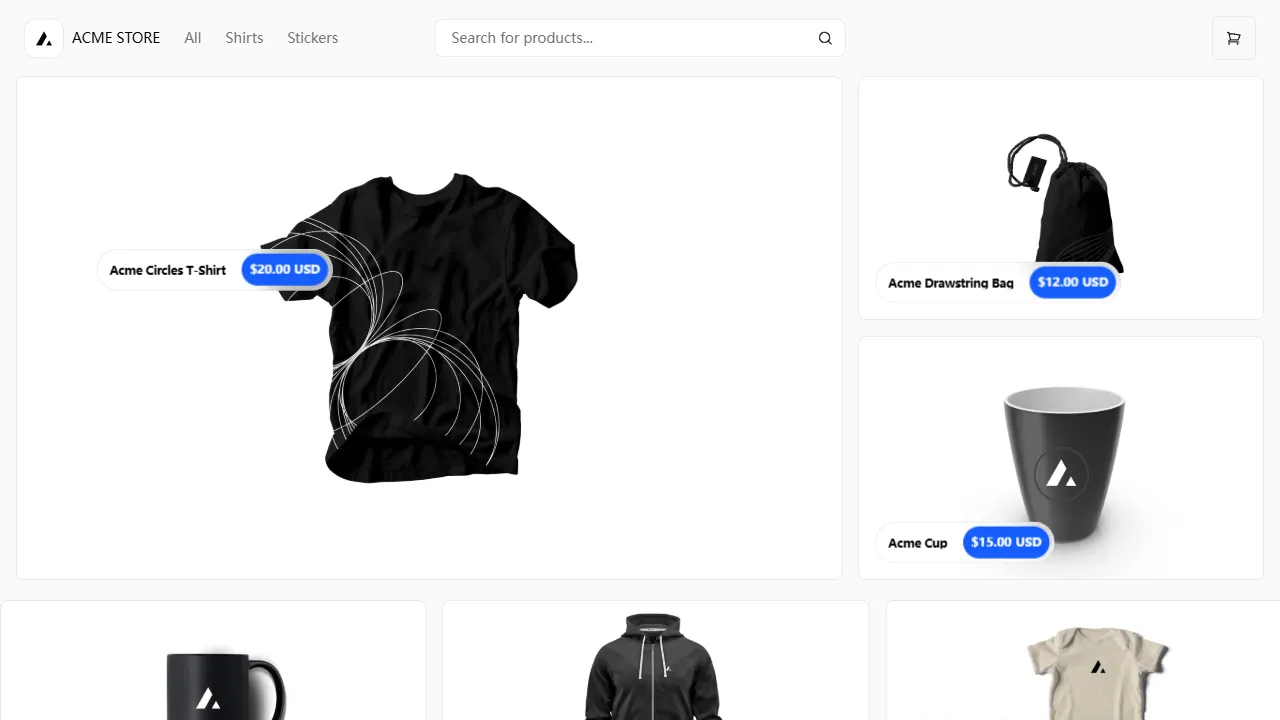
Next.js Commerce
Vercel's officially maintained Next.js App Router ecommerce starter with deep Shopify integration, offering a complete product catalog, cart, and checkout flow. Core logic is modular for swapping backends, and community provider versions exist for BigCommerce, Medusa, and Saleor.
Next.js · E-commerce
Next-js-Boilerplate
A developer-first Next.js 16 starter with Tailwind CSS 4 and TypeScript, supporting both App Router and Page Router.
Next.js · Starter

tailwind-nextjs-starter-blog
A Next.js and Tailwind CSS blog starter template using Contentlayer for Markdown/MDX, with built-in SEO, code highlighting, and tags. It targets personal technical blogs and migration from Jekyll/Hugo to React, and supports one-click Vercel deployment.
Next.js · Blog
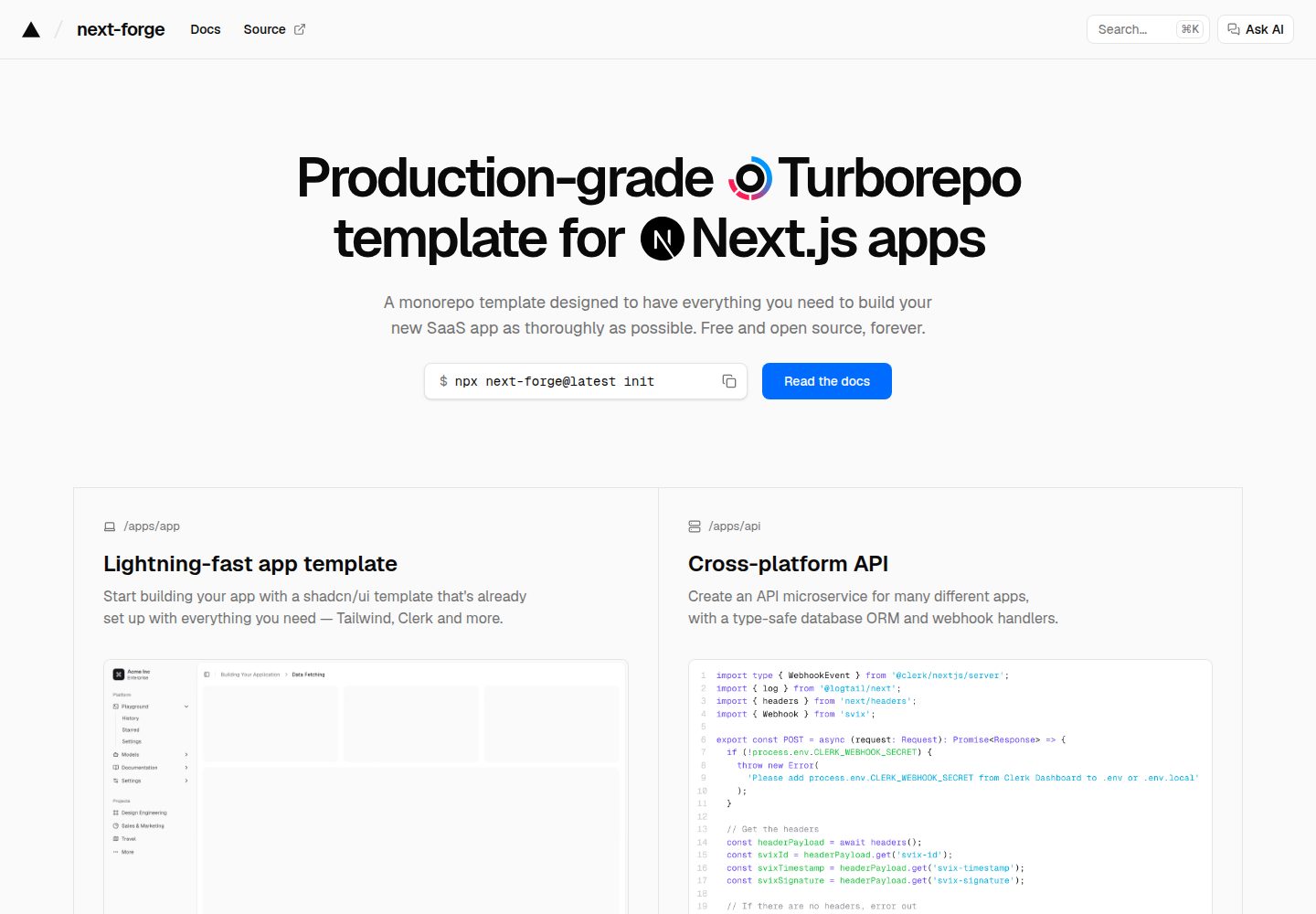
next-forge
next-forge is a Turborepo-based Next.js template maintained by Vercel, positioned as a starting point for SaaS products.
Next.js · Starter
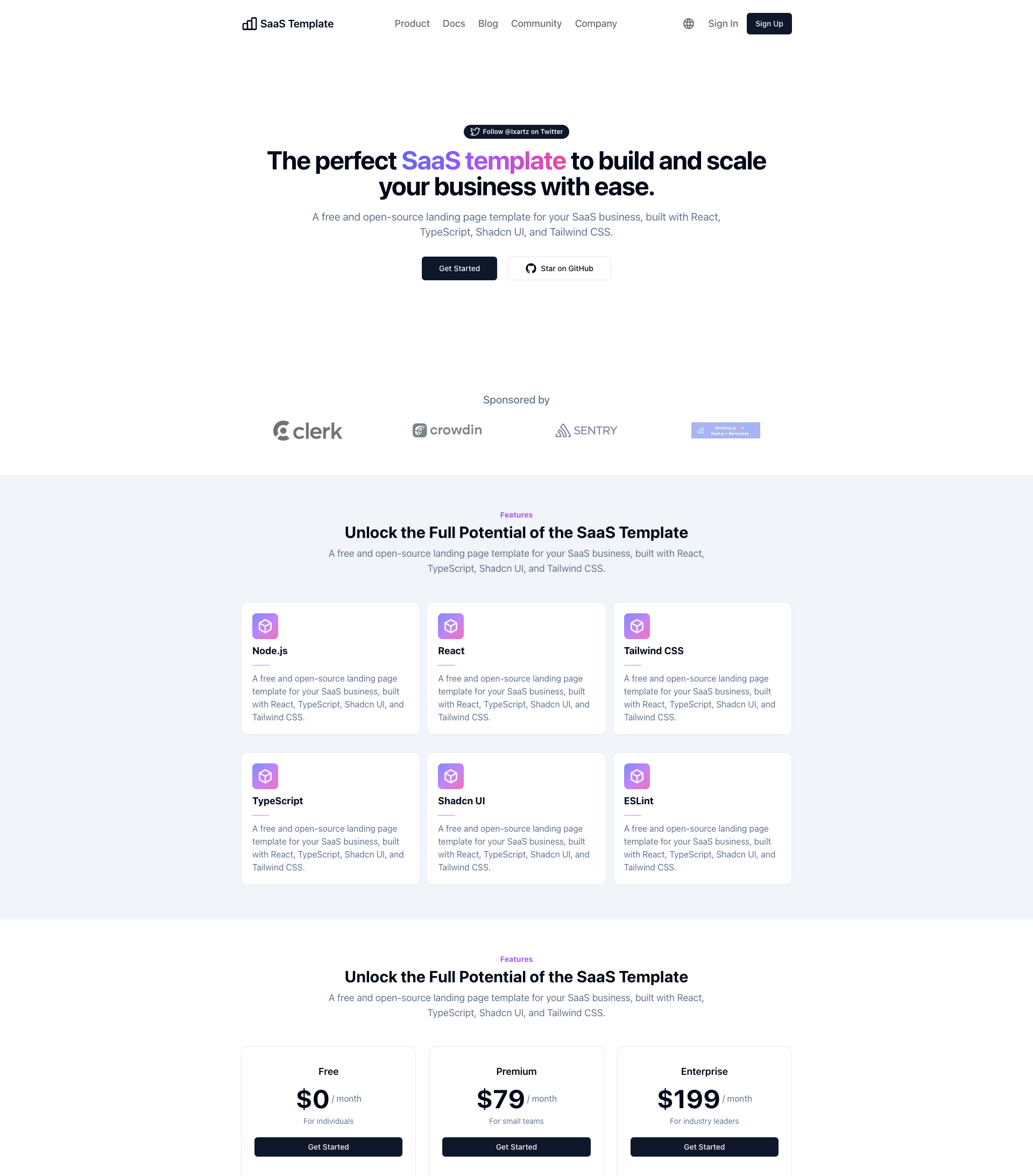
SaaS-Boilerplate
SaaS-Boilerplate is an open-source SaaS starter template built with Next.js App Router, React 19, TypeScript, Tailwind CSS, and Shadcn UI.
Next.js · SaaS