Multi-tenant isolation is implemented at the data access layer; every query automatically injects tenant filtering conditions via TenantScopedRepository
Next.jsReactSaaSStarter
saas-genai-starter — Next.js SaaS Template
By delmalih
An open-source SaaS starter for multi-tenant GenAI products, built on Next.js and FastAPI, with built-in BYO-key model access, RAG with citations, usage billing, and evaluation tools.
Explore the design
Compare the page layouts and mobile experience. Open any screenshot for a closer look.
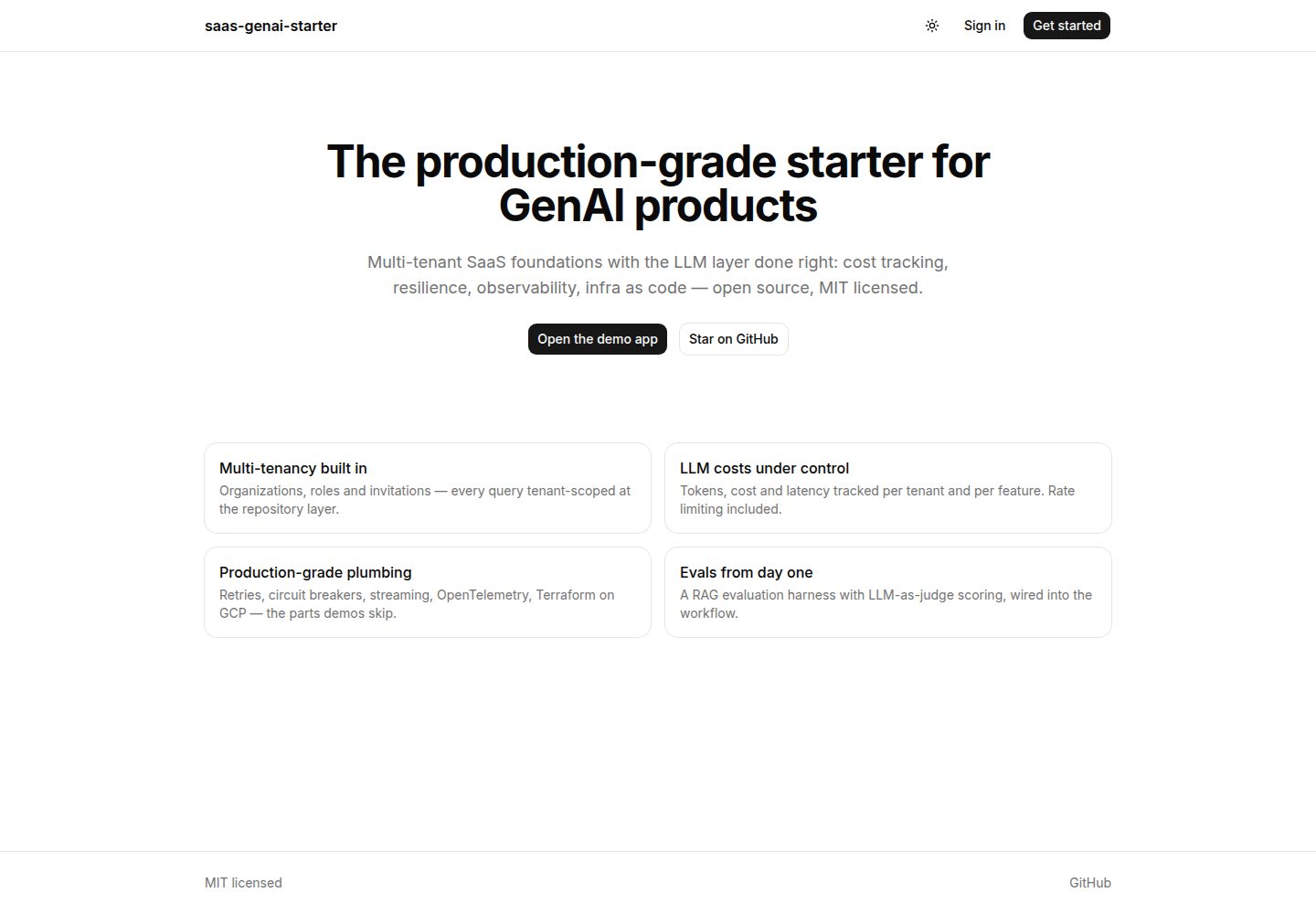
Desktop homepage1 / 2
Desktop captureTop of page
Actual screenshot captured by the server browser.
All pages & views 2
Screenshots show visual appearance; interactive behavior may differ.
Recorded 2026-10-03View source
What stands out
A quick read of the recorded project description.
Supports BYO-key mode, allowing chat providers such as Anthropic, OpenAI, Gemini, Mistral, xAI, DeepSeek, Groq, or OpenRouter to be configured per organization
The RAG pipeline includes asynchronous document parsing, chunking, embedding, and pgvector HNSW retrieval, with answers accompanied by page-level citations
Each LLM call records tokens, cost, latency, and status, supporting daily spend views by feature and model
Built-in evaluation tools use the real pipeline and an LLM judge to score faithfulness and citation correctness
Provides Terraform deployment configuration that can run within the free tiers of multiple services, and includes CI/CD workflows
Template Details
This is an open-source SaaS starter for multi-tenant GenAI products. The repository is MIT-licensed, and the code can be used, modified, and distributed free of charge. The project consists of a Next.js frontend and a FastAPI backend, together with PostgreSQL + pgvector, Redis, and Terraform deployment scripts, providing a complete foundation from authentication and tenant isolation to RAG chat and usage tracking.
At the capability level, it implements multi-tenant isolation enforced at the data layer, authentication and team invitations based on Better Auth, BYO-key key management supporting 8 chat providers and 5 embedding providers (Fernet encryption, write-only API), per-organization LLM call cost tracking, an asynchronous RAG pipeline with page-level citations, OpenTelemetry observability, and LLM-judge-based evaluation tools. The billing module is implemented via Stripe but is disabled by default and must be explicitly enabled.
Regarding usage limitations, the repository code itself is free, but third-party assets such as demo images, fonts, and icons require separate license verification; domains, hosting, databases, payments, and AI services may incur costs. The $0/month deployment mentioned in the README depends on the free tiers of each service and is not a guarantee provided by the code. The project status is v1 and live, but data such as evaluation baselines comes from specific models and configurations and does not constitute a general performance promise.
Next.jsSaaSStarter
Is it right for your project?
Use Cases
- Teams that need to quickly build a multi-tenant GenAI SaaS product prototype
- Products that want each customer to bring their own model API key and be billed independently
- Building document-based Q&A or knowledge base chat applications
- Development workflows that need to evaluate RAG answer quality and citation accuracy
- Individuals or small teams validating a full-stack GenAI product architecture within free tiers
Suitable For
- Full-stack developers familiar with Next.js and FastAPI
- GenAI product teams that need multi-tenancy and usage tracking
- Developers who want to build on MIT-licensed code for secondary development
- Technical teams focused on RAG citations and evaluation toolchains
Getting started & customization
Use these recorded setup notes alongside the repository instructions for your chosen version.
- 1
Requires Node 22 or later, pnpm, uv, and a Docker runtime environment
- 2
Run make setup, make migrate, and make dev to start the local development environment; run make worker in a separate terminal to process document ingestion
- 3
Paste your own provider key in Settings → AI Provider, or set a server-side global key in apps/api/.env as a fallback
- 4
RAG functionality requires an additional embedding model key, such as Voyage AI or an OpenAI/Gemini/Mistral key
- 5
Billing is disabled by default; Stripe-related environment variables must be configured before enabling it
License & source material
Usage conditions & limitations
Free to use · keep license noticeThis entry covers the free version under the MIT license in the public repository; the free scope is the code of this version and does not mean that external services or third-party assets are free.
Must comply with when using
- The code of this version may be used, modified, used commercially, and distributed free of charge.
- When distributing copies or substantial portions of the code, retain the original author's copyright notice and the full MIT license notice.
- The code is provided as is; warranties and limitations of liability are governed by the original license and applicable law.
Additional costs & items to verify
- Demo images, fonts, icons, and other third-party assets must be checked against their respective licenses and cannot be judged solely by the code's MIT license.
- External services such as domains, hosting, databases, payments, or AI may incur additional charges.
- Using RAG functionality requires an additional embedding model key: when paired with Anthropic, a Voyage AI key is required (a free tier is available), or use an OpenAI/Gemini/Mistral key to cover both chat and embeddings.
- You must provide and configure an AI provider API key yourself: it can be pasted per organization in settings, or a server-side global key can be set in apps/api/.env as a fallback.
- Billing is disabled by default and must be explicitly enabled via the BILLING_ENABLED flag; once enabled, a Stripe subscription service is required and a Stripe account must be configured.
- The $0/month deployment depends on the free tiers of external services (Cloud Run, Neon, Upstash, GCS, Vercel, etc.); exceeding the free tiers may incur costs, and this is not a guarantee provided by the code.
- Running requires Node 22 or later, pnpm, uv, and a Docker runtime environment.
View Original Text Basis
Permission is hereby granted, free of charge
Original License Text
For RAG you also need an embeddings key: **Voyage AI** (free tier) with Anthropic, or your OpenAI/Gemini/Mistral key covers both.
Original README
paste your provider key in *Settings → AI Provider* (per-organization, encrypted at rest), or - set server-wide keys in `apps/api/.env` (`ANTHROPIC_API_KEY`, `VOYAGE_API_KEY`, …) as the fallback for every org.
Original README
**Billing, opt-in** — Stripe subscriptions (Checkout + customer portal + signature-verified webhooks) behind a `BILLING_ENABLED` flag, with plan-based rate limits (free/pro) and upgrade prompts when quotas are hit. Off by default: no Stripe code runs and no Stripe account is needed.
Original README
The [Terraform in `infra/`](infra/terraform) deploys the whole stack inside free tiers, with CI/CD included:
Original README
https://github.com/delmalih/saas-genai-starter/blob/main/LICENSEhttps://github.com/delmalih/saas-genai-starter/blob/main/README.md**Prerequisites**: Node ≥ 22, pnpm (`corepack enable pnpm`), [uv](https://docs.astral.sh/uv/), and a Docker runtime (Docker Desktop or `brew install colima docker-compose && colima start`).
Original README
Compiled by DeepSeek based on repository license and README ·2026-10-05. Results only cover the materials read; dependencies, images, fonts, and subsequent term changes are subject to their respective original texts.
Project checks & description sources
Template Information
- Source platforms
- GitHub
- Documentation and maintenance reference score
- More documented · 88 / 100
- Technologies
- Next.js · React
- Website type
- SaaS · Starter
How this score is calculated
Our heuristic uses license records (up to 30), a demo link (12), a preview (10), stars (15), recorded maintenance (15), description completeness (8), feature records (5) and classification data (5). It is not a code, security or performance test, or a Google score. A link does not establish tested functionality.
What to verify for this project
- Repository update recorded
- 2026-06-25
- Screenshot last checked
- 2026-10-05
A demo link is listed. Check it with your own content and viewport sizes; its presence does not confirm that forms, authentication or payments work.
The catalog identifies Next.js as the primary stack. Check the actual dependency manifest and lockfile for versions and hosting requirements. These notes use recorded metadata, not a code audit or a deployment test.
Use a selection guide →How this description was prepared
AI-assisted description based on catalog records and repository material. Repository authors are not automatically the reviewers of this description.
Review declaration: [email protected] · 2026-10-05
Inspect the recorded source material
SHA-256: 8a7a639f77a5044f18e0de2d839e954ad49a8524d2acb9197c84e9ed0716faf5
2026-10-05T03:25:28.434Z
Source file / repository# saas-genai-starter
[](https://github.com/delmalih/saas-genai-starter/actions/workflows/ci.yml)
[](LICENSE)
[](https://saas-genai-starter-web.vercel.app)
**A production-grade, open-source starter for multi-tenant GenAI SaaS** — the
parts demo-grade starters ignore: multi-tenancy enforced at the data layer,
LLM cost tracking per organization, provider resilience, bring-your-own-key
support for 8 chat providers, observability, async ingestion, an eval harness
that caught real bugs before launch, and a $0/month deployment.
Built with **Next.js 15 · FastAPI · PostgreSQL + pgvector · Terraform**.
## ✨ Try it now
**[saas-genai-starter-web.vercel.app](https://saas-genai-starter-web.vercel.app)**
— sign up, paste your own API key (Anthropic, OpenAI, Gemini, Mistral, xAI,
DeepSeek, Groq or OpenRouter) in *Settings → AI Provider*, upload a PDF and
chat with it. Streamed answers, page-level citations, live cost tracking.
The demo runs the exact code in this repo on infrastructure that costs its
maintainer **0€/month** (details [below](#the-0month-deployment)). Your keys
are Fernet-encrypted at rest and write-only through the API.
## What's inside
- **Multi-tenancy you can't bypass** — every query goes through a
tenant-scoped repository that injects the filter at construction;
forgetting it is structurally impossible. Cross-tenant isolation has
dedicated tests.
- **Auth done right** — [Better Auth](https://better-auth.com) in Next.js
(email/password + Google/GitHub SSO, env-gated), FastAPI validates its
JWTs via JWKS. Roles (owner/admin/member), team invitations with
single-use hashed tokens.
- **Bring-your-own-key, multi-provider** — each organization picks its
provider (Anthropic, OpenAI, Google Gemini, Mistral, xAI, DeepSeek, Groq
or OpenRouter for chat; Voyage, OpenAI, Gemini, Mistral or Cohere for
embeddings), its model, and pastes its own API keys — encrypted at rest
(Fernet), write-only through the API, never logged. Server-wide env keys
remain as the self-host fallback, and OpenAI-compatible providers are a
[catalog entry away](docs/extending-llm-providers.md).
- **LLM costs under control** — every call (chat, RAG, ingestion,
extraction) writes a usage row: tokens (including cache reads), cost in
USD from a versioned pricing table, latency, status. Usage survives
client disconnects and mid-stream failures. A dashboard shows daily
spend per feature and model.
- **Resilience as a layer, not an afterthought** — provider-agnostic
retries with jitter, `retry-after` honored, circuit breaker with
half-open probes (429s don't trip it — throttling isn't an outage).
- **RAG pipeline** — async ingestion (parse → chunk with page numbers →
embed → pgvector HNSW), agentic chat with a search tool, citations
persisted with messages, per-tenant rate limiting (Redis, fail-open),
structured-output metadata extraction.
- **Observability** — OpenTelemetry traces (FastAPI/SQLAlchemy/httpx +
`llm.call` spans carrying model, tokens and cost), structured logs with
request and tenant ids.
- **Evals from day one** — `make evals` runs the real pipeline against a
fixture corpus and scores it with an LLM judge. Current baseline:
**0.96 overall** (faithfulness 0.99, citations 0.93) on
`claude-sonnet-4-6`. The first run scored 0.57 and exposed two real
bugs — see [Why these choices](#why-these-choices).
- **Billing, opt-in** — Stripe subscriptions (Checkout + customer portal +
signature-verified webhooks) behind a `BILLING_ENABLED` flag, with
plan-based rate limits (free/pro) and upgrade prompts when quotas are
hit. Off by default: no Stripe code runs and no Stripe account is
needed.
- **Agent-bootstrappable** — point Claude Code (or any coding agent) at
[`BOOTSTRAP.md`](BOOTSTRAP.md) with five parameters and it turns the
starter into *your* named, branded product with green tests
(`make bootstrap` for humans).
## Architecture
```mermaid
flowchart LR
subgraph web["apps/web — Next.js 15 (Vercel)"]
UI[App UI] --> BA[Better Auth<br/>sessions + EdDSA JWT]
end
subgraph api["apps/api — FastAPI (Cloud Run, scale-to-zero)"]
MW[JWT via JWKS<br/>+ X-Org-Id tenant scope] --> DOM[Domains<br/>chat · documents · usage<br/>billing · admin]
DOM --> LLM[LLM layer<br/>catalog · resilience · pricing]
DOM --> RL[Rate limiter<br/>per-tenant, plan-aware]
JOBS["/internal/jobs<br/>parse → chunk → embed"]
end
UI -->|"typed client (OpenAPI)"| MW
BA -.->|JWKS| MW
LLM --> CHAT["Chat: Anthropic · OpenAI · Gemini<br/>Mistral · xAI · DeepSeek · Groq · OpenRouter"]
LLM --> EMB["Embeddings: Voyage · OpenAI<br/>Gemini · Mistral · Cohere"]
DOM --> PG[("Postgres + pgvector<br/>(Neon)")]
JOBS --> PG
RL --> RD[("Redis<br/>(Upstash)")]
DOM --> GCS[("Blob storage<br/>local disk / GCS")]
DOM -->|enqueue| CT["Cloud Tasks (prod)<br/>ARQ on Redis (local)"]
CT -->|"OIDC-signed push"| JOBS
```
Background jobs need no always-on worker in production: the API enqueues a
Cloud Tasks task, which pushes an OIDC-signed HTTP request back to the same
scale-to-zero service. Locally the same job code runs on an ARQ worker —
the queue is an interface, the swap is configuration.
## The $0/month deployment
The [Terraform in `infra/`](infra/terraform) deploys the whole stack inside
free tiers, with CI/CD included:
| Piece | Service | Why it's free |
|---|---|---|
| API | Cloud Run | scale-to-zero, CPU billed only while serving |
| Jobs | Cloud Tasks | push queue — no idle worker to pay for |
| Database | Neon Postgres | serverless free tier, pgvector included |
| Rate limiting | Upstash Redis | free tier, per-request pricing model |
| Documents | GCS | always-free tier (US regions) |
| Web | Vercel Hobby | static + serverless |
| LLM usage | — | every org brings its own keys |
| CD | GitHub Actions | keyless deploys via Workload Identity Federation |
`git push` on `main` builds the image, runs Alembic against Neon (connection
string fetched from Secret Manager, masked in logs), deploys the new
revision and smoke-checks `/health` — no JSON service-account keys anywhere.
## Quickstart
**Prerequisites**: Node ≥ 22, pnpm (`corepack enable pnpm`),
[uv](https://docs.astral.sh/uv/), and a Docker runtime (Docker Desktop or
`brew install colima docker-compose && colima start`).
```bash
git clone https://github.com/delmalih/saas-genai-starter && cd saas-genai-starter
make setup # deps + .env files
make migrate # database schema
make dev # postgres+redis (docker), API on :8000, web on :3000
make worker # in a second terminal — document ingestion
```
Sign up on http://localhost:3000, then either:
- paste your provider key in *Settings → AI Provider* (per-organization,
encrypted at rest), or
- set server-wide keys in `apps/api/.env` (`ANTHROPIC_API_KEY`,
`VOYAGE_API_KEY`, …) as the fallback for every org.
For RAG you also need an embeddings key: **Voyage AI** (free tier) with
Anthropic, or your OpenAI/Gemini/Mistral key covers both.
**Making it yours**: [`BOOTSTRAP.md`](BOOTSTRAP.md) — written for coding
agents — renames, rebrands and re-domains the starter from five parameters.
## Evals
```bash
make evals # full run, ~7 min (paced for Voyage free tier)
make evals ARGS="--min-score 0.8"
```
The harness ingests a fixture corpus with **real embeddings** into a
dedicated database, runs the **real agent loop**, and grades every answer
with an LLM judge on faithfulness and citation correctness — including
negative cases where the right answer is "that's not in the documents".
Per-commit results land in [`evals/results/`](evals/results/).
| Metric | Baseline (claude-sonnet-4-6) |
|---|---|
| Overall | **0.963** |
| Faithfulness | 0.993 |
| Citation correctness | 0.933 |
## Why these choices
The decisions that make this starter production-grade rather than demo-grade
— several were validated the hard way:
- **Tenant isolation lives in the repository layer, not in code review.**
`TenantScopedRepository` takes the tenant at construction and injects the
filter into every query; `add()` overwrites forged tenant ids. You can't
forget a `WHERE tenant_id = ...` because you never write one.
- **`lazy="raise"` on every relationship.** Async SQLAlchemy turns implicit
lazy loads into `MissingGreenlet` errors that depend on garbage-collection
timing. A flaky test traced back to exactly that — now any unloaded
relationship access fails loudly and deterministically, and eager loading
is explicit.
- **The eval harness paid for itself on day one.** First run: 0.57. It
exposed that tool results sent the model a 400-char UI snippet instead of
full chunk content (the agent cited the right document while claiming the
information wasn't there), and that the agent answered general-knowledge
questions from memory without searching. Both fixed; baseline 0.96. No
unit test could have caught either.
- **Usage rows survive failure.** Provider costs are incurred even when the
client disconnects mid-stream — so usage records are written and committed
on the error path, with output estimated from streamed characters.
- **429 ≠ outage.** Rate limiting is backpressure with its own pacing
(`retry-after`); only real failures (5xx, timeouts) feed the circuit
breaker.
- **BYO keys are write-only.** Org API keys are Fernet-encrypted at rest and
the API only ever returns `is_set` + the last 4 characters. A database
leak does not leak provider keys.
- **One normalized message format, many providers.** Domain code speaks one
block vocabulary; each provider translates to its own dialect. The agent
loop runs unchanged on Claude, GPT, Gemini, Mistral, Grok and friends —
and a parameterized test enforces the new-provider checklist (pricing
entry, key column, settings field) straight from the catalog.
- **Queues and storage behind interfaces.** ARQ/local-disk for dev,
Cloud Tasks/GCS adapters for prod — swapping is configuration, not
refactoring.
## Project structure
```
apps/
├── web/ # Next.js 15 — Better Auth, typed OpenAPI client, chat UI
└── api/ # FastAPI — src/core (auth, tenancy, telemetry),
# src/llm (catalog, providers, resilience, pricing),
# src/domains (chat, documents, usage, billing, admin, ...)
evals/ # eval harness, fixture corpus, per-commit results
infra/terraform/ # the $0-tier deployment (modules + demo environment)
BOOTSTRAP.md # agent-driven "make it yours" guide + scripts/bootstrap.py
```
More docs: [extending the LLM layer](docs/extending-llm-providers.md) ·
[auth flow](docs/auth-flow.md) · [deployment](docs/deploy.md) ·
[backlog & decisions](tech-steps.md)
## Status
**v1 is live** — [demo](https://saas-genai-starter-web.vercel.app) deployed
from this repo, CI green, eval baseline 0.96. The full build history is
ticket-by-ticket in [`tech-steps.md`](tech-steps.md), including the
decisions and the post-launch roadmap.
## License
[MIT](LICENSE)
Explore similar templates
Compare previews and descriptions within the same stack and category.

Next.js SaaS Starter
The official Next.js SaaS starter template, integrating email/password authentication, Stripe Checkout subscriptions, a dashboard with user/team CRUD, basic Owner/Member RBAC, and activity logging.
Next.js · SaaS

Next.js Commerce
Vercel's officially maintained Next.js App Router ecommerce starter with deep Shopify integration, offering a complete product catalog, cart, and checkout flow. Core logic is modular for swapping backends, and community provider versions exist for BigCommerce, Medusa, and Saleor.
Next.js · E-commerce

Next-js-Boilerplate
A developer-first Next.js 16 starter with Tailwind CSS 4 and TypeScript, supporting both App Router and Page Router.
Next.js · Starter

tailwind-nextjs-starter-blog
A Next.js and Tailwind CSS blog starter template using Contentlayer for Markdown/MDX, with built-in SEO, code highlighting, and tags. It targets personal technical blogs and migration from Jekyll/Hugo to React, and supports one-click Vercel deployment.
Next.js · Blog

next-forge
next-forge is a Turborepo-based Next.js template maintained by Vercel, positioned as a starting point for SaaS products.
Next.js · Starter

SaaS-Boilerplate
SaaS-Boilerplate is an open-source SaaS starter template built with Next.js App Router, React 19, TypeScript, Tailwind CSS, and Shadcn UI.
Next.js · SaaS