Shared platform service centralizes tenants, users, JWT/JWKS authentication, billing, SMTP email and audit logging
Next.jsReactSaaSStarter
evo.platform — Next.js SaaS Template
By evomedia-net
evo.platform is a multi-tenant SaaS platform and template toolkit comprising shared platform services, Node and Python SDKs, a Next.js starter template and the evo new scaffold CLI, supporting standalone operation or platform integration.
Explore the design
Compare the page layouts and mobile experience. Open any screenshot for a closer look.
Desktop homepage1 / 3
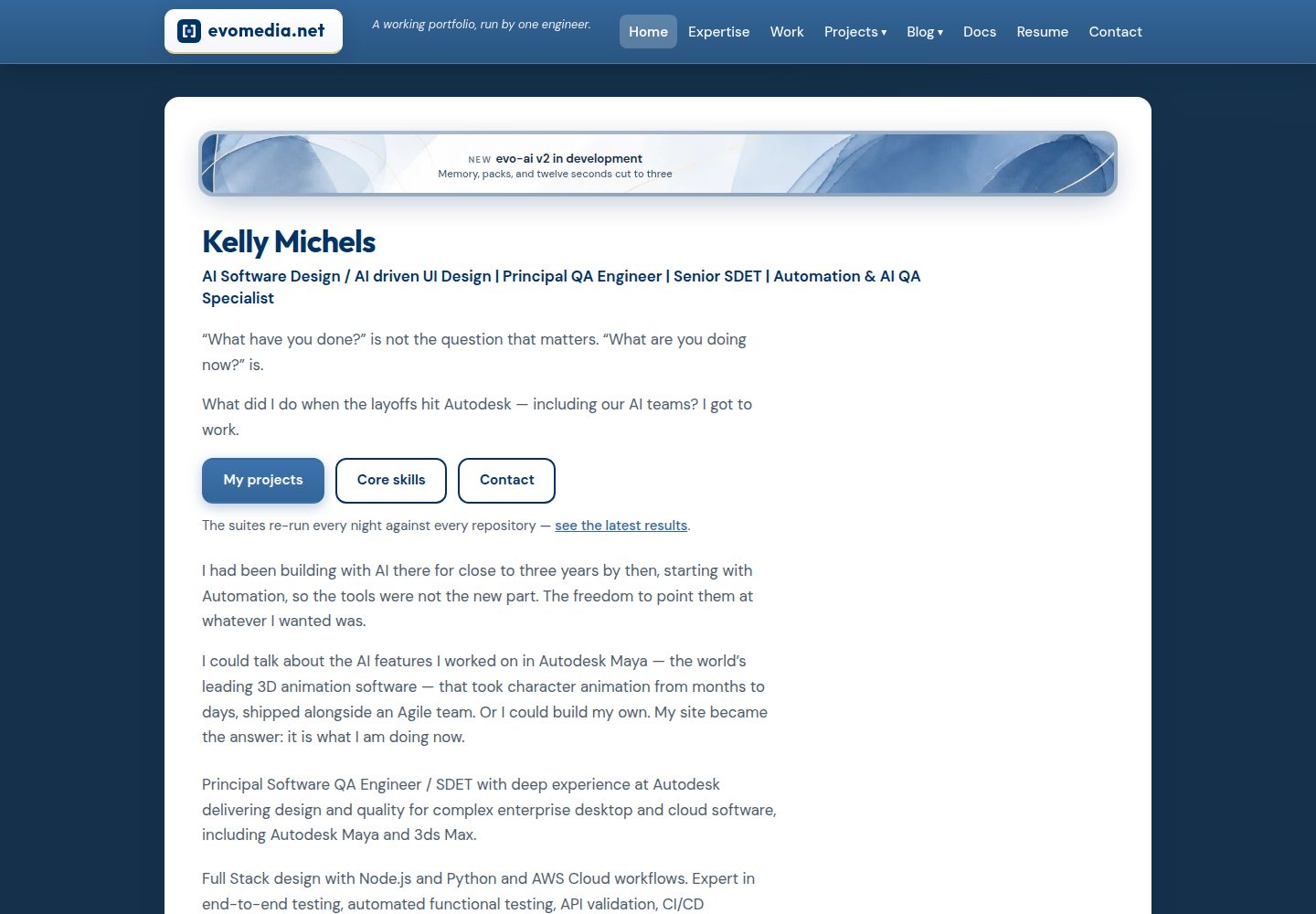
Desktop captureTop of page
Actual screenshot captured by the server browser.
All pages & views 3
Screenshots show visual appearance; interactive behavior may differ.
Recorded 2026-10-01View source
What stands out
A quick read of the recorded project description.
Provides two SDKs, Node and Python, wrapping authentication, tenants, members, invitations, billing, branding and email
The templates/next starter template is based on Next.js + Prisma + PostgreSQL, with an IndexedDB change queue and last-write-wins sync
The evo new scaffold CLI can clone templates, rename and generate keys
Each template runs standalone by default; after setting PLATFORM_URL it can switch to the platform SDK
Template Details
evo.platform extracts the repetitive underlying infrastructure of multi-tenant applications into a shared platform service plus template toolkit. The platform service is built on Node.js/NestJS, Prisma and PostgreSQL, handling tenants, users, authentication (JWT/JWKS), billing, SMTP email and audit logging; one service can serve multiple applications. Two accompanying SDKs (@evoplatform/sdk-node and the Python evoplatform-sdk) wrap authentication, tenants, members, invitations, billing, branding and email so applications need not hand-write HTTP calls. The template part provides templates/next, a Next.js + Prisma + PostgreSQL starter template with an offline-first browser layer (IndexedDB change queue, last-write-wins sync) and adherence to a unified template contract. The scaffold CLI uses evo new <app-name> to clone, rename and generate keys.
Each template runs in standalone mode by default: it uses a local user table, a single implicit tenant, depends on no external services, and can run offline on one machine. After setting PLATFORM_URL and client credentials, authentication, tenants and email switch to the platform SDK. Applications can run standalone first and connect to the platform later. The repository also includes architecture, template contract, deployment and process documentation, where the process documentation uses numbered-step sequence diagrams to illustrate registration, tenant site requests and calls to evo-ai (an independent commercial service; the SDK's AskAi client is optional).
The project states it is at working v1 status: the platform service (including admin console), both SDKs, the Next.js template and the evo new CLI are runnable and tested, and have been used in production across three applications: ProvenSheet, CivilCode and DocketMail. The code is released under the MIT license, but third-party assets such as demo images, fonts and icons require separate license verification, and external services such as domains, hosting, databases, payments or AI may incur additional charges.
Next.jsSaaSStarter
Is it right for your project?
Use Cases
- Teams needing to reuse the same tenant isolation, login, roles and billing logic across multiple applications
- Projects wanting to start from a runnable Next.js template and then integrate shared platform services as needed
- Applications that prefer local development in standalone mode first and later migrate to a multi-tenant platform
- Developers needing Node or Python clients to call authentication, tenant, member and billing APIs
Suitable For
- Development teams building multi-tenant SaaS products
- Projects needing unified authentication, RBAC, billing and audit logging infrastructure
- Developers preferring the Next.js + Prisma + PostgreSQL stack
- Teams wanting to quickly generate a tenant-aware site skeleton with the scaffold
Getting started & customization
Use these recorded setup notes alongside the repository instructions for your chosen version.
- 1
Installation and deployment steps are in docs/INSTALL.md and docs/DEPLOY.md
- 2
The platform service uses Node.js/NestJS, Prisma and PostgreSQL; templates use Next.js + Prisma + PostgreSQL
- 3
Templates run standalone by default; integrating the platform requires setting PLATFORM_URL and providing client credentials
- 4
evo-ai is an independent commercial service; the AskAi client in the SDK is optional
- 5
The code is MIT licensed, but third-party assets and external services require separate license and cost verification
License & source material
Usage conditions & limitations
Free to use · keep license noticeThis entry covers the free version under the MIT license in the public repository; the free scope is that version's code and does not imply that external services or third-party assets are free.
Must comply with when using
- Free use, modification, commercial use and distribution of this version's code are permitted.
- When distributing copies or substantial portions of the code, retain the original author's copyright notice and the full MIT license notice.
- The code is provided as is; warranties and liability limitations are governed by the original license and applicable law.
Additional costs & items to verify
- evo-ai is an independent commercial service; the AskAi client in the SDK is optional. Using that AI feature requires separate payment and depends on external services, and is not part of the free code scope.
- Integrating the shared platform service requires setting PLATFORM_URL and providing client credentials; without it, templates run in standalone mode using a local user table and a single implicit tenant.
- Demo images, fonts, icons and other third-party assets must be verified under their respective licenses and cannot be judged solely by the code's MIT license.
- External services such as domains, hosting, databases, payments or AI may incur additional charges.
View Original Text Basis
Permission is hereby granted, free of charge
Original License Text
**A tenant app asking evo-ai** (separate, commercial service; the SDK's `AskAi` client is optional)
Original README
https://github.com/evomedia-net/evo.platform/blob/main/LICENSEhttps://github.com/evomedia-net/evo.platform/blob/main/README.mdSetting `PLATFORM_URL` (plus client credentials) flips auth, tenancy, and email over to the platform SDK.
Original README
Compiled by DeepSeek based on repository license and README ·2026-10-01. Results only cover the materials read; dependencies, images, fonts, and subsequent term changes are subject to their respective original texts.
Project checks & description sources
Template Information
- Source platforms
- GitHub
- Documentation and maintenance reference score
- More documented · 85 / 100
- Technologies
- Next.js · React
- Website type
- SaaS · Starter
How this score is calculated
Our heuristic uses license records (up to 30), a demo link (12), a preview (10), stars (15), recorded maintenance (15), description completeness (8), feature records (5) and classification data (5). It is not a code, security or performance test, or a Google score. A link does not establish tested functionality.
What to verify for this project
- Repository update recorded
- 2026-09-30
- Screenshot last checked
- 2026-10-01
A demo link is listed. Check it with your own content and viewport sizes; its presence does not confirm that forms, authentication or payments work.
The catalog identifies Next.js as the primary stack. Check the actual dependency manifest and lockfile for versions and hosting requirements. These notes use recorded metadata, not a code audit or a deployment test.
Use a selection guide →How this description was prepared
AI-assisted description based on catalog records and repository material. Repository authors are not automatically the reviewers of this description.
Automatically checked against source and license rules; no manual editorial review.
Inspect the recorded source material
SHA-256: 865bb8116deca147eb52bc04ac2f78827da624df5a31a0108243a3833fd28df3
2026-10-01T00:44:16.649Z
Source file / repository# EvoPlatform  **https://evomedia.net** — built by Kelly Michels · [email protected] A multi-tenant SaaS platform and app-template toolkit. Build a new tenant-aware site by cloning a starter template — tenancy, auth, RBAC, audit logging, and deployment come wired in. > **Status: working v1.** The platform service (with admin console), both SDKs (Node and > Python), the Next.js template, and the `evo new` CLI all run and are tested, and are in > production under three apps: ProvenSheet, CivilCode, and DocketMail. **Setup: [docs/INSTALL.md](docs/INSTALL.md)** · deploy: > [docs/DEPLOY.md](docs/DEPLOY.md) · design: > [docs/ARCHITECTURE.md](docs/ARCHITECTURE.md), [docs/TEMPLATE_CONTRACT.md](docs/TEMPLATE_CONTRACT.md) · flows: > [docs/FLOWS.md](docs/FLOWS.md). ## The idea Most multi-tenant apps re-implement the same undifferentiated plumbing: tenant isolation, login, roles, billing, email, admin tooling. EvoPlatform splits that into: - **A shared platform service** (Node.js/NestJS + Prisma + PostgreSQL) that owns tenants, users, auth (JWT/JWKS), billing, and SMTP — one service serving many apps. - **Two SDKs** — `@evoplatform/sdk-node` and `evoplatform-sdk` (Python) — wrapping auth, tenancy, members, invites, billing, brand and email, so apps talk to the platform without hand-rolling HTTP calls. - **A starter template** conforming to a single template contract: `templates/next` — Next.js + Prisma + PostgreSQL, with an offline-first browser layer (IndexedDB mutation queue, last-write-wins sync). - **A scaffold CLI** — `evo new <app-name>` — clone, rename, generate secrets, done. ## Standalone mode Every template runs **without** the platform service by default: a local users table, a single implicit tenant, and no external dependencies — the whole app runs on one machine, offline if needed. Setting `PLATFORM_URL` (plus client credentials) flips auth, tenancy, and email over to the platform SDK. Apps can start standalone today and join the platform later. ## System flows How requests move through the platform — the full walkthrough with numbered steps and direction rules is in [docs/FLOWS.md](docs/FLOWS.md). Solid arrows are requests (tail = initiator), dashed are responses, amber is an out-of-band push, blue is the mechanism each figure exists to show. **User sign-up, end to end** — one request creates the workspace, its founding admin, and trial access to the arriving app only; nobody signs in until the mailbox is verified:  **A tenant site through the system** — login is delegated to the platform, then every request is verified locally against pulled JWKS keys; after login the app does not need the platform to be up:  **A tenant app asking evo-ai** (separate, commercial service; the SDK's `AskAi` client is optional) — server-side service key, tenant-scoped retrieval, and a relevance gate that refuses before any model is invoked:  ## Repository layout ``` platform/ Shared platform service (NestJS) packages/sdk-node/ Node SDK packages/sdk-python/ Python SDK templates/next/ Next.js starter template cli/ `evo new` scaffolding tool docs/ Architecture and design docs ``` ## License [MIT](LICENSE) © Kelly Michels
Explore similar templates
Compare previews and descriptions within the same stack and category.

Next.js SaaS Starter
The official Next.js SaaS starter template, integrating email/password authentication, Stripe Checkout subscriptions, a dashboard with user/team CRUD, basic Owner/Member RBAC, and activity logging.
Next.js · SaaS

Next.js Commerce
Vercel's officially maintained Next.js App Router ecommerce starter with deep Shopify integration, offering a complete product catalog, cart, and checkout flow. Core logic is modular for swapping backends, and community provider versions exist for BigCommerce, Medusa, and Saleor.
Next.js · E-commerce

Next-js-Boilerplate
A developer-first Next.js 16 starter with Tailwind CSS 4 and TypeScript, supporting both App Router and Page Router.
Next.js · Starter

tailwind-nextjs-starter-blog
A Next.js and Tailwind CSS blog starter template using Contentlayer for Markdown/MDX, with built-in SEO, code highlighting, and tags. It targets personal technical blogs and migration from Jekyll/Hugo to React, and supports one-click Vercel deployment.
Next.js · Blog

next-forge
next-forge is a Turborepo-based Next.js template maintained by Vercel, positioned as a starting point for SaaS products.
Next.js · Starter

SaaS-Boilerplate
SaaS-Boilerplate is an open-source SaaS starter template built with Next.js App Router, React 19, TypeScript, Tailwind CSS, and Shadcn UI.
Next.js · SaaS