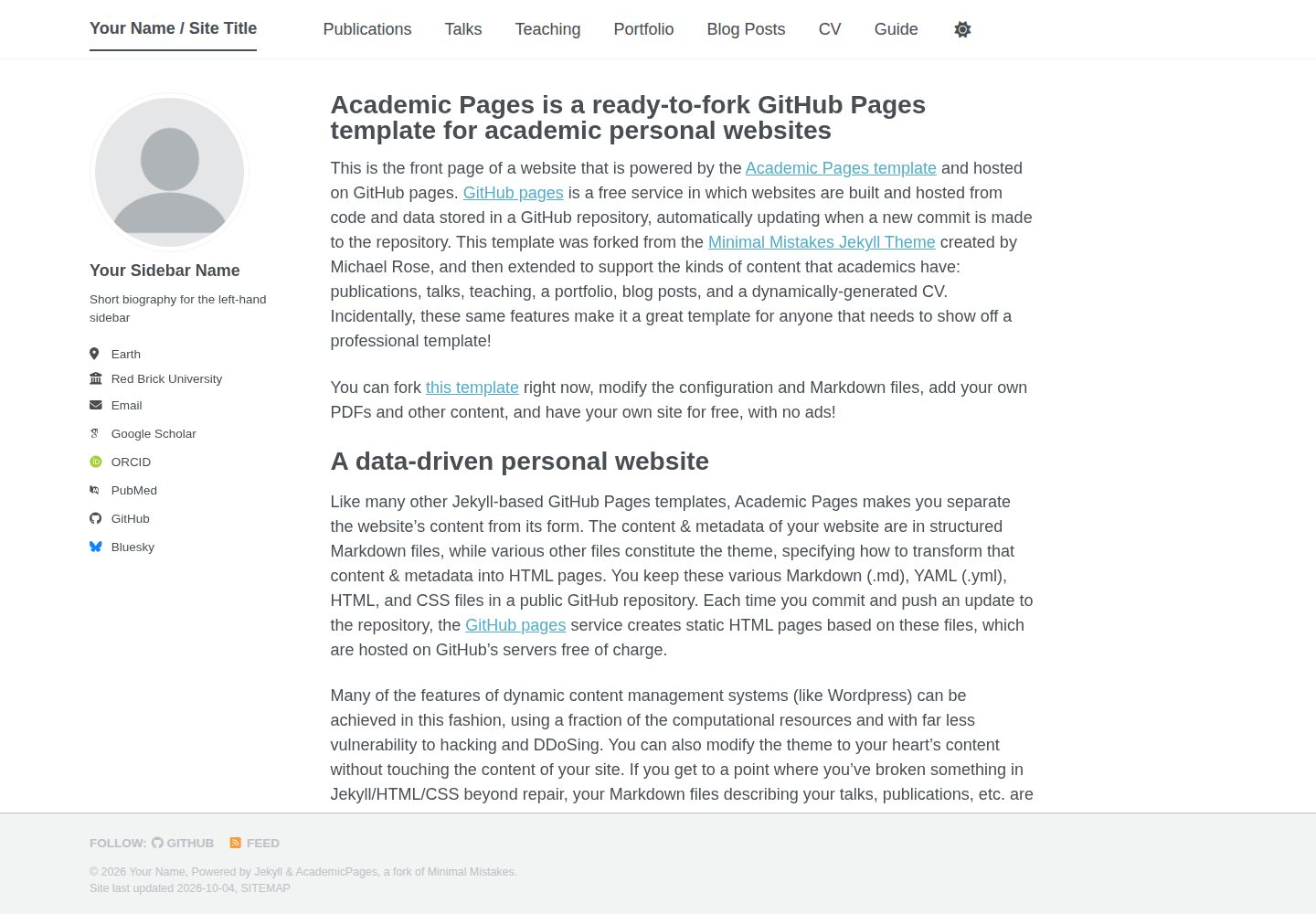
An academic personal website template derived from the Minimal Mistakes Jekyll theme, deployed as a static site on GitHub Pages
HTMLPortfolio
jmquintero.com — HTML Portfolio Template
By jmquintero925
A Jekyll-based academic personal website template derived from the Minimal Mistakes theme, used to publish a personal homepage, CV, publications, and portfolio on GitHub Pages.
Explore the design
Compare the page layouts and mobile experience. Open any screenshot for a closer look.
Desktop homepage1 / 3
Desktop captureTop of page
Actual screenshot captured by the server browser.
All pages & views 3
Screenshots show visual appearance; interactive behavior may differ.
Recorded 2026-10-05View source
What stands out
A quick read of the recorded project description.
Separates site-level configuration from content metadata, and supports different content types such as pages, posts, and collections
Provides a markdown_generator directory that can use Jupyter notebooks or Python scripts to generate Markdown for publications and talks from TSV
The files/ directory is used to store PDFs, zips, and other files, accessible externally via the /files/ path
Underlying code changes are recorded as closed issues tagged "code change", with links to the corresponding commits or diffs
Template Details
This is a personal website template for academic scenarios. The repository is maintained by jmquintero925, and the code originates from academicpages.github.io, which in turn was derived and separated from Michael Rose's Minimal Mistakes Jekyll theme. The template is organized as an HTML/Jekyll static site and published via GitHub Pages, with the site address typically being "username.github.io".
In terms of content structure, the template provides two configuration entry points: site-level configuration and content metadata, and distinguishes between different content types such as pages, posts, and collections. The README mentions that Jupyter notebooks or Python scripts in the markdown_generator directory can be used to generate Markdown files for publications and talks from TSV files. File-type resources (such as PDFs and zips) can be placed in the files/ directory and accessed via the /files/ path.
The primary usage method is forking: register a GitHub account and confirm the email, fork the repository, rename it to "username.github.io", then modify the site configuration and create content. To run locally, install ruby-dev, bundler, and nodejs, run bundle install, then preview at localhost:4000 via bundle exec jekyll liveserve; the local server automatically rebuilds and refreshes after changes. The README also notes that if a security vulnerability notification is received, the Gemfile.lock file can be deleted.
A known limitation of this template is update maintenance: after forking and customizing, pulling upstream changes can easily cause merge conflicts. The official recommendation is to delete the repository and re-fork, or manually apply patches. All underlying code changes are recorded as closed issues tagged "code change", making it easier to patch against individual commits or diffs. The repository uses the MIT license, but third-party assets such as demo images, fonts, and icons must be checked separately under their respective licenses.
HTMLPortfolio
Is it right for your project?
Use Cases
- Build an academic personal homepage on GitHub Pages to display a personal profile, publications, and talks
- Publish local PDFs or archives as attachments on the website for others to download
- Use TSV data to batch-generate Markdown pages for publications and talks
- Preview site changes locally with the Jekyll server, then push to GitHub Pages
Suitable For
- Researchers or students who need an academic personal website and are willing to use GitHub Pages
- Users familiar with or willing to learn Jekyll and Markdown content organization
- Users who want to maintain the site by forking and can accept manually syncing upstream changes
Getting started & customization
Use these recorded setup notes alongside the repository instructions for your chosen version.
- 1
Register a GitHub account and confirm the email, fork the repository, then rename it to "username.github.io"
- 2
Modify the site-level configuration in the repository settings, and create content and metadata as needed
- 3
Running locally requires installing ruby-dev, bundler, and nodejs; after bundle install, preview at localhost:4000 with bundle exec jekyll liveserve
- 4
If a security vulnerability notification is received, the Gemfile.lock file can be deleted
- 5
After forking and customizing, pulling upstream updates can easily cause merge conflicts; you need to delete and re-fork, or manually apply patches according to code change issues
License & source material
Usage conditions & limitations
Free to use · keep license noticeThis entry covers the free version under the MIT license in the public repository; the free scope is the code of this version and does not mean external services or third-party assets are free.
Must comply with when using
- Free use, modification, commercial use, and distribution of this version's code are permitted.
- When distributing copies or substantial portions of the code, retain the original author's copyright notice and the complete MIT license notice.
- The code is provided as is; warranties and limitations of liability are governed by the original license and applicable law.
Additional costs & items to verify
- Demo images, fonts, icons, and other third-party assets must be checked under their respective licenses and cannot be judged solely by the code's MIT license.
- External services such as domains, hosting, databases, payments, or AI may incur additional charges.
- Using this template requires registering a GitHub account and confirming the email, which is a platform account requirement.
- The deployment method requires forking the specified repository rather than downloading it directly for standalone use.
- The repository must be renamed to "username.github.io"; the site URL is determined by this and is bound to GitHub Pages naming rules.
- Running locally requires installing ruby-dev, bundler, and nodejs dependencies yourself.
- Local preview depends on Jekyll and bundler commands and requires a corresponding Ruby environment.
- When a security vulnerability notification is received, the Gemfile.lock file must be deleted, which is a maintenance operation limitation.
- After forking and customizing, pulling upstream updates can easily cause merge conflicts, limiting synchronization maintenance.
- Syncing upstream changes can only be done by deleting the repository and re-forking or manually applying patches; there is no automatic upgrade path.
View Original Text Basis
Permission is hereby granted, free of charge
Original License Text
1. Register a GitHub account if you don't have one and confirm your e-mail (required!)
Original README
Fork [this repository](https://github.com/academicpages/academicpages.github.io) by clicking the "fork" button in the top right.
Original README
Rename the repository "[your GitHub username].github.io", which will also be your website's URL.
Original README
Make sure you have ruby-dev, bundler, and nodejs installed: `sudo apt install ruby-dev ruby-bundler nodejs`
Original README
Run `bundle exec jekyll liveserve` to generate the HTML and serve it from `localhost:4000`
Original README
if you are using this repo and now get a notification about a security vulnerability, delete the Gemfile.lock file.
Original README
If you fork this repository, customize it, then pull again, you'll probably get merge conflicts.
Original README
https://github.com/jmquintero925/jmquintero.com/blob/master/LICENSEhttps://github.com/jmquintero925/jmquintero.com/blob/master/README.mdyou can delete the repository and fork it again. Or you can manually patch.
Original README
Compiled by DeepSeek based on repository license and README ·2026-10-05. Results only cover the materials read; dependencies, images, fonts, and subsequent term changes are subject to their respective original texts.
Project checks & description sources
Template Information
- Source platforms
- GitHub
- Documentation and maintenance reference score
- More documented · 83 / 100
- Technologies
- HTML
- Website type
- Portfolio
How this score is calculated
Our heuristic uses license records (up to 30), a demo link (12), a preview (10), stars (15), recorded maintenance (15), description completeness (8), feature records (5) and classification data (5). It is not a code, security or performance test, or a Google score. A link does not establish tested functionality.
What to verify for this project
- Repository update recorded
- 2026-10-05
- Screenshot last checked
- 2026-10-05
A demo link is listed. Check it with your own content and viewport sizes; its presence does not confirm that forms, authentication or payments work.
The catalog identifies HTML as the primary stack. Check the actual dependency manifest and lockfile for versions and hosting requirements. These notes use recorded metadata, not a code audit or a deployment test.
Use a selection guide →How this description was prepared
AI-assisted description based on catalog records and repository material. Repository authors are not automatically the reviewers of this description.
Review declaration: [email protected] · 2026-10-06
Inspect the recorded source material
SHA-256: e0a44da2bc437dcf72a04596f93e03acb5912724408ae8055e7f28604910eb47
2026-10-05T23:35:42.501Z
Source file / repositoryA Github Pages template for academic websites. This was forked (then detached) by [Stuart Geiger](https://github.com/staeiou) from the [Minimal Mistakes Jekyll Theme](https://mmistakes.github.io/minimal-mistakes/), which is © 2016 Michael Rose and released under the MIT License. See LICENSE.md. I think I've got things running smoothly and fixed some major bugs, but feel free to file issues or make pull requests if you want to improve the generic template / theme. ### Note: if you are using this repo and now get a notification about a security vulnerability, delete the Gemfile.lock file. # Instructions 1. Register a GitHub account if you don't have one and confirm your e-mail (required!) 1. Fork [this repository](https://github.com/academicpages/academicpages.github.io) by clicking the "fork" button in the top right. 1. Go to the repository's settings (rightmost item in the tabs that start with "Code", should be below "Unwatch"). Rename the repository "[your GitHub username].github.io", which will also be your website's URL. 1. Set site-wide configuration and create content & metadata (see below -- also see [this set of diffs](http://archive.is/3TPas) showing what files were changed to set up [an example site](https://getorg-testacct.github.io) for a user with the username "getorg-testacct") 1. Upload any files (like PDFs, .zip files, etc.) to the files/ directory. They will appear at https://[your GitHub username].github.io/files/example.pdf. 1. Check status by going to the repository settings, in the "GitHub pages" section 1. (Optional) Use the Jupyter notebooks or python scripts in the `markdown_generator` folder to generate markdown files for publications and talks from a TSV file. See more info at https://academicpages.github.io/ ## To run locally (not on GitHub Pages, to serve on your own computer) 1. Clone the repository and made updates as detailed above 1. Make sure you have ruby-dev, bundler, and nodejs installed: `sudo apt install ruby-dev ruby-bundler nodejs` 1. Run `bundle clean` to clean up the directory (no need to run `--force`) 1. Run `bundle install` to install ruby dependencies. If you get errors, delete Gemfile.lock and try again. 1. Run `bundle exec jekyll liveserve` to generate the HTML and serve it from `localhost:4000` the local server will automatically rebuild and refresh the pages on change. # Changelog -- bugfixes and enhancements There is one logistical issue with a ready-to-fork template theme like academic pages that makes it a little tricky to get bug fixes and updates to the core theme. If you fork this repository, customize it, then pull again, you'll probably get merge conflicts. If you want to save your various .yml configuration files and markdown files, you can delete the repository and fork it again. Or you can manually patch. To support this, all changes to the underlying code appear as a closed issue with the tag 'code change' -- get the list [here](https://github.com/academicpages/academicpages.github.io/issues?q=is%3Aclosed%20is%3Aissue%20label%3A%22code%20change%22%20). Each issue thread includes a comment linking to the single commit or a diff across multiple commits, so those with forked repositories can easily identify what they need to patch. # Isaac's Notes Using the directions [here](https://jayrobwilliams.com/posts/2020/06/academic-website/) Helpful info on pages vs posts vs collections [here](https://ben.balter.com/2015/02/20/jekyll-collections/)
Explore similar templates
Compare previews and descriptions within the same stack and category.
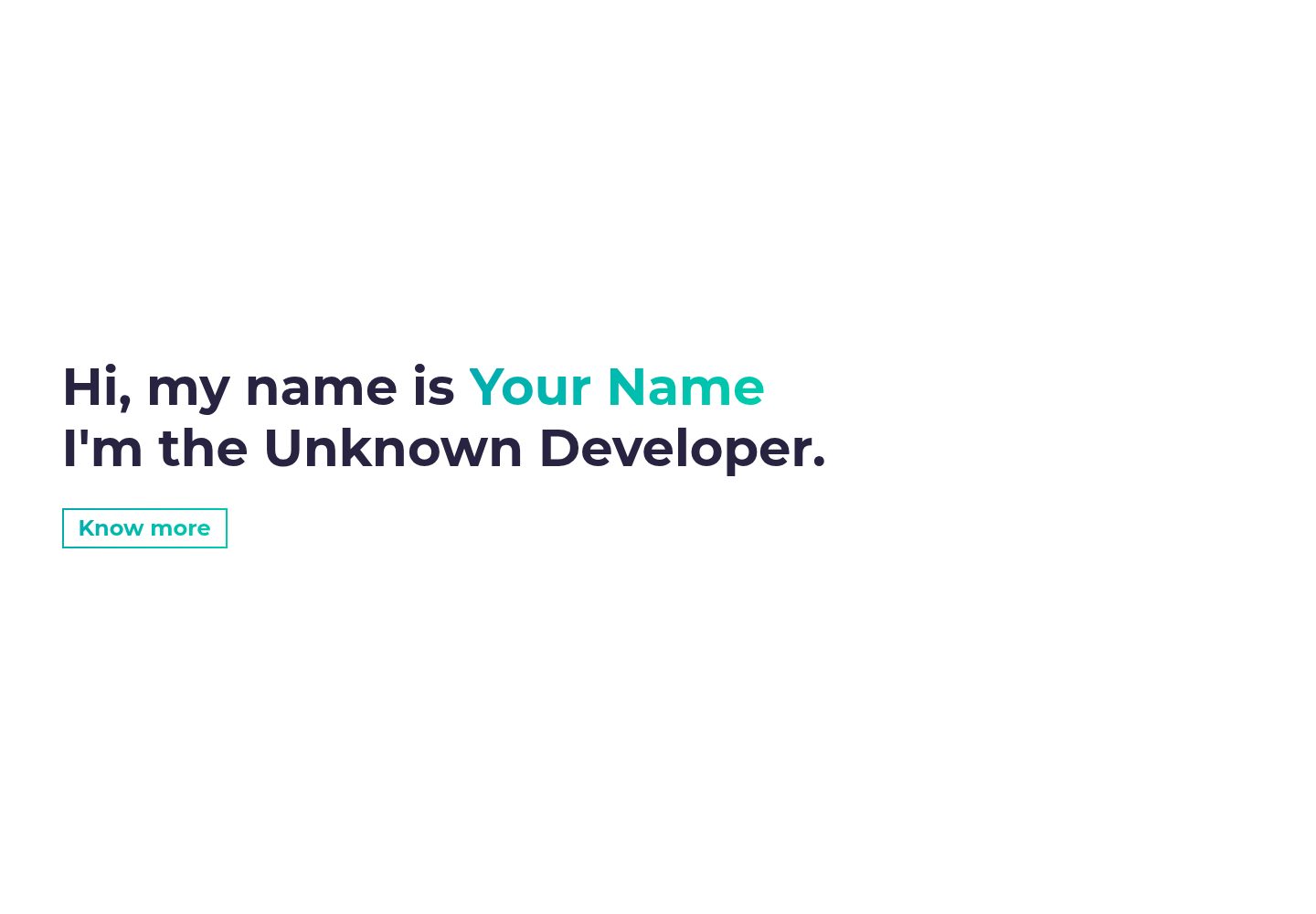
simplefolio
Simplefolio is a minimal single-page portfolio template for developers, built with HTML, Bootstrap, SCSS, and Parcel under the MIT license. It includes Hero, About, Projects, Contact, and Footer sections, with content edited in /src/index.html and theme colors controlled by two SCSS variables.
HTML · Portfolio

Freelancer
A bright, single-page Bootstrap portfolio template for freelancers, designers, and small studios. It includes a responsive portfolio grid with modal detail windows and an SB Forms contact form that requires an API token.
HTML · Portfolio
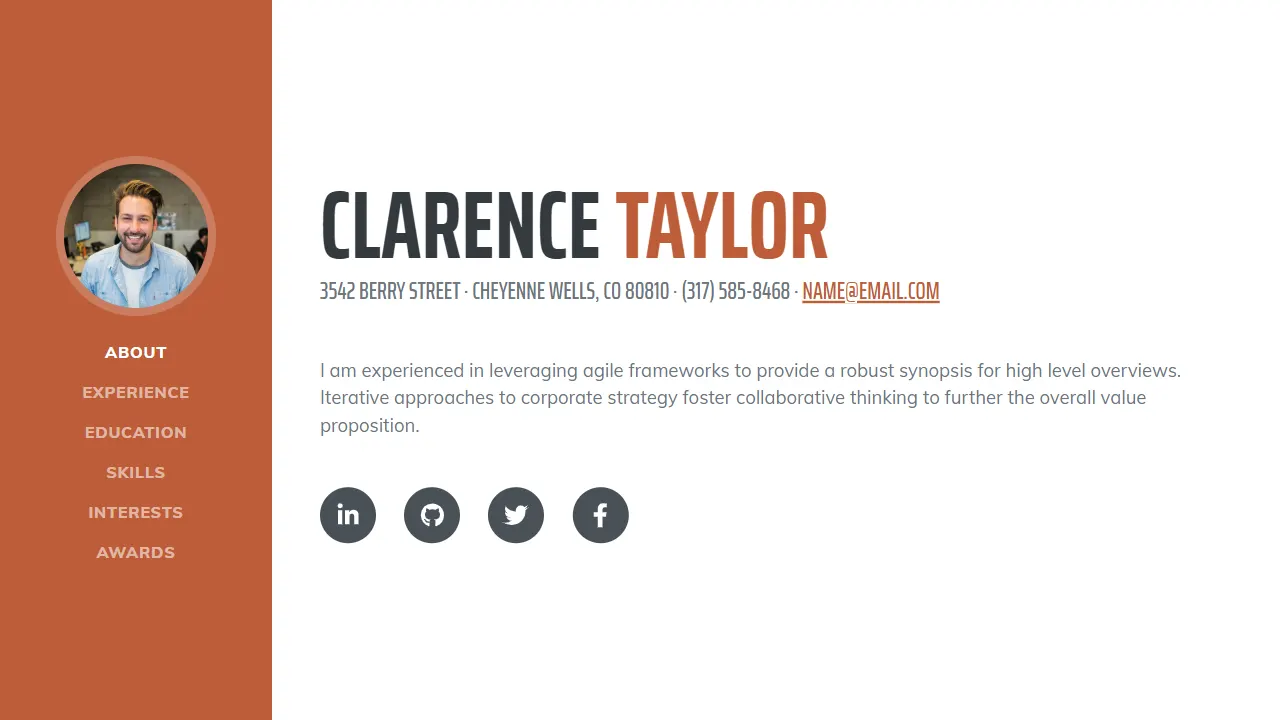
Resume
A single-page resume and CV template from Start Bootstrap, built on Bootstrap with a fixed sidebar and content sections.
HTML · Portfolio
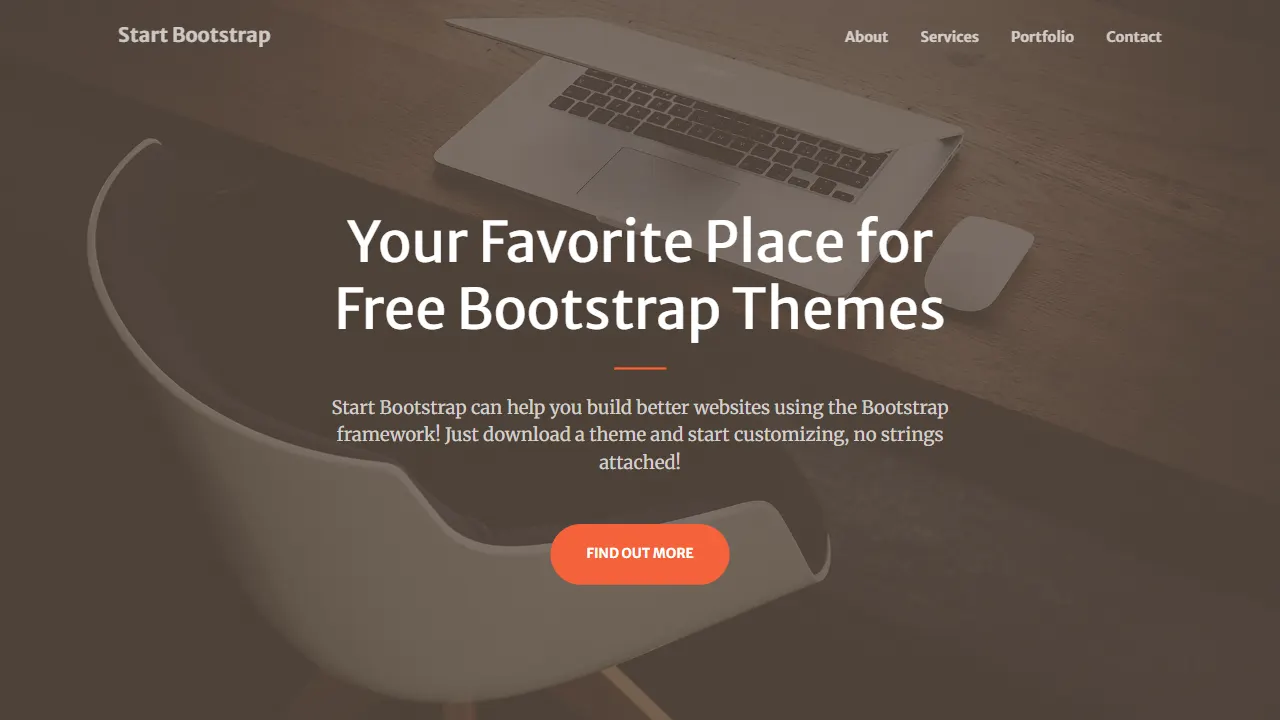
Creative
A single-page marketing template by Start Bootstrap for creative agencies and product services, built on Bootstrap with SCSS, featuring a portfolio grid and call-to-action sections. It includes pre-set SB Forms markers for form integration and npm build scripts for source customization.
HTML · Corporate Website
Grayscale
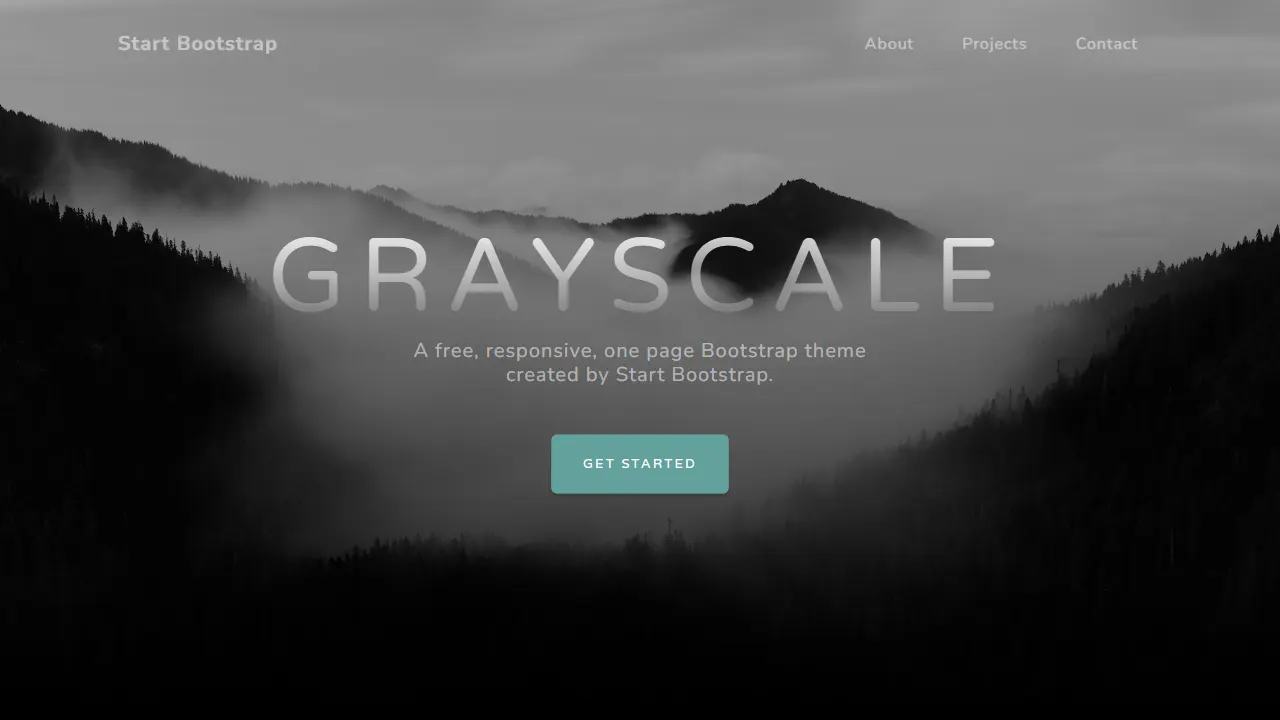
A dark single-page Bootstrap template from Start Bootstrap for photography, events and brand storytelling, with a large hero and clearly separated sections.
HTML · Corporate Website
startbootstrap-stylish-portfolio
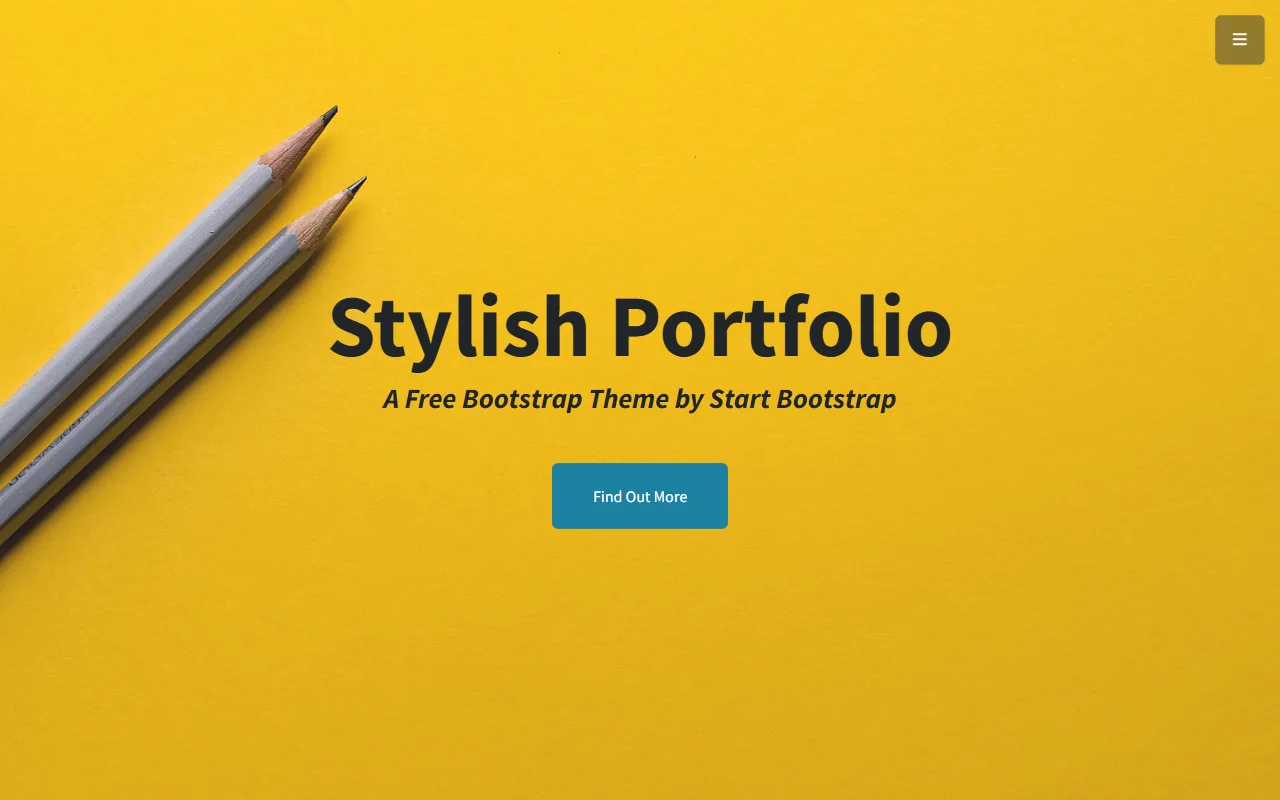
A one-page Bootstrap portfolio theme from Start Bootstrap with multiple content sections and an off-canvas navigation menu. Basic use means editing HTML/CSS under dist and opening index.html; advanced use relies on npm with Pug and SCSS build scripts.
HTML · Portfolio