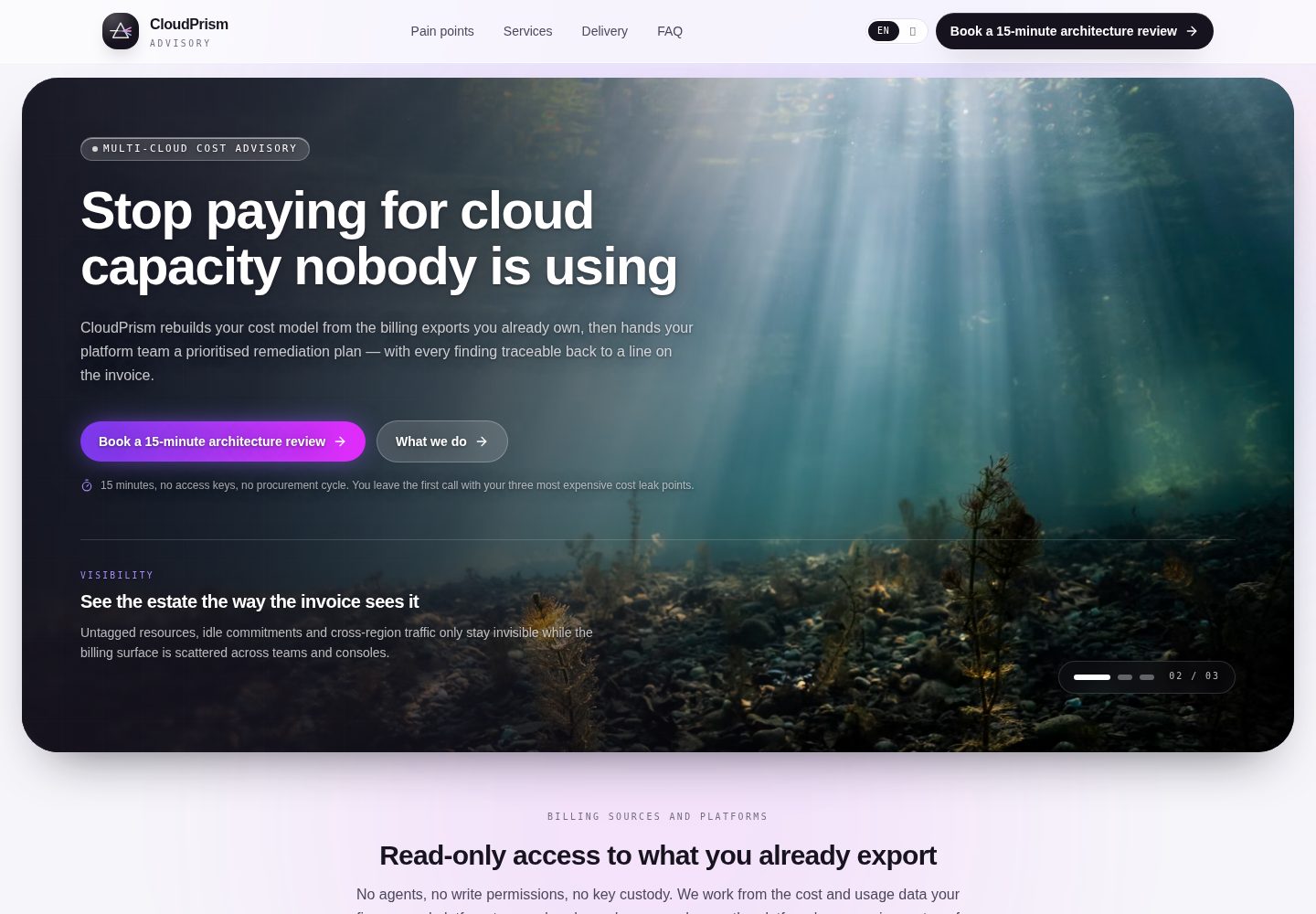
Pure client architecture; all sections use typed mock data and work out of the box without a database or API key
Next.jsReactAdmin dashboard
developer-portal-template — Next.js Admin dashboard Template
By kenzikenzili-build
A developer console template based on the Next.js App Router, using TypeScript and Tailwind CSS, with all data from local mocks and static export deployment to any static host.
Explore the design
Compare the page layouts and mobile experience. Open any screenshot for a closer look.
Desktop homepage1 / 2
Desktop captureTop of page
Actual screenshot captured by the server browser.
All pages & views 2
Screenshots show visual appearance; interactive behavior may differ.
Recorded 2026-10-14View source
What stands out
A quick read of the recorded project description.
next.config.mjs is preconfigured with output: 'export', allowing static site export to S3, Cloudflare Pages, Vercel, GitHub Pages, or Nginx
Includes dashboard sections such as task board, FinOps, commute telemetry, knowledge base, intelligence feed, delivery board, tool launcher, reports, assets and cash flow, contracts, and secrets vault
Adjust branding, timezone, storage prefix, and section data through config files such as config/site.ts and config/mockData.ts
Provides a ⌘K command palette, light/dark theme persistence, PWA manifest, and a build ID-based cache-clearing mechanism
The auth layer implements a mock session via the WorkspaceAuthState contract and can be replaced with Auth0, NextAuth, Cognito, Clerk, or Supabase
Template Details
This is a developer mission control frontend template. The README states it uses Next.js 16 App Router, React 19, TypeScript 5.7, Tailwind CSS v4, and shadcn-style UI components. The template is positioned as a purely client-driven static frontend shell: all sections consume local typed mock data, do not connect to the network, and require no database or API key, so it can be exported as a static site via output: 'export' in next.config.mjs and deployed to S3 + CloudFront, Cloudflare Pages, Vercel, GitHub Pages, or Nginx.
The dashboard consists of multiple sections, listed in the README in layout order: Hero cover (clock, greeting, weather, local notes), task board, FinOps cloud spend, commute telemetry, knowledge base, intelligence feed, delivery board, tool launcher, reports, assets and cash flow, contract ledger, and secrets vault. It also includes a ⌘K command palette, architecture modal, light/dark theme persistence, PWA manifest, custom cursor, animated weather icons, and a cache-clearing mechanism based on NEXT_PUBLIC_BUILD_ID.
Customization is mainly done through configuration files: config/site.ts manages branding, timezone, mock operator identity, and localStorage prefix; config/mockData.ts centralizes data for each section; config/toolCatalog.ts, config/tools.ts, config/reports.ts, config/contracts.ts, and config/wealth.ts hold domain data and seeds. When connecting to a real backend, the README suggests keeping the exported types, fetching data with useSWR or useEffect, and passing it into the existing props or context, and lists optional endpoint environment variables in .env.example. Authentication is implemented by components/providers/workspace-auth-provider.tsx, using a mock session in localStorage, and can be replaced with Auth0, NextAuth, Cognito, Clerk, or Supabase.
Limitations to note: the README explicitly states that the secrets vault is a UI demo only, with placeholder values, and real credentials should not be bundled on the client; the mock session is stored in localStorage, and the auth provider should be replaced before exposing real content; there are no API routes, middleware, or server actions in the repository, to keep static export valid. The README does not provide performance data, production validation conclusions, or backend implementation details.
Next.jsReactAdmin dashboard
Is it right for your project?
Use Cases
- As a frontend starting point for a developer's personal or team internal dashboard, first showing each section layout with mock data
- Deploy a pure frontend console on a static hosting platform without introducing a backend runtime
- Fork the template and replace branding, timezone, and data in config to quickly produce a customized portal
- Follow the README to replace mock data with data returned by your own API and connect a real auth provider
Suitable For
- Developer portal or console frontend projects that need static export and no backend dependency
- Developers who want to quickly customize dashboard content in a config-driven way
- Teams planning to later connect their own API and authentication services
- Projects using the Next.js App Router, TypeScript, and Tailwind CSS stack
Getting started & customization
Use these recorded setup notes alongside the repository instructions for your chosen version.
- 1
Requires Node.js 20+; clone the repository and run npm install
- 2
Run npm run dev for local development; in container environments with restricted file watching, use npm run dev:webpack or increase fs.inotify.max_user_watches
- 3
npm run build performs type checking and exports a static site to the out/ directory; npm run export is an alias for build
- 4
When deploying to Vercel, Cloudflare Pages, Netlify, or GitHub Pages, set the build command to npm run build and the output directory to out; subpath deployments require adding basePath in next.config.mjs
- 5
When connecting a real API, refer to the optional endpoint variables in .env.example and keep the existing exported types to reuse component props
License & source material
Usage conditions & limitations
Free to use · keep license noticeThis entry covers the free version in a public repository under the MIT license; the free scope is the code of that version and does not mean external services or third-party assets are free.
Must comply with when using
- Free use, modification, commercial use, and distribution of that version's code are permitted.
- When distributing copies or substantial portions of the code, retain the original author's copyright notice and the full MIT license notice.
- The code is provided as is; warranties and liability limitations are governed by the original license and applicable law.
Additional costs & items to verify
- Demo images, fonts, icons, and other third-party assets must be checked against their respective licenses and cannot be judged solely by the code's MIT license.
- External services such as domains, hosting, databases, payments, or AI may incur separate charges.
- The secrets vault is a UI demo only, and its values are placeholders; do not bundle real credentials on the client, and read them through your own backend proxy returning only masked values.
- The mock session is stored in localStorage for demonstration convenience only; this auth provider must be replaced before exposing any real content.
- There are no API routes, middleware, or server actions in the repository, to keep output: 'export' static export valid; maintain this state if static hosting is required.
- The auth layer is a mock implementation and must be replaced with a real provider such as Auth0, NextAuth, Cognito, Clerk, or Supabase.
- All sections currently consume only local mock data and make no network requests; connecting a real API requires implementing data fetching yourself.
- When deploying to a subpath (such as a GitHub Pages project site), add basePath in next.config.mjs.
- In container or CI environments with restricted file watching, next dev may fail due to inotify limits; use npm run dev:webpack or increase fs.inotify.max_user_watches.
- Requires Node.js 20+ (Next.js 16 baseline).
View Original Text Basis
Permission is hereby granted, free of charge
Original License Text
- **The vault card is a UI demo.** Its values are obvious placeholders. Never ship real credentials in a client bundle — proxy secret reads through your own backend and return masked values only.
Original README
- Mock sessions live in `localStorage` for convenience. Replace the provider before exposing anything real.
Original README
- There are no API routes, middleware, or server actions in this repository, so `output: 'export'` stays valid — keep it that way if you want to retain static hosting.
Original README
`components/providers/workspace-auth-provider.tsx` implements the `WorkspaceAuthState` contract from `lib/auth/types.ts` and keeps a mocked session in localStorage. Swap in Auth0 / NextAuth / Cognito / Clerk / Supabase, or point it at your own session endpoint — no dashboard component changes are required.
Original README
Every section consumes a plain typed shape and never talks to the network today. To go live:
Original README
For hosting under a sub-path (for example GitHub Pages project sites), add `basePath` to `next.config.mjs`.
Original README
`next dev` fails with `OS file watch limit reached` when `fs.inotify.max_user_watches` is set too low — common in containers and CI. `npm run dev:webpack` is more tolerant because webpack polling needs fewer watchers. Alternatively raise the host limit:
Original README
https://github.com/kenzikenzili-build/developer-portal-template/blob/main/LICENSEhttps://github.com/kenzikenzili-build/developer-portal-template/blob/main/README.mdNode.js 20+ is required (Next.js 16 baseline).
Original README
Compiled by DeepSeek based on repository license and README ·2026-10-14. Results only cover the materials read; dependencies, images, fonts, and subsequent term changes are subject to their respective original texts.
Project checks & description sources
Template Information
- Source platforms
- GitHub
- Documentation and maintenance reference score
- More documented · 85 / 100
- Technologies
- Next.js · React
- Website type
- Admin dashboard
How this score is calculated
Our heuristic uses license records (up to 30), a demo link (12), a preview (10), stars (15), recorded maintenance (15), description completeness (8), feature records (5) and classification data (5). It is not a code, security or performance test, or a Google score. A link does not establish tested functionality.
What to verify for this project
- Repository update recorded
- 2026-09-28
- Screenshot last checked
- 2026-10-14
A demo link is listed. Check it with your own content and viewport sizes; its presence does not confirm that forms, authentication or payments work.
The catalog identifies Next.js as the primary stack. Check the actual dependency manifest and lockfile for versions and hosting requirements. These notes use recorded metadata, not a code audit or a deployment test.
Use a selection guide →How this description was prepared
AI-assisted description based on catalog records and repository material. Repository authors are not automatically the reviewers of this description.
Review declaration: codex-user-requested-batch-review-20261015 · 2026-10-15
Inspect the recorded source material
SHA-256: efefb612ed9b98e246de4f32a913eae3c10f17cc54adb7f53fb48faa42c783a9
2026-10-14T23:46:57.739Z
Source file / repository# Developer Mission Control (OSS Portal Template) A clean, decoupled, and production-grade developer control center built with **Next.js 16 (App Router)**, **React 19**, **TypeScript 5.7**, **Tailwind CSS v4**, and shadcn-style UI primitives. Designed as a lightweight, zero-maintenance frontend shell that can be deployed to any static host (AWS S3 + CloudFront, Cloudflare Pages, Vercel, GitHub Pages, or plain Nginx) without requiring a backend runtime, a database, or a single API key.  --- ## Table of Contents - [Key Features](#key-features) - [Quick Start](#quick-start) - [How to Customize (Make It Yours)](#how-to-customize-make-it-yours) - [Project Structure](#project-structure) - [Deployment Recipes](#deployment-recipes) - [Security Notes](#security-notes) - [Author & Connect](#author--connect) - [License](#license) --- ## Key Features - **Decoupled architecture:** 100% client-driven with typed mock adapters. Runs out-of-the-box with zero database or API setup. - **Static export ready:** Pre-configured with `output: 'export'` in `next.config.mjs` for sub-second static loads and near-zero hosting costs. - **Developer telemetry:** Built-in sprint delivery tracking, task board, workspace app launcher, intelligence feed, reports, FinOps spend telemetry, contracts ledger, and infrastructure status widgets. - **Config-driven customization:** Brand, timezone, telemetry, and mock datasets are localized into two straightforward config files. - **Pure demo secret vault:** Safe visual UI demo component without sensitive credential leakage risks. ### Feature Tour Rows are listed in the dashboard block order, which the sticky `TopNav` mirrors one-for-one (`components/dashboard/authorized-dashboard.tsx` is the single source of truth for the layout; `components/dashboard/top-nav.tsx` renders it with progressive `md`/`lg`/`xl` tiers). | # | Section | What it shows | Mock source | | --- | --- | --- | --- | | 1 | Hero cover | Live clock, greeting, weather card, local quick memo | `mockWeather`, `siteConfig` | | 2 | Task board | Three-column queue with local persistence | `mockTasks` | | 3 | FinOps | Month-to-date cloud spend with trend deltas | `mockFinopsMetrics` | | 4 | Commute telemetry | Travel hub — one direction and one leg at a time, fastest service crowned and pinned to slot 1, local 1 Hz countdown | `mockCommute` | | 5 | Knowledge hub | Note capture, tag select, keyword search, copy-to-clipboard | `mockKnowledgeNotes` | | 6 | Intelligence feed | Category tabs, severity badges, read/unread, save to notes | `mockIntelligence` | | 7 | Delivery board | Sprint switcher, project filters, status cycling, KPI rail | `mockSprintCatalog` | | 8 | Tool launcher | Category filters, drag & drop reorder, lock, reset | `toolCatalog` | | 9 | Reports | Top-8 / all view, read state, drawer with markdown body | `mockReports` | | 10 | Portfolio & cash flow | Liquid assets, net-worth milestones, budget categories | `mockWealthTelemetry`, `mockBudgetTelemetry` | | 11 | Contracts | Renewal urgency, cancelled-service ledger, draft drawer | `mockContracts` | | 12 | Secret vault | **UI demo only** — masked placeholders, reveal & copy | `mockVaultEntries` | Also included: ⌘K command palette, architecture modal, dark/light theme with persistence, PWA manifest, custom cursor, animated weather icons, and a build-id cache kill-switch for clean CDN releases. --- ## Quick Start ### 1. Clone & Install ```bash git clone https://github.com/kenzikenzili-build/developer-portal-template.git cd developer-portal-template npm install ``` Node.js 20+ is required (Next.js 16 baseline). ### 2. Run Local Development For standard environments: ```bash npm run dev ``` You are signed in automatically with a local mock session, so the dashboard renders immediately. Use the sign-out button in the top nav to visit `/login` and start the mock session again. If developing inside resource-constrained Docker / WebContainer environments: ```bash npm run dev:webpack ``` `next dev` fails with `OS file watch limit reached` when `fs.inotify.max_user_watches` is set too low — common in containers and CI. `npm run dev:webpack` is more tolerant because webpack polling needs fewer watchers. Alternatively raise the host limit: ```bash sudo sysctl fs.inotify.max_user_watches=524288 ``` Open [http://localhost:3000](http://localhost:3000) to access your mission control. The production build is unaffected by the watch-limit issue. ### 3. Available Scripts | Script | Description | | --- | --- | | `npm run dev` | Start the dev server (Turbopack) | | `npm run dev:webpack` | Dev server on the webpack pipeline (containers with low file-watch limits) | | `npm run build` | Type-check and export the static site to `out/` | | `npm run start` | Serve a production build with `next start` | | `npm run export` | Alias of `build` for static hosting pipelines | --- ## How to Customize (Make It Yours) This template is designed to be forked and customized in under 10 minutes. ### 1. Site Branding & Preferences Edit `config/site.ts` to adjust: - Workspace name, short name, monogram, tagline, footer label, and metadata. - Default locale and timezone used by every clock / date formatter. - The mock `operator` identity shown while no auth provider is wired up. - `storagePrefix` — the prefix applied to every persisted localStorage key, so forks never collide. ### 2. Updating Telemetry & Mock Data All widget data lives in `config/mockData.ts`: - **Sprint & Delivery Board:** Update ongoing roadmap milestones, sprint catalog, and task progress (`mockSprintCatalog`, `mockTasks`). - **Travel hub:** Each direction (`morning` / `evening`) owns two legs, and every boardable service lives in that leg's `options` array — the lowest `etaMinutes` in the selected leg is crowned and pinned automatically (`mockCommute`). - **Quick Launcher:** Add or remove shortcuts to your internal tools and daily web apps (`config/toolCatalog.ts`). - **System Metrics & Feeds:** Configure the static cards representing your infra health, intelligence items, reports, FinOps deltas, contracts, wealth, and budget telemetry. Domain contracts and seeds live next to their sections — `config/tools.ts`, `config/reports.ts`, `config/contracts.ts`, `config/wealth.ts` — alongside the pure helpers in `lib/`. Replace the exported constants and the UI updates instantly. ### 3. Connecting to Real APIs (Bring Your Own Backend) Every section consumes a plain typed shape and never talks to the network today. To go live: 1. Keep the exported type (for example `IntelReport`, `SprintCatalog`). 2. Fetch your payload with `useSWR` or a `useEffect`. 3. Pass the result into the same prop / context the mock previously supplied. Optional endpoint env vars are documented in `.env.example`: `NEXT_PUBLIC_SPRINT_ENDPOINT`, `NEXT_PUBLIC_REPORTS_ENDPOINT`, `NEXT_PUBLIC_INTELLIGENCE_ENDPOINT`, `NEXT_PUBLIC_FINOPS_ENDPOINT`, `NEXT_PUBLIC_TASKS_ENDPOINT`. ### 4. Replace the Auth Provider `components/providers/workspace-auth-provider.tsx` implements the `WorkspaceAuthState` contract from `lib/auth/types.ts` and keeps a mocked session in localStorage. Swap in Auth0 / NextAuth / Cognito / Clerk / Supabase, or point it at your own session endpoint — no dashboard component changes are required. --- ## Project Structure ``` app/ Next.js App Router (static export) (workspace)/ Dashboard routes + per-section anchors login/ Mock sign-in seam components/ dashboard/ One file per dashboard section providers/ Theme / modal / auth providers ui/ shadcn-style primitives config/ site.ts Branding, timezone, storage prefix mockData.ts ⭐ The entire mock data registry toolCatalog.ts Generic tool launcher catalog tools.ts reports.ts contracts.ts wealth.ts Domain contracts + seeds lib/ Pure helpers (sprint, budget, wealth, news, storage) hooks/ Sprint catalog + report read-state hooks public/ Icons, videos, placeholder art ``` --- ## Deployment Recipes ### Static Build Export every route to a clean static distribution directory (`out/`): ```bash npm run build ``` `next.config.mjs` sets `output: 'export'` and `images.unoptimized: true`, which disables Route Handlers, middleware, and server actions. That is exactly why this template ships with no backend coupling. ### AWS S3 + CloudFront ```bash npm run build aws s3 sync out/ s3://<your-bucket> --delete aws cloudfront create-invalidation --distribution-id <id> --paths '/*' ``` Upload the contents of `out/` directly to your S3 bucket, front it with CloudFront, and invalidate the distribution on every release. ### Vercel / Cloudflare Pages / Netlify / GitHub Pages Connect your GitHub repository and set: - **Build command:** `npm run build` - **Output / publish directory:** `out` For hosting under a sub-path (for example GitHub Pages project sites), add `basePath` to `next.config.mjs`. ### Cache-Busting Releases `NEXT_PUBLIC_BUILD_ID` (defaults to the Git SHA in CI, otherwise a timestamp) is baked into the client bundle. When it changes, the shell purges stale Cache Storage entries and unregisters old service workers, so clients never serve a previous app shell. --- ## Security Notes - **The vault card is a UI demo.** Its values are obvious placeholders. Never ship real credentials in a client bundle — proxy secret reads through your own backend and return masked values only. - Mock sessions live in `localStorage` for convenience. Replace the provider before exposing anything real. - There are no API routes, middleware, or server actions in this repository, so `output: 'export'` stays valid — keep it that way if you want to retain static hosting. - No personal or project-specific data is checked in; `.env.example` documents optional endpoints only. --- ## Tech Stack Next.js 16 (App Router) · React 19 · TypeScript 5.7 · Tailwind CSS v4 · next-themes · framer-motion · lucide-react · cmdk · @dnd-kit · Base UI --- ## Author & Connect Crafted by **KZ** ([@kenzikenzili-build](https://github.com/kenzikenzili-build)) *Cloud Solutions Architect & Systems Builder* Specializing in cost-optimized serverless architectures, decoupled frontend systems, and developer automation. - **Discussions & Feedback:** Open an [Issue](https://github.com/kenzikenzili-build/developer-portal-template/issues) or start a GitHub Discussion on this repository. - **Consulting & Projects:** Open for architectural consulting, high-impact implementation opportunities, and technical advisory. - **Reach out:** Connect via GitHub or reach out directly at [[email protected]](mailto:[email protected]). --- ## License This project is open-source under the [MIT License](LICENSE). Feel free to fork, adapt, and build upon it.
Explore similar templates
Compare previews and descriptions within the same stack and category.
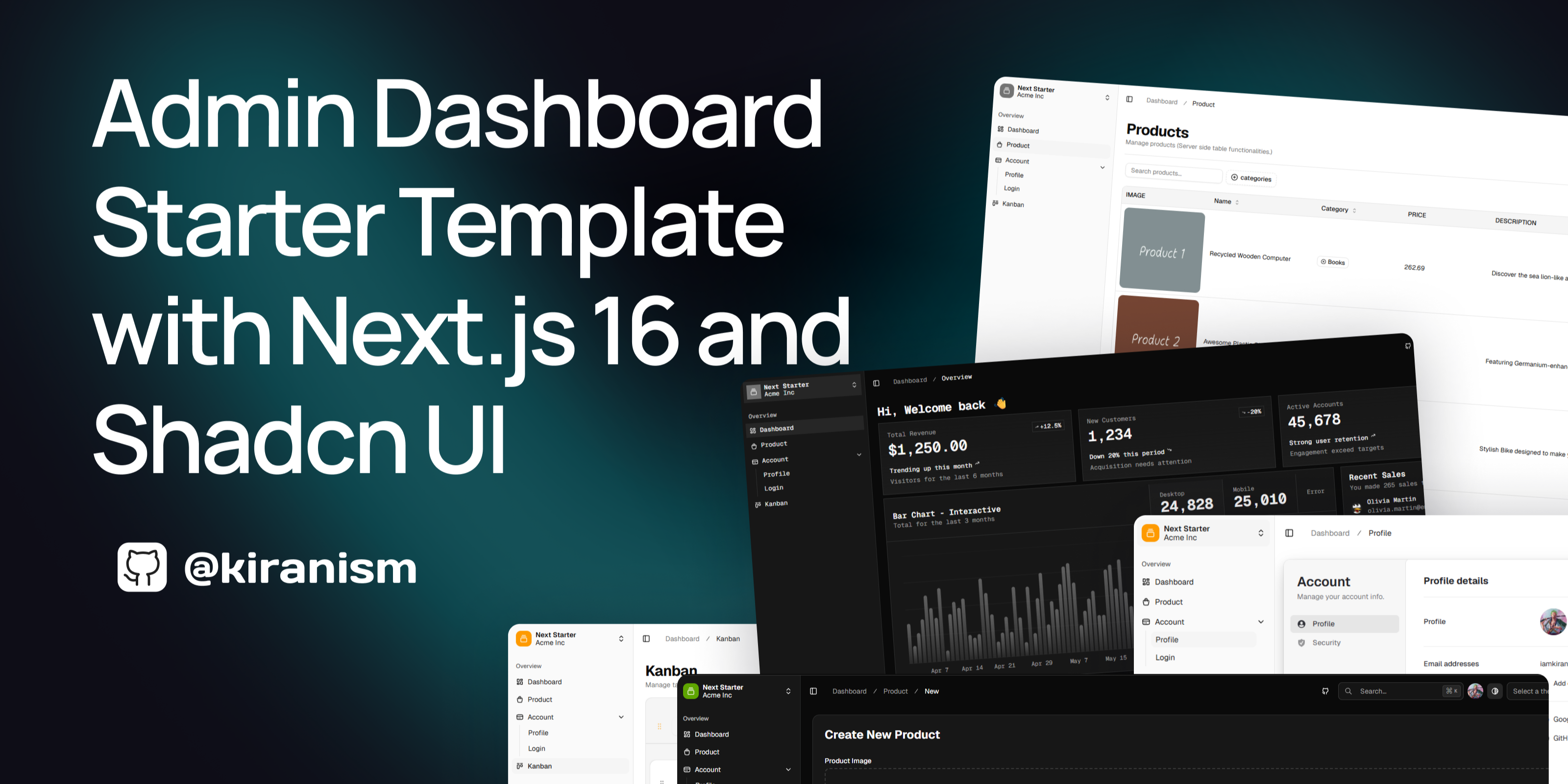
next-shadcn-dashboard-starter
An MIT-licensed admin dashboard starter built with Next.js 16, shadcn/ui, Tailwind CSS v4, and TypeScript.
Next.js · Admin dashboard
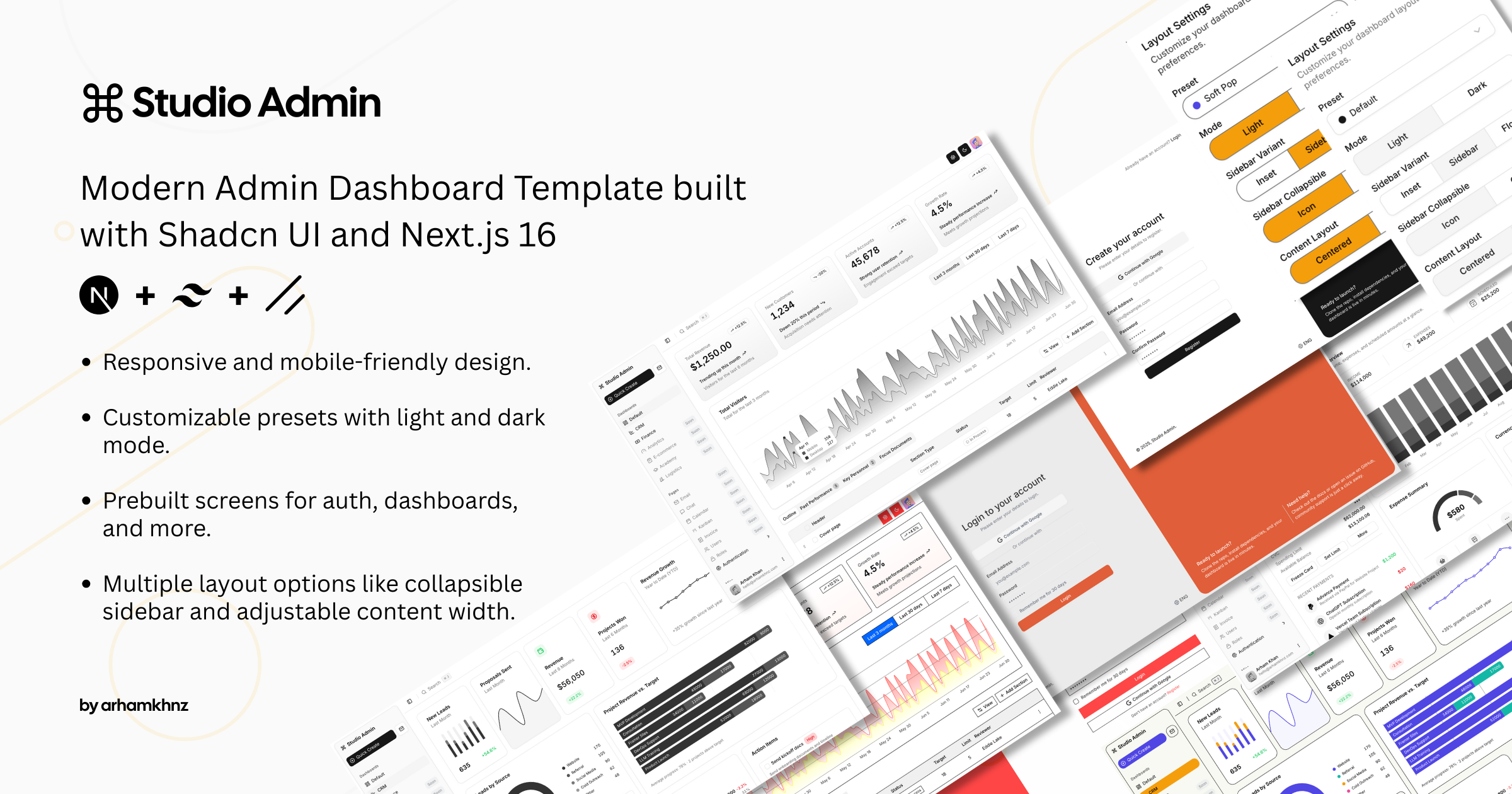
Studio Admin · Radix UI
Studio Admin is an admin dashboard template built with Next.js 16, TypeScript, Tailwind CSS v4, and Shadcn UI.
Next.js · Admin dashboard
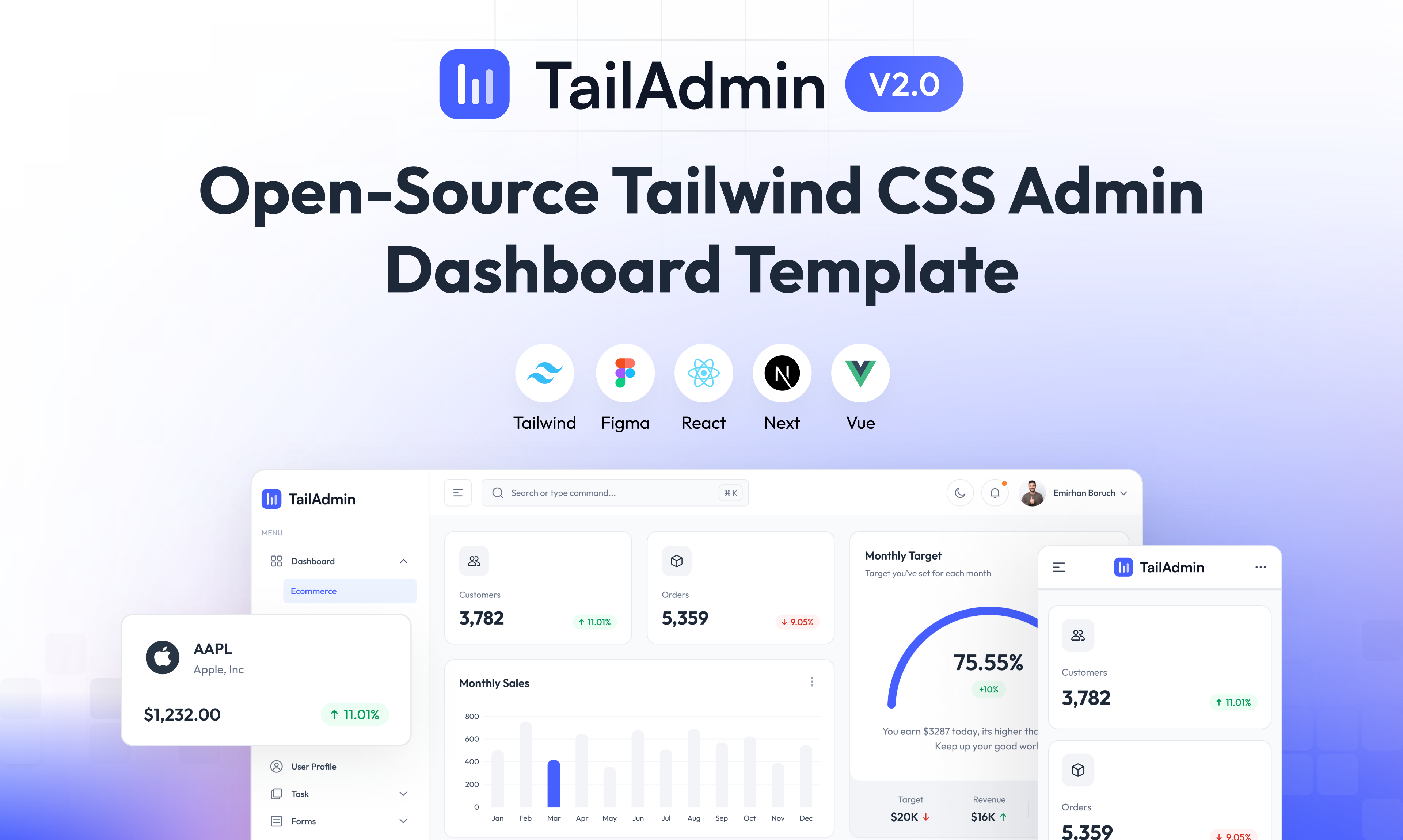
free-nextjs-admin-dashboard
A free, open-source admin dashboard template built on Next.js 16, React 19, TypeScript, and Tailwind CSS v4. It provides a collapsible sidebar, charts, tables, authentication forms, modals, dropdowns, and dark mode, with internationalization and RTL support since version 2.4.0.
Next.js · Admin dashboard
materio-mui-nextjs-admin-template-free
Materio Free is a Next.js admin dashboard template based on App Router and MUI, integrating Tailwind CSS and available in TypeScript and JavaScript versions.
Next.js · Admin dashboard
nextjs-postgres-nextauth-tailwindcss-template
A Vercel-maintained Next.js App Router admin dashboard starter with Auth.js GitHub OAuth, Postgres, Tailwind CSS, and Shadcn UI, plus a sample products table, seed endpoint, and CRUD interface.
Next.js · Admin dashboard
shadcn-dashboard-landing-template
An open-source admin dashboard and marketing landing page template built on shadcn/ui and Tailwind CSS, with both Vite + React and Next.js versions in one repository.
Next.js · Admin dashboard