Provides a single-URL Streamable HTTP connector endpoint using mcp-handler on the Next.js App Router, with no redirects required
Next.jsReactDirectory siteStarter
small-business-mcp-starter — Next.js Directory site Template
By ModernMustardSeed
A remote MCP connector template built on Next.js and mcp-handler, with built-in tool convention validation, SSRF-safe fetch, rate limiting, evals, and a submission checklist to help pass Claude directory review.
Explore the design
Compare the page layouts and mobile experience. Open any screenshot for a closer look.
Desktop homepage1 / 2
Desktop captureTop of page
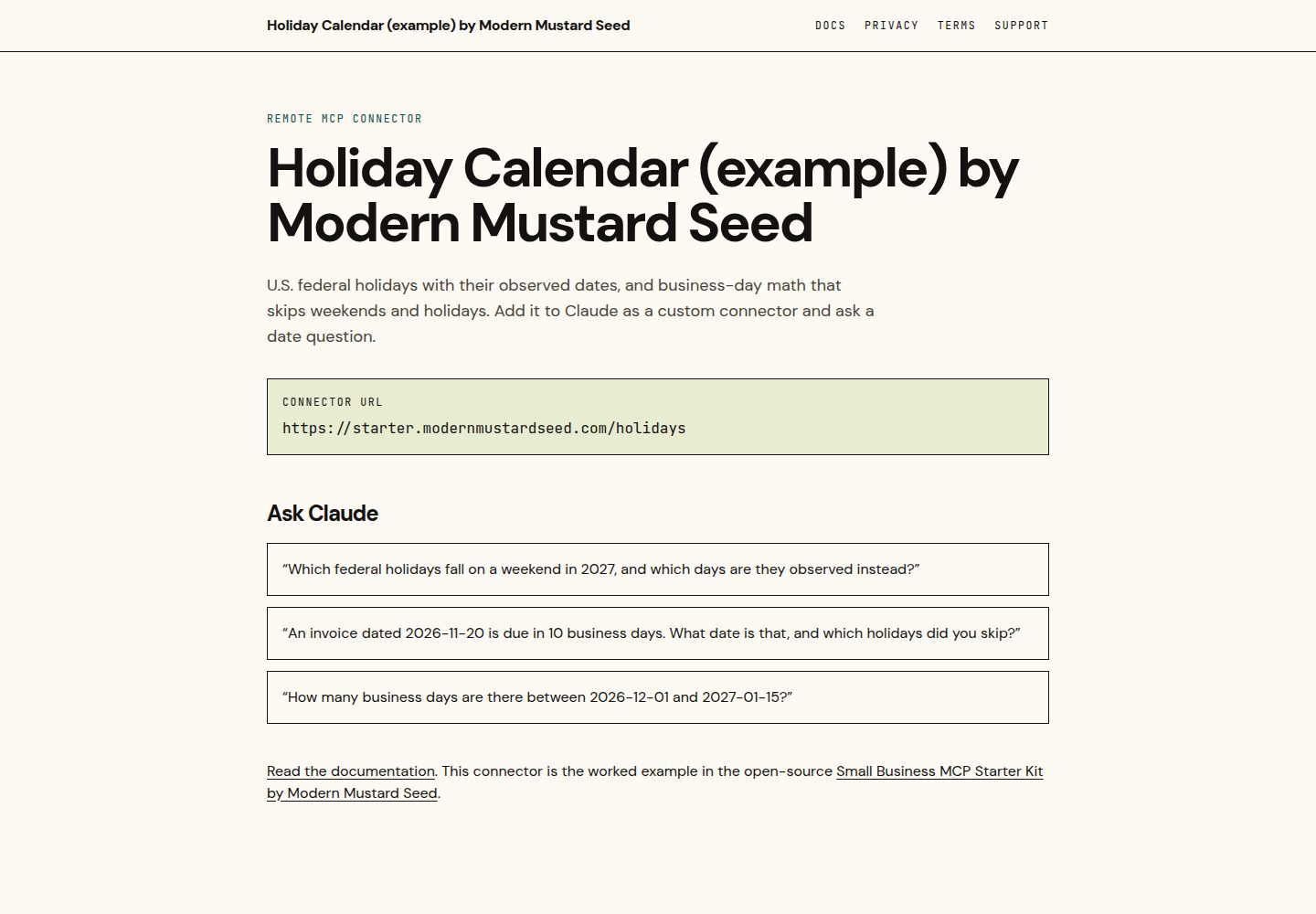
Actual screenshot captured by the server browser.
All pages & views 2
Screenshots show visual appearance; interactive behavior may differ.
Recorded 2026-10-12View source
What stands out
A quick read of the recorded project description.
Validates tool conventions at load time: title, readOnlyHint or destructiveHint, snake_case names no longer than 64 characters, descriptive descriptions; violations fail tests
Rate limiting designed for Claude's shared egress range, not counted by IP and not returning HTTP 429
SSRF-safe fetch for tools that read user-provided URLs, including public address restrictions, controlled DNS lookups, redirect checks, byte limits, and timeouts
Evaluation tooling with no model and no API keys, capable of running real prompt cases against a running URL
Documentation, privacy, terms, support pages, and security.txt driven by a single configuration file, plus a directory submission checklist
Template Details
This is a Next.js starter template for Claude remote MCP connectors, maintained by Modern Mustard Seed under the MIT license. It organizes common production connector patterns into a copyable project structure: on the Next.js App Router, mcp-handler exposes the connector via Streamable HTTP at a single URL without relying on redirects. The template enforces tool conventions at load time, including that every tool must have a title, a readOnlyHint or destructiveHint, a snake_case name of no more than 64 characters, and a descriptive rather than leading description; violations cause pnpm test to fail. It also provides specific error messages, output size limits, rate limiting designed for Claude's shared egress range (not counted by IP and not returning 429), SSRF-safe fetch for tools that read user-provided URLs, evaluation tooling with no model or API keys, and documentation, privacy, terms, support pages, and security.txt driven by a single configuration file. The repository includes a runnable example connector: a US federal holidays and business days calendar with five read-only tools covering 2021 through 2100, making no network requests and storing no data. The template also provides a submission checklist and schema documentation corresponding to the directory form. Before use, Node 22.6 or later, pnpm, and a hosting environment capable of running Next.js are required; the example itself needs no environment variables, with optional configuration of the site URL and Upstash Redis to enable cross-instance global rate limiting and caching.
Next.jsDirectory siteStarter
Is it right for your project?
Use Cases
- Building and submitting a remote MCP connector for Claude that must meet directory review tool conventions and page requirements
- Quickly setting up a spec-compliant connector endpoint and tool registration structure in a Next.js project
- Adding SSRF protection, output size limits, and rate limiting logic to tools that read user-provided URLs
- Running evaluations against a deployed connector with real prompts and performing pre-submission checks
- Implementing read-only tools and corresponding evaluations by referencing the US federal holidays and business days calendar example
Suitable For
- Developers or small teams that need to submit a remote MCP connector to the Claude directory
- Engineers using Next.js who want to reuse tool conventions, rate limiting, and safe fetch patterns
- Project maintainers who need to prepare documentation, privacy, terms, and support pages for a connector
- Teams looking to reduce review rework risk with model-free evaluations and a submission checklist
Getting started & customization
Use these recorded setup notes alongside the repository instructions for your chosen version.
- 1
Requires Node 22.6 or later, pnpm, and a hosting environment capable of running Next.js (such as Vercel)
- 2
The example runs without environment variables; optionally set SITE_URL to specify the public origin, or configure Upstash Redis to enable cross-instance global rate limiting and caching
- 3
After deployment, run pnpm preflight and pnpm evals to check HTTPS, no redirects, no 403 or 429, pages returning 200, and MCP handshake and annotation rules
- 4
Disable Attack Challenge Mode and bot protection rules for the MCP path to avoid returning challenge pages to Claude
- 5
Replace app/icon.svg and app/apple-icon.png, and edit the company, support, and security contact information and policy dates in lib/site.ts
License & source material
Usage conditions & limitations
Free to use · keep license noticeThis entry covers the free version in the public repository under the MIT license; the free scope is the code of that version and does not mean external services or third-party assets are free.
Must comply with when using
- You may use, modify, commercialize, and distribute the code of this version for free.
- When distributing copies or substantial portions of the code, retain the original author's copyright notice and the full MIT license notice.
- The code is provided as is; warranties and limitations of liability are governed by the original license and applicable law.
Additional costs & items to verify
- Demo images, fonts, icons, and other third-party assets must be checked against their respective licenses and cannot be judged solely by the code's MIT license.
- External services such as domains, hosting, databases, payments, or AI may incur separate charges.
- Before use, Node 22.6 or later, pnpm, and a hosting environment capable of running Next.js (such as a Vercel account) are required.
- When deploying, Attack Challenge Mode and bot protection rules must be disabled for the MCP path, otherwise challenge pages will be returned to Claude.
- Without Redis configured, each instance only rate limits itself in memory at one tenth of the global value, so cross-instance global rate limiting is not possible.
- This toolkit is not affiliated with or endorsed by Anthropic; Claude is a trademark of Anthropic, PBC.
View Original Text Basis
Permission is hereby granted, free of charge
Original License Text
You need Node 22.6 or later, pnpm, and a Vercel account (any host that runs Next.js works).
Original README
Leave Attack Challenge Mode and any bot-protection rule off for your MCP paths: they answer Claude with a challenge page.
Original README
Without Redis, each instance limits itself in memory at one tenth of the global numbers.
Original README
https://github.com/ModernMustardSeed/small-business-mcp-starter/blob/main/LICENSEhttps://github.com/ModernMustardSeed/small-business-mcp-starter/blob/main/README.mdThis kit is not affiliated with or endorsed by Anthropic. "Claude" is a trademark of Anthropic, PBC.
Original README
Compiled by DeepSeek based on repository license and README ·2026-10-12. Results only cover the materials read; dependencies, images, fonts, and subsequent term changes are subject to their respective original texts.
Project checks & description sources
Template Information
- Source platforms
- GitHub
- Documentation and maintenance reference score
- More documented · 85 / 100
- Technologies
- Next.js · React
- Website type
- Directory site · Starter
How this score is calculated
Our heuristic uses license records (up to 30), a demo link (12), a preview (10), stars (15), recorded maintenance (15), description completeness (8), feature records (5) and classification data (5). It is not a code, security or performance test, or a Google score. A link does not establish tested functionality.
What to verify for this project
- Repository update recorded
- 2026-10-12
- Screenshot last checked
- 2026-10-12
A demo link is listed. Check it with your own content and viewport sizes; its presence does not confirm that forms, authentication or payments work.
The catalog identifies Next.js as the primary stack. Check the actual dependency manifest and lockfile for versions and hosting requirements. These notes use recorded metadata, not a code audit or a deployment test.
Use a selection guide →How this description was prepared
AI-assisted description based on catalog records and repository material. Repository authors are not automatically the reviewers of this description.
Review declaration: [email protected] · 2026-10-13
Inspect the recorded source material
SHA-256: cd0b6ff7fd80262436fa492b7eaf8d222313277cc8e571488ae59f3858e40cc7
2026-10-12T09:21:28.954Z
Source file / repository# Small Business MCP Starter Kit by Modern Mustard Seed Ship a remote MCP connector for Claude that is built to pass Anthropic's directory review on the first try. This kit is the set of patterns Modern Mustard Seed uses for the connectors it runs in production, pulled out into a clean Next.js project you can fork: - **A route template** on Next.js App Router and [`mcp-handler`](https://www.npmjs.com/package/mcp-handler), serving Streamable HTTP at one URL per connector, with no redirect. - **Tool conventions enforced at load time**: a title, `readOnlyHint` or `destructiveHint` on every tool, snake_case names of 64 characters or fewer, and descriptions that describe instead of steer. Break a rule and `pnpm test` fails, long before a reviewer sees it. - **Specific error messages** instead of "Bad Request", and **output size caps** under Claude's limits. - **Rate limiting built for Claude's shared egress range.** Every claude.ai user arrives from `160.79.104.0/21`, so nothing is keyed by IP and nothing returns HTTP 429. - **An SSRF-safe fetch** for any tool that reads a URL a user supplied, with tests that prove a listening loopback server receives zero requests. - **An eval harness** that runs real prompts against your live URL, with no model and no API key. - **Docs, privacy, terms and support page templates** plus `/.well-known/security.txt`, all driven by one config file. - **A submission checklist** mapped to the directory form's 10 steps and its seven policy acknowledgments, with every rule linked to Anthropic's documentation. - **A worked example**: a U.S. federal holiday and business-day calendar with five read-only tools that passes all 35 of its own evals. MIT licensed. Built by [Modern Mustard Seed](https://modernmustardseed.com). ## Working demo The example connector runs live, deployed from this repository with no changes: - Connector URL: `https://starter.modernmustardseed.com/holidays` (add it in Claude under **Customize > Connectors > Add custom connector**) - Docs page reviewers read: https://starter.modernmustardseed.com/docs/holidays - Privacy, terms and support: https://starter.modernmustardseed.com/privacy, [/terms](https://starter.modernmustardseed.com/terms), [/support](https://starter.modernmustardseed.com/support) - Official MCP Registry entry: `com.modernmustardseed/holiday-calendar` Run the evals against it yourself: `node eval/holidays.eval.mjs https://starter.modernmustardseed.com` ## Quickstart: 10 minutes You need Node 22.6 or later, pnpm, and a Vercel account (any host that runs Next.js works). **1. Make your copy.** (1 minute) ```sh gh repo create my-connector --template ModernMustardSeed/small-business-mcp-starter --public --clone cd my-connector pnpm install ``` Or select **Use this template** on GitHub. **2. Run it and prove it works.** (2 minutes) ```sh pnpm dev ``` In a second terminal: ```sh pnpm test pnpm evals http://localhost:3000 ``` You should see `32 pass` from the unit tests and `35 of 35 passed` from the evals. Open http://localhost:3000/docs/holidays to see the docs page reviewers read. **3. Make it yours.** (2 minutes) Edit `lib/site.ts`: company name, location, website, support inbox, security inbox, and the policy date. Every public page and `security.txt` read from it. Replace `app/icon.svg` and `app/apple-icon.png` with your own mark; the directory listing asks for an icon. **4. Deploy.** (3 minutes) Import the repository at [vercel.com/new](https://vercel.com/new), or from the terminal: ```sh vercel deploy --prod ``` Vercel sets `VERCEL_PROJECT_PRODUCTION_URL`, which the pages use for their links. Leave Attack Challenge Mode and any bot-protection rule off for your MCP paths: they answer Claude with a challenge page. **5. Check the deployment.** (1 minute) ```sh pnpm preflight https://your-project.vercel.app pnpm evals https://your-project.vercel.app npx @modelcontextprotocol/inspector --cli https://your-project.vercel.app/holidays --transport http --method tools/list ``` Preflight checks HTTPS, no redirect, no 403 or 429, every public page returning 200, the MCP handshake and the annotation rules. **6. Try it in Claude.** (1 minute) In Claude, open **Customize > Connectors > Add custom connector** and paste `https://your-project.vercel.app/holidays`. Ask: "An invoice dated 2026-11-20 is due in 10 business days. What date is that?" In Claude Code: ```sh claude mcp add --transport http holidays https://your-project.vercel.app/holidays ``` ## Build your own connector 1. Copy `lib/holidays/tools.ts` to `lib/<yours>/tools.ts`. Declare each tool as a `ToolSpec`: name, title, description, zod input schema, annotations, a per-minute limit, optional global limits, the fields that are safe to log, and a `run` function that returns `ok(data)` or `fail(code, sentence)`. 2. Copy `app/holidays/route.ts` to `app/<yours>/route.ts` and point it at your tools. 3. Copy `app/docs/holidays/page.tsx` to `app/docs/<yours>/page.tsx`. Keep the "For reviewers" section: you paste it into the form. 4. Rewrite `app/privacy/page.tsx` so every sentence is true of your tools: what they receive, what they read, what you keep and for how long, who else touches it. 5. Copy `eval/holidays.eval.mjs`. Write 20 to 50 cases from prompts real users type, with expected values from an authority outside your code. Include the error cases. 6. If a tool fetches a URL a user gave you, use `safeFetch` from `lib/mcp/safe-fetch.ts`. Never `fetch` a user-supplied URL directly. 7. Deploy, run `pnpm preflight` and `pnpm evals` against production, test every tool in Claude, then work through [docs/SUBMISSION-CHECKLIST.md](docs/SUBMISSION-CHECKLIST.md). Why each pattern exists, with the rule it answers: [docs/PATTERNS.md](docs/PATTERNS.md). ## What is in the box | Path | What it does | |---|---| | `app/holidays/route.ts` | The connector endpoint. One file per connector. | | `lib/mcp/tool.ts` | `ToolSpec`, `registerTools`, `runTool`: conventions, limits, errors, size cap, logging. | | `lib/mcp/limits.ts` | Per-instance and global limits, never by IP; Redis with an in-memory fallback; a small cache. | | `lib/mcp/safe-fetch.ts` | SSRF-safe fetch: public addresses only, guarded DNS lookup, five checked redirects, byte cap, deadline. | | `lib/holidays/` | The example connector: the holiday engine and its five tools. | | `lib/site.ts` | Company, support and security contacts, policy date. Edit first. | | `app/docs`, `app/privacy`, `app/terms`, `app/support` | The pages reviewers and users open. | | `app/.well-known/security.txt` | RFC 9116 security contact. | | `eval/` | Dependency-free MCP client and the example's 35 checks against a live URL. | | `scripts/preflight.mjs` | Pre-submission checks against a deployed URL. | | `scripts/check-prose.mjs` | Fails on em and en dashes in tracked files. | | `test/` | Unit tests for conventions, limits, SSRF guard and the example engine. | | `docs/` | The submission checklist and the pattern notes. | ## Environment The example runs with no environment variables. Optional: | Variable | Purpose | |---|---| | `SITE_URL` | Public origin, if you are not on Vercel or want a custom domain in page links. | | `UPSTASH_REDIS_REST_URL`, `UPSTASH_REDIS_REST_TOKEN` | Global rate limits and cache shared across instances. The Vercel Marketplace integration sets `KV_REST_API_URL` and `KV_REST_API_TOKEN` instead; both are read. Without Redis, each instance limits itself in memory at one tenth of the global numbers. | ## Commands | Command | What it does | |---|---| | `pnpm dev` | Local server on port 3000. | | `pnpm test` | Unit tests (Node's built-in runner). | | `pnpm evals <url>` | The example's evals against a running server. | | `pnpm preflight <url>` | Pre-submission checks against a deployed URL. | | `pnpm typecheck`, `pnpm lint`, `pnpm build` | The usual. | | `pnpm check:prose` | No em or en dashes in tracked files. | ## About the example The Holiday Calendar computes the eleven U.S. federal holidays from 5 U.S.C. 6103, a public-domain statute, with the observance rule federal offices follow: Saturday holidays move to the Friday before, Sunday holidays to the Monday after. It covers 2021 through 2100. Its tools list a year of holidays, find the next ones, check whether a date is a business day, add business days to a date, and count business days in a span. It makes no network calls and stores nothing. The evals check its answers against the Office of Personnel Management's published schedules. ## Contributing and security Issues and pull requests are welcome; see [CONTRIBUTING.md](CONTRIBUTING.md). Report vulnerabilities privately as described in [SECURITY.md](SECURITY.md). This kit is not affiliated with or endorsed by Anthropic. "Claude" is a trademark of Anthropic, PBC. Directory rules change; the checklist links every rule to Anthropic's documentation so you can confirm it before you submit. ## License [MIT](LICENSE), Copyright (c) 2026 Modern Mustard Seed LLC.
Explore similar templates
Compare previews and descriptions within the same stack and category.

Next.js SaaS Starter
The official Next.js SaaS starter template, integrating email/password authentication, Stripe Checkout subscriptions, a dashboard with user/team CRUD, basic Owner/Member RBAC, and activity logging.
Next.js · SaaS

Next.js Commerce
Vercel's officially maintained Next.js App Router ecommerce starter with deep Shopify integration, offering a complete product catalog, cart, and checkout flow. Core logic is modular for swapping backends, and community provider versions exist for BigCommerce, Medusa, and Saleor.
Next.js · E-commerce

Next-js-Boilerplate
A developer-first Next.js 16 starter with Tailwind CSS 4 and TypeScript, supporting both App Router and Page Router.
Next.js · Starter

tailwind-nextjs-starter-blog
A Next.js and Tailwind CSS blog starter template using Contentlayer for Markdown/MDX, with built-in SEO, code highlighting, and tags. It targets personal technical blogs and migration from Jekyll/Hugo to React, and supports one-click Vercel deployment.
Next.js · Blog

next-forge
next-forge is a Turborepo-based Next.js template maintained by Vercel, positioned as a starting point for SaaS products.
Next.js · Starter

SaaS-Boilerplate
SaaS-Boilerplate is an open-source SaaS starter template built with Next.js App Router, React 19, TypeScript, Tailwind CSS, and Shadcn UI.
Next.js · SaaS