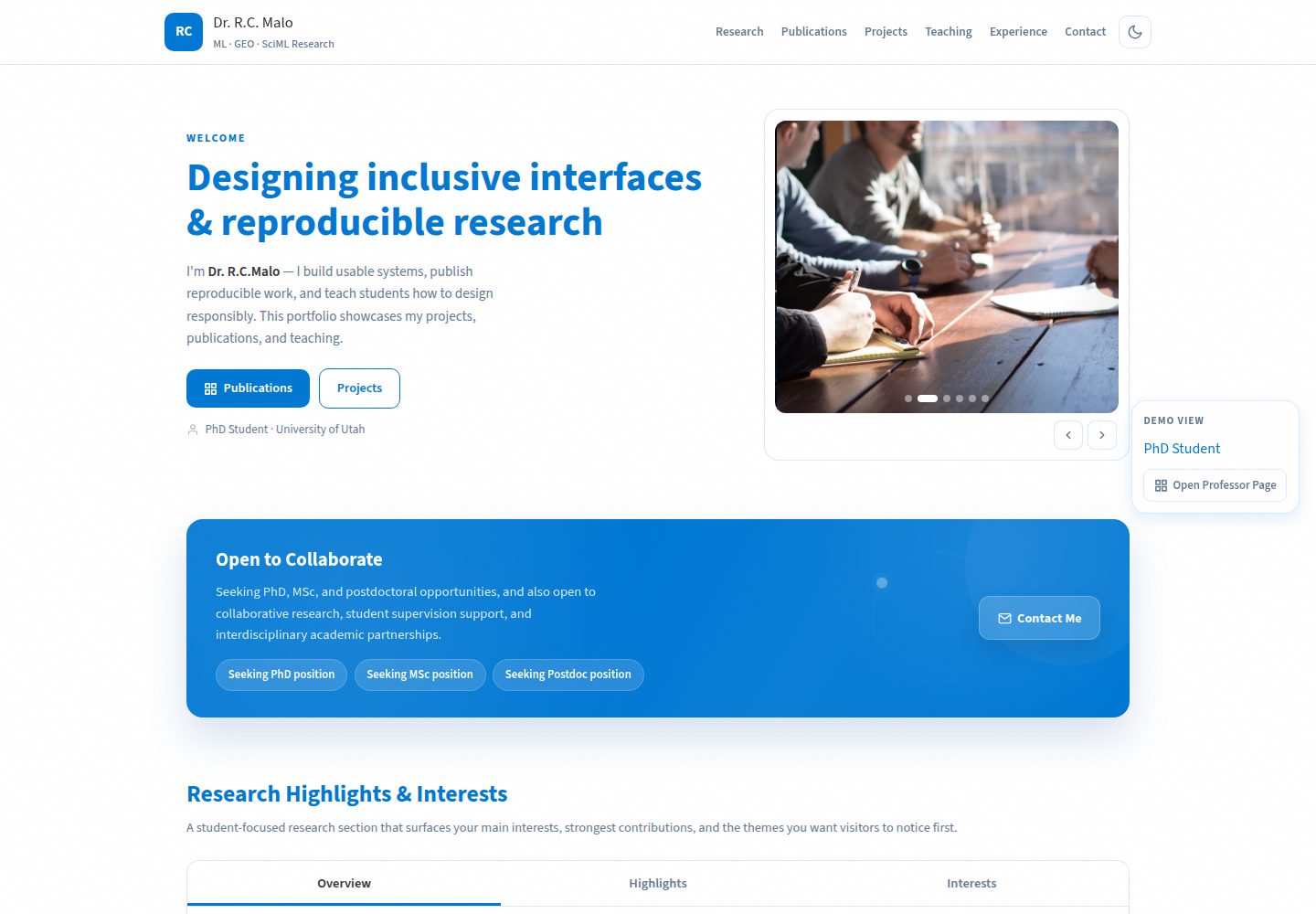
All site content is driven by a single data.json, so pages can be updated without editing HTML
HTMLPortfolio
acadpro — HTML Portfolio Template
By riponcm
AcadPro is a JSON-driven academic portfolio and lab website template built with pure HTML, CSS, and JavaScript, offering two frontends: student/researcher and professor/lab.
Explore the design
Compare the page layouts and mobile experience. Open any screenshot for a closer look.
Desktop homepage1 / 2
Desktop captureTop of page
Actual screenshot captured by the server browser.
All pages & views 2
Screenshots show visual appearance; interactive behavior may differ.
Recorded 2026-10-02View source
What stands out
A quick read of the recorded project description.
Provides two frontends—student/researcher and professor/lab—sharing the same data file
The publications module supports sorting by year or citation count, load-more pagination, and a BibTeX copy modal
The default theme (light, dark, blue) can be configured in JSON, and the template type can be switched
Optionally updates citation counts from Google Scholar via a Python script while preserving manual edits
Implemented in pure HTML, CSS, and JavaScript, with no framework, build tools, or package manager dependencies
Template Details
AcadPro is a static website template for academic scenarios, with the repository under the MIT license. The template is written in pure HTML, CSS, and JavaScript, with no framework or package manager dependencies. All site content is stored centrally in a data.json file, which JavaScript reads and renders into sections on page load, so routine maintenance only requires editing the JSON without touching the HTML.
The template provides two frontends: index.html targets PhD students, MSc/MS students, postdocs, and early-career researchers, with sections for bio, hiring/collaboration banner, research highlights and interests, publications, projects, teaching, experience, education, awards, and contact; professor.html targets professors, faculty, senior academics, and lab heads, with a lab-oriented hero, collaboration and open positions, lab introduction (including tabs for overview, themes, facilities/methods, team, etc.), lab publications, and a contact section with a map. Both pages share the same data.json and publication display engine.
Content configuration covers JSON keys such as profile, hiring/opportunities, researchProfile, publications, projects, teaching, experience, education, awards, contact, and footer. It also supports switching the template (phd or professor) in settings, setting the default theme (light, dark, blue), and controlling the demo template toggle button. The publications module supports sorting by year or citation count, load-more pagination, a BibTeX copy-to-clipboard modal, and optionally updating citation counts from Google Scholar via fetch_scholar.py.
Usage limitations: because the page reads data.json via fetch, opening index.html directly with file:// will not work; local testing requires starting a static server. Google Scholar auto-update requires installing additional Python dependencies and configuring a Scholar ID. The template itself contains no build tools or server-side code; deploying to static hosting such as Netlify, GitHub Pages, or Vercel is sufficient.
HTMLPortfolio
Is it right for your project?
Use Cases
- PhD students, MSc/MS students, or postdocs building a personal academic portfolio homepage
- Professors or faculty creating a personal faculty profile page
- Research labs or groups publishing lab introductions, open positions, and publication lists
- Researchers showcasing publications, projects, teaching, experience, education, and awards
- Academic websites that need to be deployed statically to Netlify, GitHub Pages, or Vercel
Suitable For
- PhD students and MSc/MS students
- Postdocs and early-career researchers
- Professors, faculty, and senior academics
- Research labs, groups, and principal investigators
- Academic website maintainers who want to manage content centrally with JSON
Getting started & customization
Use these recorded setup notes alongside the repository instructions for your chosen version.
- 1
After cloning the repository, edit data.json to replace the demo content with personal information
- 2
Local testing requires starting a static server (e.g., python3 -m http.server 8000 or npx serve .); opening index.html directly will not work because browsers block fetch requests under file://
- 3
Use index.html for the student/researcher page and professor.html for the professor/lab page; both read the same data.json
- 4
In data.json settings, set template to phd or professor to choose the template, and configure templateLabel to display a label
- 5
To automatically update citation counts from Google Scholar, install scholarly and run fetch_scholar.py --scholar-id YOUR_SCHOLAR_ID
License & source material
Usage conditions & limitations
Free to use · keep license noticeThis entry covers the free version under the MIT license in the public repository; the free scope is the code of this version and does not imply that external services or third-party assets are free.
Must comply with when using
- Free use, modification, commercial use, and distribution of this version's code are permitted.
- When distributing copies or substantial portions of the code, retain the original author's copyright notice and the full MIT license notice.
- The code is provided as is; warranties and limitations of liability are governed by the original license and applicable law.
Additional costs & items to verify
- The page reads data.json via fetch, so opening index.html directly with file:// will not work; local testing must start a static server (e.g., python3 -m http.server or npx serve).
- The optional Google Scholar auto-update feature requires installing the Python dependency scholarly and configuring a Scholar ID; it is an external service integration, not a core template feature.
- Google Scholar has no official API; the script relies on the third-party scholarly library and may be affected by Google rate limiting, requiring waiting and retrying.
- Custom branding, layout modifications, additional sections, or CMS/backend integrations are paid commissioned services and are not included in the free template itself.
- Demo images, fonts, icons, and other third-party assets must be checked against their respective licenses and cannot be judged solely by the code's MIT license.
- External services such as domains, hosting, databases, payments, or AI may incur separate charges.
View Original Text Basis
Permission is hereby granted, free of charge
Original License Text
Since the site loads `data.json` via JavaScript fetch, you need a local server to test
Original README
pip install scholarly python fetch_scholar.py --scholar-id YOUR_SCHOLAR_ID
Original README
Google Scholar has no official API — the script uses the `scholarly` library
Original README
https://github.com/riponcm/acadpro/blob/main/LICENSE.txthttps://github.com/riponcm/acadpro/blob/main/README.mdIf you need a tailored version of this portfolio with custom branding, unique layout modifications, additional sections, or integration with a CMS or backend system, I am available for commissioned work.
Original README
Compiled by DeepSeek based on repository license and README ·2026-10-02. Results only cover the materials read; dependencies, images, fonts, and subsequent term changes are subject to their respective original texts.
Project checks & description sources
Template Information
- Source platforms
- GitHub
- Documentation and maintenance reference score
- More documented · 83 / 100
- Technologies
- HTML
- Website type
- Portfolio
How this score is calculated
Our heuristic uses license records (up to 30), a demo link (12), a preview (10), stars (15), recorded maintenance (15), description completeness (8), feature records (5) and classification data (5). It is not a code, security or performance test, or a Google score. A link does not establish tested functionality.
What to verify for this project
- Repository update recorded
- 2026-04-09
- Screenshot last checked
- 2026-10-02
A demo link is listed. Check it with your own content and viewport sizes; its presence does not confirm that forms, authentication or payments work.
The catalog identifies HTML as the primary stack. Check the actual dependency manifest and lockfile for versions and hosting requirements. These notes use recorded metadata, not a code audit or a deployment test.
Use a selection guide →How this description was prepared
AI-assisted description based on catalog records and repository material. Repository authors are not automatically the reviewers of this description.
Automatically checked against source and license rules; no manual editorial review.
Inspect the recorded source material
SHA-256: cce1472f008bbb731c75340ad4d1066c2c6f9a905eb80409960887fe35583ee7
2026-10-02T21:35:02.450Z
Source file / repository# AcadPro--Academic Portfolio Template
**A GitHub repository for an academic portfolio template, professor lab website, researcher homepage, and university faculty profile theme.**
  
<div align="center">
[](https://acadpro.netlify.app)
</div>
**Preview**

# AcadPro--Academic Portfolio Template
Acadpro is a modern, JSON-driven academic portfolio and lab website repository built with pure HTML, CSS, and JavaScript for PhD students, MSc students, postdocs, professors, research groups, and university faculty who want a polished online presence without frameworks or dependencies.
---
> **If this project is useful to you, please consider giving it a star.**
> Stars help others discover this project and motivate continued development.
>
> [](https://github.com/riponcm/acadpro)
---
## What's New in V2.0.2
- All site content is now driven by a single `data.json` file — no more editing HTML
- Student and Professor modes are now supported with separate frontends
- New dedicated `professor.html` page for faculty and research lab websites
- Floating demo switcher now opens the Student or Professor page directly
- Student template keeps the portfolio-oriented homepage and no-map contact layout
- Professor page adds a lab-focused hero, collaboration section, lab overview, lab publications, and map-based contact layout
- Research Highlights & Interests now use a tabbed layout matching the existing theme
- Highlights and Interests can now render compact technical skill cards with icons and learning levels
- Optional Google Scholar integration to auto-update citation counts
- Two publication display styles — card grid or tabbed list — switchable via JSON
- Dynamic Publication sorting by "Year" or "Citations" with "Load More" pagination
- BibTeX Copy-to-Clipboard modal
- Every section (projects, publications, teaching, experience, education, awards, contact) is fully configurable from JSON
- Configurable Default Theme (`light`, `dark`, `blue`) directly controlled from `data.json`
---
## Overview
This is a complete, production-ready academic portfolio website. All content lives in `data.json` — edit that one file and the website updates automatically. No build tools, no package managers, no server-side code.
The design follows an editorial aesthetic with warm muted tones, refined typography, and subtle animations. It includes light and dark mode, responsive layout, and all interactive features built from scratch.
---
---
## Templates
Acadpro now supports two main academic website experiences:
- `index.html` for Student / Researcher portfolios
- `professor.html` for Professor / Lab frontends
### Student Template
Use this for:
- PhD students
- MSc / MS students
- Postdocs
- Early-career researchers
Main characteristics:
- Hero remains in the same visual style
- Simple `Open to Collaborate` banner
- Tabbed `Research Highlights & Interests` section
- Compact technical skill cards supported inside research tabs
- Existing publication system stays unchanged
- Existing project cards stay unchanged
- Existing teaching section stays unchanged
- Existing experience and education tabs stay unchanged
- Existing awards section stays unchanged
- `Contact Me` becomes two centered banner blocks with no map
### Professor Template
Use this for:
- Professors
- Teachers
- Senior faculty profiles
- Research labs
- Principal investigators
Main characteristics:
- Same visual theme and shared academic branding
- Dedicated `professor.html` page instead of forcing all logic into one homepage
- Lab-first hero with welcome message and research highlight slider
- Collaboration and open positions section for PhD, Master's, postdoc, and visiting researchers
- Large `About the Lab` section with tabs for overview, themes, facilities/methods, and team/culture
- Lab publications section reusing the shared publication engine
- Map-based `Contact Us` area with professor/lab details, CV, and academic profiles
### How To Change Template
In `data.json`:
```json
"settings": {
"template": "phd",
"templateLabel": "PhD Student"
}
```
Available values:
- `phd` for the student/researcher view
- `professor` for the professor/teacher view
You can also change the visible label:
```json
"templateLabel": "Postdoctoral Researcher"
```
### Which File To Open
- Use `index.html` for the student/researcher site
- Use `professor.html` for the professor/lab site
- Both pages read from the same `data.json`
### Demo Switcher
For demo purposes, the site can show a floating switch button on the middle-right side of the screen to open the Student or Professor page quickly.
Enable it in `data.json`:
```json
"settings": {
"demoTemplateSwitcher": true
}
```
Hide it on a real published site:
```json
"settings": {
"demoTemplateSwitcher": false
}
```
When hidden, visitors will only see the single template selected in `settings.template`.
---
## Page Structure
| # | Section | JSON Key | Description |
|:---:|:---|:---|:---|
| 01 | **Header** | `profile` | Sticky navigation with glass blur effect and theme toggle |
| 02 | **Hero** | `profile` & `projects` | Welcome text with auto-rotating photo carousel (combines profile pics + project pics) |
| 03 | **Hiring Banner** | `hiring` | Highlighted "Open to Work" section with animated pulse |
| 04 | **Research Highlights & Interests** | `researchProfile`, `expertise`, `lab` | Tabbed research overview, highlights, and interests |
| 05 | **Publications** | `publications` | Existing publication system with auto-fetch compatibility, sorting, BibTeX, sharing, and load more |
| 06 | **Projects** | `projects` | Existing project cards with images, GitHub links, and share dropdown |
| 07 | **Teaching** | `teaching` | Existing video tiles that open YouTube in a modal |
| 08 | **Experience** | `experience` | Existing tabbed work-history panel |
| 09 | **Education** | `education` | Existing tabbed degree panel |
| 10 | **Awards** | `awards` | Existing compact cards with external links |
| 11 | **Contact Me** | `contact`, `cv`, `settings.template` | Student view: two centered banners without map. Professor view: map layout with contact info |
| 12 | **Footer** | `footer` | Existing footer style with version and repo link |
### Professor Page Structure
| # | Section | JSON Key | Description |
|:---:|:---|:---|:---|
| 01 | **Header** | `profile` | Shared sticky header and branding |
| 02 | **Lab Hero** | `professorPage.hero`, `profile`, `lab` | Welcome to lab message with research highlight slider |
| 03 | **Collaboration & Open Positions** | `professorPage.collaboration` | PhD, Master's, postdoc, visiting researcher, and collaboration callout |
| 04 | **About the Lab** | `professorPage.aboutLab`, `lab` | Large tabbed lab section with overview, themes, methods, and people |
| 05 | **Lab Publications** | `publications` | Shared publication engine reused for the professor frontend |
| 06 | **Contact Us** | `contact`, `cv`, `lab`, `profile` | Map-based faculty/lab contact section |
| 07 | **Footer** | `footer` | Shared footer style |
---
## Installation
### Step 1 — Clone the Repository
```bash
git clone https://github.com/riponcm/acadpro.git
cd acadpro
```
### Step 2 — Edit Your Data
Open `data.json` in any text editor (VS Code recommended) and replace the demo content with your own information. See the Customization Guide below for details on each section.
### Step 3 — Test Locally
Since the site loads `data.json` via JavaScript fetch, you need a local server to test:
```bash
# Using Python (recommended)
python3 -m http.server 8000
# Using Node.js
npx serve .
```
Then open `http://localhost:8000` in your browser.
**Note:** Opening `index.html` directly as a file will not work because browsers block `fetch()` requests from `file://` protocol. Always use a local server for testing.
### Step 4 (Optional) — Auto-Update from Google Scholar
```bash
pip install scholarly
python fetch_scholar.py --scholar-id YOUR_SCHOLAR_ID
```
Your Google Scholar ID is the value after `user=` in your profile URL:
`https://scholar.google.com/citations?user=YOUR_SCHOLAR_ID`
This updates citation counts for existing papers and adds new ones with placeholder images. Your manual edits (images, PDFs, descriptions) are never overwritten. A backup is saved as `data.backup.json` before each update.
---
## Deployment
### Option 1 — Netlify (Recommended)
1. Go to [app.netlify.com](https://app.netlify.com) and sign in.
2. Click **"Add new site"** then **"Deploy manually"**.
3. Drag your project folder (containing `index.html` and `data.json`) into the upload area.
4. Your site is live. Netlify provides a free URL and HTTPS.
To update: drag the updated folder into the re-deploy area on the **Deploys** tab.
### Option 2 — GitHub Pages
1. Push your repository to GitHub.
2. Go to repository **Settings** then **Pages**.
3. Under **Source**, select branch `main` and root folder `/`.
4. Click **Save**. Your site will be available at `https://username.github.io/repo-name`.
5. Any push to `main` will automatically redeploy.
### Option 3 — Vercel
1. Go to [vercel.com](https://vercel.com) and import your GitHub repository.
2. No build settings needed — it serves static files automatically.
3. Deploys on every push.
---
## File Structure
```
acadpro/
|-- index.html <- Main site (reads data.json, renders everything)
|-- data.json <- All site content (edit this file)
|-- fetch_scholar.py <- Optional: auto-pull from Google Scholar
|-- LICENSE.txt <- License terms
|-- README.md <- This file
|-- .gitignore
|-- screenshots/
|-- light-mode.png
|-- dark-mode.png
|-- hero.png
|-- banner.png
|-- expertise.png
|-- tabs.png
```
---
## Customization Guide
### How It Works
All site content is stored in `data.json`. The `index.html` file reads this JSON on page load and renders every section dynamically. You never need to touch the HTML — just edit the JSON and push.
### Profile and Hero Section
```json
"profile": {
"name": "Dr. Your Name",
"initials": "YN",
"tagline": "Your Research Areas",
"headline": "Your headline text",
"bio": "Your bio with <strong>HTML</strong> allowed",
"role": "Your Title",
"affiliation": "Your University",
"photos": [
{ "src": "https://your-photo-url.jpg", "alt": "Description" }
]
}
```
### Hiring Banner / Open To Collaborate
Toggle the banner on or off:
```json
"hiring": {
"enabled": true,
"title": "Open to Collaboration",
"description": "Your hiring message here."
}
```
Set `enabled` to `false` to hide the banner completely.
You can also supply a cleaner opportunity list for student-style templates:
```json
"opportunities": {
"title": "Open to Collaborate",
"summary": "Open to PhD, MSc, postdoc, and collaborative research opportunities.",
"positions": [
"Seeking PhD position",
"Seeking MSc position",
"Seeking Postdoc position"
]
}
```
### Research Highlights & Interests
```json
"researchProfile": {
"title": "Research Highlights & Interests",
"summary": "Short overview of your research direction.",
"interests": [
"Geotechnical Engineering",
"Ground Improvement",
"Experimental Soil Mechanics"
],
"metrics": [
{ "label": "Publications", "value": "8+" }
],
"highlights": [
{
"title": "Area of Expertise",
"description": "Your focus areas.",
"items": [
"Soft soil improvement",
"Vacuum densification"
]
}
]
}
```
### Contact And CV
```json
"contact": {
"email": "[email protected]",
"phone": "+1 (000) 000-0000",
"office": "Room 101, Building Name",
"cvUrl": "https://example.edu/cv.pdf",
"socials": [
{ "platform": "google-scholar", "url": "https://scholar.google.com/..." },
{ "platform": "github", "url": "https://github.com/..." },
{ "platform": "linkedin", "url": "https://linkedin.com/in/..." },
{ "platform": "orcid", "url": "https://orcid.org/..." }
]
},
"cv": {
"title": "Academic CV",
"buttonLabel": "View CV",
"url": "https://example.edu/cv.pdf"
}
```
Template behavior:
- `phd` removes the map and shows two centered contact banners
- `professor` keeps the map contact layout
### Previous Lab Content
The previous lab-oriented data can still remain in `data.json`, and the research section can reuse it as supporting content when needed.
```json
"lab": {
"directorName": "Dr. Your Name",
"title": "Your Lab Name",
"description": "Lab focus and descriptions go here."
}
```
### Real Site Setup
For a real site, these are the most common production settings:
```json
"settings": {
"template": "phd",
"templateLabel": "PhD Student",
"demoTemplateSwitcher": false,
"publicationStyle": "alt",
"theme": "blue"
}
```
That keeps one stable template live and hides the floating demo switcher from visitors.
### Legacy Lab / About Section Data
If you still want to keep older lab-oriented content in the JSON, you can:
```json
"lab": {
"directorName": "Dr. Your Name",
"title": "Your Lab Name",
"description": "Lab focus and descriptions go here. Explaining what you build.",
"members": [
{
"roleGroup": "Postdoctoral Researchers",
"people": [
{ "name": "Dr. Alice Smith", "role": "Postdoc, ML", "image": "img1.png" }
]
},
{
"roleGroup": "Ph.D. Students",
"people": [
{ "name": "Charlie Davis", "role": "Ph.D. Candidate", "image": "img2.png" }
]
}
]
}
```
### Expertise Tags
Add or remove skills. Levels control visual size: `expert` (largest), `advanced`, `intermediate`.
```json
"expertise": [
{ "name": "Machine Learning", "level": "expert" },
{ "name": "Python", "level": "advanced" }
]
```
### Projects
```json
"projects": [
{
"title": "Project Name",
"subtitle": "Short description",
"year": "2024",
"image": "https://your-image-url.jpg",
"description": "Detailed description.",
"github": "https://github.com/you/repo",
"url": "https://project-url.com"
}
]
```
### Publications
Each publication entry:
```json
{
"title": "Paper Title",
"authors": "A. You, B. Coauthor",
"highlightAuthor": "A. You",
"venue": "Journal Name, Vol. X",
"year": 2024,
"type": "journal",
"image": "https://card-image.jpg",
"thumbnail": "https://list-thumbnail.jpg",
"description": "Paper abstract or summary.",
"pdfUrl": "https://link-to-pdf.pdf",
"url": "https://paper-url.com",
"citations": 42,
"bibtex": "@article{key,title={...},author={...},year={2024}}"
}
```
The `type` field accepts `journal`, `conference`, or `workshop` — this controls the filter tabs.
The `highlightAuthor` field is your name as it appears in the authors string — it gets bolded and color-highlighted automatically.
### Publication Display Style
In the `settings` section of `data.json`:
```json
"settings": {
"publicationStyle": "alt"
}
```
Options: `"alt"` (tabbed list view), `"card"` (grid cards), or `"both"` (shows both styles).
### Teaching
```json
"teaching": [
{
"title": "Lecture 1 — Topic",
"subtitle": "Short description",
"videoUrl": "https://www.youtube.com/embed/VIDEO_ID",
"bgColor": "#2d5a7b"
}
]
```
### Experience and Education
Experience uses icon names. Education uses logo image URLs.
```json
"experience": [
{
"title": "Job Title",
"organization": "Company or University",
"description": "What you did.",
"years": "2022 — Present",
"icon": "monitor"
}
],
"education": [
{
"title": "Ph.D. in Your Field",
"organization": "University Name",
"description": "Details about your degree.",
"years": "2016 — 2020",
"logo": "https://university-logo-url.png"
}
]
```
Available icon names: `monitor`, `globe`, `pencil`, `code`, `shield`, `cap`, `star`, `award`.
### Awards
```json
"awards": [
{
"title": "Best Paper Award",
"subtitle": "Conference Name, 2024",
"url": "https://link-to-award.com",
"icon": "award",
"iconColor": "warm"
}
]
```
Icon color options: `"warm"` (copper), `"accent"` (blue), `"sage"` (green).
### Contact and Socials
```json
"contact": {
"email": "[email protected]",
"phone": "+1 (555) 000-0000",
"office": "Room 100, Building Name",
"mapEmbed": "https://www.google.com/maps/embed?pb=YOUR_EMBED_URL",
"socials": [
{ "platform": "google-scholar", "url": "https://scholar.google.com/..." },
{ "platform": "github", "url": "https://github.com/you" },
{ "platform": "linkedin", "url": "https://linkedin.com/in/you" },
{ "platform": "orcid", "url": "https://orcid.org/0000-..." }
]
}
```
Supported social platforms: `google-scholar`, `github`, `linkedin`, `orcid`, `twitter`.
### Adjust Colors
All colors are CSS variables at the top of `index.html`. Edit `:root` for light mode and `[data-theme="dark"]` for dark mode.
You can also set the default appearance in `data.json` under `settings`:
```json
"settings": {
"theme": "blue" // Available options: "light", "dark", "blue"
}
```
The "blue" theme uses a crisp white background with primary blue accents. Users will still be able to toggle to a dark mode via the UI button.
---
## Google Scholar Integration
The included `fetch_scholar.py` script connects to Google Scholar and updates your `data.json` automatically.
### Setup
```bash
pip install scholarly
```
### First Run
Add your Scholar ID to `data.json`:
```json
"settings": {
"scholarId": "YOUR_SCHOLAR_ID"
}
```
Then run:
```bash
python fetch_scholar.py
```
### What It Does
- Fetches all your publications from Google Scholar
- For **existing papers** in `data.json`: updates citation count only
- For **new papers**: adds them with placeholder images (you replace later)
- **Never deletes or overwrites** your manual edits (images, PDFs, descriptions)
- Creates `data.backup.json` before every save
### Recommended Workflow
Run the script monthly to keep citations current:
```bash
python fetch_scholar.py
# Review data.json for new entries
# Replace placeholder images for new papers
# Add PDF URLs
git add data.json
git commit -m "Update publications from Scholar"
git push
```
### Important Notes
- Google Scholar has no official API — the script uses the `scholarly` library
- Google may rate-limit requests; if blocked, wait and try again later
- The script takes 30-60 seconds depending on your number of publications
---
## Features
### Design
- Clean editorial typography using Playfair Display and Source Sans 3
- Light and dark theme with smooth toggle and persistence via localStorage
- Warm muted color palette — slate blue, copper, sage green
- Subtle grain texture overlay for depth
- Glassmorphism header with backdrop blur
- Responsive layout — works on desktop, tablet, and mobile
- Print-friendly styles
### Interactive Elements
- Auto-rotating photo carousel with dot indicators and navigation arrows
- Scroll-triggered reveal animations with staggered timing
- Expertise cloud with hover tooltips showing proficiency levels
- Tabbed content panel for experience and education
- Tabbed professor lab section for overview, research themes, facilities, and team
- Share dropdown with Copy Link, Facebook, LinkedIn, and X support
- BibTeX download button that generates and saves citation files
- Publication filter tabs including Journal, Conference, Workshop, Poster, and Thesis / Dissertation
- Video tiles that open lectures in a YouTube modal
- Awards and certifications with popup detail support
- Project detail popups with tabs, screenshots, demo links, repository links, and video support
### Technical
- JSON-driven — all content in one file, zero HTML editing needed for content updates
- Dual static frontends: `index.html` and `professor.html`
- All icons are inline SVG — no icon library needed
- Google Fonts loaded via preconnect for performance
- Fully semantic HTML with ARIA labels
- Zero JavaScript frameworks — pure vanilla JS
- No cookies, no analytics, no tracking
---
## Custom Design Service
If you need a tailored version of this portfolio with custom branding, unique layout modifications, additional sections, or integration with a CMS or backend system, I am available for commissioned work.
**Contact for custom design inquiries:**
| | |
|:---|:---|
| **Author** | Ripon Chandra Malo |
| **LinkedIn** | *https://www.linkedin.com/in/engr-ripon/* |
Typical turnaround for custom modifications is 3 to 7 business days depending on scope.
---
## License
This project is released under the MIT License.
You can use, modify, publish, distribute, sublicense, and sell this project, as long as the copyright notice and license text are included in substantial copies of the software.
---
## Technical Notes
- Tested on Chrome, Firefox, Safari, and Edge (latest versions).
- Mobile responsive down to 320px viewport width.
- Lighthouse score: 95+ Performance, 100 Accessibility, 100 Best Practices, 100 SEO (when hosted over HTTPS).
- Total file size: approximately 55 KB HTML + 15 KB JSON uncompressed.
- No external JavaScript dependencies. No npm. No Webpack. No React.
- Requires a web server for local testing (uses `fetch()` to load JSON).
---
**AcadPro — An Academic Portfolio Template** — Version 2.0.2
Designed by **Ripon Chandra Malo**
---
> **If this project helped you, consider buying me a coffee.**
<div align="center">
[](https://www.buymeacoffee.com/riponce) [](https://github.com/riponcm/acadpro)
</div>
<p align="center">
<a href="#">
<img src="https://api.visitorbadge.io/api/VisitorHit?user=riponcm&repo=acadpro-badge&countColor=%237B1E7A" />
</a>
</p>
Explore similar templates
Compare previews and descriptions within the same stack and category.
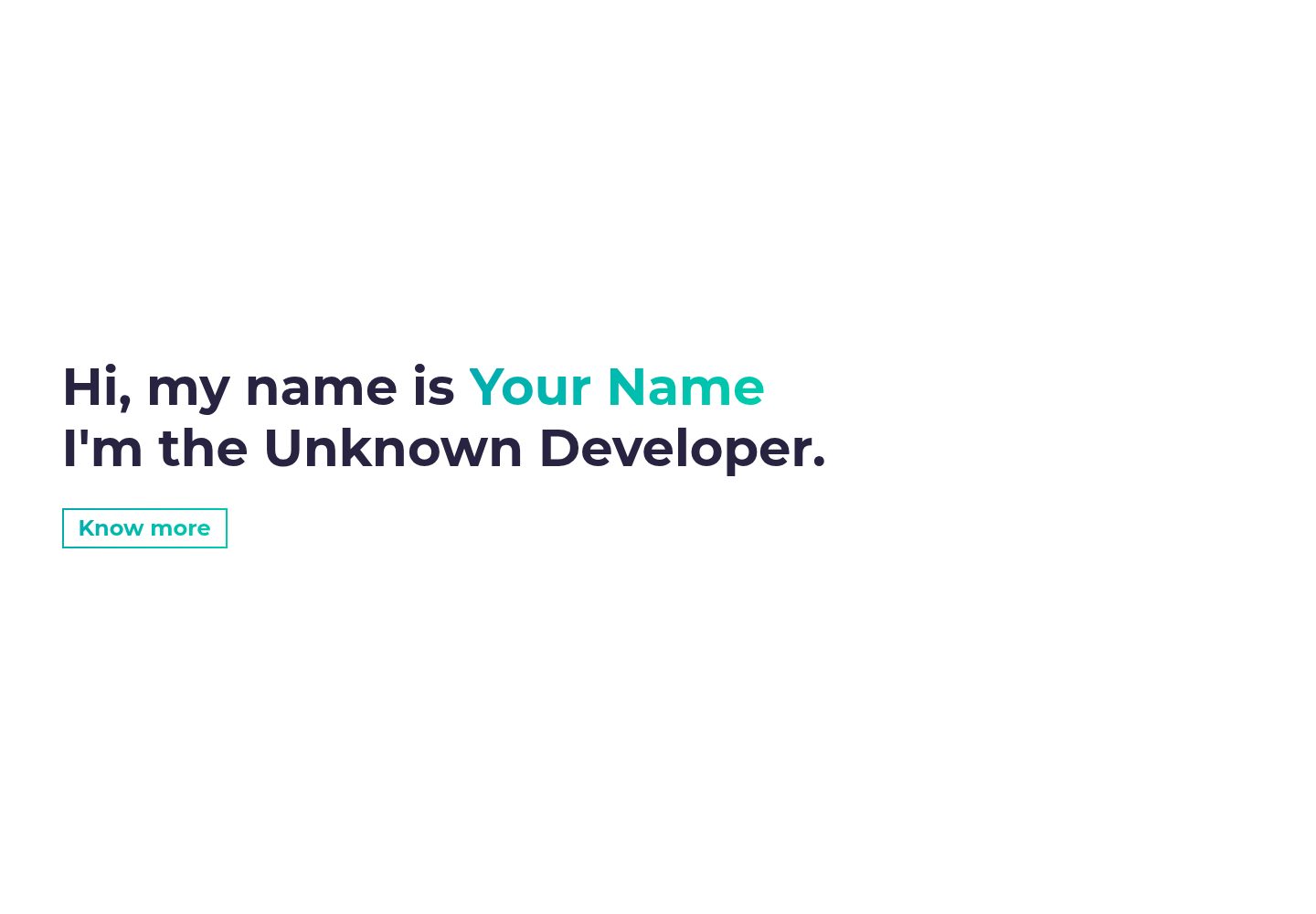
simplefolio
Simplefolio is a minimal single-page portfolio template for developers, built with HTML, Bootstrap, SCSS, and Parcel under the MIT license. It includes Hero, About, Projects, Contact, and Footer sections, with content edited in /src/index.html and theme colors controlled by two SCSS variables.
HTML · Portfolio
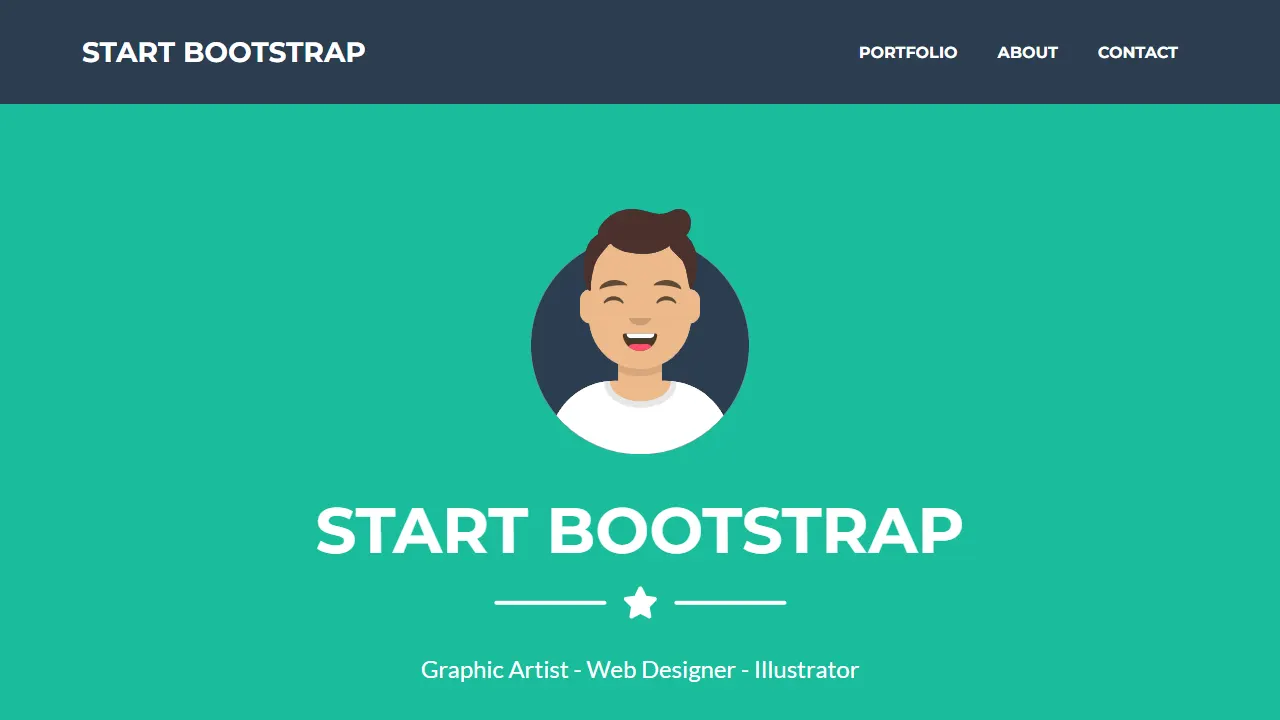
Freelancer
A bright, single-page Bootstrap portfolio template for freelancers, designers, and small studios. It includes a responsive portfolio grid with modal detail windows and an SB Forms contact form that requires an API token.
HTML · Portfolio
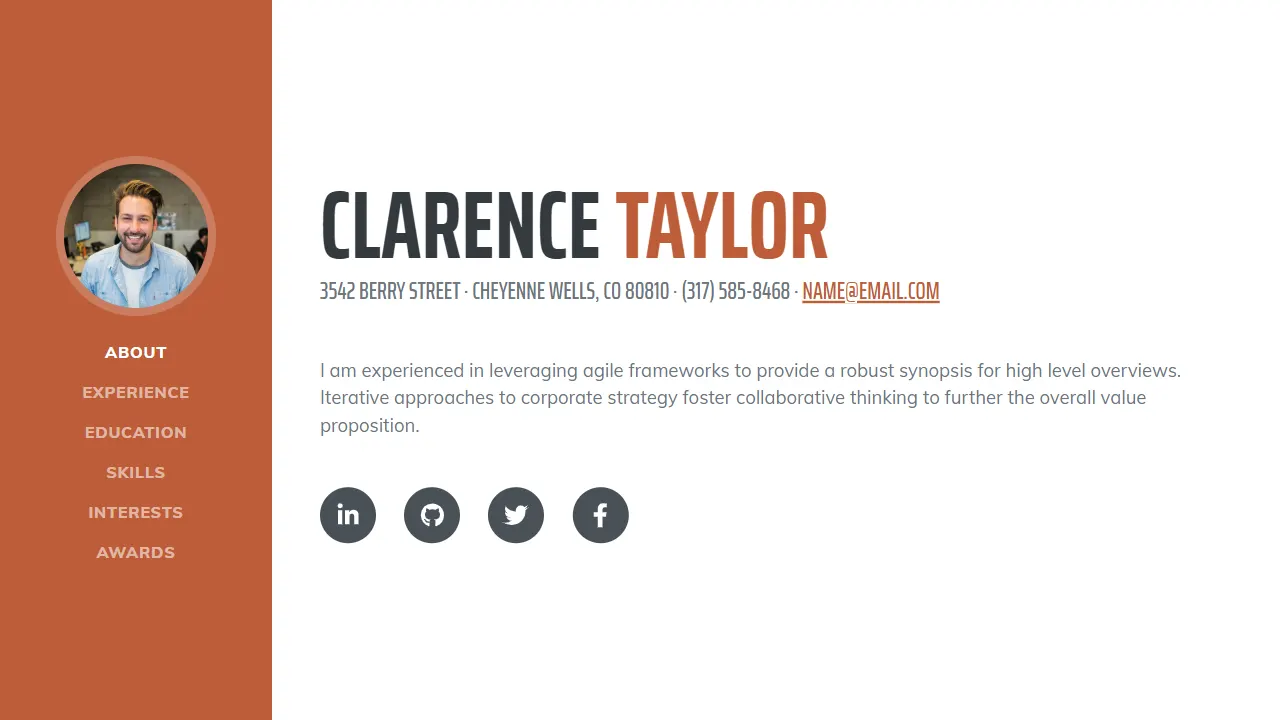
Resume
A single-page resume and CV template from Start Bootstrap, built on Bootstrap with a fixed sidebar and content sections.
HTML · Portfolio
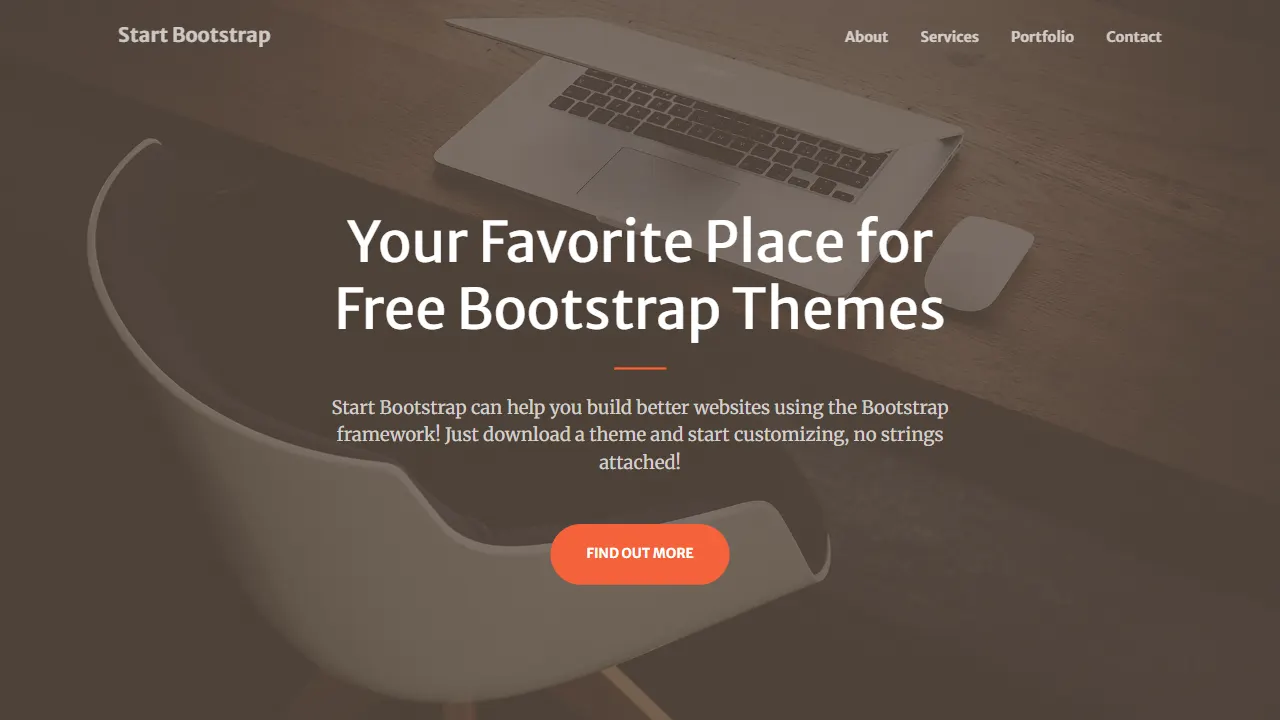
Creative
A single-page marketing template by Start Bootstrap for creative agencies and product services, built on Bootstrap with SCSS, featuring a portfolio grid and call-to-action sections. It includes pre-set SB Forms markers for form integration and npm build scripts for source customization.
HTML · Corporate Website
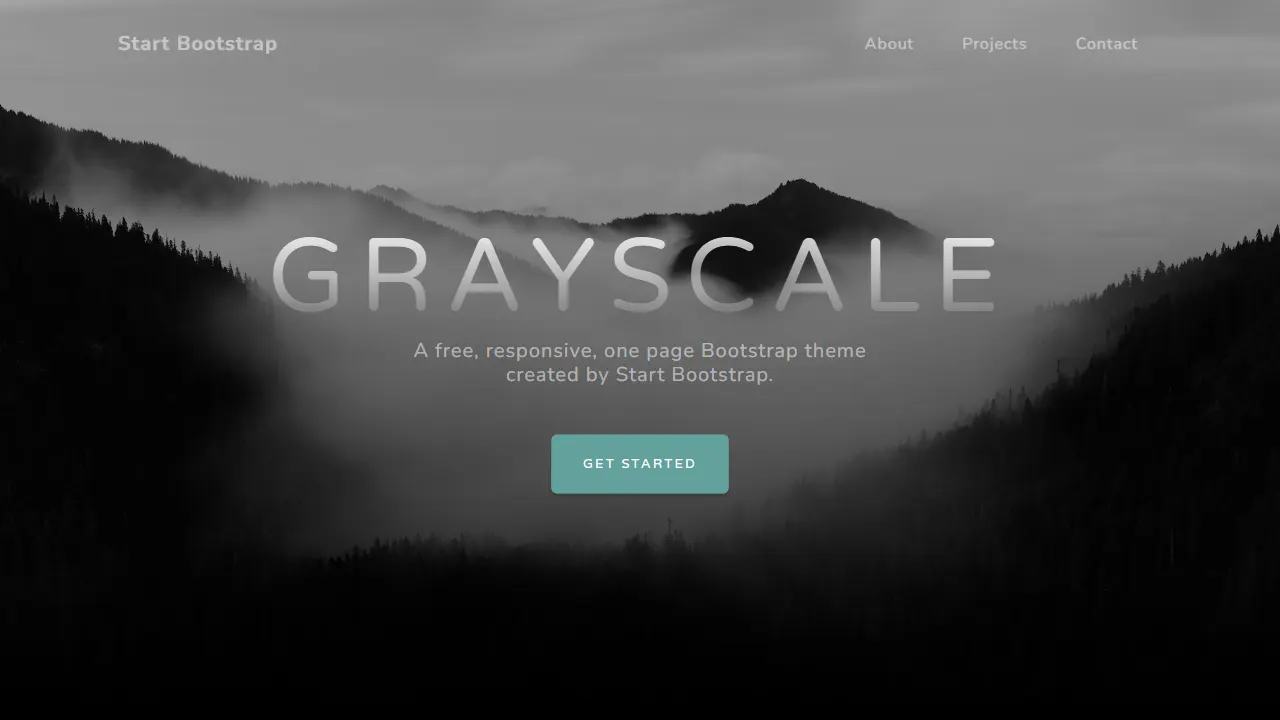
Grayscale
A dark single-page Bootstrap template from Start Bootstrap for photography, events and brand storytelling, with a large hero and clearly separated sections.
HTML · Corporate Website
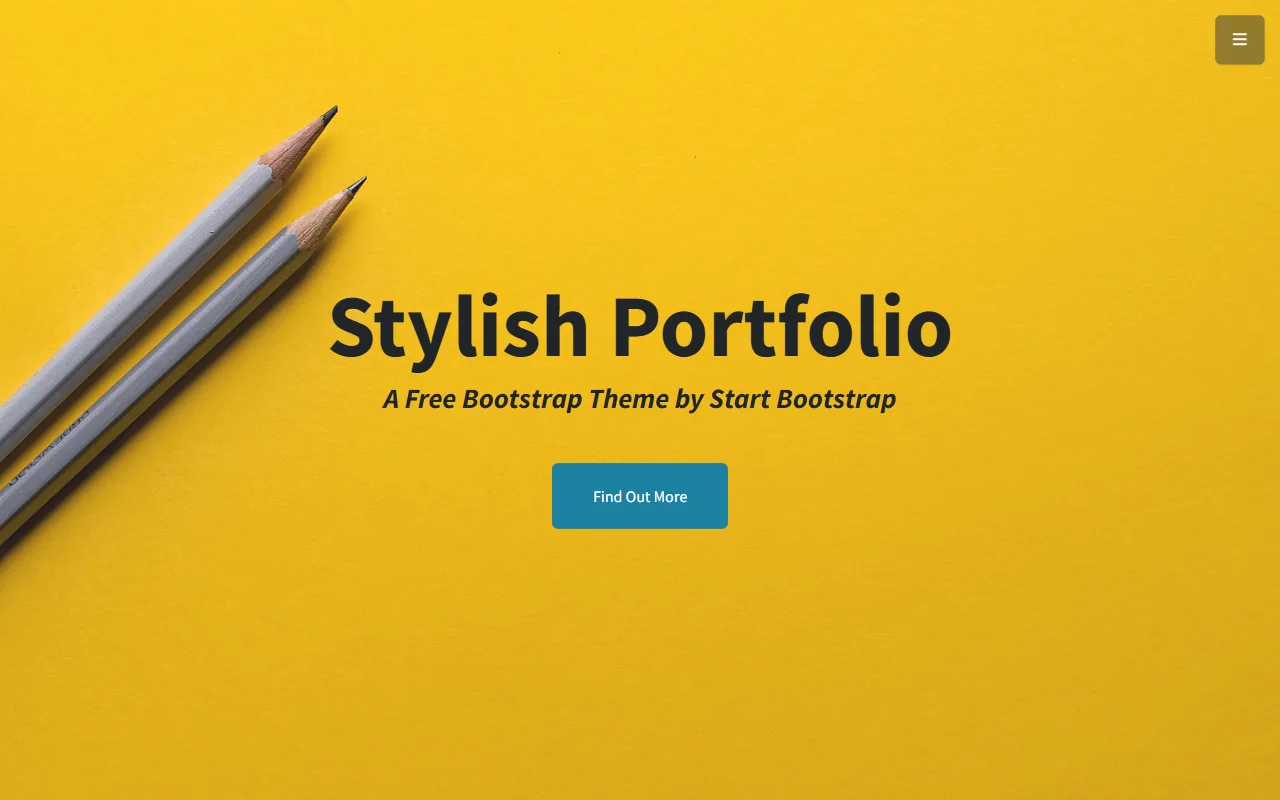
startbootstrap-stylish-portfolio
A one-page Bootstrap portfolio theme from Start Bootstrap with multiple content sections and an off-canvas navigation menu. Basic use means editing HTML/CSS under dist and opening index.html; advanced use relies on npm with Pug and SCSS build scripts.
HTML · Portfolio