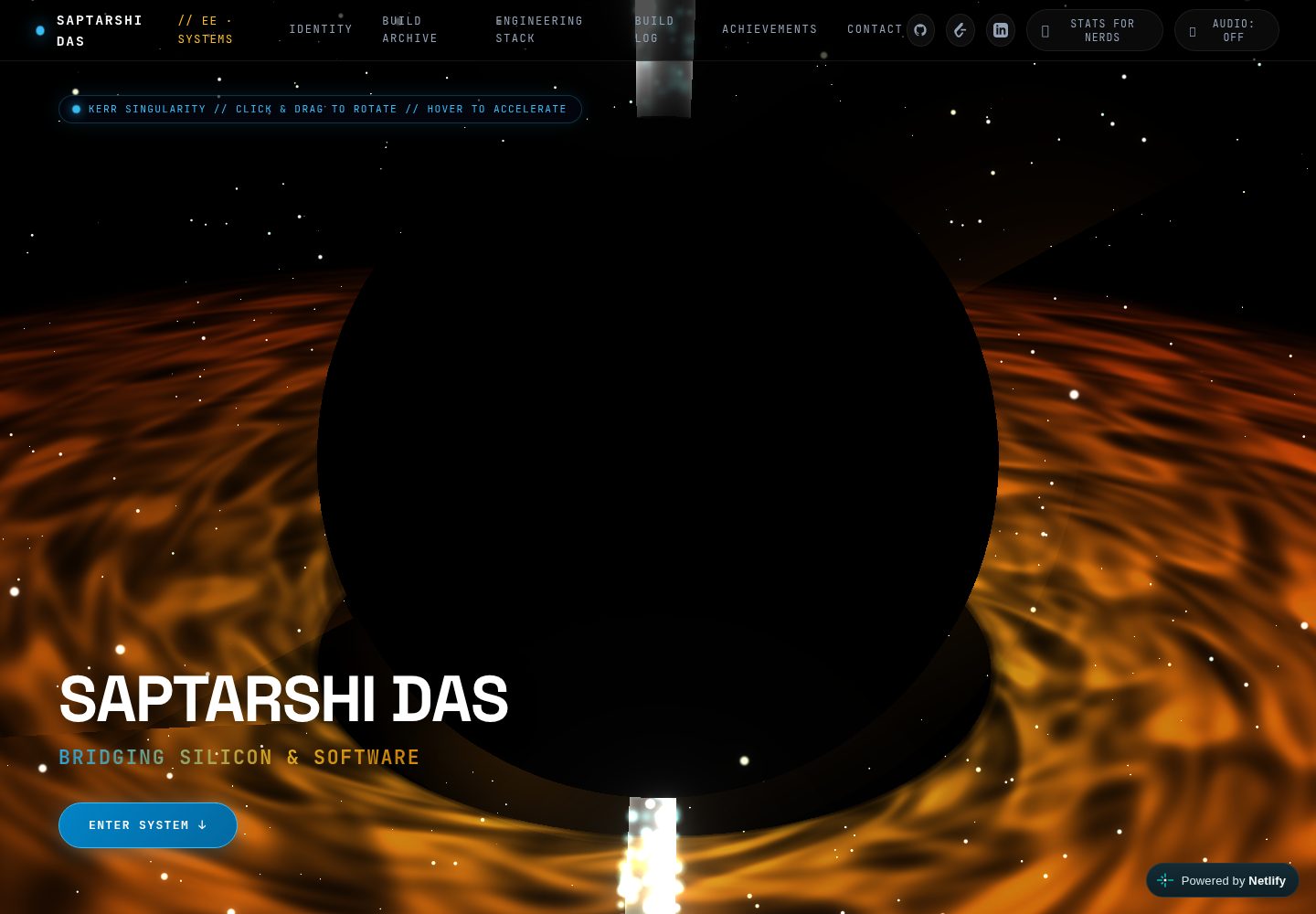
Interactive 3D WebGL narrative built with Three.js and GLSL shaders, centered on a Kerr black hole with dual relativistic plasma jets
AstroVitePortfolio
portfolio-website — Astro Portfolio Template
By saptarshidas578
Saptarshi Das's personal portfolio and cyber-physical systems showcase site, built with Three.js as an interactive 3D WebGL narrative featuring visual modules such as a Kerr black hole, starfield, engineering case studies, tech stack constellation, and Tokamak fusion reactor.
Explore the design
Compare the page layouts and mobile experience. Open any screenshot for a closer look.
Desktop homepage1 / 2
Desktop captureTop of page
Actual screenshot captured by the server browser.
All pages & views 2
Screenshots show visual appearance; interactive behavior may differ.
Recorded 2026-10-09View source
What stands out
A quick read of the recorded project description.
Scroll-driven starfield system: 7,000+ multispectral stars scatter outward and migrate to the left and right edges on scroll, preserving the central reading area
7-stage engineering case study overlay: problem, concept, system architecture (ASCII), hardware specifications, control logic and interlocks, firmware/telemetry, quantified benchmarks
60 FPS HTML5 canvas engineering stack constellation covering electronics, embedded systems, software engineering, and AI/ML, with node hover showing telemetry cards
Tokamak magnetic confinement fusion reactor core finale, including 3-axis counter-rotating gyroscopic coils, plasma noise, and 1,400 toroidal helical flux particles
README lists four flagship engineering systems, including domain, hardware, firmware, and key metrics
Template Details
This repository is the personal portfolio and cyber-physical engineering showcase of Saptarshi Das (Electrical and Computer Science Engineering). The README explains that it is not a static resume, but an end-to-end interactive 3D WebGL narrative built from scratch with Vanilla CSS, JavaScript, and Three.js: at the center is a rotating Kerr black hole devouring procedural firmware and algorithm source code; users can descend through the event horizon into an information-dense cyber-physical systems command center, closing with a real-time Tokamak magnetic confinement fusion reactor core.
The page contains multiple scroll-driven visual modules: a Kerr black hole with dual relativistic plasma jets, a starfield of 7,000+ multispectral stars that scatter outward and migrate to the left and right edges on scroll, selected engineering systems, a 7-stage engineering case study full-screen overlay, an interactive engineering stack constellation, a chronological build log with credential verification, and a Tokamak fusion reactor and quantum uplink finale.
The README lists four flagship engineering systems (smart grid and AC power monitoring, ESP32 dual-core smart desk clock, multimodal AI interview assistant, Air Whiteboard Pro spatial gesture computing), with each one's domain, hardware, firmware/pipeline, and key metrics. The technical architecture section includes Kerr metric ray marching, relativistic Kepler orbital velocity, relativistic beaming intensity, and Tokamak magnetic confinement equations.
The local development section only provides the beginning of the prerequisites (Node.js); the README is truncated at this point, so complete installation, build, and deployment steps are not given in the available material.
AstroVitePortfolio
Is it right for your project?
Use Cases
- As a personal portfolio and cyber-physical systems showcase for an Electrical and Computer Science Engineering student
- Showcasing technical details of embedded systems, power electronics, computer vision, and edge machine learning projects
- Presenting engineering methodology and quantified benchmarks through an interactive 3D narrative and case study overlay
- As a learning reference project for Three.js, WebGL shaders, and scroll-driven animation
Suitable For
- Electrical/computer engineering students or developers who need to showcase hardware and firmware projects
- Developers interested in Three.js, GLSL shaders, and interactive 3D web narratives
- Engineering portfolio authors who want to reference the case study structure of cyber-physical systems projects
Getting started & customization
Use these recorded setup notes alongside the repository instructions for your chosen version.
- 1
The local development section of the README only lists the prerequisite Node.js; subsequent installation and run steps are truncated in the available material, so complete commands cannot be provided.
- 2
The project structure shows Vite is used as the build tool, including netlify.toml for Netlify production builds and security header configuration.
- 3
Static assets are located in public/assets/, including SVG blueprints, personal portraits, contact videos, and PCB artifacts.
- 4
Source code is located in src/, including main.js, style.css, and multiple system modules under the shaders/ and systems/ directories.
License & source material
Usage conditions & limitations
Free to use · keep license noticeThis listing covers the free version of the public repository under the MIT license; the free scope is the code of this version and does not mean external services or third-party assets are free.
Must comply with when using
- Free use, modification, commercial use, and distribution of this version's code are permitted.
- When distributing copies or substantial portions of the code, retain the original author's copyright notice and the complete MIT license notice.
- The code is provided as is; warranties and limitations of liability are governed by the original license and applicable law.
Additional costs & items to verify
- Demo images, fonts, icons, and other third-party assets must be checked against their respective licenses and cannot be judged solely by the code's MIT license.
- External services such as domains, hosting, databases, payments, or AI may incur separate charges.
View Original Text Basis
https://github.com/saptarshidas578/portfolio-website/blob/main/LICENSEhttps://github.com/saptarshidas578/portfolio-website/blob/main/README.mdPermission is hereby granted, free of charge
Original License Text
Compiled by DeepSeek based on repository license and README ·2026-10-09. Results only cover the materials read; dependencies, images, fonts, and subsequent term changes are subject to their respective original texts.
Project checks & description sources
Template Information
- Source platforms
- GitHub
- Documentation and maintenance reference score
- More documented · 85 / 100
- Technologies
- Astro · Vite
- Website type
- Portfolio
How this score is calculated
Our heuristic uses license records (up to 30), a demo link (12), a preview (10), stars (15), recorded maintenance (15), description completeness (8), feature records (5) and classification data (5). It is not a code, security or performance test, or a Google score. A link does not establish tested functionality.
What to verify for this project
- Repository update recorded
- 2026-10-09
- Screenshot last checked
- 2026-10-09
A demo link is listed. Check it with your own content and viewport sizes; its presence does not confirm that forms, authentication or payments work.
The catalog identifies Astro as the primary stack. Check the actual dependency manifest and lockfile for versions and hosting requirements. These notes use recorded metadata, not a code audit or a deployment test.
Use a selection guide →How this description was prepared
AI-assisted description based on catalog records and repository material. Repository authors are not automatically the reviewers of this description.
Review declaration: codex-user-requested-batch-review-20261017 · 2026-10-16
Inspect the recorded source material
SHA-256: cc063b8d0d372603320cea4b1a3e013c0b907fc21943d4795cb18fe36fe56790
2026-10-09T11:12:38.981Z
Source file / repository# Saptarshi Das // Portfolio & Cyber-Physical Systems Showcase
<div align="center">







**Bridging Silicon, Bare-Metal Firmware, Algorithms & Multimodal Intelligence.**
[Live Production Deployment (Netlify)](https://saptarshidas-portfolio.netlify.app/) • [Architecture](#architecture--narrative-flow) • [Featured Systems](#flagship-engineering-systems) • [Local Setup](#local-development)
</div>
---
## Overview
This repository houses the personal portfolio and cyber-physical engineering showcase of **Saptarshi Das** (Electrical & Computer Science Engineering).
Rather than adopting a static resume format, this project represents an **end-to-end interactive 3D WebGL narrative** built from first principles with **Vanilla CSS, JavaScript, and Three.js**. The experience models the physics of a **spinning Kerr Black Hole** consuming procedural firmware and algorithmic source code, invites the user to dive past the **Event Horizon**, and emerges into an information-dense cyber-physical systems command center before concluding with a real-time **Tokamak Magnetic Confinement Fusion Reactor Core**.
---
## Visual Showcase
### 01 — Centered Kerr Black Hole with Dual Relativistic Plasma Jets
The visual source of truth: An astrophysically accurate supermassive **Kerr Singularity** positioned dead-center, flanked by **twin relativistic gas/plasma jets** erupting along its magnetic poles (north and south) at near light-speed.
- **Sky of 7,000+ Stars:** Multi-spectral celestial field (O/B ionized blue, A diamond white, G solar, K amber, M red) with realistic scintillation.
- **Hover Acceleration:** Hovering over the singularity accelerates disk spin and particle ejection by **2.5×**.
- **Click-and-Drag 3D Rotation:** Full interactive control over orbital pitch and yaw with smooth inertial damping.
- **Normal Scrolling:** Smooth mouse-wheel scrolling is preserved without interruption.
| Centered Singularity & Dual Relativistic Jets | Interactive 3D Click-and-Drag Rotation |
| :----------------------------------------------------------------------: | :--------------------------------------------------------------: |
|  |  |
---
### 02 — Scroll-Driven Starfield Scattering & Side-Margin Framing
As the user scrolls down from the hero:
1. **Dynamic Outward Scatter:** Relativistic shockwaves cause the stars to explode outward radially during mid-scroll.
2. **Side-Margin Migration:** 7,000 stars seamlessly migrate into two luminous columns flanking the left and right edges of the screen ($|X_{ndc}| \in [0.62, 0.98]$), completely clearing the central reading corridor.
3. **Persistent Viewport Anchoring:** Stars remain anchored along the left and right margins throughout all subsequent sections (Identity, Selected Systems, Engineering Stack, Build Log, Achievements, Contact Reactor), gently scintillating as the user scrolls.
| Mid-Scroll Outward Star Scatter | Persistent Side-Margin Framing (Identity Section) |
| :-----------------------------------------------------------------------: | :--------------------------------------------------------------: |
|  |  |
---
### 03 — Flagship Engineering Systems
Massive, viewport-commanding systems with interactive hardware blueprints, domain classifications, verified hardware metrics, and component-level technology pills.

---
### 04 — Full-Screen 7-Stage Engineering Case Study Overlay
Clicking **VIEW CASE STUDY ↗** opens an in-depth technical dossier following an uncompromising 7-stage engineering methodology: _Problem → Concept → System Architecture (ASCII) → Hardware Specs → Control Logic & Interlocks → Firmware/Telemetry → Quantitative Benchmarks_.

---
### 05 — Interactive Engineering Stack (Neural / Circuit Constellation)
A 60 FPS HTML5 canvas constellation mapping the engineering graph across **Electronics**, **Embedded Systems**, **Software Engineering**, and **AI/ML**. Circuit traces pulse with moving electron particles, and hovering any node reveals a live telemetry card detailing protocols, specs, and projects.

---
### 06 — Chronological Build Log & Credential Verifications
A vertical developer milestone timeline tracking foundational circuit theory (2024), real-time embedded systems & competitive DSA (2025), active hardware builds (2026), and future FPGA acceleration (2027+), alongside verified credential modals.

---
### 07 & 08 — Tokamak Fusion Reactor & Quantum Uplink (Finale)
A creative, eye-catching finale tailored for an Electrical & Computer Science engineer: a **3D Tokamak Magnetic Confinement Plasma Fusion Reactor Core** with 3-axis counter-rotating gyroscopic coils, superheated noise plasma, and 1,400 toroidal helical flux particles. Hovering over the encrypted transmission button excites the core into **Hyper-Drive mode (2.8× spin rate)**.
| Standard Confinement State | Hyper-Drive Excitation (On Hover) |
| :-----------------------------------------------------------------------: | :-------------------------------------------------------------------: |
|  |  |
---
## Flagship Engineering Systems
### 1. Intelligent Smart Grid & AC Power Monitoring System
- **Domain:** Power Electronics • Embedded Safety • True-RMS C++
- **Hardware:** Hand-wound 1000:1 toroidal current transformer (CT) coil, active DC-bias shift front-end, isolated solid-state relay interlocks.
- **Firmware:** High-frequency ADC sampling pipeline on ESP32 Core 0, real-time Simpson's rule numerical integration for True-RMS current, instant overcurrent trip interlock.
- **Key Metrics:** 16.0 A continuous load, < 18.5 ms fault interruption, 2.5 kV galvanic isolation.
- **Repository:** [Smart_ac_control_system](https://github.com/saptarshidas578/Smart_ac_control_system)
### 2. ESP32 Dual-Core Smart Grandfather Clock
- **Domain:** Electro-Acoustic Horology • FreeRTOS • I2S Digital Audio
- **Hardware:** ESP32 (Xtensa dual-core LX6 @ 240 MHz), Texas Instruments PCM5100A 32-bit I2S stereo DAC, DS1307 battery-backed RTC, WS2812B NeoPixel aura ring.
- **Firmware:** FreeRTOS dual-task architecture pinning audio DMA synthesis to Core 0 (0.0 µs jitter) while Core 1 manages NTP time synchronization, ambient light sensing, and chimes.
- **Key Metrics:** 32-bit audio resolution, 0.0 ms audio underrun jitter, dual-core task pinning.
- **Repository:** [ESP32-Smart-Grandfather-Clock](https://github.com/saptarshidas578/ESP32-Smart-Grandfather-Clock)
### 3. Multimodal AI Interview Intelligence Assistant
- **Domain:** Edge Machine Learning • Computer Vision • Low-Latency NLP
- **Pipeline:** OpenAI Whisper acoustic feature extraction, Google MediaPipe 468-point 3D facial landmark mesh for micro-expression tracking, Groq LPU LLaMA-3 70B inference engine.
- **Key Metrics:** < 120 ms transcription latency, 280+ tokens/sec LLM evaluation, 468 tracked 3D landmarks.
### 4. Air Whiteboard Pro — 60 FPS Spatial Gesture Computing
- **Domain:** Spatial Computing • Computer Vision • Real-Time DSP
- **Pipeline:** Real-time 21-node hand skeleton tracking via webcam, Kalman filter trajectory prediction with Euclidean velocity gating, EasyOCR stroke-to-LaTeX converter.
- **Key Metrics:** 60 FPS locked tracking, zero-contact input, real-time math formula export.
---
## Technical Architecture & Mathematical Foundations
### 1. Relativistic Kerr Metric Ray Marching & Code Streams
The central black hole simulates the gravitational lensing and frame-dragging of a rotating Kerr black hole:
$$\Omega = \frac{2aMr}{\rho^4}$$
Code snippets and telemetry strings are instantiated as procedural particle billboards orbiting in an inclined accretion geometry ($i \approx 62^\circ$). Tangential orbital velocity follows relativistic Keplerian mechanics:
$$v_\phi = \sqrt{\frac{GM}{r}} \cdot \frac{1}{\sqrt{1 - \frac{3GM}{rc^2}}}$$
Relativistic beaming modulates color and intensity based on the angle between the emitter's orbital vector and the camera look vector:
$$I_{\text{observed}} = I_0 \cdot \left[\gamma (1 - \beta \cos\theta)\right]^{-3}$$
### 2. Tokamak Magnetic Confinement Equations
The Section 08 reactor simulates 1,400 magnetic flux particles tracing magnetic field lines along a nested torus:
$$ \begin{aligned}
x &= (R + r \cos(v)) \cos(u) \\
y &= (R + r \cos(v)) \sin(u) \\
z &= r \sin(v) + \delta \sin(k \cdot u)
\end{aligned}$$
where $R = 3.6$ is the major radius, $r = 1.35$ is the minor radius, and $q = \frac{du}{dv}$ represents the magnetic safety factor preventing plasma instability.
---
## Project Structure
```text
portfolio-website/
├── index.html # Semantic HTML5 single-page application & SEO metadata
├── netlify.toml # Production Netlify build & security headers
├── vite.config.js # Fast Vite configuration
├── package.json # Dependency manifest and scripts
├── .gitignore # Strict version control ignore rules
├── public/
│ └── assets/ # High-resolution SVG blueprints, portrait & contact video
│ ├── smart_ac_hardware.svg
│ ├── esp32_smart_clock.svg
│ ├── ai_interview_assistant.svg
│ ├── air_whiteboard_cv.svg
│ ├── saptarshi_profile.jpg
│ ├── first_touch_portrait.mp4
│ ├── first_touch_portrait_poster.jpg
│ └── pcb/ # High-density EDA PCB artifacts
├── docs/
│ └── images/ # High-definition visual documentation previews
└── src/
├── main.js # Application lifecycle, scroll rigs & audio synthesis
├── style.css # Dark cosmic design system, typography & glassmorphism
├── shaders/ # Relativistic Kerr black hole GLSL shaders
└── systems/
├── BlackHoleSystem.js # 3D Kerr black hole & accretion shader
├── CaseStudyController.js # Dynamic 7-stage case study modal engine
├── CodeStreamSystem.js # Procedural relativistic code streams
├── ConstellationSystem.js # 60 FPS neural/circuit node constellation
├── CosmicAudioSynthesizer.js # Web Audio API ambient spatial sound engine
├── NerdStatsOverlay.js # Real-time Stats for Nerds telemetry HUD
├── PostProcessingPipeline.js # Cinematic bloom & dispersion pipeline
├── ScrollCameraRig.js # Smooth scroll camera controller
└── StarfieldSystem.js # Deep space cosmic starfield
```
---
## Local Development
### Prerequisites
- [Node.js](https://nodejs.org/) (v18.0.0 or higher recommended)
- [npm](https://www.npmjs.com/) or [pnpm](https://pnpm.io/)
### Installation
1. **Clone the repository:**
```bash
git clone https://github.com/saptarshidas578/portfolio-website.git
cd portfolio-website
```
2. **Install dependencies:**
```bash
npm install
```
3. **Start local development server:**
```bash
npm run dev
```
Open your browser and navigate to `http://localhost:5173/`.
4. **Production Build:**
```bash
npm run build
```
The compiled bundle will be output to the `dist/` directory.
---
## Deployment
### Deploying to GitHub Pages
1. In `vite.config.js`, set the base path to your repository name:
```javascript
export default {
base: '/portfolio-website/',
};
```
2. Build the project:
```bash
npm run build
```
3. Deploy the `dist` folder via GitHub Actions or the `gh-pages` branch.
### Deploying to Vercel or Netlify
Simply connect your GitHub repository to Vercel or Netlify. The build command `npm run build` and output directory `dist` are automatically detected.
---
## Engineering Profile & Direct Links
- **GitHub:** [@saptarshidas578](https://github.com/saptarshidas578)
- **LinkedIn:** [Saptarshi Das](https://www.linkedin.com/in/saptarshi-das-3255673a1/)
- **LeetCode:** [@Saptarshi2007](https://leetcode.com/u/Saptarshi2007/)
- **Terminal Email:** [[email protected]](mailto:[email protected])
---
## License
This project is licensed under the **MIT License** — see the [LICENSE](LICENSE) file for details.
$$
Explore similar templates
Compare previews and descriptions within the same stack and category.
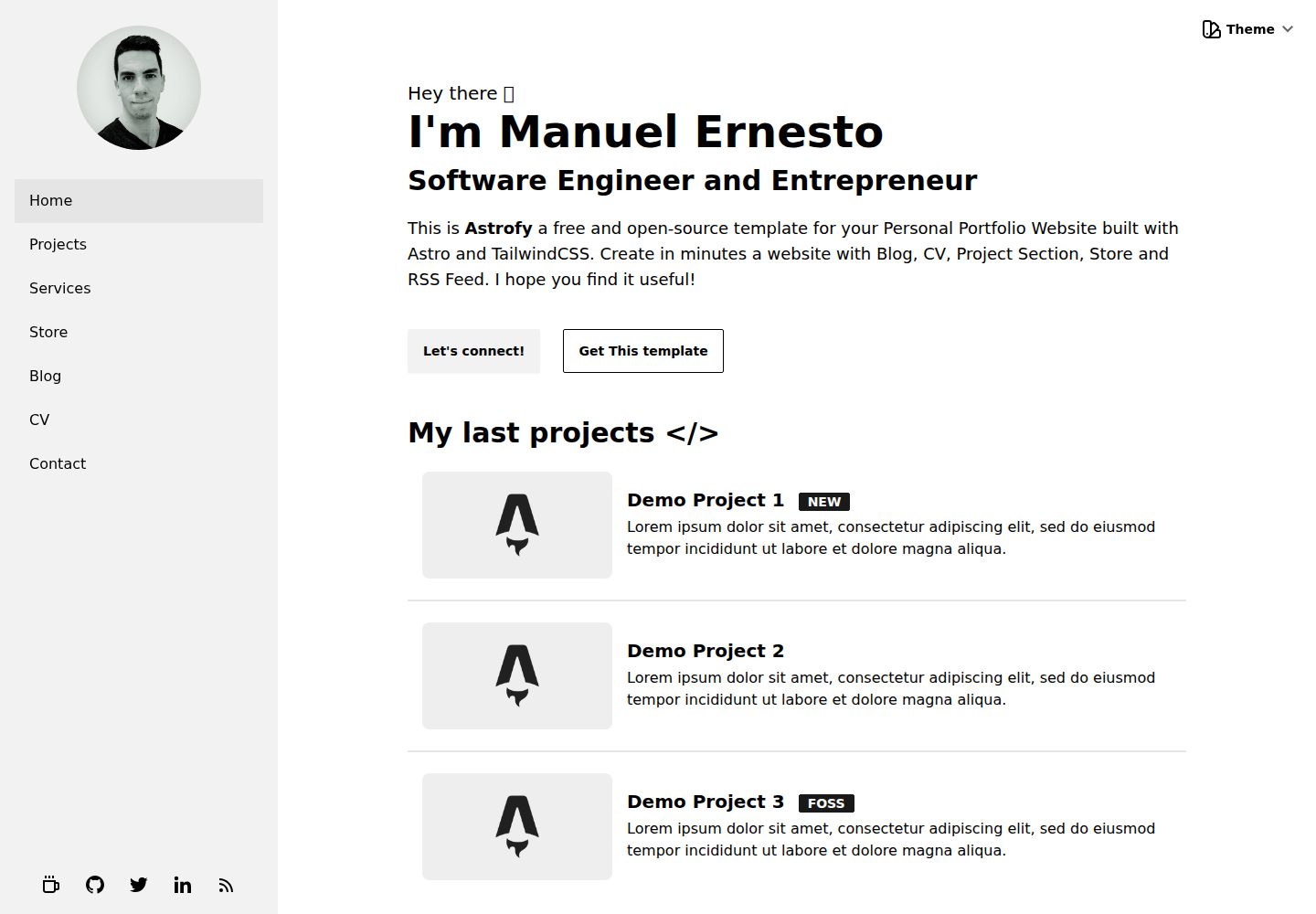
astrofy
Astrofy is a free and open-source personal portfolio website template built with Astro and TailwindCSS, with built-in blog, CV timeline, project showcase, store, and RSS feed modules.
Astro · Portfolio
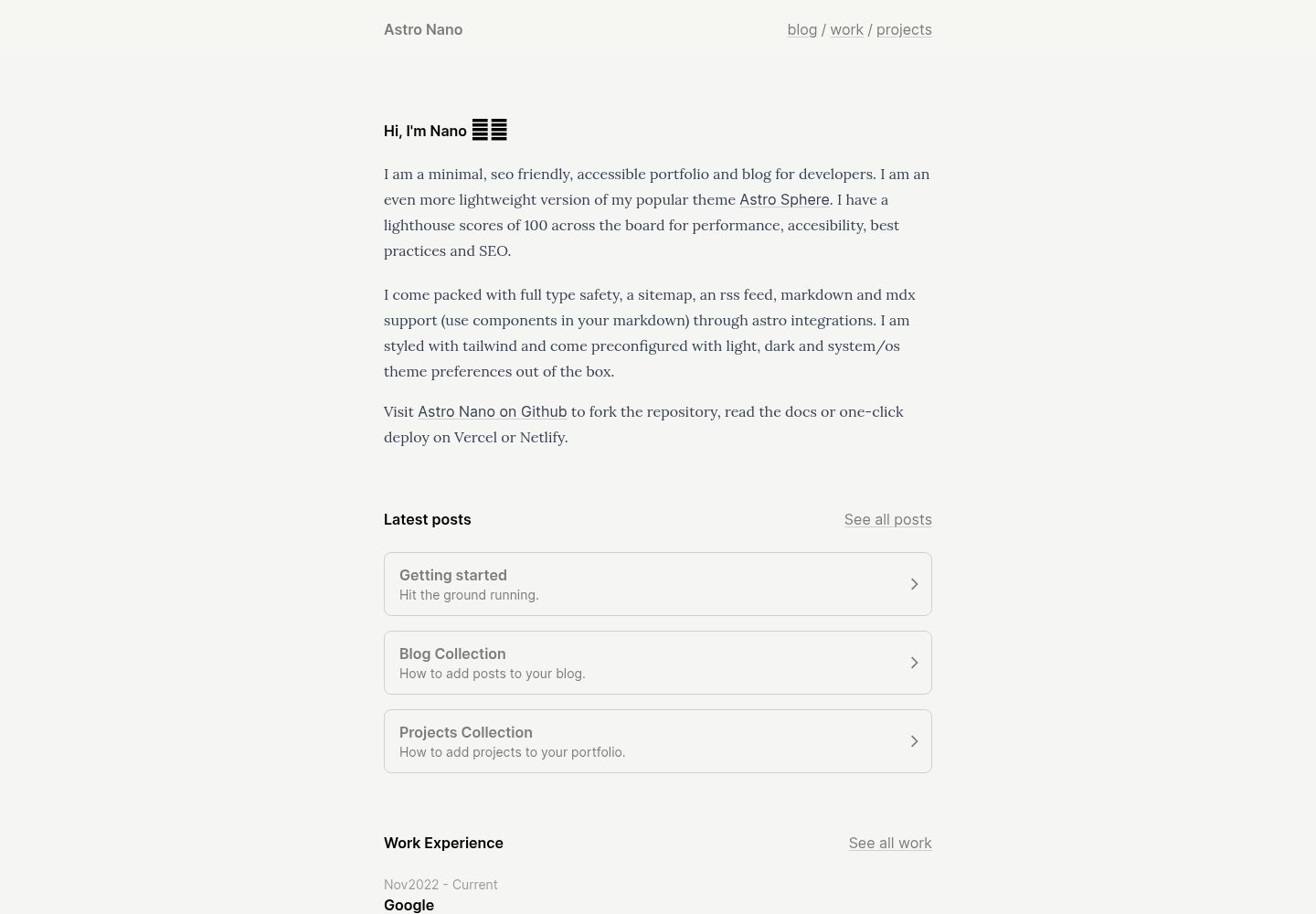
astro-nano
Astro Nano is a static, minimalist portfolio and blog template built with Astro, Tailwind, and TypeScript without frontend frameworks. It includes light/dark themes, animated UI, automatic sitemap and RSS feed generation, and Markdown/MDX support with component imports.
Astro · Portfolio
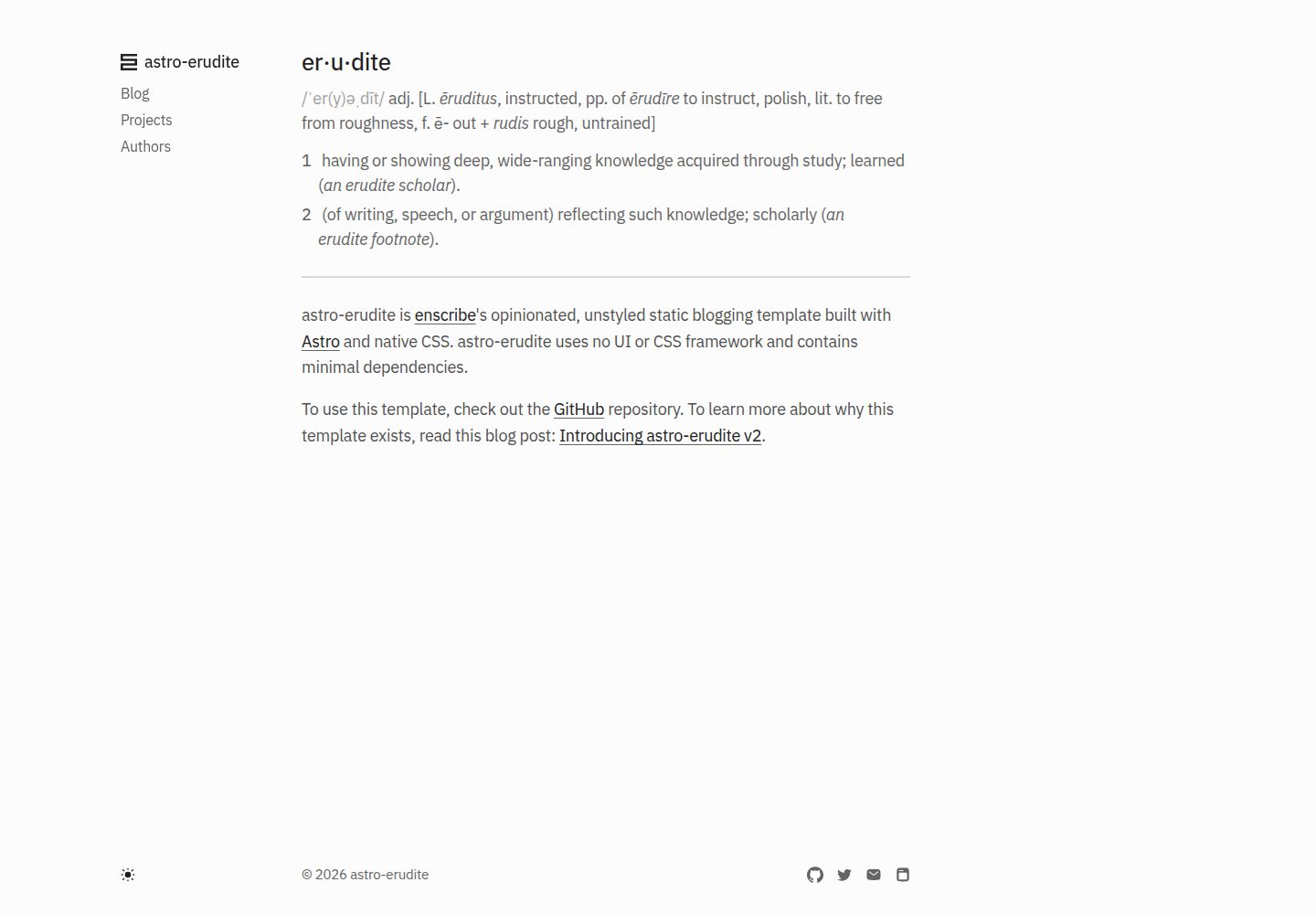
astro-erudite
astro-erudite is an opinionated, unstyled static blog template built with Astro and native CSS, with no UI or CSS framework and minimal dependencies.
Astro · Portfolio
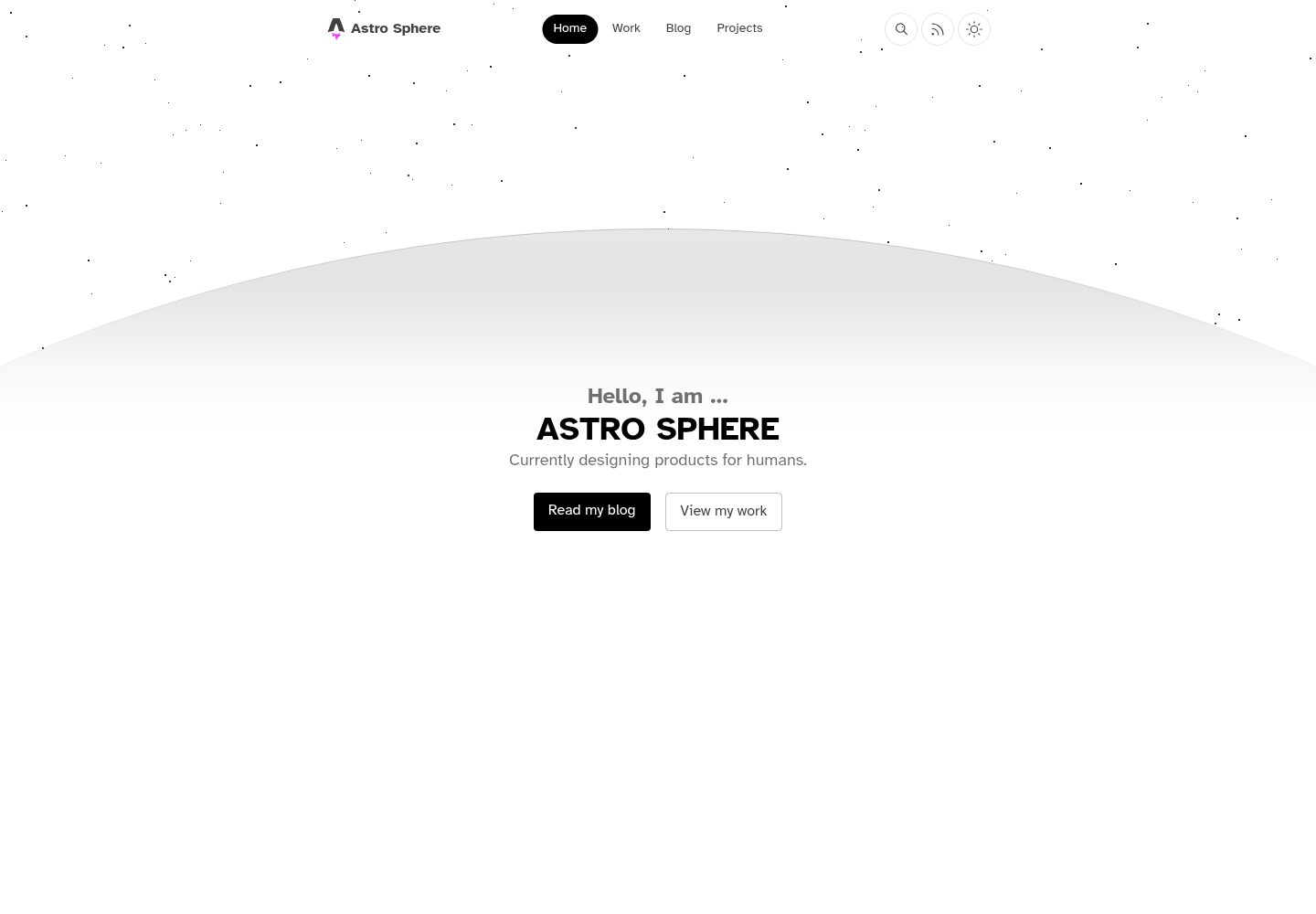
astro-sphere
Astro Sphere is a static, minimalist portfolio and blog theme maintained by markhorn-dev, built mainly with Astro, Tailwind, and TypeScript, with a small amount of SolidJS for stateful components.
Astro · Portfolio
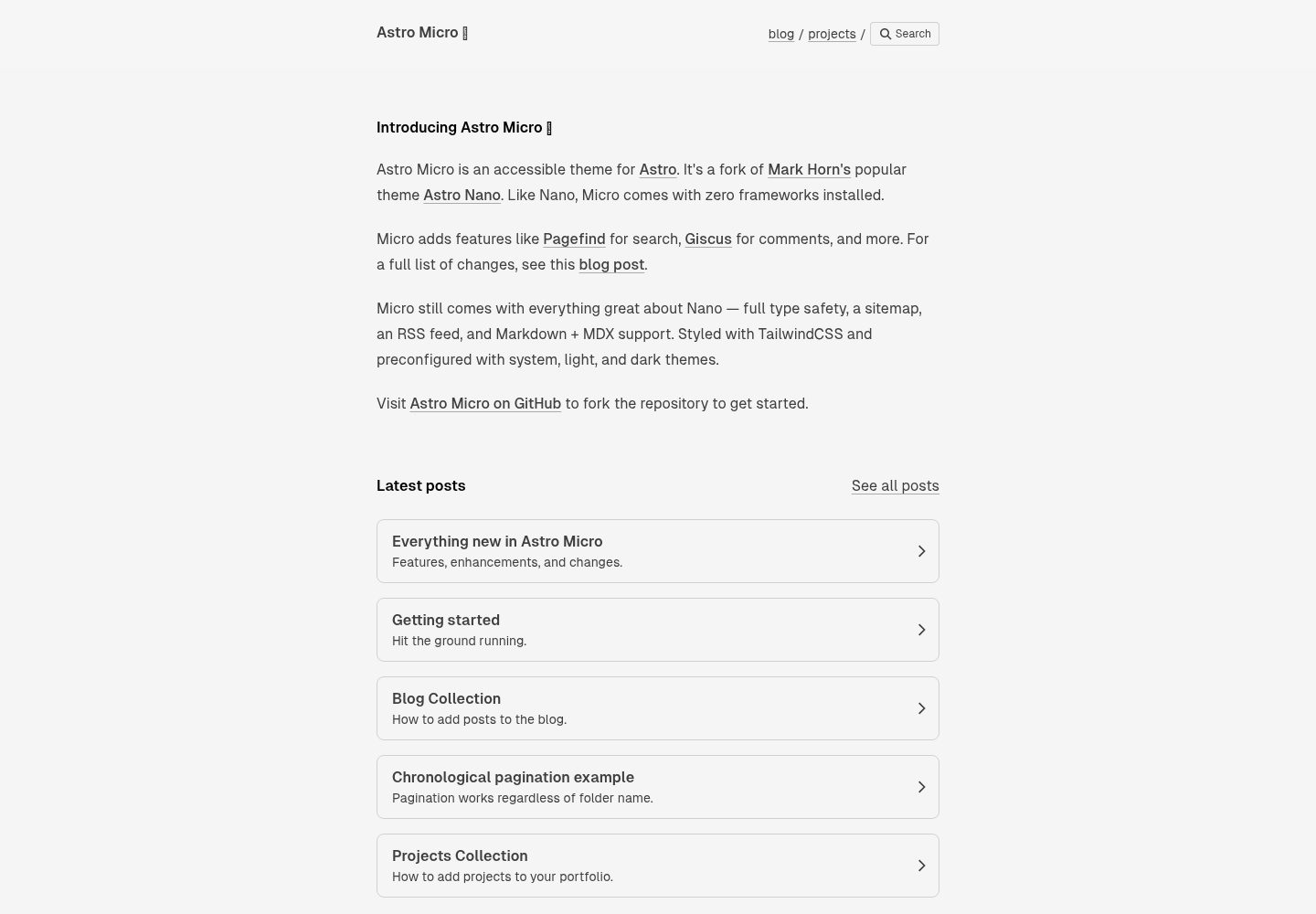
astro-micro
Astro Micro is a framework-free blog and portfolio theme for Astro, forked from Astro Nano. It adds Pagefind search and Giscus comments while retaining type safety, sitemap, RSS, Markdown and MDX support, and TailwindCSS with system, light, and dark themes.
Astro · Portfolio
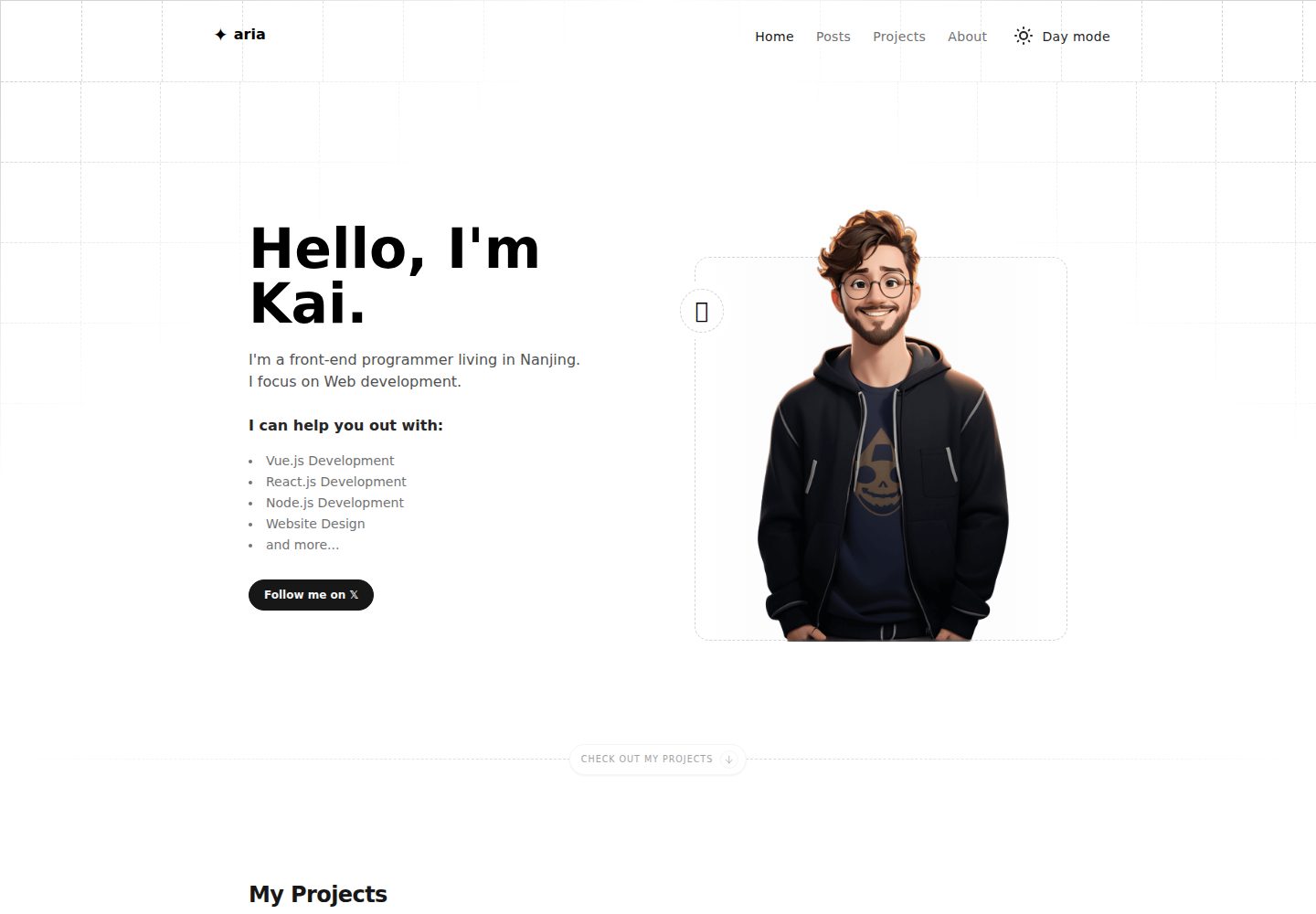
astro-aria
astro-aria is an Astro-based personal blog and portfolio template maintained by miantiao-me, ported from static-templates/aria.
Astro · Portfolio