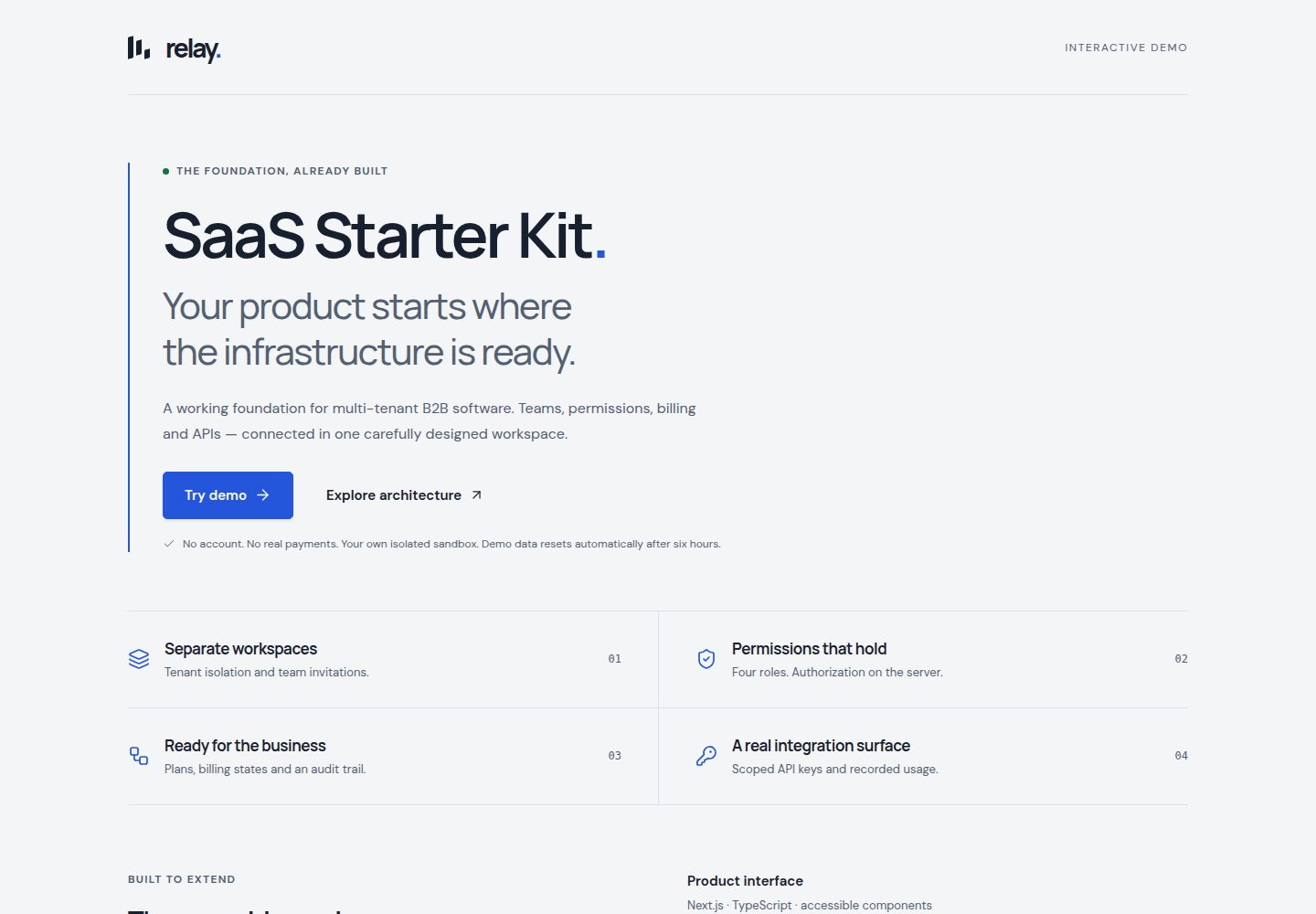
Centralized four-role RBAC (Owner/Admin/Member/Viewer) with server-enforced membership checks
Next.jsReactSaaSStarter
saas-starter-kit — Next.js SaaS Template
By shipap
A Next.js-based multi-tenant SaaS starter with built-in RBAC, teams and workspaces, mock billing, API keys, audit logs, and isolated demo sandboxes.
Explore the design
Compare the page layouts and mobile experience. Open any screenshot for a closer look.
Desktop homepage1 / 2
Desktop captureTop of page
Actual screenshot captured by the server browser.
All pages & views 2
Screenshots show visual appearance; interactive behavior may differ.
Recorded 2026-10-02View source
What stands out
A quick read of the recorded project description.
Organization creation, switching, and settings, with team invitations, role management, and a development email outbox
Workspace API keys: one-time plaintext display, hashed storage, scopes, and revocation
Mock billing supports switching between Free/Pro/Business plan states, with a reserved Stripe adapter boundary
Isolated demo sandbox: independent data per visitor, expires after six hours, resets affect only the visitor's own sandbox
Local use of PGlite in-process PostgreSQL, production use of pg to connect to PostgreSQL, sharing the same initial schema
Template Details
This is a multi-tenant SaaS foundation template that demonstrates core capabilities such as accounts, workspaces, team permissions, billing status, and API access around a fictional B2B workspace console called Relay. The repository uses Next.js, with code split into apps/web (product UI and API bridge) and packages such as platform, db, auth, billing, email, and shared; business operations are centralized in the platform package.
For permissions, it provides a centralized four-role model (Owner/Admin/Member/Viewer). Both organization-level reads and writes require server-side membership checks; resource IDs or organization IDs passed from the client are not used as authorization evidence. API keys are authenticated with tenant scoping; the plaintext is shown only once at creation, stored hashed, and supports revocation and scopes.
Billing is a mock implementation that can safely switch between Free, Pro, and Business plan states, with a reserved Stripe adapter boundary. Invitation tokens are single-use and have an expiration time; emails remain in a development outbox. Local development uses PGlite to run PostgreSQL in-process without Docker; the production driver uses pg to connect to PostgreSQL, and both share the same initial schema.
The public demo assigns each visitor an independent sandbox with fictional data that expires after six hours; resets affect only the current sandbox, and normal registration is disabled in the public demo. The template is positioned as a reusable product foundation rather than a complete industry SaaS: it includes only one resource type, business plan quotas are illustrative, rate limiting is per-process, and ownership transfer, real payment checkout, external email delivery, and versioned schema upgrades remain extension points.
Next.jsSaaSStarter
Is it right for your project?
Use Cases
- Product prototypes that need multi-tenant accounts, workspaces, and team permission foundations
- Scenarios that aim to demonstrate SaaS fundamentals such as RBAC, API keys, and audit logs
- Running locally and experiencing the full flow without Docker or external credentials
- As a code starting point for later integration of real payments, email, and business features
Suitable For
- Development teams that need a multi-tenant SaaS foundation skeleton
- Developers who want to study server-side permission checks and API key design
- Template users who need a publicly demonstrable template with isolated sandboxes
Getting started & customization
Use these recorded setup notes alongside the repository instructions for your chosen version.
- 1
Local demo requires Node.js 24 LTS and pnpm 12.8.1; run pnpm install, then pnpm demo, visit http://localhost:3000, and select Try demo
- 2
Production requires an independently generated BETTER_AUTH_SECRET, a PostgreSQL connection string, and an exact HTTPS application origin
- 3
Real email delivery must be injected via createPlatform({ emailProvider }); without configuration, production invitations will not be sent
- 4
Playwright browser tests require running pnpm exec playwright install chromium first
- 5
Docker/Compose deployment requires generating independent POSTGRES_PASSWORD and BETTER_AUTH_SECRET, and setting an exact HTTPS APP_URL
License & source material
Usage conditions & limitations
Free to use · keep license noticeThis entry covers the free version under the MIT license in the public repository; the free scope is the code of that version and does not mean external services or third-party assets are free.
Must comply with when using
- You may use, modify, commercialize, and distribute the code of this version for free.
- When distributing copies or substantial portions of the code, retain the original author's copyright notice and the complete MIT license notice.
- The code is provided as is; warranties and limitations of liability are governed by the original license and applicable law.
Additional costs & items to verify
- Billing is a mock implementation and emails remain in a development outbox; no real payments or messages are sent. Real payments and email delivery must be integrated separately.
- Production checkout, price/customer mapping, and out-of-order event handling still need to be integrated separately; actual Stripe calls have not been tested.
- Real email delivery must be injected via createPlatform({ emailProvider }); without configuration, production invitations will refuse to send.
- Production deployment requires independently generating a stable BETTER_AUTH_SECRET, a PostgreSQL connection string, and an exact HTTPS application origin.
- Rate limiting is implemented per process; multi-instance deployments require shared storage provided separately.
- Ownership transfer, payment checkout, external email delivery, and versioned schema upgrades are all extension points that must be implemented separately.
- Actual online calls to OAuth, email, and Stripe have not been tested.
- The public demo uses isolated temporary sandboxes and cannot be used as production customer service.
- Business plan quotas are illustrative only and are not enforced quotas.
- PGlite is a single-process development database and cannot replace a production multi-process deployment.
- Demo images, fonts, icons, and other third-party assets must be checked against their respective licenses; the code's MIT license alone is not sufficient to determine this.
- External services such as domains, hosting, databases, payments, or AI may incur separate charges.
View Original Text Basis
Permission is hereby granted, free of charge
Original License Text
Billing is simulated and email stays in a development outbox; no real payments or messages are sent.
Original README
Production checkout, price/customer mapping and handling out-of-order provider events still need integration. Live Stripe calls were not tested.
Original README
Real email delivery is injected through `createPlatform({ emailProvider })`; normal production invitations refuse to send without it.
Original README
Production requires a stable, independently generated `BETTER_AUTH_SECRET`, PostgreSQL URL and exact HTTPS application origin.
Original README
Rate limiting is per process and needs a shared store for multiple instances.
Original README
Ownership transfer, provider checkout, external email delivery and versioned schema upgrades remain extension points.
Original README
Live OAuth, email and Stripe were not tested.
Original README
The public demonstration uses isolated temporary sandboxes; it is not a production customer service.
Original README
Commercial plan entitlements are illustrative, not enforced quotas.
Original README
https://github.com/shipap/saas-starter-kit/blob/main/LICENSEhttps://github.com/shipap/saas-starter-kit/blob/main/README.mdPGlite is a single-process development database, not a production multi-worker replacement.
Original README
Compiled by DeepSeek based on repository license and README ·2026-10-02. Results only cover the materials read; dependencies, images, fonts, and subsequent term changes are subject to their respective original texts.
Project checks & description sources
Template Information
- Source platforms
- GitHub
- Documentation and maintenance reference score
- More documented · 88 / 100
- Technologies
- Next.js · React
- Website type
- SaaS · Starter
How this score is calculated
Our heuristic uses license records (up to 30), a demo link (12), a preview (10), stars (15), recorded maintenance (15), description completeness (8), feature records (5) and classification data (5). It is not a code, security or performance test, or a Google score. A link does not establish tested functionality.
What to verify for this project
- Repository update recorded
- 2026-10-01
- Screenshot last checked
- 2026-10-02
A demo link is listed. Check it with your own content and viewport sizes; its presence does not confirm that forms, authentication or payments work.
The catalog identifies Next.js as the primary stack. Check the actual dependency manifest and lockfile for versions and hosting requirements. These notes use recorded metadata, not a code audit or a deployment test.
Use a selection guide →How this description was prepared
AI-assisted description based on catalog records and repository material. Repository authors are not automatically the reviewers of this description.
Automatically checked against source and license rules; no manual editorial review.
Inspect the recorded source material
SHA-256: 093a1e05c5d5f77b807d6695dee4ae36d5f0d9c9e22eca2d513cd1d51c7d495c
2026-10-02T13:59:35.146Z
Source file / repository# SaaS Starter Kit
Build a multi-tenant SaaS product without starting again with accounts, workspaces, team permissions, billing state and API access.
The starter demonstrates those foundations through **Relay**, a fictional B2B workspace console. Open the demo without a password, create projects, invite a teammate through a development outbox, switch roles, try mock plans and issue a real workspace API key. Every demo visitor gets an isolated sandbox. The next step for a client is adding their business-specific feature to this foundation.
Relay and its seeded people, organizations and activity are fictional. Billing is simulated and email stays in a development outbox; no real payments or messages are sent.
## Live Demo
Try it without installing anything: **https://saas.rkn.fail**.
No account required. Each visitor receives an isolated demo sandbox with fictional data. Demo data expires after six hours; reset affects only your sandbox. Normal sign-up is disabled on the public demonstration.
[Try the live demo →](https://saas.rkn.fail)
## Local demo
Requires Node.js 24 LTS and pnpm 12.8.1. From this directory:
```sh
pnpm install
pnpm demo
```
Open **http://localhost:3000** and choose **Try demo**. No Docker, external credentials, real payments or outgoing email are needed. The startup command prepares local database configuration and starts the application on loopback. Initialization applies the schema; each new sandbox is seeded independently. Use **Demo controls** to switch Owner/Admin/Member/Viewer, reset the sandbox or open the development outbox.
## Demo behavior
Each visitor receives a separate sandbox containing fictional workspaces, members, projects and activity. Sessions expire after **six hours**. Reset restores only the current visitor's seeded data. Role switching affects that sandbox's effective role; it never grants normal account or global administrator privileges. The platform preview shows only the caller's sandbox.
Billing is simulated and invitations stay in the guarded development outbox. Demo API keys authenticate requests to this application only. No external service, payment provider or email account is connected.
## Features
- Better Auth email/password sessions and optional configured OAuth providers, separate from demo sessions.
- Organization creation, switching and settings with membership checks on the server.
- Centralized four-role authorization and protected ownership operations.
- Projects with search, status filtering, create/edit/archive and permission-aware controls.
- Expiring, one-use team invitations, role management and a development email outbox.
- Free, Pro and Business plan state through mock billing; a Stripe adapter boundary for later integration.
- Workspace API keys, one-time plaintext reveal, hashes at rest, revocation and scopes.
- API usage records, scoped audit events and meaningful dashboard totals.
- Account preferences, light/dark/system themes and a guarded platform administration preview.
- Isolated demo sandboxes with expiration and scoped reset; no shared destructive reset.
## Screenshots
Real screenshots from the PostgreSQL-backed public demonstration:

<details>
<summary>Live landing and mobile overview</summary>


</details>
<details>
<summary>Additional local screenshots: landing, themes, billing and team</summary>


</details>
## Architecture
```mermaid
flowchart LR
Browser[Relay web interface] --> Next[Next.js API bridge]
Next --> Auth[Better Auth or isolated demo session]
Auth --> Policy[Membership and centralized RBAC]
Policy --> Services[Workspace business services]
Services --> Database[Parameterized SQL and Drizzle auth schema]
Database --> Local[PGlite for local review]
Database --> PG[PostgreSQL for production]
Services --> Outbox[Development email outbox]
Services --> Billing[Mock billing / Stripe adapter]
Key[Workspace API key] --> API[Scoped example API]
API --> Policy
```
`apps/web` contains the product interface and a thin API bridge. `packages/platform` owns business operations. `packages/db`, `auth`, `billing`, `email` and `shared` contain the persistence/auth/provider boundaries and shared data contracts. Tests live in `tests`; startup tooling lives in `scripts`. The repository is self-contained; it includes no adjacent projects or their dependencies.
Design direction and research: [Design brief](docs/DESIGN_BRIEF.md). Server/API contracts: [Implementation contracts](docs/CONTRACTS.md). Self-hosted fonts retain their [Manrope license](docs/licenses/Manrope-OFL.txt) and [DM Sans license](docs/licenses/DM-Sans-OFL.txt).
## RBAC matrix
| Capability | Owner | Admin | Member | Viewer |
| --------------------------------------- | -------------- | ----- | ------ | ------ |
| Read projects, team and audit | Yes | Yes | Yes | Yes |
| Create/edit/archive projects | Yes | Yes | Yes | No |
| Manage invites and non-owner members | Yes | Yes | No | No |
| Manage API keys and workspace settings | Yes | Yes | No | No |
| Change billing plan/state | Yes | No | No | No |
| Delete organization / ownership actions | Yes, protected | No | No | No |
Workspace Admin is not Platform Admin. Hiding or disabling controls is only presentation: server checks are mandatory for every operation. Owner removal, demotion and leaving are blocked; ownership transfer needs a separate explicit workflow. Demo role switching is available only inside a demo sandbox and does not grant access to normal organizations.
## Multi-tenancy and database architecture
All organization-scoped reads and mutations require authenticated membership. A resource ID or organization ID supplied by a client is never sufficient authorization. API keys derive their tenant from their stored record. Demo session IDs and workspace IDs are separate; each sandbox contains its own seeded workspaces.
PGlite runs PostgreSQL in-process for Docker-free local development. It is not a fake in-memory business store. The production driver uses PostgreSQL through `pg`; the schema and data contracts stay the same. PGlite is a single-process development database, not a production multi-worker replacement. The same additive initial schema is applied through both drivers. The public demo runs PostgreSQL 17 in a private container; its initialization and live application requests were verified.
## Billing, invitations and API keys
Mock billing allows safe plan changes, cancellation and reactivation without money. Provider webhooks verify signatures and deduplicate stored event IDs before state transitions. The official Stripe SDK adapter verifies subscription-event fixtures; it is injected through `createPlatform({ billingProvider })`, not activated by an environment switch. Production checkout, price/customer mapping and handling out-of-order provider events still need integration. Live Stripe calls were not tested.
Invitation tokens and API keys are cryptographically random and hashed before storage. Tokens expire and can be used once. Plaintext API keys are shown only when created. Demo outbox messages contain a non-secret workspace link and invitation ID; acceptance stays inside your sandbox. Normal invitations deliver their bearer token only through a configured email provider. The outbox is not an audit log or a production email service.
For the example API, create a key with project-read scope in the UI:
```sh
curl http://localhost:3000/api/v1/projects \
-H "Authorization: Bearer YOUR_NEWLY_CREATED_KEY"
```
Do not commit the key. Requests are tenant-scoped and tracked as usage. The UI displays actual stored usage and audit records; seed activity is fictional and labeled.
## Configuration
`.env.example` documents local and production settings. `pnpm demo` supplies safe development configuration without an environment file. Production requires a stable, independently generated `BETTER_AUTH_SECRET`, PostgreSQL URL and exact HTTPS application origin. Leave OAuth and Stripe credentials blank for the public demo. Real email delivery is injected through `createPlatform({ emailProvider })`; normal production invitations refuse to send without it.
Normal local sign-up uses Better Auth and a separate account session. Its verification email is available from the authenticated development outbox only on localhost with demo mode enabled. Invitation acceptance requires the verified recipient email. The database initializes its idempotent initial schema automatically; future schema upgrades need versioned migrations.
Public attribution is configured with `PUBLIC_PORTFOLIO_URL`, `PUBLIC_CONTACT_EMAIL`, `PUBLIC_TELEGRAM_URL` and optional `PUBLIC_SOURCE_URL`. The Source link is hidden when no real source URL is configured. None of these public settings may contain secrets.
## Testing
```sh
pnpm lint
pnpm format:check
pnpm typecheck
pnpm test:unit
pnpm test:integration
pnpm test:browser
pnpm build
```
Playwright tests require an installed Chromium browser (`pnpm exec playwright install chromium`). Vitest uses isolated local test databases. [QA record](docs/QA.md) records actual counts and outcomes. [Security review](docs/SECURITY_REVIEW.md) records verified protections and outstanding production boundaries.
## Security and production notes
Treat membership, RBAC, key scopes, invitation recipient identity, webhook verification and platform permissions as server responsibilities. Session cookies are HttpOnly; cookie-authenticated mutations validate the request origin. Validate all input, bound request sizes, use parameterized queries and never log secrets. Audit records are written only by server operations and must not include passwords or plaintext tokens.
For a commercial deployment, configure HTTPS, durable secrets, verified email delivery, required providers, backups/restore drills, monitoring and retention policies. Distributed deployments require shared rate limiting and production database tests. Review the documented demo TTL and cleanup behavior before exposing public sandboxes. Mock billing is not a completed live payment integration.
Docker/Compose files provide a PostgreSQL-backed deployment architecture. Generate independent random `POSTGRES_PASSWORD` and `BETTER_AUTH_SECRET`, set the exact HTTPS `APP_URL`, and validate the image/Compose stack in the target environment. The public-demo image, private PostgreSQL service and HTTPS gateway were built and exercised; evidence is in the [QA record](docs/QA.md). See [deployment notes](docs/DEPLOYMENT.md) for resource limits, six-hour sandbox cleanup and safe operation. Never remove persistent volumes during upgrades.
## Limitations
This is a reusable product foundation, not a finished industry-specific SaaS. It includes one resource type, not a full project management suite. Email stays in the development outbox and billing uses mocks. Commercial plan entitlements are illustrative, not enforced quotas. Rate limiting is per process and needs a shared store for multiple instances. Ownership transfer, provider checkout, external email delivery and versioned schema upgrades remain extension points. Live OAuth, email and Stripe were not tested. PostgreSQL was tested on the public demonstration, without high-load or failover testing. The public demonstration uses isolated temporary sandboxes; it is not a production customer service.
## Author & Custom Development
Built and maintained by **bububi / Alexander** — [@shipap](https://github.com/shipap).
Need a custom version, integration, deployment, or a similar SaaS product?
Portfolio: [https://bububi.icu](https://bububi.icu)
Email: [[email protected]](mailto:[email protected])
Telegram: [https://t.me/o3amfeels](https://t.me/o3amfeels)
GitHub: [https://github.com/shipap](https://github.com/shipap)
Explore similar templates
Compare previews and descriptions within the same stack and category.

Next.js SaaS Starter
The official Next.js SaaS starter template, integrating email/password authentication, Stripe Checkout subscriptions, a dashboard with user/team CRUD, basic Owner/Member RBAC, and activity logging.
Next.js · SaaS

Next.js Commerce
Vercel's officially maintained Next.js App Router ecommerce starter with deep Shopify integration, offering a complete product catalog, cart, and checkout flow. Core logic is modular for swapping backends, and community provider versions exist for BigCommerce, Medusa, and Saleor.
Next.js · E-commerce

Next-js-Boilerplate
A developer-first Next.js 16 starter with Tailwind CSS 4 and TypeScript, supporting both App Router and Page Router.
Next.js · Starter

tailwind-nextjs-starter-blog
A Next.js and Tailwind CSS blog starter template using Contentlayer for Markdown/MDX, with built-in SEO, code highlighting, and tags. It targets personal technical blogs and migration from Jekyll/Hugo to React, and supports one-click Vercel deployment.
Next.js · Blog

next-forge
next-forge is a Turborepo-based Next.js template maintained by Vercel, positioned as a starting point for SaaS products.
Next.js · Starter

SaaS-Boilerplate
SaaS-Boilerplate is an open-source SaaS starter template built with Next.js App Router, React 19, TypeScript, Tailwind CSS, and Shadcn UI.
Next.js · SaaS