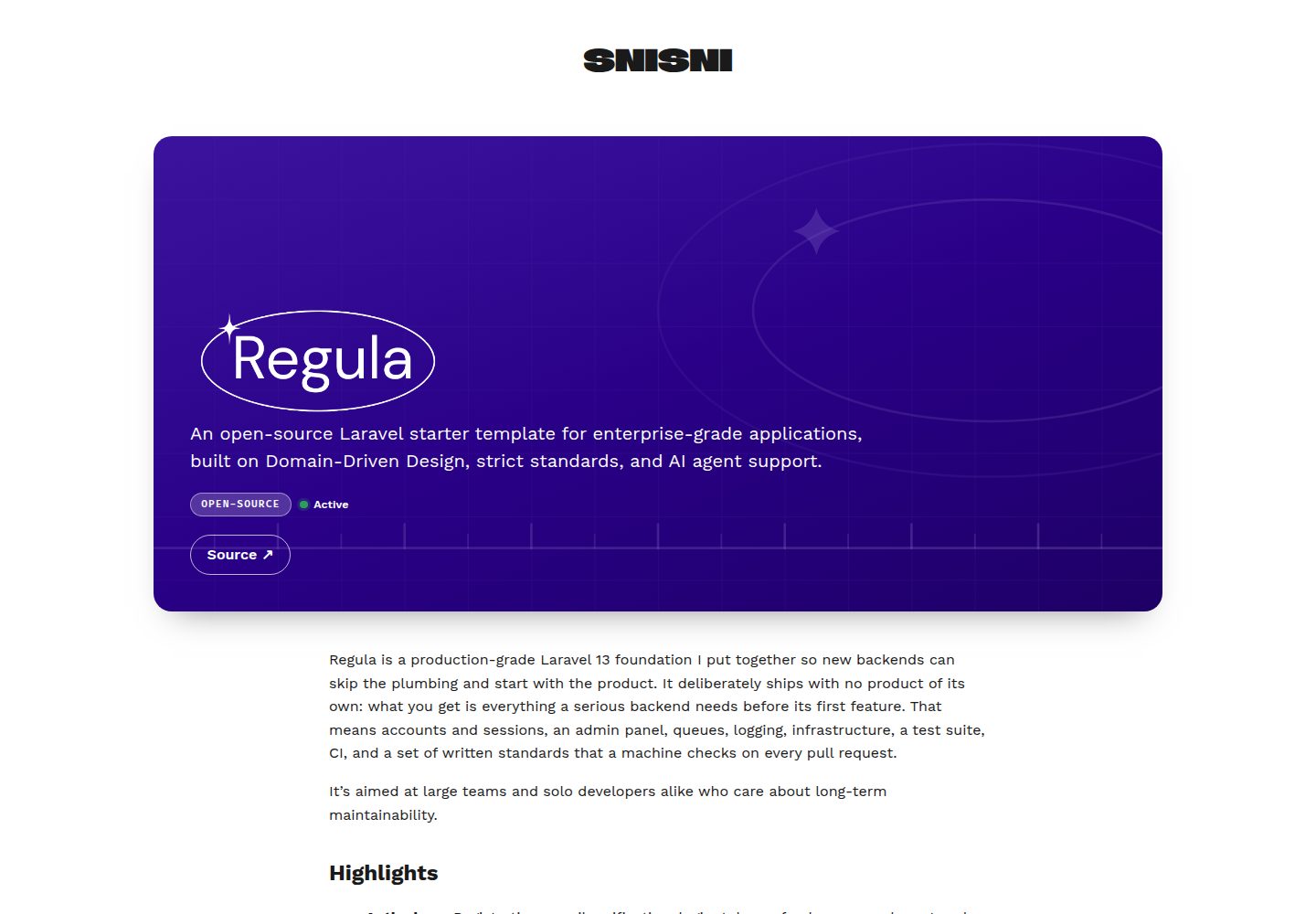
Complete authentication lifecycle: registration, email verification, login, dual-token refresh, password reset, and two-phase account deletion
LaravelStarter
regula — Laravel Starter Template
By sinisimattia
Regula is a Laravel-based enterprise-grade starter template with built-in Domain-Driven Design structure, dual-token authentication, Filament admin panel, queue and logging infrastructure, and automatically checked coding standards.
Explore the design
Compare the page layouts and mobile experience. Open any screenshot for a closer look.
Desktop homepage1 / 3
Desktop captureTop of page
Actual screenshot captured by the server browser.
All pages & views 3
Screenshots show visual appearance; interactive behavior may differ.
Recorded 2026-10-01View source
What stands out
A quick read of the recorded project description.
Domain-Driven Design structure: business logic lives in self-contained modules under app/Domains/, exposed through entities, service interfaces, and events
Filament admin panel: located at /admin, integrated with Spatie Permission roles and permissions, with Super Admin able to bypass all authorization checks
Built-in infrastructure: four priority queues, CloudWatch log driver, read/write database separation, and an AWS CDK TypeScript stack
Automatically checked coding standards: php artisan canon:check checks mechanical rules in docs/standards/, and violations fail the build
Multilingual and unified theme: verification, password reset, and account deletion emails are translated into seven languages, with colors and fonts centralized in config/theme.php
Template Details
Regula is a deliberately business-logic-free Laravel starter whose goal is to provide accounts and sessions, an admin panel, queues, logging, infrastructure, a test suite, CI, and machine-checkable written standards before the first feature is built. It targets teams and solo developers concerned with long-term maintainability.
For authentication, the template provides the full lifecycle of registration, email verification, login, token refresh, password reset, and account deletion, using Sanctum dual-token pairs: a short-lived access token for API calls and a long-lived refresh token used only to obtain new token pairs. Password reset revokes all of the user's tokens; account deletion is two-phase, first locking the account, then a queued job deletes it with up to five retries. Login and password reset do not reveal whether an email is registered.
Architecturally, business logic lives in self-contained domain modules under app/Domains/, and other code can only access them through entities, service interfaces, and events. It initially includes two domains: Core and Auth. The admin panel uses Filament and Livewire at /admin, provides roles and permissions via Spatie Permission, requires a verified email and at least one role to enter, and Super Admin can bypass all authorization checks.
Infrastructure includes four priority queues, a CloudWatch log driver, read/write database separation, an AWS CDK TypeScript stack, unified theme configuration, and multilingual emails in seven languages. Quality gates consist of PHP-CS-Fixer, PHP Insights, canon:check, and PHPUnit, with CI running in parallel on every pull request.
In terms of limitations, the template contains no product features and requires you to add domains yourself; local development depends on Docker; third-party assets such as demo images, fonts, and icons must be checked against their respective licenses; and external services such as domains, hosting, databases, payments, or AI may incur additional charges.
LaravelStarter
Is it right for your project?
Use Cases
- Building a Laravel backend project from scratch with strict layering and long-term maintainability requirements
- Wanting a complete account lifecycle, admin panel, and queue infrastructure out of the box without assembling them yourself
- Teams using written coding standards and wanting CI to automatically check compliance
- Needing to use the same codebase locally, on self-hosted servers, and on AWS, switching drivers only through environment variables
- Wanting to provide AI agents with a working environment consistent with written standards, including expert agents, workflow skills, and the Laravel Boost MCP server
Suitable For
- Laravel development teams concerned with long-term maintainability and willing to accept a Domain-Driven Design structure
- Projects that need an enterprise-grade authentication, admin panel, and infrastructure starting point but do not want preset business features
- Developers using Docker for local development and possibly deploying to self-hosted servers or AWS
- Teams wanting to incorporate coding standards, quality gates, and CI checks into their daily development workflow
Getting started & customization
Use these recorded setup notes alongside the repository instructions for your chosen version.
- 1
Local development only requires Docker; PHP, Composer, PostgreSQL, and nginx all run in containers
- 2
Copy .env.example to .env, run docker compose up -d --build, then enter the app container and run composer install, php artisan key:generate, and php artisan migrate --seed
- 3
The default access address is http://localhost:8080, the admin panel is at /admin, the local password is set in UserSeeder, and the port can be changed via APP_PORT
- 4
To rename the application, change the vendor part of name in composer.json; configuration defaults, cookie and cache prefixes, and the AWS stack name are all derived from it
- 5
Set colors and fonts in config/theme.php; the welcome page, error pages, emails, and admin panel all read this configuration; ALLOWED_REDIRECT_ORIGINS specifies the allowed frontend origins for email links
License & source material
Usage conditions & limitations
Free to use · keep license noticeThis entry covers the free version under the MIT license in the public repository; the free scope is the code of that version and does not mean external services or third-party assets are free.
Must comply with when using
- You may use, modify, commercialize, and distribute the code of this version for free.
- When distributing copies or substantial portions of the code, retain the original author's copyright notice and the full MIT license notice.
- The code is provided as is; warranties and limitations of liability are governed by the original license and applicable law.
Additional costs & items to verify
- Local development requires Docker; PHP, Composer, PostgreSQL, and nginx all run in containers, so you cannot develop directly on the host machine.
- Admin panel login uses ADMIN_EMAIL, and the local password is set by UserSeeder; you need to check that file yourself for credentials.
- Password reset and post-verification redirect links in emails may only point to origins configured in ALLOWED_REDIRECT_ORIGINS; you must set the frontend address yourself.
- When using SQS, each queue connection requires its own worker, which is more operationally complex than a single-worker mode.
- Ordered queues guarantee order only on SQS FIFO; on other drivers, order is maintained only when a single worker consumes that queue.
- Self-hosted production deployment requires manually configuring APP_KEY, APP_ENV, APP_DEBUG, database connections, and environment variables for each driver.
- AWS deployment requires configuring CDK according to cloud/aws/README.md and manually copying stack outputs into .env, involving an AWS account and costs.
- AI-assisted features depend on the Laravel Boost MCP server running via Docker, which requires additional configuration.
- Demo images, fonts, icons, and other third-party assets must be checked against their respective licenses and cannot be judged solely by the code's MIT license.
- External services such as domains, hosting, databases, payments, or AI may incur additional charges.
View Original Text Basis
Permission is hereby granted, free of charge
Original License Text
The only thing you need on your machine is **Docker**. PHP, Composer, PostgreSQL and nginx all run > in containers.
Original README
Sign in as `ADMIN_EMAIL`, whose local password is set in [`UserSeeder`](database/seeders/UserSeeder.php)
Original README
Set `ALLOWED_REDIRECT_ORIGINS` to the origins your password reset page and post-verification redirect live on.
Original README
On `sqs` each connection is its own queue, so run one worker per connection (`queue:work high`, `queue:work low`, and so on).
Original README
Jobs on `default-ordered` keep their order on SQS FIFO. Elsewhere they keep it only while a single worker consumes that queue.
Original README
Copy the env file, then set `APP_KEY`, `APP_ENV=production`, `APP_DEBUG=false`, `DB_*` and the drivers:
Original README
Profiles, commands and the stack outputs to copy into `.env` are in [`cloud/aws/README.md`](cloud/aws/README.md).
Original README
https://github.com/sinisimattia/regula/blob/main/LICENSEhttps://github.com/sinisimattia/regula/blob/main/README.mdA **Laravel Boost** MCP server runs through Docker for version-accurate docs, schema inspection and Tinker.
Original README
Compiled by DeepSeek based on repository license and README ·2026-10-01. Results only cover the materials read; dependencies, images, fonts, and subsequent term changes are subject to their respective original texts.
Project checks & description sources
Template Information
- Source platforms
- GitHub
- Documentation and maintenance reference score
- More documented · 83 / 100
- Technologies
- Laravel
- Website type
- Starter
How this score is calculated
Our heuristic uses license records (up to 30), a demo link (12), a preview (10), stars (15), recorded maintenance (15), description completeness (8), feature records (5) and classification data (5). It is not a code, security or performance test, or a Google score. A link does not establish tested functionality.
What to verify for this project
- Repository update recorded
- 2026-09-30
- Screenshot last checked
- 2026-10-01
A demo link is listed. Check it with your own content and viewport sizes; its presence does not confirm that forms, authentication or payments work.
The catalog identifies Laravel as the primary stack. Check the actual dependency manifest and lockfile for versions and hosting requirements. These notes use recorded metadata, not a code audit or a deployment test.
Use a selection guide →How this description was prepared
AI-assisted description based on catalog records and repository material. Repository authors are not automatically the reviewers of this description.
Automatically checked against source and license rules; no manual editorial review.
Inspect the recorded source material
SHA-256: 00cb012e5d43d44699888605e187ee2aee37a5385677479c5af655f2e4ab6b67
2026-10-01T02:21:36.274Z
Source file / repository<div align="center">
<img src="regula-logo.png" alt="Regula" width="250" height="100">
**A production-grade Laravel 13 foundation: domain-driven structure, token authentication, a Filament
admin panel, and a coding canon that enforces itself.**
Clone it, name it, and start building your product, not your plumbing.






[Quick start](#-quick-start) ·
[Features](#-features) ·
[Architecture](#-architecture) ·
[Where it runs](#-where-it-runs) ·
[Standards](docs/standards/) ·
[Contributing](CONTRIBUTING.md)
</div>
---
This repository starts **deliberately empty of product**. What it ships is everything a serious
backend needs before its first feature: accounts and sessions, an admin panel, queues, logging,
infrastructure, a test suite, CI, and written standards that a machine checks on every pull request.
<table>
<tr>
<td width="33%" valign="top">
<h3>🔐 Auth, done</h3>
Registration, email verification, login, token refresh, password reset and account deletion,
all behind a dual Sanctum token pair.
</td>
<td width="33%" valign="top">
<h3>🧱 Domain modules</h3>
Business logic lives in self-contained domains with entities, services behind interfaces,
private repositories and their own docs.
</td>
<td width="33%" valign="top">
<h3>🛡️ Self-enforcing canon</h3>
Every rule a machine can check is checked by <code>php artisan canon:check</code>, and the build
fails on any single violation.
</td>
</tr>
<tr>
<td width="33%" valign="top">
<h3>🖥️ Filament 5 admin</h3>
An admin panel at <code>/admin</code> with roles and permissions, and a seeded Super Admin
who bypasses every gate.
</td>
<td width="33%" valign="top">
<h3>☁️ Runs anywhere</h3>
The same code runs on a laptop, a self-hosted server or AWS. Env picks every driver; no
backend is named in code.
</td>
<td width="33%" valign="top">
<h3>🤖 AI-ready</h3>
Subject-matter specialist agents, workflow skills and a Laravel Boost MCP server, all pointed at
the same written standards.
</td>
</tr>
</table>
## 🚀 Quick start
> [!NOTE]
> The only thing you need on your machine is **Docker**. PHP, Composer, PostgreSQL and nginx all run
> in containers.
```bash
cp .env.example .env
```
```bash
docker compose up -d --build
```
```bash
docker compose exec app bash
```
Then, inside the `app` container:
```bash
composer install
```
```bash
php artisan key:generate
```
```bash
php artisan migrate --seed
```
That's it:
| URL | What you'll find |
|---|---|
| http://localhost:8080 | The welcome page |
| http://localhost:8080/api/health | The health check, answering `{"status":"ok"}` |
| http://localhost:8080/admin | The admin panel. Sign in as `ADMIN_EMAIL`, whose local password is set in [`UserSeeder`](database/seeders/UserSeeder.php) |
> [!TIP]
> Change the port with `APP_PORT` in `.env`. On Fedora or another SELinux distribution, see the
> [Linux notes in `CONTRIBUTING.md`](CONTRIBUTING.md#linux-setup-rpm-based-distros-fedora-rhel-centos).
### Make it yours
1. **Name the application.** Change the vendor part of `name` in [`composer.json`](composer.json).
That's the only place the name is written: config defaults, cookie and cache prefixes and AWS stack
names all derive from it, and `APP_NAME` in `.env` overrides it at runtime
([PHP-22](docs/standards/php.md)).
2. **Brand it.** Set your colours and fonts in [`config/theme.php`](config/theme.php). The welcome
page, the error pages, the emails and the admin panel all read them from there
([PHP-26](docs/standards/php.md), [how theming works](docs/infrastructure/theme.md)).
3. **Point emailed links at your frontend.** Set `ALLOWED_REDIRECT_ORIGINS` to the origins your
password reset page and post-verification redirect live on.
4. **Write your welcome letter** in [`resources/views/welcome.blade.php`](resources/views/welcome.blade.php).
5. **Add your first domain.** Read [`domain-architecture.md`](docs/standards/domain-architecture.md),
or ask the `domain-specialist` agent to scaffold one.
6. **Choose your drivers** for each environment. See [Where it runs](#-where-it-runs).
## ✨ Features
### 🔐 Authentication
A complete account lifecycle, documented rule by rule in the [Auth domain](app/Domains/Auth/README.md).
- **Dual token sessions.** A short-lived access token for API calls and a longer-lived refresh token
whose only power is to mint a new pair. "Remember me" is chosen at login and kept across refreshes.
- **Email verification** through signed, time-limited links, with an optional redirect to your frontend.
- **Password reset** that signs the user out everywhere by revoking every token they hold.
- **Two-phase account deletion.** The account is locked out immediately, then a queued job removes it
and retries up to five times. A persistent failure lands in `failed_jobs` with its real cause.
- **No account enumeration.** Login and password reset never reveal whether an email has an account.
- **Safe emailed links.** Links only point at an origin you allow, and emails are unique regardless
of letter case.
| Method | Endpoint | Called with |
|---|---|---|
| `POST` | `/api/auth/register` | nothing (guest) |
| `POST` | `/api/auth/login` | nothing (guest) |
| `POST` | `/api/auth/forgot_password` | nothing (guest) |
| `POST` | `/api/auth/reset_password` | nothing (guest) |
| `POST` | `/api/auth/refresh_token` | the refresh token |
| `POST` | `/api/auth/logout` | an access token |
| `POST` | `/api/auth/send_verification_email` | an access token |
| `DELETE` | `/api/auth/delete_account` | an access token |
| `GET` | `/verify/{userId}/{hash}` | the signed link from the verification email |
| `GET` | `/api/health` | nothing |
Guest routes are throttled to 20 requests a minute. A new authenticated route goes in the
`authenticated` middleware group, which admits access tokens only.
### 🖥️ Admin panel
- **Filament 5 on Livewire 4**, served at `/admin`, with a dashboard ready for your widgets.
- **Roles and permissions** through Spatie Permission, with view, create, update and delete
permissions seeded for users, roles and permissions.
- **Guarded front door.** Entering takes a verified email and at least one role.
- **Super Admin** bypasses every authorization check in the application, and the seeder grants it to
`ADMIN_EMAIL`.
### ⚙️ Infrastructure built in
- **Four priority queues:** `high`, `default`, `default-ordered` and `low`, with an SQS FIFO connector
so ordered jobs really keep their order in production.
- **CloudWatch log driver** that ships batched logs straight to a log group.
- **Read/write database split.** Plain reads go to the Aurora reader endpoint, and writes,
transactions and locking reads go to the writer. With a single database, leave `DB_READ_HOST`
empty.
- **AWS CDK stacks** in TypeScript: SQS queues with a dead-letter queue, a log group, an S3 bucket and a
DynamoDB cache table in `main`, and an Aurora PostgreSQL cluster in `database`.
- **One theme everywhere.** Colours and fonts live in `config/theme.php`, and the welcome page, the
error pages, the emails and the admin panel all derive from it. `canon:check` fails on a colour
written anywhere else.
- **Branded emails** for verification, password reset and account deletion, translated into seven
languages. Signed-in requests run in the user's preferred language.
- **Custom error pages** for 400, 401, 403, 404, 419, 429, 500 and 503.
### 🛡️ Quality gates
| Layer | Owns | Command |
|---|---|---|
| **PHP-CS-Fixer** | Formatting. Auto-fixes, so nobody reviews it by hand. | `composer lint:fix` |
| **PHP Insights** | Aggregate quality: typing, complexity, architecture. Thresholds only ratchet upward. | `composer insights` |
| **Canon check** | Every mechanical rule in `docs/standards/`, one violation at a time. | `php artisan canon:check` |
| **PHPUnit 12** | Unit and feature suites against a real PostgreSQL. | `composer test` |
CI runs all of them on every pull request in parallel, along with a branch-name check and a
`composer audit` for dependency advisories. The pipeline ships as a GitHub Actions workflow,
[`.github/workflows/ci.yml`](.github/workflows/ci.yml).
## 🧭 Architecture
Business logic lives in **domains** under `app/Domains/`. Each one is a self-contained module that
other code reaches only through its public surface: entities, service interfaces and events.
```text
app/Domains/Auth/
├── README.md what the domain does, in plain language
├── Docs/ its business rules, with worked examples
├── Entities/ User, UserId, TokenPair: typed data, never arrays
├── Events/ UserRegistered, UserDeleted
├── Http/ Controllers · Requests · Resources
├── Providers/ binds every interface explicitly
├── Repositories/ injected only into this domain's own services
├── Services/ AccountServiceInterface, AuthServiceInterface
└── … Enums, Exceptions, Listeners, Mail, Notifications, Rules
```
Every request takes the same path through a domain:
```mermaid
flowchart LR
Route --> Request["Form Request<br/>validates, builds the entity"]
Request --> Controller["Controller<br/>one service call"]
Controller --> Service["Service interface"]
Service --> Repository
Repository --> Model[("Eloquent model")]
Service -. dispatches .-> Events
Controller --> Resource["API Resource<br/>shapes the response"]
```
The domains you start with:
| Domain | Holds |
|---|---|
| **Core** | Foundational types every domain builds on, such as the base class for typed entity IDs |
| **Auth** | Accounts, sessions, verification, password reset, deletion, and who may enter the admin panel |
<details>
<summary><b>The rest of the repository</b></summary>
```text
app/
├── Domains/ domain modules
├── Filament/ the admin panel
├── Http/ shared HTTP layer: kernel, middleware, the health check
├── Logging/ the CloudWatch log driver
├── Policies/Admin/ who may manage users, roles and permissions
└── Queue/ the SQS FIFO connector for ordered jobs
cloud/aws/ AWS CDK infrastructure
docker/ the PHP, nginx and PostgreSQL images
docs/
├── standards/ the coding canon, the single authority
└── infrastructure/ how configuration, drivers and framework overrides work
insights/ the checks behind canon:check
lang/ translations
tests/ Unit and Feature suites
.claude/ AI specialist agents, skills and hooks
```
</details>
## 🌍 Where it runs
The same code runs on a laptop, a self-hosted server and AWS. Env is the only difference: no backend
is named in code ([PHP-23](docs/standards/php.md)).
| Service | Local default | Self-hosted | AWS | Switched by |
|---|---|---|---|---|
| Database | Postgres (compose) | Postgres | Aurora Postgres | `DB_*`, `DB_READ_HOST` |
| Queues | `sync` | `database` or `redis` | `sqs` | `QUEUE_DRIVER` |
| Cache | `database` | `database` or `redis` | `dynamodb` | `CACHE_STORE`, `DYNAMODB_CACHE_TABLE` |
| Sessions | `database` | `database` or `redis` | `database` | `SESSION_DRIVER` |
| Files | local disk | local disk or any S3-compatible bucket | S3 | `FILESYSTEM_DISK`, `AWS_BUCKET`, `AWS_ENDPOINT` |
| Logs | `single` | `stderr` | `stderr,cloud` | `LOG_STACK` |
| Mail | `log` | `smtp` | `ses` | `MAIL_MAILER` |
Moving files from the local disk to a bucket, for example, means setting `FILESYSTEM_DISK=s3` and
filling in the `AWS_*` bucket variables. Nothing else changes.
<details>
<summary><b>Queue workers</b></summary>
<br>
Jobs run inline locally (`QUEUE_DRIVER=sync`), so there is no worker to start. To try real queueing,
set `QUEUE_DRIVER=database` and start the worker and the scheduler:
```bash
docker compose --profile workers up -d
```
On `database` or `redis` the four queue connections share one store, so a single worker serves them
all, highest priority first:
```bash
php artisan queue:work default --queue=high,default,default-ordered,low
```
On `sqs` each connection is its own queue, so run one worker per connection (`queue:work high`,
`queue:work low`, and so on). Jobs on `default-ordered` keep their order on SQS FIFO. Elsewhere they
keep it only while a single worker consumes that queue.
</details>
<details>
<summary><b>Self-hosting</b></summary>
<br>
[`compose.production.yml`](compose.production.yml) runs the production images: the app, the web
server, a queue worker and the scheduler. PostgreSQL is included under the `database` profile if you
don't bring your own.
Copy the env file, then set `APP_KEY`, `APP_ENV=production`, `APP_DEBUG=false`, `DB_*` and the drivers:
```bash
cp .env.example .env
```
```bash
docker compose -f compose.production.yml --profile database up -d --build
```
```bash
docker compose -f compose.production.yml exec app php artisan migrate --force --isolated
```
</details>
<details>
<summary><b>AWS</b></summary>
<br>
The infrastructure is declared with AWS CDK in [`cloud/aws/`](cloud/aws/). One stage per environment,
each with two stacks:
| Stack | Resources |
|---|---|
| `main` | SQS queues (`default`, `high`, `low`, `default-ordered.fifo` with its dead-letter queue), the log group, the `files` S3 bucket and the `cache` DynamoDB table |
| `database` | Aurora PostgreSQL cluster, its security groups, and the generated credentials secret |
Profiles, commands and the stack outputs to copy into `.env` are in
[`cloud/aws/README.md`](cloud/aws/README.md).
</details>
## 🧰 Everyday commands
> [!IMPORTANT]
> Commands run **inside the `app` container**. Open a shell there with `docker compose exec app bash`.
| Command | Does |
|---|---|
| `composer test` | Runs the test suite |
| `composer test:coverage` | Runs it with coverage, written to `coverage/html` and `coverage/xml` |
| `./vendor/bin/phpunit --filter SomeTest` | Runs one test class or method |
| `composer lint:fix` | Fixes code style |
| `composer lint:check` | Checks code style without changing anything |
| `composer insights` | Scores aggregate code quality |
| `php artisan canon:check` | Lists every mechanical rule and fails on any violation |
| `php artisan migrate --seed` | Migrates and seeds roles, permissions and the Super Admin |
## 📐 Standards
[`docs/standards/`](docs/standards/) is the single authority on how code is written here, for people
and AI assistants alike. Every rule has a permanent ID (`DA-03`, `ENT-02`, `HTTP-12`), so a review
comment is a lookup rather than an argument.
| File | Covers |
|---|---|
| [`php.md`](docs/standards/php.md) | Types, naming and class suffixes, PHPDoc, comments |
| [`domain-architecture.md`](docs/standards/domain-architecture.md) | Domain structure, the public surface, services |
| [`entities.md`](docs/standards/entities.md) | Entity design, `store` / `get` / `delete` semantics |
| [`http.md`](docs/standards/http.md) | Controllers, Form Requests, API Resources, routes, exceptions |
| [`persistence.md`](docs/standards/persistence.md) | Models, repositories, migrations, factories |
| [`testing.md`](docs/standards/testing.md) | Test conventions |
| [`git.md`](docs/standards/git.md) | Branching, commits, pull requests |
| [`tasks.md`](docs/standards/tasks.md) | Writing tasks for the tracker |
Start with the [index and its non-negotiables](docs/standards/README.md). It also explains how to
change a rule you think is wrong.
## 🤖 Working with AI assistants
Everything in [`.claude/`](.claude/) is committed, so a fresh clone opened in Claude Code comes fully
equipped. [`CLAUDE.md`](CLAUDE.md) routes the assistant to the right standard before it writes a line.
<table>
<tr>
<th>Specialist agents</th>
<th>Skills</th>
</tr>
<tr>
<td valign="top">
- `http-specialist`: endpoints, Form Requests, Resources
- `domain-specialist`: domain modules and services
- `database-specialist`: migrations, models, queries
- `filament-specialist`: the admin panel
- `test-specialist`: writing, auditing and fixing tests
- `docker-specialist`: the container setup
- `task-specialist`: breaking work down into tickets
- `code-standards-specialist`: reviewing PHP against the canon
</td>
<td valign="top">
- `/ship`: takes a ticket from intake to release
- `/audit`: reviews a branch, domain or path against the standards
- `/create-task`: publishes a task breakdown to Jira
- `/review-pr`: reviews a pull request
- `/handoff`: saves progress for the next session
- `coding-standards`: loads the canon into a session
</td>
</tr>
</table>
A **Laravel Boost** MCP server runs through Docker for version-accurate docs, schema inspection and
Tinker. A hook also reminds the assistant to run a standards review whenever a turn changes PHP. The
rules for AI-assisted work are in [`CONTRIBUTING.md`](CONTRIBUTING.md#working-with-ai-assistants).
## 🤝 Contributing
Setup details, branch naming, the review flow and the house rules are in
[`CONTRIBUTING.md`](CONTRIBUTING.md). In short: branch off `main` as `feat/<KEY>-<slug>`,
`fix/<KEY>-<slug>`, `chore/<slug>` or `refactor/<slug>`, keep CI green, and bring what you touch up
to standard.
## 📄 License
Released under the [MIT license](LICENSE).
Explore similar templates
Compare previews and descriptions within the same stack and category.
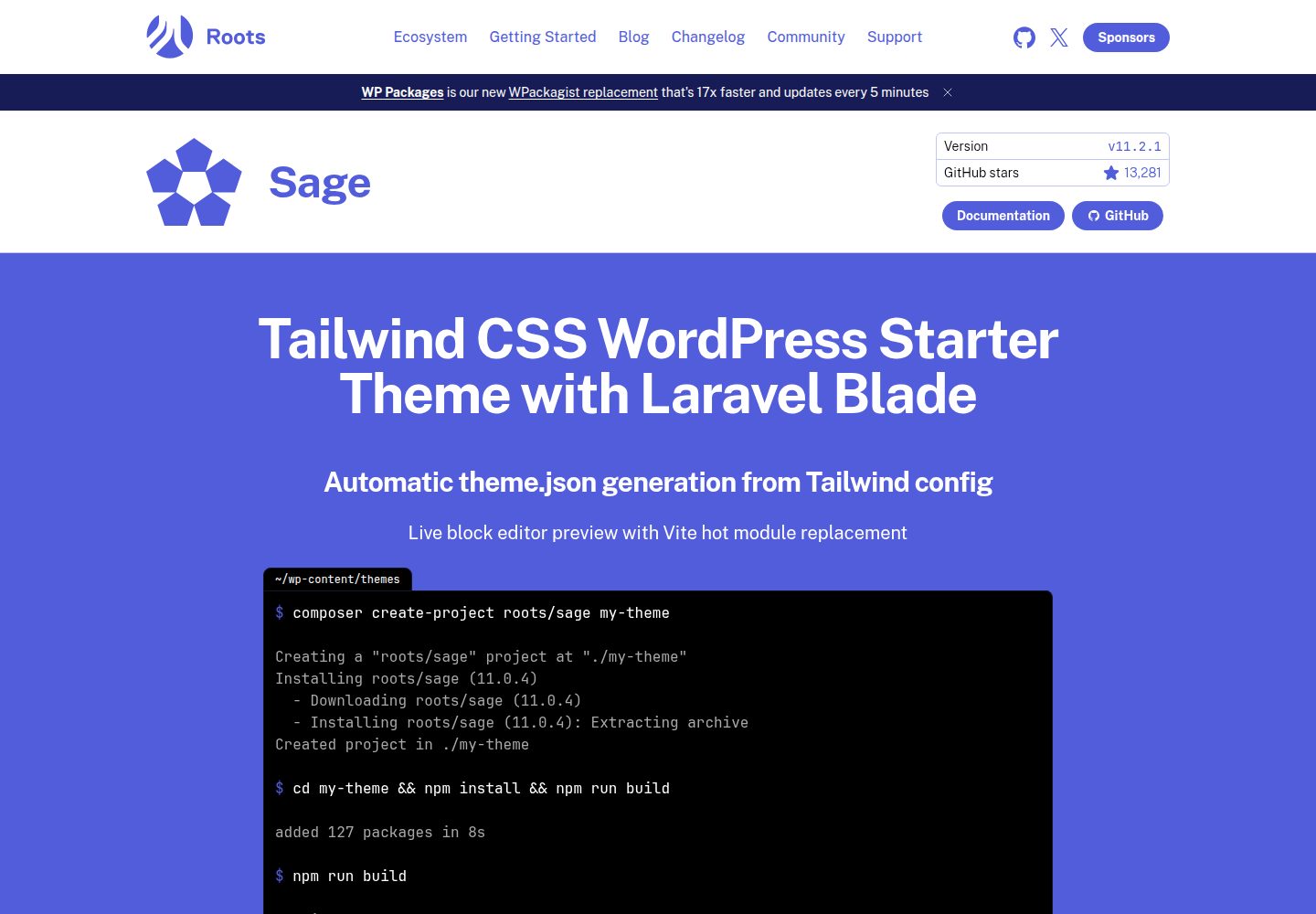
sage
Sage is a WordPress starter theme maintained by Roots, using Laravel Blade components and templates, Vite builds, Tailwind CSS, and built-in block editor support.
Laravel · Starter
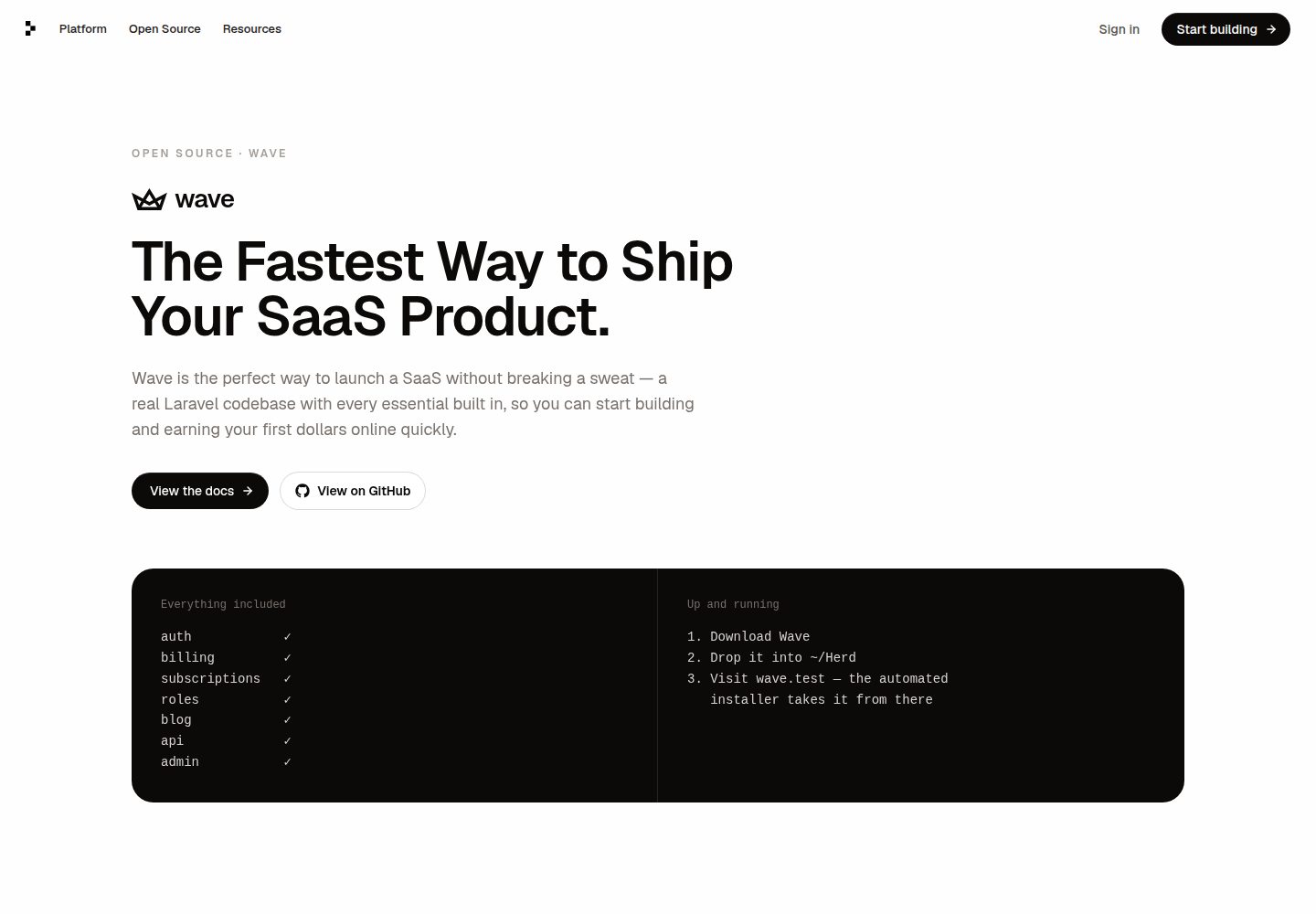
wave
Wave is an open-source SaaS starter kit built on Laravel and released under the MIT license.
Laravel · SaaS
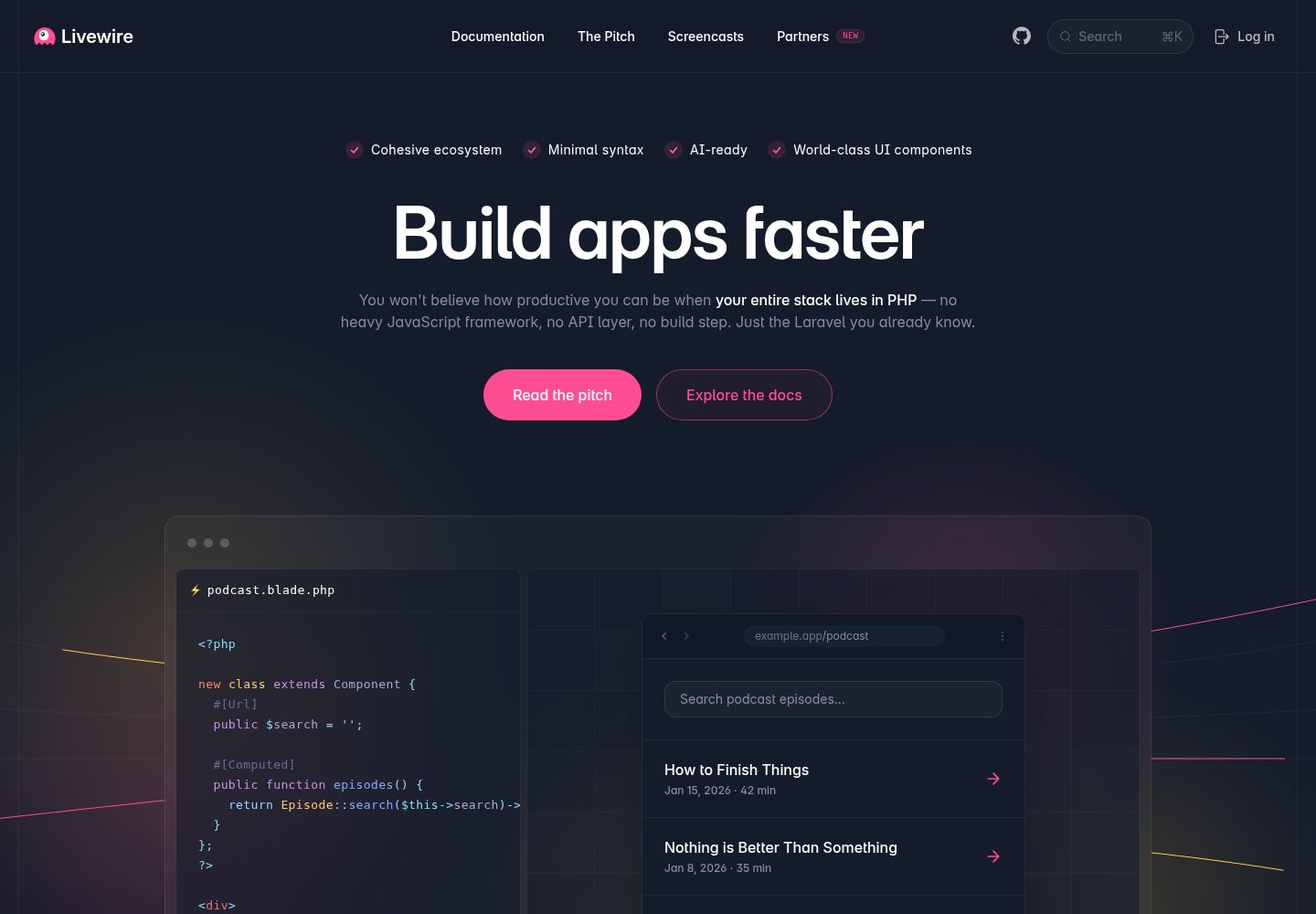
filament-starter
A Laravel TALL stack starter template maintained by Log1x, with a preconfigured Filament admin panel and plugins including Curator, Gravatar, Exceptions, Jobs Monitor, Breezy, Peek, and Logger.
Laravel · Starter
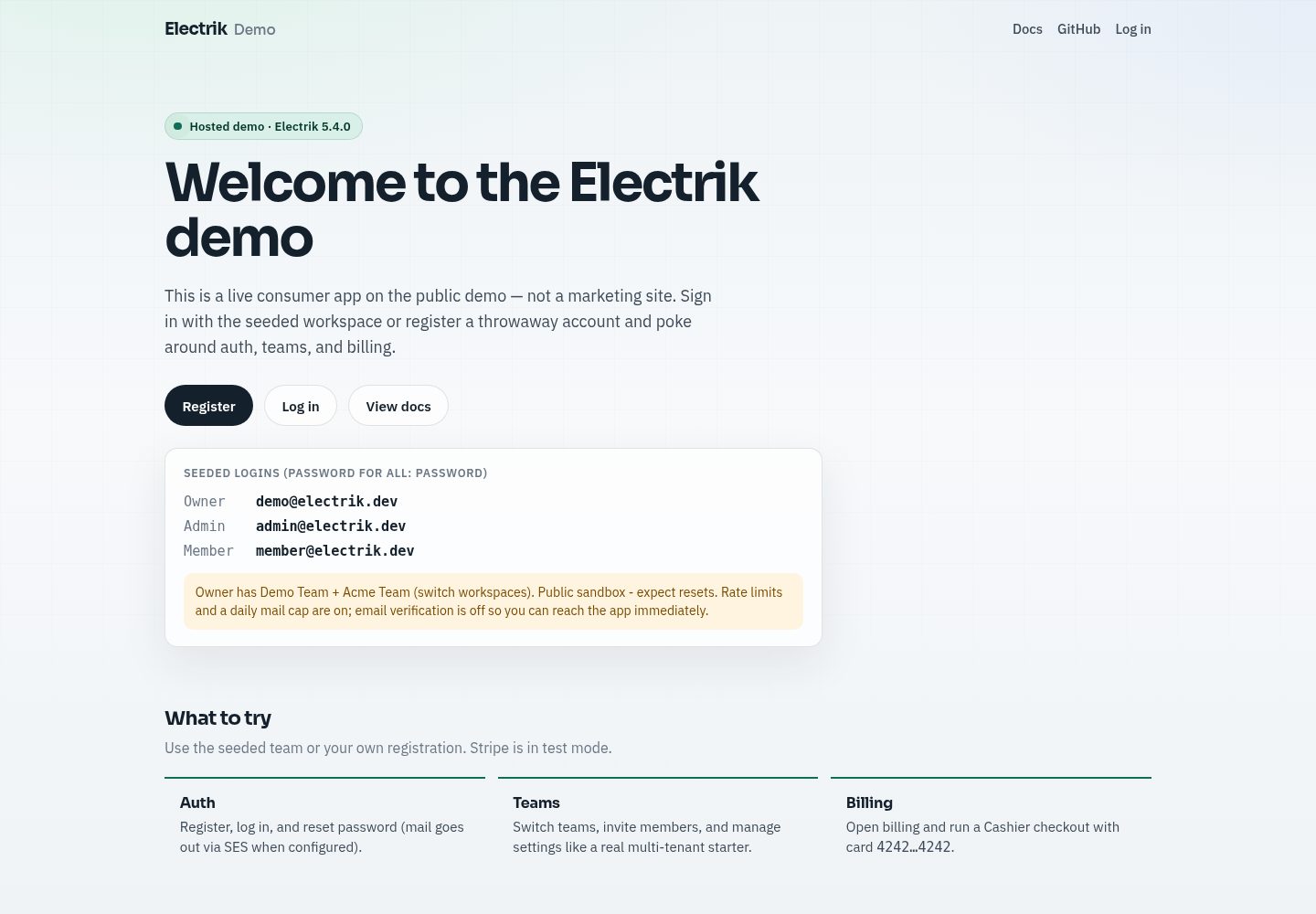
electrik
Electrik is a Laravel SaaS starter kit installed as a Composer package, with authentication, teams, Stripe subscription billing, and the Slate 3 interface under the Electrik\ namespace rather than copied into App\.
Laravel · SaaS
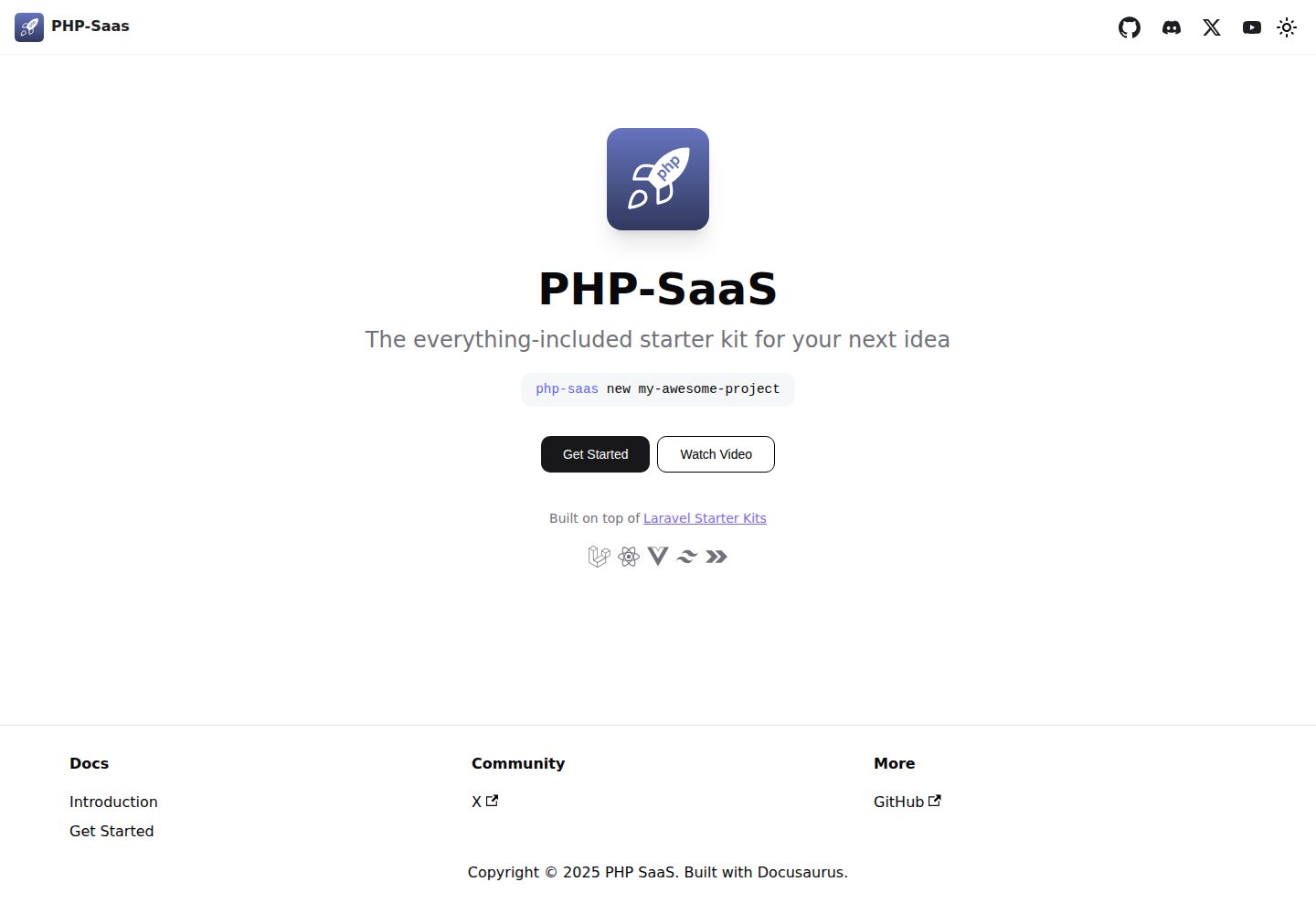
php-saas
php-saas is a Laravel-based SaaS starter positioned as an everything-included kit. It generates new projects via a global Composer command and includes authentication with two-factor, API tokens, Stripe and Paddle billing, and project, team, and organization management.
Laravel · SaaS
filament-jetstream
A Laravel starter kit that implements Jetstream-like authentication and account features using Filament's native panels and components. It includes login, registration, two-factor authentication, session management, user profiles, and optional teams and API tokens.
Laravel · Starter