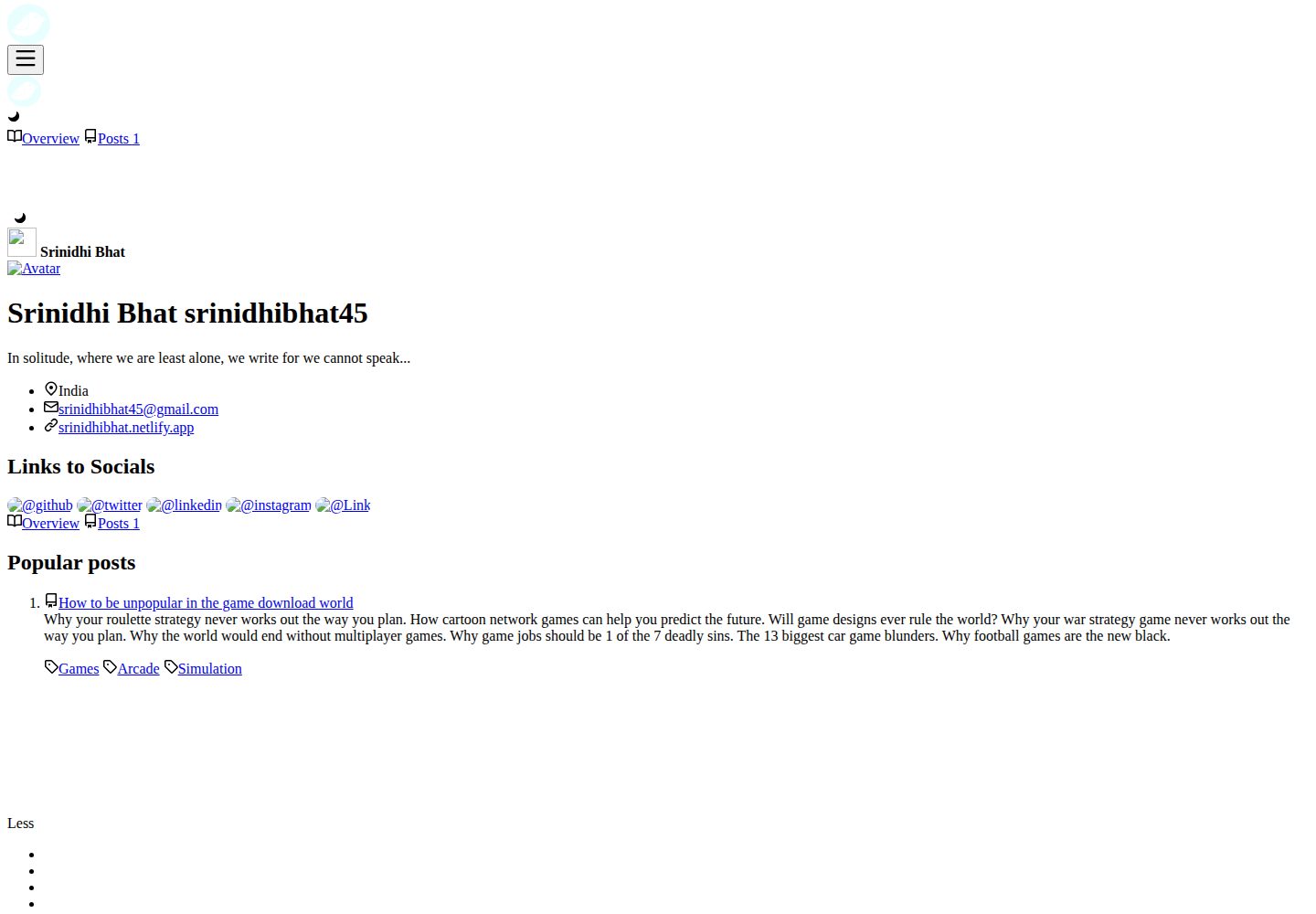
Hugo static site with content managed as Markdown files, and posts located in the content/post directory
HugoPortfolioBlog
srinidhi-github-blog — Hugo Portfolio Template
By srinidhibhat45
A Hugo-based static blog and portfolio site template with a GitHub-style interface, generating pages from Markdown content and TOML configuration, supporting pinned posts, summary truncation, LaTeX formulas, and last modified time.
Explore the design
Compare the page layouts and mobile experience. Open any screenshot for a closer look.
Desktop homepage1 / 2
Desktop captureTop of page
Actual screenshot captured by the server browser.
All pages & views 2
Screenshots show visual appearance; interactive behavior may differ.
Recorded 2026-10-03View source
What stands out
A quick read of the recorded project description.
GitHub-style interface, with the homepage supporting a readme.md as the site introduction
Setting pin: true in the front matter pins a post
Supports two summary truncation methods: the summary field or <!--more-->
Enabling math in the front matter causes KaTeX to render inline and block formulas
config.toml can configure the author, social accounts, custom links, RSS, and favicon
Template Details
This is a Hugo static site template. The repository is named srinidhi-github-blog, and the README states that its theme is github-style. Site content is organized as Markdown files, with posts placed in the content/post directory and created via hugo new post/title.md; Hugo generates drafts with draft: true by default, and they must be changed to false to appear on the site. A readme.md can be placed on the homepage as a personal introduction or site description.
The template provides several content control capabilities: setting pin: true in the front matter pins a post; the summary field or the <!--more--> marker controls the summary range displayed on list pages, with the difference being that summary does not appear in the body text. Enabling lastmod in config.toml and configuring the frontmatter allows the post's last modified time to be displayed. Adding math: true to a post's front matter (the README example writes katex: math) causes KaTeX to automatically render \( ... \) inline formulas and $$ ... $$ block formulas.
Configuration is centralized in config.toml, where you can set the site title, author, description, social accounts (GitHub, Facebook, Twitter, LinkedIn, Instagram, Tumblr, email), keywords, RSS, favicon, location information, and a custom link list. The README also provides a deploy.sh example that publishes build output to the gh-pages branch via git worktree, and recommends setting HUGO_ENV=production for production builds to enable Google Analytics.
The repository uses the MIT license, allowing free use, modification, commercial use, and distribution of the code, provided the copyright and license notice are retained; demo images, fonts, icons, and other third-party assets, as well as external services such as domains and hosting, require separate verification of licensing and fees. The repository has 0 stars and was last updated in 2021. The README is mainly based on the upstream github-style theme's documentation and provides no additional information about accessibility, browser compatibility, or long-term maintenance status.
HugoPortfolioBlog
Is it right for your project?
Use Cases
- Building a personal technical blog and publishing Markdown posts
- Creating a portfolio or resume-style site with a personal introduction homepage
- Blogs that need pinned key posts or control over summary display on list pages
- Writing technical notes or study records that include mathematical formulas
Suitable For
- Individual developers familiar with or willing to learn Hugo and Markdown
- Users who need a static blog that can be hosted on GitHub Pages or Netlify
- Writers who prefer a GitHub visual style interface
- Users who want to freely modify and distribute code under the MIT license
Getting started & customization
Use these recorded setup notes alongside the repository instructions for your chosen version.
- 1
First run hugo new site mysite to create a site, then add the theme to themes/github-style as a git submodule
- 2
When upgrading from an older version, rename content/posts to content/post
- 3
New posts default to draft: true and must be changed to false to be displayed
- 4
Fill in baseURL, title, author, social accounts, and other parameters in config.toml
- 5
The README provides a deploy.sh example that publishes to the gh-pages branch via git worktree; for production builds, setting HUGO_ENV=production is recommended
License & source material
Usage conditions & limitations
Free to use · keep license noticeThis entry covers the free version under the MIT license in the public repository; the free scope is the code of this version and does not mean that external services or third-party assets are free.
Must comply with when using
- Free use, modification, commercial use, and distribution of this version's code are permitted.
- When distributing copies or substantial portions of the code, retain the original author's copyright notice and the complete MIT license notice.
- The code is provided as is; warranties and limitations of liability are governed by the original license and applicable law.
Additional costs & items to verify
- Enabling Google Analytics requires applying for an account and filling in a tracking ID; this is an external service and may involve privacy and compliance requirements.
- The deployment example relies on the Hugo command-line tool and git worktree to publish to the gh-pages branch, and you must prepare the build and hosting environment yourself.
- The theme is introduced from the upstream repository as a git submodule, and its use and updates require access to that external GitHub repository.
- Demo images, fonts, icons, and other third-party assets must be checked against their respective licenses and cannot be judged solely by the code's MIT license.
- External services such as domains, hosting, databases, payments, or AI may incur additional fees.
View Original Text Basis
Permission is hereby granted, free of charge
Original License Text
googleAnalytics = "UA-123456-789"
Original README
env HUGO_ENV="production" hugo -t github-style
Original README
https://github.com/srinidhibhat45/srinidhi-github-blog/blob/main/LICENSEhttps://github.com/srinidhibhat45/srinidhi-github-blog/blob/main/README.mdgit submodule add [email protected]:MeiK2333/github-style.git themes/github-style
Original README
Compiled by DeepSeek based on repository license and README ·2026-10-03. Results only cover the materials read; dependencies, images, fonts, and subsequent term changes are subject to their respective original texts.
Project checks & description sources
Template Information
- Source platforms
- GitHub
- Documentation and maintenance reference score
- Partly documented · 70 / 100
- Technologies
- Hugo
- Website type
- Portfolio · Blog
How this score is calculated
Our heuristic uses license records (up to 30), a demo link (12), a preview (10), stars (15), recorded maintenance (15), description completeness (8), feature records (5) and classification data (5). It is not a code, security or performance test, or a Google score. A link does not establish tested functionality.
What to verify for this project
- Repository update recorded
- 2021-04-15
- Screenshot last checked
- 2026-10-03
A demo link is listed. Check it with your own content and viewport sizes; its presence does not confirm that forms, authentication or payments work.
The catalog identifies Hugo as the primary stack. Check the actual dependency manifest and lockfile for versions and hosting requirements. These notes use recorded metadata, not a code audit or a deployment test.
Use a selection guide →How this description was prepared
AI-assisted description based on catalog records and repository material. Repository authors are not automatically the reviewers of this description.
Review declaration: [email protected] · 2026-10-04
Inspect the recorded source material
SHA-256: 77b2f5808f623d2fbb39014550615d3b7960ab747f2b495f5558dc859896fd99
2026-10-03T22:38:37.161Z
Source file / repository# github-style ## Init hugo site ```bash hugo new site mysite cd mysite ``` ## Install the theme ```bash git submodule add [email protected]:MeiK2333/github-style.git themes/github-style ``` ## Update the theme If you just installed the theme, it is already in the latest version. If not, you can update using the below commands ```bash cd themes/github-style git pull ``` Then, you need to rename the previous `posts` folder to `post` ```bash cd <you-project-folder> mv content/posts content/post ``` ## Setup readme ```bash hugo new readme.md echo '`Hello World!`' > content/readme.md ``` ## Pin post ``` --- pin: true --- ``` ## Add new post Hugo will create a post with `draft: true`, change it to false in order for it to show in the website. ``` hugo new post/title_of_the_post.md ``` ## Limit display content ### Approch 1: use summary ``` --- title: "title" date: 2019-10-22T18:46:47+08:00 draft: false summary: "The summary content" --- ``` ### Approch 2: use `<!--more-->` Use `<!--more-->` to seperate content that will display in the posts page as abstraction and the rest of the content. This is different from summary, as summary will not appear in the post. ``` --- title: "title" date: 2019-10-22T18:46:47+08:00 draft: false --- abstraction show in the post page <!--more--> other content ``` ## add last modified data add to `config.toml` ```toml lastmod = true [frontmatter] lastmod = ["lastmod", ":fileModTime", ":default"] ``` ## Support LaTex In you post add `math: true` to [front matter](https://gohugo.io/content-management/front-matter/) ``` --- katex: math --- ``` Then the [katex script](https://katex.org/docs/autorender.html) will auto render the string enclosed be delimiters. ``` # replace ... with latex formula display inline \\( ... \\) display block $$ ... $$ ```  ## config.toml example ```toml baseURL = "https://meik2333.com/" languageCode = "zh-cn" title = "MeiK's blog" theme = "github-style" googleAnalytics = "UA-123456-789" pygmentsCodeFences = true pygmentsUseClasses = true [params] author = "MeiK" description = "In solitude, where we are least alone." github = "MeiK2333" facebook = "MeiK2333" twitter = "MeiK2333" linkedin = "MeiK2333" instagram = "MeiK2333" tumblr = "MeiK2333" email = "[email protected]" url = "https://meik2333.com" keywords = "blog, google analytics" rss = true lastmod = true favicon = "/images/github.png" location = "China" [[params.links]] title = "Link" href = "https://github.com/meik2333" [[params.links]] title = "Link2" href = "https://meik2333.com" icon = "https://meik2333.com/images/avatar.png" [frontmatter] lastmod = ["lastmod", ":fileModTime", ":default"] ``` ## deploy.sh example There are various way to deploy to github, here is a link to official [document](https://gohugo.io/hosting-and-deployment/hosting-on-github/). Here is an sample. Note line 22 have `env HUGO_ENV="production"`, makes sure googleAnalysis is loaded during production, but is not loaded when we are testing it in localhost. ```bash #!/bin/sh if [ "`git status -s`" ] then echo "The working directory is dirty. Please commit any pending changes." exit 1; fi echo "Deleting old publication" rm -rf public mkdir public git worktree prune rm -rf .git/worktrees/public/ echo "Checking out gh-pages branch into public" git worktree add -B gh-pages public origin/gh-pages echo "Removing existing files" rm -rf public/* echo "Generating site" env HUGO_ENV="production" hugo -t github-style echo "Updating gh-pages branch" cd public && git add --all && git commit -m "Publishing to gh-pages (publish.sh)" #echo "Pushing to github" #git push --all ``` Then you can verify the site is working and use `git push --all` to push the change to github. If you don't want to check again every time, you can uncomment the `#git push --all` in the script.
Explore similar templates
Compare previews and descriptions within the same stack and category.

hugo-PaperMod
A fast, clean, responsive Hugo theme for blogs and lightweight portfolios, with three layout modes (Regular, Home-Info, Profile), automatic and manual light/dark themes, Fuse.js client-side search, multilingual support, and built-in Open Graph, Twitter Cards, and Schema.org data.
Hugo · Portfolio

LoveIt
LoveIt is a clean, elegant, and feature-rich Hugo blog theme derived from LeaveIt and KeepIt, MIT-licensed. It offers light/dark modes, responsive layout, multilingual support, and search via Lunr.js or Algolia.
Hugo · Blog

hugo-coder
hugo-coder is a minimalist Hugo blog theme maintained by luizdepra under the MIT license. It provides a clean, text-focused blog appearance, configuration documentation in the docs directory, and a complete exampleSite with hugo.toml.
Hugo · Blog

blowfish
Blowfish is a Hugo personal website and blog theme built with Tailwind CSS 4, focused on lightness, simplicity, and content-first presentation.
Hugo · Blog

hugo-paper
hugo-paper is a simple, clean, and customizable Hugo blog theme configured through config.toml or hugo.toml.
Hugo · Blog

hextra
Hextra is a Hugo theme for documentation and blog sites, built on Hugo and Tailwind CSS with design referencing Nextra.
Hugo · Documentation