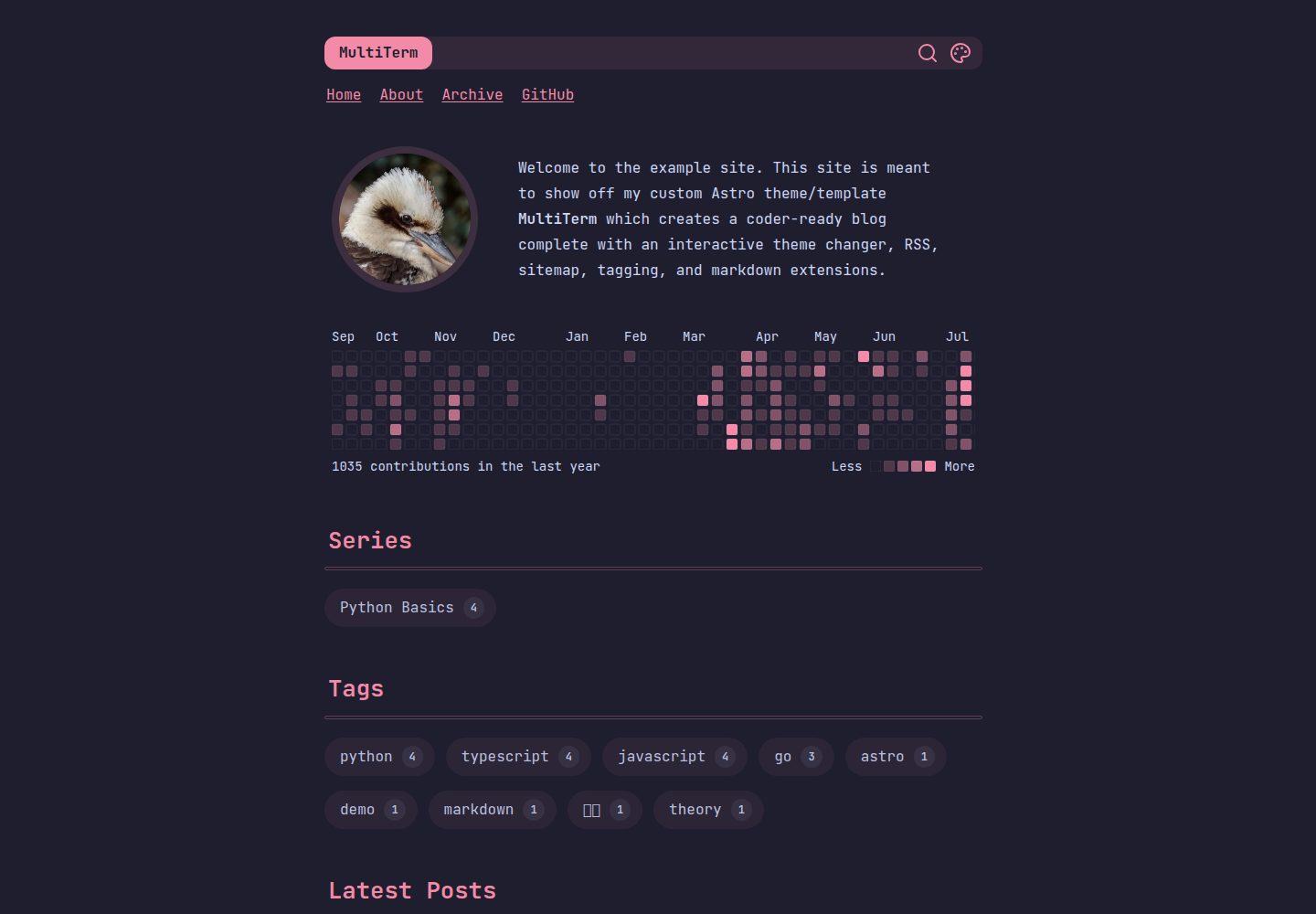
Uses the Shiki themes built into Expressive Code as the site-wide color source; choose any two for light/dark/auto modes, or enable multi-theme mode so readers can select from a dialog
AstroBlog
multiterm-astro — Astro Blog Template
By stelcodes
MultiTerm is an Astro-based blog theme whose core selling point is switchable editor color schemes. It supports light, dark, and auto modes as well as multiple theme selection, and includes Giscus comments, a GitHub activity component, Markdown extensions, RSS, and a sitemap.
Explore the design
Compare the page layouts and mobile experience. Open any screenshot for a closer look.
Desktop homepage1 / 3
Desktop captureTop of page
Actual screenshot captured by the server browser.
All pages & views 3
Screenshots show visual appearance; interactive behavior may differ.
Recorded 2026-09-30View source
What stands out
A quick read of the recorded project description.
A theme toggle button in the header offers light, dark, and follow-system modes, with colors linked through CSS variables
Built-in Giscus comments based on GitHub Discussions, with styling adapted to the theme's color schemes
The homepage can optionally display a statically generated GitHub activity calendar that changes with the current color scheme
Markdown extensions include admonitions, an auto table of contents, emoji shortcodes, KaTeX math formulas, MDX, and reading time
Built-in RSS and sitemap, with social links supporting GitHub, Mastodon, Twitter, LinkedIn, and email
Template Details
MultiTerm is an Astro blog theme aimed at developer writing scenarios, organizing its visual system around "editor color schemes." It uses the Shiki themes built into Expressive Code as the site-wide color source. Readers can switch between light, dark, or follow-system via a header button, or in multi-theme mode choose any theme from a dialog, with page elements changing color in sync through CSS variables.
On the content side, the theme provides Markdown extensions: admonitions, an auto table of contents that sticks to the side on large screens, emoji shortcodes, KaTeX math formulas, MDX, and reading time estimation. It also includes RSS and a sitemap with no extra configuration. Social links cover GitHub, Mastodon, Twitter, LinkedIn, and email. Comments use Giscus, backed by GitHub Discussions; the homepage can optionally display a statically generated GitHub activity calendar. Social card images are generated automatically via Satori.
Configuration is centralized in a single file, src/site.config.ts, and example content is in the src/content directory, which can be replaced entirely. The build outputs a static site by default, but can be changed to dynamically generate content. The project is MIT licensed, allowing free use, modification, commercial use, and distribution, but third-party assets such as demo images, fonts, and icons require separate license checks; external services such as domains and hosting may incur costs.
AstroBlog
Is it right for your project?
Use Cases
- Developers building a personal technical blog who want the site-wide color scheme to match their usual editor theme
- Wanting to let readers choose their own reading color scheme, including light, dark, follow-system, or multi-theme switching
- Needing basic blog capabilities such as comments, RSS, a sitemap, and social links without configuring each one individually
- Writing technical articles that include math formulas, admonitions, a table of contents, or MDX components
- Wanting to show GitHub activity on the homepage and have social share cards generated automatically
Suitable For
- Developers using Astro who accept centralized configuration in src/site.config.ts
- Writers who prefer editor color schemes and want the blog's visuals to match their code theme
- Personal sites that need Markdown extensions, RSS, and a sitemap as standard blog features
- Users willing to check and replace third-party assets such as demo images, fonts, and icons themselves
Getting started & customization
Use these recorded setup notes alongside the repository instructions for your chosen version.
- 1
After cloning the repository, run npm install to install dependencies, npm run dev to start the development server, and npm run build && npm run preview to build and preview
- 2
Site configuration is centralized in src/site.config.ts, and example content is in src/content, which can be deleted and replaced with your own articles
- 3
The Giscus comments and GitHub activity component depend on GitHub-side configuration; complete the Giscus setup before use
- 4
The default build is a static site, but it can be changed to dynamically generate content
- 5
The project code is MIT licensed; when distributing, retain the copyright notice and license text; third-party assets and external services require separate confirmation
License & source material
Usage conditions & limitations
Free to use · keep license noticeThis entry covers the free version under the MIT license in the public repository; the free scope is the code of this version and does not mean external services or third-party assets are free.
Must comply with when using
- Free use, modification, commercial use, and distribution of this version's code are permitted.
- When distributing copies or substantial portions of the code, retain the original author's copyright notice and the full MIT license notice.
- The code is provided as is; warranties and limitations of liability are governed by the original license and applicable law.
Additional costs & items to verify
- The comment feature depends on GitHub Discussions and the Giscus service, requiring configuration on the GitHub side and connection to an external service; it is not a purely local feature.
- The homepage GitHub activity calendar is an optional component that requires connecting to a GitHub data source and completing the corresponding external configuration before use.
- Demo images, fonts, icons, and other third-party assets must be checked against their respective licenses and cannot be judged solely by the code's MIT license.
- External services such as domains, hosting, databases, payments, or AI may incur additional charges.
View Original Text Basis
Permission is hereby granted, free of charge
Original License Text
Allow readers to respond, discuss, and react with a comment section powered by GitHub and [Giscus](https://giscus.app).
Original README
https://github.com/stelcodes/multiterm-astro/blob/main/LICENSE.txthttps://github.com/stelcodes/multiterm-astro/blob/main/README.mdOptionally include a statically generated GitHub activity calendar on the homepage
Original README
Compiled by DeepSeek based on repository license and README ·2026-10-01. Results only cover the materials read; dependencies, images, fonts, and subsequent term changes are subject to their respective original texts.
Project checks & description sources
Template Information
- Source platforms
- GitHub
- Documentation and maintenance reference score
- More documented · 85 / 100
- Technologies
- Astro
- Website type
- Blog
How this score is calculated
Our heuristic uses license records (up to 30), a demo link (12), a preview (10), stars (15), recorded maintenance (15), description completeness (8), feature records (5) and classification data (5). It is not a code, security or performance test, or a Google score. A link does not establish tested functionality.
What to verify for this project
- Repository update recorded
- 2025-09-15
- Screenshot last checked
- 2026-10-01
A demo link is listed. Check it with your own content and viewport sizes; its presence does not confirm that forms, authentication or payments work.
The catalog identifies Astro as the primary stack. Check the actual dependency manifest and lockfile for versions and hosting requirements. These notes use recorded metadata, not a code audit or a deployment test.
Use a selection guide →How this description was prepared
AI-assisted description based on catalog records and repository material. Repository authors are not automatically the reviewers of this description.
Automatically checked against source and license rules; no manual editorial review.
Inspect the recorded source material
SHA-256: 4a3100779c1f449799cf49a96c712a36daaa29719bfe0de4f87b4a79eb07d4d9
2026-10-01T13:47:25.664Z
Source file / repository# MultiTerm Astro 🎨⚡️ **MultiTerm** is an Astro blog theme designed for coders who love their color schemes. Easily theme your whole website with your favorite color schemes and have your prose rendered with a nod to the aesthetics of raw markdown. Check out the [Showing Off Blog Features](https://multiterm.stelclementine.com/posts/showing-off-blog-features) post to see all the exciting MultiTerm capabilites on the [live example site](https://multiterm.stelclementine.com)! > v2.0.0 has been released! 🥳        ## ✨ Features - **Amazing Theme Selection**: Personalize your blog's appearance with your favorite editor color scheme. Pick your favorite [Shiki themes](https://expressive-code.com/guides/themes/#available-themes) bundled with Expressive Code. - **Dark/Light/Auto Theme Mode**: Choose any two Shiki themes and use the standard light/dark/auto model for automatically adapting to your reader's theme preferences with button in the site header. - **Multiple Theme Mode**: Choose three (or all 59!) Shiki themes and allow your reader to choose their favorite from a dialog menu opened from a button in the header. Every element seamlessly changes color interactively using the magic of CSS variables. - **GitHub Comment Section**: Allow readers to respond, discuss, and react with a comment section powered by GitHub and [Giscus](https://giscus.app). Painstakingly themed to match your site perfectly. - **GitHub Activity Widget**: Optionally include a statically generated GitHub activity calendar on the homepage that (of course) matches the active color scheme perfectly. - **Markdown Extensions**: Admonitions, auto-generated TOC that sticks to the side on large screens, emoji shortcodes, KaTeX math, MDX, and reading time estimates. See the example site's [Showing Off Blog Features](https://multiterm.stelclementine.com/posts/showing-off-blog-features) post. - **RSS Feed and Sitemap**: Built-in support for RSS feeds and sitemap with no extra configuration. - **Social Links**: Easily include links to common developer platforms including GitHub, Mastodon, Twitter, LinkedIn and E-mail. - **Responsive Design**: Optimized for all devices from desktops to mobile phones. Built with [Tailwind v4](https://tailwindcss.com/). - **SEO Optimized**: Boost your site's visibility with built-in SEO best practices and automatically generated social card images for every page via [Satori](https://github.com/vercel/satori). - **Customizable Build**: Powered by [Astro](https://astro.build/), render as a static site (the default) or generate content dynamically. Check out the example site [PageSpeed scores](https://pagespeed.web.dev/analysis/https-multiterm-stelclementine-com/qhnp521yci?form_factor=mobile) and [OpenGraph analysis](https://www.opengraph.xyz/url/https%3A%2F%2Fmultiterm.stelclementine.com) ## 🚀 Getting Started **Clone the Repository**: ```bash git clone --depth 1 https://github.com/stelcodes/multiterm-astro my-new-blog && cd my-new-blog ``` **Install Dependencies**: ```bash npm install ``` **Start the Development Server**: ```bash npm run dev ``` **Build Your Site and View the Results**: ```bash npm run build && npm run preview ``` ## 🛠️ Configuration Simple configuration is a core feature of MultiTerm. All configuration is done from a single file: `src/site.config.ts`. This is where you can tailor your website to match your vision. Please take a look at `src/site.config.ts` for more information about the configuration options. To add your own content, check out the `src/content` directory. Feel free to remove all the example content and replace it with your own! ## 📄 License This project is licensed under the [MIT License](LICENSE.txt). ## Inspiration - https://github.com/panr/hugo-theme-terminal - https://github.com/chrismwilliams/astro-theme-cactus ## 🩷 Sponsor Consider [buying me a coffee](https://ko-fi.com/stelclementine) to keep me caffeinated while I work on open source projects like this one! [](https://www.star-history.com/#stelcodes/multiterm-astro&Date)
Explore similar templates
Compare previews and descriptions within the same stack and category.

astrowind
AstroWind is a free, open-source Astro starter theme using Astro and Tailwind CSS, released under the MIT license.
Astro · Blog

astro-paper
AstroPaper is a minimal, responsive, accessible, and SEO-friendly Astro blog theme. Articles are stored as Markdown/MDX in src/content/posts/, with subdirectories affecting URLs.
Astro · Blog

fuwari
Fuwari is a static blog template built with Astro and Tailwind CSS for personal blogs. It manages posts as Markdown files in src/content/posts/, with frontmatter for title, date, description, cover, tags, categories, draft status, and language.
Astro · Blog

Firefly
Firefly is a clean personal blog theme forked from Astro and Fuwari, offering four background modes, single/double sidebar and list/grid layouts, Pagefind client-side full-text search, and a six-language UI.
Astro · Blog

astro-theme-cactus
Astro Cactus is an Astro-based blog and portfolio theme that uses Markdown/MDX content collections to manage posts, notes, and tags, with frontmatter type-checked by a schema.
Astro · Portfolio

astrofy
Astrofy is a free and open-source personal portfolio website template built with Astro and TailwindCSS, with built-in blog, CV timeline, project showcase, store, and RSS feed modules.
Astro · Portfolio