Write with MDX, allowing JSX directly in Markdown documents
Next.jsReactBlogStarter
blogging-website-template — Next.js Blog Template
By thekamalkashyap
A blog site template based on Next.js and Tailwind CSS, bootstrapped from tailwind-nextjs-starter-blog, supporting MDX writing, tags and multiple authors, PWA offline and installation, light and dark themes, and built-in SEO configurations such as RSS and sitemap.
Explore the design
Compare the page layouts and mobile experience. Open any screenshot for a closer look.
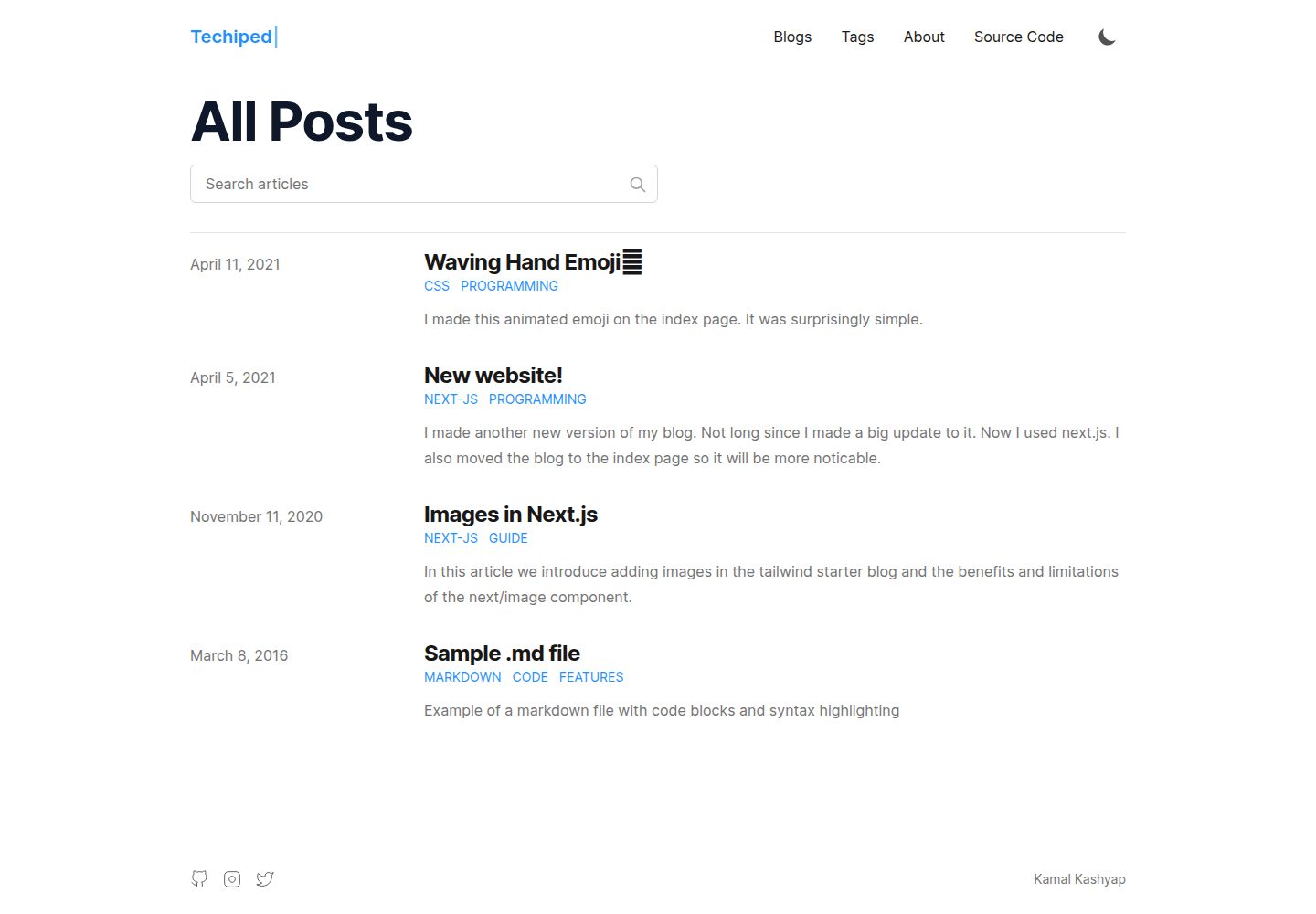
Desktop homepage1 / 3
Desktop captureTop of page
Actual screenshot captured by the server browser.
All pages & views 3
Screenshots show visual appearance; interactive behavior may differ.
Recorded 2026-10-02View source
What stands out
A quick read of the recorded project description.
Supports separate pages for tags, multiple authors, and nested routes for blog posts
Server-side syntax highlighting with line numbers and line highlighting (rehype-prism-plus)
PWA capabilities: offline access, installable as a native app, custom install button
Built-in light and dark themes, top progress bar, and mobile-optimized views
SEO-related configurations include RSS subscription and sitemap
Template Details
This is a blog site template for individuals or small teams, built with Next.js and React, styled with Tailwind CSS, and featuring a primary color attribute for easy color adjustment. The README states that this template is bootstrapped from Timlrx's tailwind-nextjs-starter-blog and is positioned as a progressive web app (PWA).
On the content side, the template uses MDX for writing articles, allowing JSX within Markdown; it supports tags (each tag generates a separate page), multiple authors, and nested routes for blog posts. Code highlighting is done server-side, supports line numbers and line highlighting, and relies on rehype-prism-plus.
In terms of site capabilities, the template provides light and dark themes, a top progress bar, mobile-optimized views, offline access and installation as a native app, and includes a custom PWA install button. For SEO, it includes configurations such as RSS subscription and sitemap.
Usage limitations and notes: the repository does not provide a dependency list for verification, so specific framework version numbers are not listed; the Lighthouse scores mentioned in the README are the original author's test records and do not represent this template's performance in the current environment. Third-party assets such as demo images, fonts, and icons must be checked separately under their respective licenses; the code is under the MIT license, which covers only the code of this version itself.
Next.jsReactBlogStarter
Is it right for your project?
Use Cases
- Building a personal tech blog and wanting to manage articles with Markdown/MDX
- Needing to organize content by tags and give each tag its own page
- Multiple people collaborating on the same blog, requiring multiple author support
- Wanting the site to be accessible offline and installable on desktop or mobile devices
- Needing basic SEO outputs such as RSS and sitemap
Suitable For
- Developers familiar with Next.js and React who are willing to configure site metadata themselves
- Blog projects focused on text content that need tag and author dimensions
- Individuals or small teams wanting to start quickly with a ready-made template and deploy to Vercel
Getting started & customization
Use these recorded setup notes alongside the repository instructions for your chosen version.
- 1
After downloading the repository via git clone, first modify siteMetadata.js to fill in site-related information
- 2
Modify authors/default.md to configure the primary author information
- 3
Adjust headerNavLinks.js as needed to customize navigation links, and add blog posts
- 4
For local development, run npm start or npm run dev, then visit http://localhost:3000
- 5
Run node ./scripts/compose.js to generate a new article with pre-filled front matter following interactive prompts
License & source material
Usage conditions & limitations
Free to use · keep license noticeThis entry covers the free version under the MIT license in the public repository; the free scope is the code of this version and does not mean external services or third-party assets are free.
Must comply with when using
- Permits free use, modification, commercial use, and distribution of this version's code.
- When distributing copies or substantial portions of the code, retain the original author's copyright notice and the full MIT license notice.
- The code is provided as-is; warranties and limitations of liability are governed by the original license and applicable law.
Additional costs & items to verify
- Demo images, fonts, icons, and other third-party assets must be checked under their respective licenses and cannot be judged solely by the code's MIT license.
- External services such as domain, hosting, database, payment, or AI may incur additional charges.
View Original Text Basis
Compiled by DeepSeek based on repository license and README ·2026-10-02. Results only cover the materials read; dependencies, images, fonts, and subsequent term changes are subject to their respective original texts.
Project checks & description sources
Template Information
- Source platforms
- GitHub
- Documentation and maintenance reference score
- More documented · 77 / 100
- Technologies
- Next.js · React
- Website type
- Blog · Starter
How this score is calculated
Our heuristic uses license records (up to 30), a demo link (12), a preview (10), stars (15), recorded maintenance (15), description completeness (8), feature records (5) and classification data (5). It is not a code, security or performance test, or a Google score. A link does not establish tested functionality.
What to verify for this project
- Repository update recorded
- 2022-12-13
- Screenshot last checked
- 2026-10-02
A demo link is listed. Check it with your own content and viewport sizes; its presence does not confirm that forms, authentication or payments work.
The catalog identifies Next.js as the primary stack. Check the actual dependency manifest and lockfile for versions and hosting requirements. These notes use recorded metadata, not a code audit or a deployment test.
Use a selection guide →How this description was prepared
AI-assisted description based on catalog records and repository material. Repository authors are not automatically the reviewers of this description.
Automatically checked against source and license rules; no manual editorial review.
Inspect the recorded source material
SHA-256: a7a6488cbd335e402d26925715ca147368f7fbdc6c6caf3ecaf39cde17c35a0c
2026-10-02T23:57:53.270Z
Source file / repository# Progressive web app for Blogging

This is a [Next.js](https://nextjs.org/) blogging site bootstrapped from [Timlrx's](https://github.com/timlrx) web [template](https://github.com/timlrx/tailwind-nextjs-starter-blog)
# Deploy with Vercel
[](https://vercel.com/new/git/external?repository-url=https://github.com/thekamalkashyap/blogging-website-template)
## Features
- Easy styling customization with [Tailwind 3.0](https://tailwindcss.com/blog/tailwindcss-v3) and primary color attribute
- Near perfect lighthouse score - [Lighthouse report](https://www.webpagetest.org/result/210111_DiC1_08f3670c3430bf4a9b76fc3b927716c5/)
- Mobile-friendly view
- Works offline
- Can install it as native app
- Custom install button for pwa
- Have top progress bar
- Light and dark theme
- [MDX - write JSX in markdown documents!](https://mdxjs.com/)
- Server-side syntax highlighting with line numbers and line highlighting via [rehype-prism-plus](https://github.com/timlrx/rehype-prism-plus)
- Support for tags - each unique tag will be its own page
- Support for multiple authors
- Support for nested routing of blog posts
- SEO friendly with RSS feed, sitemaps and more!
## Quick Start Guide
1. Downlod using git clone
2. Personalize `siteMetadata.js` (site related information)
3. Personalize `authors/default.md` (main author)
5. Modify `headerNavLinks.js` to customize navigation links
6. Add blog posts
7. Deploy on Vercel
## Development
First, run the development server:
```bash
npm start
```
or
```bash
npm run dev
```
Open [http://localhost:3000](http://localhost:3000) with your browser to see the result.
You can start editing the page by modifying `pages/index.js`. The page auto-updates as you edit the file.
### Compose
Run `node ./scripts/compose.js` to bootstrap a new post.
Follow the interactive prompt to generate a post with pre-filled front matter.
## Deploy
**Vercel**
The easiest way to deploy the template is to use the [Vercel Platform](https://vercel.com) from the creators of Next.js. Check out the [Next.js deployment documentation](https://nextjs.org/docs/deployment) for more details.
Explore similar templates
Compare previews and descriptions within the same stack and category.

Next.js SaaS Starter
The official Next.js SaaS starter template, integrating email/password authentication, Stripe Checkout subscriptions, a dashboard with user/team CRUD, basic Owner/Member RBAC, and activity logging.
Next.js · SaaS

Next.js Commerce
Vercel's officially maintained Next.js App Router ecommerce starter with deep Shopify integration, offering a complete product catalog, cart, and checkout flow. Core logic is modular for swapping backends, and community provider versions exist for BigCommerce, Medusa, and Saleor.
Next.js · E-commerce

Next-js-Boilerplate
A developer-first Next.js 16 starter with Tailwind CSS 4 and TypeScript, supporting both App Router and Page Router.
Next.js · Starter

tailwind-nextjs-starter-blog
A Next.js and Tailwind CSS blog starter template using Contentlayer for Markdown/MDX, with built-in SEO, code highlighting, and tags. It targets personal technical blogs and migration from Jekyll/Hugo to React, and supports one-click Vercel deployment.
Next.js · Blog

next-forge
next-forge is a Turborepo-based Next.js template maintained by Vercel, positioned as a starting point for SaaS products.
Next.js · Starter

SaaS-Boilerplate
SaaS-Boilerplate is an open-source SaaS starter template built with Next.js App Router, React 19, TypeScript, Tailwind CSS, and Shadcn UI.
Next.js · SaaS