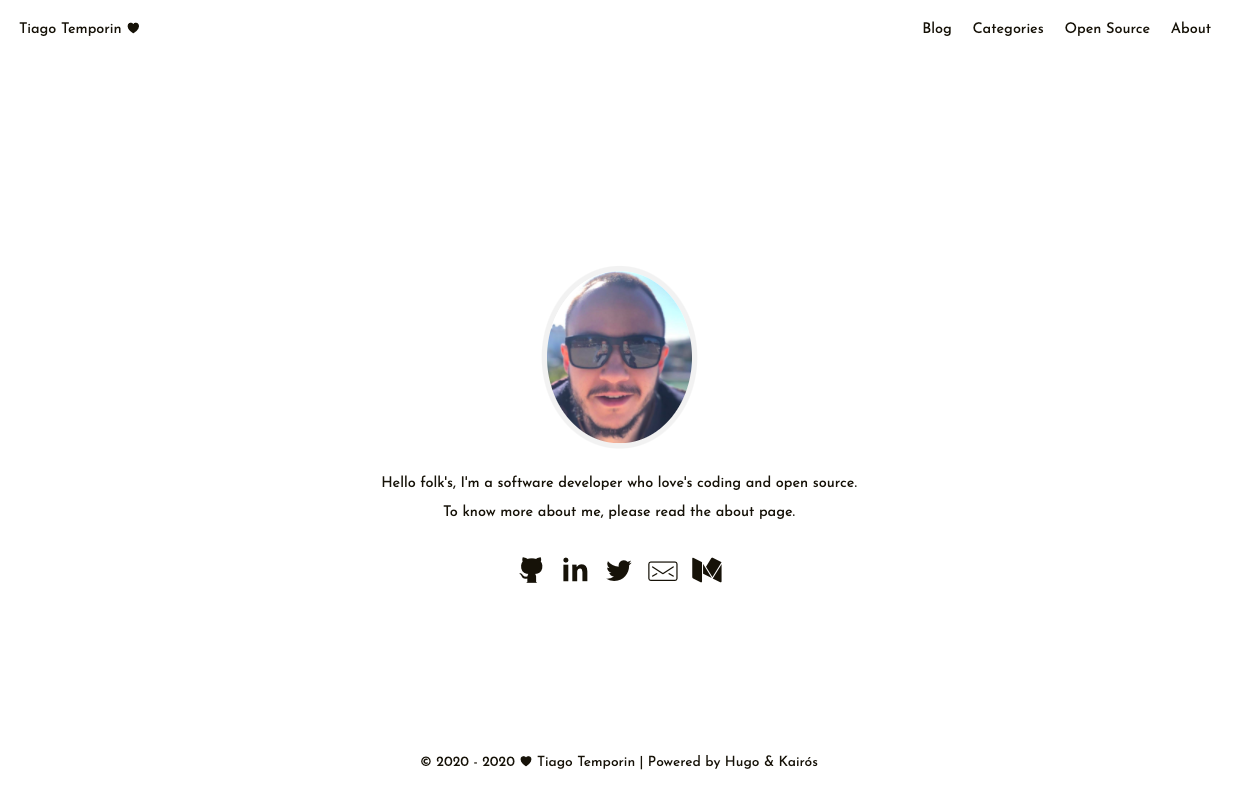
Derived from the LeaveIt and Ink themes, positioned as a minimalist Hugo blog theme
HugoBlog
hugo-kairos — Hugo Blog Template
By tiaguinho
Kairós is a Hugo blog theme derived from the LeaveIt and Ink themes, offering common blog features such as multilingual support, pagination, comment systems, and dark mode.
Explore the design
Compare the page layouts and mobile experience. Open any screenshot for a closer look.
Author preview
Author-provided previewTop of page
Preview provided in the project README.
One original preview is available. Open the full image to inspect the design.
Screenshots show visual appearance; interactive behavior may differ.
Recorded 2026-10-04View source
What stands out
A quick read of the recorded project description.
Supports multilingual content, pagination, and dark/light mode switching
Built-in support for five comment systems: Disqus, Gitalk, Valine, Gitment, and Utterances
Supports Gravatar and local avatars, article sharing, and search engine verification
Homepage can switch between profile and post list modes (home_mode)
Styles are written in SCSS, requiring the Hugo extended version
Template Details
Kairós is a Hugo theme developed by tiaguinho for a personal blog. The README states that it is derived from two themes: LeaveIt by LiuZhichao and Ink by Kailash Nadh, and is positioned as a minimalist blog theme. The theme provides multilingual support, pagination, dark/light mode switching, and built-in support for multiple comment systems (Disqus, Gitalk, Valine, Gitment, Utterances), along with configuration options for Gravatar, local avatars, article sharing, and search engine verification. The homepage supports two display modes: by default it shows a personal profile, but this can be changed to directly display a list of posts by setting home_mode = "post" in config.toml. Styles are written in SCSS, so the extended Sass/SCSS version of Hugo is required; when generating the site, the HUGO_ENV=production environment variable must be set because some features only work in production mode. The theme includes an exampleSite directory with sample configuration and demo content that can serve as a configuration reference. The repository also contains a Netlify configuration file and third-party resources such as lazysizes, lightGallery, and code-prettify.
HugoBlog
Is it right for your project?
Use Cases
- Building a personal tech blog or writing site
- A Hugo blog that needs multilingual support and pagination
- A blog that wants to use comment systems such as Disqus or Utterances
- A reading-focused site that needs dark/light mode switching
Suitable For
- Developers building blogs with Hugo
- Authors who need a multilingual blog site
- Personal blogs that prefer a clean reading experience
- Hugo users who want to quickly reuse the example configuration
Getting started & customization
Use these recorded setup notes alongside the repository instructions for your chosen version.
- 1
Clone the repository into the themes directory of your Hugo site and set theme = "kairos" in config.toml
- 2
The extended Sass/SCSS version of Hugo is required because the theme styles are written in SCSS
- 3
When generating the site, set the HUGO_ENV=production environment variable; some features only work in production mode
- 4
Refer to the config.toml and sample content in the exampleSite directory for configuration
- 5
It is recommended to place custom favicon and other icon files in the /static directory and configure browserconfig.xml and site.webmanifest as described in the README
License & source material
Usage conditions & limitations
Free to use · keep license noticeThis entry covers the free version under the MIT license in the public repository; the free scope applies to the code of this version and does not mean that external services or third-party assets are free.
Must comply with when using
- You are allowed to use, modify, commercially use, and distribute the code of this version for free.
- When distributing copies or substantial portions of the code, retain the original author's copyright notice and the full MIT license notice.
- The code is provided as is; warranties and limitations of liability are governed by the original license and applicable law.
Additional costs & items to verify
- When generating the site, the HUGO_ENV=production environment variable must be set because some features only work in production mode; otherwise, these features will not function properly.
- The extended Sass/SCSS version of Hugo must be installed because the theme styles are written in SCSS, and the regular version cannot compile the styles correctly.
- Enabling Google Analytics requires configuring a Google Analytics account and tracking ID yourself; this is an external service.
- Using the Disqus comment system requires registering a Disqus account and configuring the site shortname; comment data is hosted on a third-party service.
- Using the Gitalk comment system requires creating a GitHub OAuth application and providing credentials such as clientID and clientSecret; it depends on a GitHub account.
- Using the Valine comment system requires configuring a LeanCloud application ID and Key; it depends on the external LeanCloud service.
- Using the Gitment comment system requires registering a GitHub OAuth application and configuring the relevant credentials; it depends on a GitHub account.
- Using the Utterances comment system requires specifying a public GitHub repository and installing the Utterances app; it depends on a GitHub account.
- The search engine verification feature requires registering your site on platforms such as Google, Bing, Yandex, and Baidu and obtaining verification codes yourself; this is an external service.
- Icons such as the favicon are recommended to be generated via the third-party website realfavicongenerator.net; this is an external service.
- The theme includes third-party resources such as lazysizes, lightGallery, and code-prettify; these resources each follow their original licenses, and you should verify their license terms before use.
- Demo images, fonts, icons, and other third-party assets must be checked against their respective licenses; the MIT license of the code alone is not sufficient to determine this.
- External services such as domains, hosting, databases, payments, or AI may incur additional charges.
View Original Text Basis
Permission is hereby granted, free of charge
Original License Text
you **need to add a production** environment variables when generating your site
Original README
you must download and install the “extended” Sass/SCSS version
Original README
Google Analytics support
Original README
Disqus Comment System
Original README
Gitalk Comment System
Original README
Valine Comment System
Original README
Gitment Comment System
Original README
Utterances Comment System
Original README
Search engine verification support (Google, Bind, Yandex and Baidu)
Original README
They’re easily created via https://realfavicongenerator.net/
Original README
https://github.com/tiaguinho/hugo-kairos/blob/master/LICENSEhttps://github.com/tiaguinho/hugo-kairos/blob/master/README.md* lazysizes - https://github.com/aFarkas/lazysizes * lightGallery - https://github.com/sachinchoolur/lightGallery * code-prettify - https://github.com/google/code-prettify
Original README
Compiled by DeepSeek based on repository license and README ·2026-10-04. Results only cover the materials read; dependencies, images, fonts, and subsequent term changes are subject to their respective original texts.
Project checks & description sources
Template Information
- Source platforms
- GitHub
- Documentation and maintenance reference score
- Partly documented · 68 / 100
- Technologies
- Hugo
- Website type
- Blog
How this score is calculated
Our heuristic uses license records (up to 30), a demo link (12), a preview (10), stars (15), recorded maintenance (15), description completeness (8), feature records (5) and classification data (5). It is not a code, security or performance test, or a Google score. A link does not establish tested functionality.
What to verify for this project
- Repository update recorded
- 2020-07-06
- Screenshot last checked
- 2026-10-04
A demo link is listed. Check it with your own content and viewport sizes; its presence does not confirm that forms, authentication or payments work.
The catalog identifies Hugo as the primary stack. Check the actual dependency manifest and lockfile for versions and hosting requirements. These notes use recorded metadata, not a code audit or a deployment test.
Use a selection guide →How this description was prepared
AI-assisted description based on catalog records and repository material. Repository authors are not automatically the reviewers of this description.
Review declaration: [email protected] · 2026-10-04
Inspect the recorded source material
SHA-256: dc176f806496d74434734123257da0ca6f2483176daa0e479aa29257a08a92df
2026-10-04T00:38:35.597Z
Source file / repositoryKairós Hugo Theme ======================== Kairós is a clean, elegant, simple but not simpler blog theme for Hugo based on the original [LeaveIt Theme](https://raw.githubusercontent.com/liuzc/LeaveIt/) developed by [LiuZhichao](https://raw.githubusercontent.com/liuzc/) and [Ink Theme](https://github.com/knadh/hugo-ink) developed by [Kailash Nadh](https://github.com/knadh).  # Features * Optimized for performance: 99/100 on mobile and 100/100 on desktop in Google PageSpeed Insights * Optimized SEO performance with a correct SEO SCHEMA based on JSON-LD * A More coerent style beetwen page and sections * Multilanguage support * Pagination support * Google Analytics support * Disqus Comment System * Gitalk Comment System * Valine Comment System * Gitment Comment System * Utterances Comment System * Gravatar Support * Local Avatar Support * Share post support * Search engine verification support (Google, Bind, Yandex and Baidu) * Added configuration file for use on [Netlify](https://www.netlify.com) * Dark/Light mode * Up to 54 social sites supported out-of-the-box [see the list here](https://github.com/Fastbyte01/KeepIt/wiki/List-of-social-platforms-supported-out-of-box) * Translation ready * Wrap Image with Figure Tag without Shortcode. Thanks [Junian.Net](https://www.junian.net/hugo-image-figure-wrap/) * Load images with Lazy Load By [lazysizes](https://github.com/aFarkas/lazysizes) * Automatically highlighting code By [Google code-prettify](https://github.com/google/code-prettify), Customizable styles via CSS. See the [themes gallery](https://rawgit.com/google/code-prettify/master/styles/index.html). * Automagical image gallery with [lightGallery](https://github.com/sachinchoolur/lightGallery) * ... # Getting Started Clone this repository to your hugo theme directory. ```bash cd themes git clone https://github.com/tiaguinho/hugo-kairos.git ``` Next, open config.toml in the base of the Hugo site and ensure the theme option is set to Kairós: ```bash theme = "kairos" ``` For more information read the [official setup guide](https://gohugo.io/documentation/) of Hugo. # Site Configuration Take a look in the `exampleSite` folder. This directory contains an example config file and the content for the demo. It serves as an example setup for your documentation. Copy the `config.toml` in the root directory of your website. Overwrite the existing config file if necessary. # Content Suggestions A few suggestions to help you get a good looking site quickly: * Keep blog posts in the content/posts directory, for example: content/posts/my-first-post.md * Keep static pages in the content directory, for example: content/about.md * Keep media like images in the static directory, for example: static/images/2019/10/screenshot.png # Customizing styles for your website If you want to change some styling to fit your own website needs, you can edit them: * `assets/css/_varibales/default.scss`: You can override the variables in `_variables.scss` to customize the style * `assets/css/_custom.scss` : You can put your custom css in this file # Favicons, Browserconfig, Manifest It is recommended to put your own favicons * apple-touch-icon.png (180x180) * favicon-32x32.png (32x32) * favicon-16x16.png (16x16) * mstile-150x150.png (150x150) * android-chrome-192x192.png (192x192) * android-chrome-512x512.png (512x512) into `/static`. They’re easily created via https://realfavicongenerator.net/. Customize browserconfig.xml and site.webmanifest to set theme-color and background-color for example. # Tips #### Set production environment when generating site Because some functions are only in production mode, So you **need to add a production** environment variables when generating your site. ```bash HUGO_ENV=production hugo --gc --minify ``` #### Hugo “extended” Sass/SCSS version required This theme write style with scss, So you must download and install the “extended” Sass/SCSS version #### How to toggle dark-light mode * You can click the sun logo to toggle dark-light mode. In the desktop version the sun logo is to the right and in the mobile version is positioned to the left, close to the site title. * If you want to make your own theme toggle-able element, you can create an element with a class `.theme-switch`. See [here](https://github.com/tiaguinho/kairos/blob/master/assets/js/main.js#L32) # Home Post model If you want to show posts on index instead of a personal profile, just open config.toml in the base of the Hugo site, add the following line to config.toml ```toml [params] home_mode = "post" # post or other ``` # Add logo and cover for SEO Add a logo image (127x40) and a cover image (800x600). This images are used for SEO. # Questions, ideas, bugs, pull requests? All feedback is welcome! Head over to the [issue tracker](https://github.com/tiaguinho/hugo-kairos/issues). For more configuration info or other tips you can see the [wiki](https://github.com/tiaguinho/hugo-kairos/wiki). # License Kairós is licensed under the MIT license. Check the LICENSE file for details. The following resources are included in the theme: * lazysizes - https://github.com/aFarkas/lazysizes * lightGallery - https://github.com/sachinchoolur/lightGallery * code-prettify - https://github.com/google/code-prettify # Author [tiaguinho](https://github.com/tiaguinho) # See Also * [Hugo-Ink](https://github.com/knadh/hugo-ink) * [LeaveIt](https://github.com/liuzc/LeaveIt)
Explore similar templates
Compare previews and descriptions within the same stack and category.

hugo-PaperMod
A fast, clean, responsive Hugo theme for blogs and lightweight portfolios, with three layout modes (Regular, Home-Info, Profile), automatic and manual light/dark themes, Fuse.js client-side search, multilingual support, and built-in Open Graph, Twitter Cards, and Schema.org data.
Hugo · Portfolio

LoveIt
LoveIt is a clean, elegant, and feature-rich Hugo blog theme derived from LeaveIt and KeepIt, MIT-licensed. It offers light/dark modes, responsive layout, multilingual support, and search via Lunr.js or Algolia.
Hugo · Blog

hugo-coder
hugo-coder is a minimalist Hugo blog theme maintained by luizdepra under the MIT license. It provides a clean, text-focused blog appearance, configuration documentation in the docs directory, and a complete exampleSite with hugo.toml.
Hugo · Blog

blowfish
Blowfish is a Hugo personal website and blog theme built with Tailwind CSS 4, focused on lightness, simplicity, and content-first presentation.
Hugo · Blog

hugo-paper
hugo-paper is a simple, clean, and customizable Hugo blog theme configured through config.toml or hugo.toml.
Hugo · Blog

hextra
Hextra is a Hugo theme for documentation and blog sites, built on Hugo and Tailwind CSS with design referencing Nextra.
Hugo · Documentation