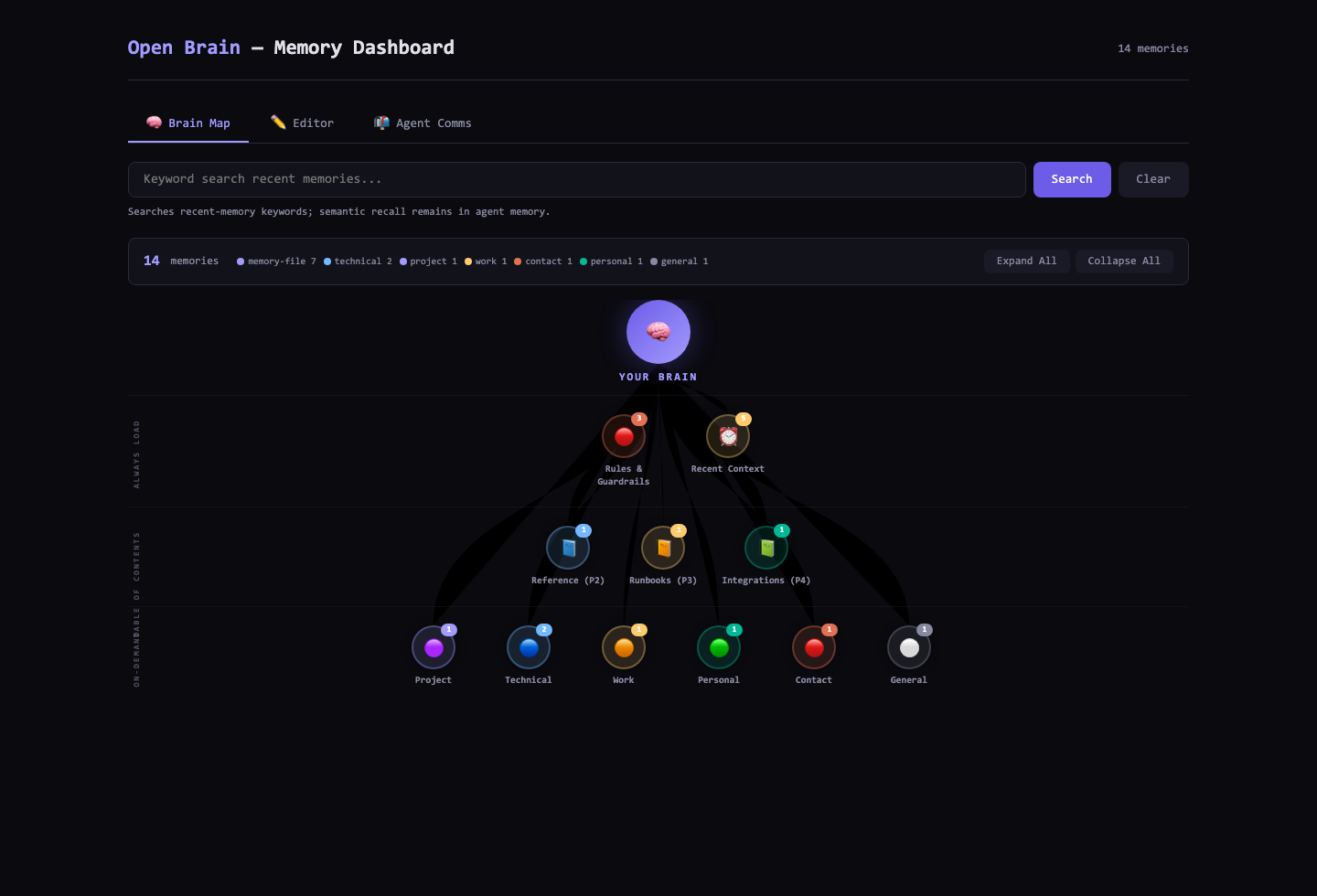
Loads memories by P1 to P4 priority, distinguishing rules that must load every session from references, runbooks, and integration docs loaded on demand
HTMLAdmin dashboard
open-brain-template — HTML Admin dashboard Template
By wefilmshit
Open Brain is an MIT-licensed AI agent memory template that uses Supabase pgvector for semantic recall, and includes a visual memory dashboard and MCP interface.
Explore the design
Compare the page layouts and mobile experience. Open any screenshot for a closer look.
Author preview
Author-provided previewTop of page
Preview provided in the project README.
One original preview is available. Open the full image to inspect the design.
Screenshots show visual appearance; interactive behavior may differ.
Recorded 2026-10-04View source
What stands out
A quick read of the recorded project description.
Provides a visual brain map and memory editor that can expand, edit, or delete memory nodes
Supports agent semantic recall through Supabase pgvector and the memory API, while dashboard search is explicitly keyword search
Optional Mem0 for memory deduplication and compression, and optional Memory Steward for query rewriting, parallel retrieval, and reranking
Prime Radiant operations board documentation covers Chevrons, Seldon Plans, Splices, Gate reports, and write-back safety conventions
Includes optional scripts and documentation such as the Optimization Kit and Memory File Sync Kit
Template Details
Open Brain is a persistent memory template for AI agents, structured as an HTML frontend with a Supabase backend. It organizes memories by priority from P1 to P4: P1 rules load every session, P2 references load when relevant, P3 runbooks load before touching the corresponding system, and P4 integration docs load only when needed. The repository provides a visual brain map and editor that can expand, edit, or delete memory nodes, and supports recording prompts and response artifacts between multiple agents using agent-artifact tags.
Memory storage and retrieval depend on Supabase and pgvector: you must first create a Supabase project, apply migrations, and deploy the Edge Function, then replace the Supabase URL and anon key in index.html. Search within the dashboard is explicitly labeled as keyword search; semantic recall goes through the agent memory API and pgvector embeddings, and unless separately integrated and verified, the dashboard does not provide semantic search. Optional integrations include Mem0 for deduplication and compression, and the optional Memory Steward intelligent query layer for query rewriting, parallel retrieval, reranking, and deduplicated synthesized answers.
The repository also includes Prime Radiant operations board documentation, using Chevrons, Seldon Plans, Splices, Seldon Crises, Agent Roster, and Gate reports to describe multi-agent task ownership, status, and write-back safety conventions, along with optional scripts such as the Optimization Kit and Memory File Sync Kit. The screenshots in the README are sanitized template illustrations, not a real production memory store.
HTMLBackend
Is it right for your project?
Use Cases
- Provide the same persistent memory for MCP-compatible tools such as Claude Code, Claude Desktop, ChatGPT, and Cursor
- Share project rules, preferences, and guardrails across multiple AI tools to avoid repeating context every session
- Use agent-artifact records and the Prime Radiant operations board to track ownership and status of multi-agent tasks
- Automatically inject the most recent memories at the start of a Claude Code session via the SessionStart hook
- Use the Memory File Sync Kit to keep local Markdown memory files in sync with Open Brain's memory-file records
Suitable For
- Heavy AI users who use Claude or GPT daily and want to reduce repeating context
- Developers who need to establish persistent project memory for AI agents
- Teams that want to share AI rules and preferences across members
- Users willing to set up their own Supabase backend and configure MCP tools
Getting started & customization
Use these recorded setup notes alongside the repository instructions for your chosen version.
- 1
First create a project in Supabase, then apply migrations and deploy the Edge Function according to supabase/README.md; otherwise the dashboard has no backend to communicate with
- 2
Replace YOUR_SUPABASE_URL and YOUR_SUPABASE_ANON_KEY in index.html
- 3
Dashboard search is keyword search; semantic recall must be integrated separately through the memory API and pgvector embeddings
- 4
Mem0, Memory Steward, Memory File Sync Kit, and the SessionStart hook are all optional and must be configured separately according to their documentation
- 5
The repository uses the MIT license, but third-party assets such as demo images, fonts, and icons, as well as external services like Supabase, require separate license and cost verification
License & source material
Usage conditions & limitations
Free to use · keep license noticeThis listing covers the free version in the public repository under the MIT license; the free scope is the code of that version and does not mean external services or third-party assets are free.
Must comply with when using
- You may use, modify, commercialize, and distribute the code of this version for free.
- When distributing copies or substantial portions of the code, retain the original author's copyright notice and the full MIT license notice.
- The code is provided as is; warranties and limitations of liability are governed by the original license and applicable law.
Additional costs & items to verify
- Using this template requires creating your own Supabase project as the backend, which is an external service dependency, and you are responsible for the account and costs.
- You must enter your own Supabase URL and anon key in index.html, meaning you need your own Supabase credentials.
- You must add your email to the ALLOWED_EMAILS allowlist in the configuration to log in and use it.
- Deployment depends on external hosting services such as Vercel, requiring you to register an account and potentially incur costs.
- Mem0 is an optional external service for memory compression and deduplication; enabling it requires integrating that third-party service.
- Dashboard search is keyword search only; semantic search must be integrated and verified yourself and is not available out of the box.
- The Memory Steward intelligent query layer is an optional advanced feature that must be set up yourself according to the documentation.
- The Memory File Sync Kit is an optional script that must be configured yourself; scheduling is not enabled automatically.
- Demo images, fonts, icons, and other third-party assets must be checked against their respective licenses and cannot be judged solely by the code's MIT license.
- External services such as domains, hosting, databases, payments, or AI may incur additional charges.
View Original Text Basis
Permission is hereby granted, free of charge
Original License Text
Create a [Supabase](https://supabase.com) project
Original README
Replace `YOUR_SUPABASE_URL` and `YOUR_SUPABASE_ANON_KEY` in `index.html`
Original README
Add your email to `ALLOWED_EMAILS`
Original README
Deploy to [Vercel](https://vercel.com)
Original README
Pairs with [Mem0](https://mem0.ai) for intelligent memory compression and deduplication
Original README
The dashboard search is intentionally labeled as keyword search unless you wire and prove semantic dashboard search separately.
Original README
Stand up Memory Steward via [docs/memory-steward.md](docs/memory-steward.md)
Original README
https://github.com/wefilmshit/open-brain-template/blob/main/LICENSEhttps://github.com/wefilmshit/open-brain-template/blob/main/README.mdSync local markdown memory files with Open Brain rows via [docs/memory-file-sync.md](docs/memory-file-sync.md)
Original README
Compiled by DeepSeek based on repository license and README ·2026-10-04. Results only cover the materials read; dependencies, images, fonts, and subsequent term changes are subject to their respective original texts.
Project checks & description sources
Template Information
- Source platforms
- GitHub
- Documentation and maintenance reference score
- Partly documented · 71 / 100
- Technologies
- HTML
- Website type
- Admin dashboard
How this score is calculated
Our heuristic uses license records (up to 30), a demo link (12), a preview (10), stars (15), recorded maintenance (15), description completeness (8), feature records (5) and classification data (5). It is not a code, security or performance test, or a Google score. A link does not establish tested functionality.
What to verify for this project
- Repository update recorded
- 2026-07-10
- Screenshot last checked
- 2026-10-04
No demo link is recorded. Use the repository instructions to evaluate the project locally; the screenshot alone cannot establish interactive behavior.
The catalog identifies HTML as the primary stack. Check the actual dependency manifest and lockfile for versions and hosting requirements. These notes use recorded metadata, not a code audit or a deployment test.
Use a selection guide →How this description was prepared
AI-assisted description based on catalog records and repository material. Repository authors are not automatically the reviewers of this description.
Review declaration: [email protected] · 2026-10-04
Inspect the recorded source material
SHA-256: bf2073522c92d5621412caeceec3b0825064f04c2f0941ce8155d83f2f543315
2026-10-04T02:53:04.587Z
Source file / repository# Open Brain + Prime Radiant - Open-Source AI Agent Memory Dashboard and Operating Board for Claude, ChatGPT, Cursor, MCP, Supabase, and pgvector
**Persistent AI agent memory with an MCP-compatible dashboard, Supabase pgvector recall, Mem0 support, Prime Radiant operating-board docs, an Optimization Kit, and a Memory File Sync Kit.**
Open Brain is an MIT-licensed template for managing what your AI agents know, when they load it, how they prioritize context, and how multi-agent work gets tracked. It gives Claude Code, Claude Desktop, ChatGPT, Cursor, and other MCP-compatible tools one persistent memory bank with visual editing, honest dashboard keyword search, agent recall, Prime Radiant operating-board patterns, and repeatable optimization checks.
Works with Claude Code, Claude Desktop, ChatGPT, Cursor, or any MCP-compatible AI tool. Pairs with [Mem0](https://mem0.ai) for intelligent memory compression and deduplication. Includes optional Memory Steward docs for a smart-query layer that can reformulate, re-rank, deduplicate, and cite memory results.
    
New to AI memory systems? Start with [Give This Repo to Your AI](docs/give-this-to-your-ai.md). It is a plain-English setup brief you can paste into Claude, ChatGPT, or Cursor so your assistant can read the repo with the right boundaries.
## The Problem
AI agents start every session with amnesia. You re-explain your preferences, re-state your rules, re-describe your project. Notes apps and docs don't solve this because they're flat. The AI doesn't know what to read first, what's critical vs. reference, or when to load what.
And even when you have a memory bank wired up, raw recall or search can return noise. Ask "what's our deploy procedure" and you get back five tangentially related memories, only one of which is actually the answer. The AI then has to read all of them and guess.
## How Open Brain Solves It
**Priority-based loading.** Not all memories are equal. P1 rules load every session. P2 reference loads when relevant. P3 runbooks load before touching specific systems. P4 integrations load only when needed. Your AI boots up like an operating system, not a blank slate.
**Visual brain map.** See your entire memory hierarchy at a glance. Click any node to expand, edit, or delete. Know exactly what your AI knows.
**Agent comms view.** Track prompt/response artifacts saved by multiple agents as lightweight pointer memories tagged `agent-artifact`, with from/to/topic/date/priority columns and click-throughs to the source file path.
**Prime Radiant operating board.** Turn memory, agent artifacts, Chevrons, splices, gates, assignment state, write-back receipts, and rollback plans into one operating board for multi-agent work. The public package includes the model, staged implementation path, write-back safety contract, prompt, and report templates. See [docs/prime-radiant.md](docs/prime-radiant.md).
**Agent roster and project tags.** Define which agents exist, what they can own, which project or lane tags apply, and which operations they are allowed to perform. Prime Radiant uses this roster to make ownership visible before any assignment changes happen.
**Memory Red-Team / Seldon Crisis Guard.** Surface stale memories, duplicate memories, contradictory memory, bad recall, missing proof, stale Chevrons, and unsafe gate claims before they become trusted context. Start observe-only, then add park/block behavior only after false-positive rates are acceptable.
**Agent semantic recall.** Let your AI retrieve memory by meaning through the memory API and pgvector embeddings. The dashboard search is intentionally labeled as keyword search unless you wire and prove semantic dashboard search separately.
**Works across tools.** One memory bank, any AI tool. Claude Code at work, ChatGPT on your phone, Cursor in your IDE — they all read from the same brain.
**Optional smart query layer via Memory Steward.** A dedicated memory steward can sit in front of raw recall and do the work raw recall does not: reformulate queries for better embedding matches, run multiple parallel searches, re-rank results by actual usefulness, filter duplicates and stale entries, and synthesize one good answer with cited memory IDs. Slower than raw recall, but designed for higher relevance.
**(New) Auto-load at session start.** A single SessionStart hook script reads your N most recent memories at the beginning of every Claude Code session and injects them as context, so the AI literally starts the conversation already knowing what happened yesterday.
**Recall quality upgrades.** Five features underneath Memory Steward that raise the ceiling on what raw recall returns: hybrid search (vector + BM25 + recency), retrieval miss tracking with classified failure reasons, aggregate queries on bank shape, audit-preserving memory corrections, and directed knowledge-graph edges between memories. See [docs/recall-quality.md](docs/recall-quality.md). Inspired in part by Peter Simmons' [engram-go](https://github.com/petersimmons1972/engram-go).
**Optimization Kit.** Scripts, prompts, templates, smoke checks, and playbooks for improving an Open Brain without mixing up speed, quality, shadow builds, and production. See [docs/optimization-kit.md](docs/optimization-kit.md).
**Memory File Sync Kit.** Optional scripts for keeping local markdown memory files aligned with Open Brain `memory-file` rows. No scheduler is auto-enabled; use it only if you want file-based memory editing. See [docs/memory-file-sync.md](docs/memory-file-sync.md).
## Screenshots
These are sanitized template screenshots, not a private production memory bank. The dashboard screenshot also shows the public template's keyword-search boundary; semantic recall remains an agent-memory path unless you wire and prove semantic dashboard search separately.
### Brain Map - Visual Memory Hierarchy

### Editor - Priority-Based Memory Files

## Who This Is For
- **AI power users** who work with Claude/GPT daily and are tired of re-explaining context
- **Developers** building with AI agents who need persistent project memory
- **Teams** that want shared AI context (rules, preferences, guardrails) across members
- **Anyone** who's said "I already told you this last session"
## Why Not Just Use Notes?
| | Notes/Docs | Open Brain |
|---|---|---|
| Priority loading | No | P1-P4 system |
| Agent semantic recall | No | pgvector embeddings |
| Smart query (re-rank, dedup) | No | Memory Steward smart-query layer |
| Multi-agent operating board | No | Prime Radiant |
| Agent ownership map | No | Agent roster + project tags |
| Drift and crisis guard | No | Memory Red-Team / Seldon Crisis Guard |
| Agent-readable | Copy-paste | MCP protocol (native) |
| Session boot sequence | Manual | Automatic checklist |
| Auto-load on session start | No | SessionStart hook |
| Mid-session refresh | Start over | `/refresh` command |
| Multi-tool | Per-app | One brain, any tool |
## Key Concepts
### Priority-Based Load Order
```
P1 (Always Load) -- Rules, guardrails, gotchas. Every session, no exceptions.
P2 (Reference) -- Tech stack, pipeline, workflow. When working on related systems.
P3 (Runbooks) -- How-to guides, specs, roadmap. Before touching these systems.
P4 (Integrations) -- Third-party setup docs. Only when relevant.
```
### Session Start Checklist
Your AI agent follows this boot sequence every session:
1. Load P1 rules (non-negotiable)
2. Load recent context (last session checkpoint)
3. Read table of contents (know what exists, don't load everything)
4. Ask what you're working on
5. Load specific memories on-demand as topics come up
### The /refresh Pattern
Long AI sessions cause context drift — the agent "forgets" rules loaded at the start. The `/refresh` command forces re-reading of P1 rules mid-session without starting over.
### Prime Radiant
Prime Radiant is the operating-board layer on top of Open Brain. It answers the questions memory alone cannot:
- Which agent owns this lane?
- Which plan or sub-plan is active?
- What proof exists?
- What gate is still blocked?
- What changed since the last checkpoint?
- Is this a read-only observation, an interactive planning move, or a real assignment write?
The public package includes:
- **Chevrons** - current position markers for plans and lanes.
- **Seldon Plans** - durable plans or roadmaps.
- **Splices** - sub-plans or branch lanes under a larger plan.
- **Seldon Crises** - plan-vs-reality drift, stale evidence, bad recall, or blocked gates.
- **Agent Roster + Project Tags** - agents, availability, lane tags, allowed operations, and current assignments.
- **Gate reports and closeouts** - receipts for review, merge, deploy, dry-run, live-write, rollback, and publish decisions.
- **Write-back safety contract** - off-switch, dry-run default, audit receipt, idempotency, rollback, and no browser-to-database or browser-to-plan-file write path.
- **Memory Red-Team / Seldon Crisis Guard** - observe-only detection first, then park/block behavior only after false-positive rates are measured and accepted.
Start with [docs/prime-radiant.md](docs/prime-radiant.md).
### Mem0 Integration (Recommended)
[Mem0](https://mem0.ai) adds an intelligent layer on top of Open Brain:
- **Automatic deduplication** — won't store the same fact twice
- **Memory compression** — extracts clean facts from messy conversations
- **Better relevance ranking** — 0.9 similarity scores vs. 0.5 with raw pgvector
- Supabase stays your source of truth. Mem0 makes search smarter.
### Memory Steward Smart Query
Raw semantic recall is fast but can return noise. Memory Steward is an optional smart-query layer that wraps raw recall in intelligence:
- **Query reformulation** — your "deploy command" becomes "deploy procedure for production frontend including the dangerous CLI to never use"
- **Parallel multi-search** — runs 3-5 different phrasings in parallel, gathers all candidates
- **Re-ranking** — re-scores by usefulness to your actual task, not raw cosine similarity
- **Dedup-check before save** — when called to remember something, runs a recall first to check for near-duplicates
- **Synthesized output** — returns one tight answer with cited memory IDs instead of a list of raw matches
It exposes as a single MCP tool (`memory_query`) alongside the existing 5. Use raw `recall` when you need bulk results or a category dump. Use `memory_query` when you want one good answer.
Setup recipe in [docs/memory-steward.md](docs/memory-steward.md).
### SessionStart Auto-Load Hook
Add this single hook to your `~/.claude/settings.json` and Claude Code will automatically inject your last N memories as context at the start of every session — no manual `recall` needed at the top of each conversation:
```json
{
"hooks": {
"SessionStart": [
{
"hooks": [
{
"type": "command",
"command": "$HOME/.claude/hooks/session-start-memory.sh",
"timeout": 15
}
]
}
]
}
}
```
The hook script template lives at [docs/session-start-hook.md](docs/session-start-hook.md).
## Quick Start
1. Create a [Supabase](https://supabase.com) project
2. Clone this repo
3. Deploy the memory backend: apply the migration and deploy the Edge Function in [supabase/README.md](supabase/README.md) -- this is what actually stores and serves memories; the dashboard alone has nothing to talk to without it
4. Replace `YOUR_SUPABASE_URL` and `YOUR_SUPABASE_ANON_KEY` in `index.html`
5. Add your email to `ALLOWED_EMAILS`
6. Deploy to [Vercel](https://vercel.com)
7. Wire up [memory-server/](memory-server/) so Claude Code, Claude Desktop, or Cursor can read/write memories via MCP
8. (Optional) Add the SessionStart hook for auto-loading
9. Add Prime Radiant operating-board structure via [docs/prime-radiant.md](docs/prime-radiant.md)
10. (Optional, advanced) Stand up Memory Steward via [docs/memory-steward.md](docs/memory-steward.md)
11. (Optional, advanced) Sync local markdown memory files with Open Brain rows via [docs/memory-file-sync.md](docs/memory-file-sync.md)
Full setup instructions are in [CLAUDE.md](CLAUDE.md). If you want your assistant to help with setup, start with [docs/give-this-to-your-ai.md](docs/give-this-to-your-ai.md).
## Stack
- **Frontend:** Vanilla HTML/CSS/JS (no build step, single file)
- **Auth:** Supabase Auth with Google OAuth
- **Database:** Supabase (Postgres + pgvector)
- **Hosting:** Vercel
- **Memory Protocol:** MCP (Model Context Protocol)
- **Smart Layer (recommended):** Mem0 for compression, dedup, and ranking
- **Smart Query (optional, advanced):** Memory Steward smart-query layer
- **Operating Board:** Prime Radiant model, Chevrons, splices, gates, assignment receipts, red-team crisis guard, and write-back safety contract
## How Your AI Agent Uses This
```
Session starts
|
v
SessionStart hook auto-injects last 20 memories as context (new)
|
v
Load P1 rules (ADHD rules, project guardrails, gotchas)
|
v
Read table of contents (know what exists)
|
v
Ask: "What are we doing today?"
|
v
Load specific memories on-demand:
- For one good answer: memory_query (Steward, 10-40s) (new)
- For bulk / category dump: recall (raw, sub-second)
|
v
After meaningful work, save a checkpoint
|
v
Prime Radiant records lane ownership, gate state, proof, and next action
```
## Architecture
```
You <-> AI Agent (Claude/GPT/Cursor)
|
v
MCP Server (memory-server/, ships in this repo)
| |
| v
| Memory Steward Managed Agent (new, optional)
| |
| v
v Orchestrator (executes Steward's tool calls)
Mem0 (smart layer - recommended)
|
v
Supabase (source of truth)
|
v
Open Brain Dashboard (visual UI)
|
v
Prime Radiant Board
(Chevrons, splices, agents, gates, receipts, rollback)
```
The Memory Steward path is optional — the older direct `recall` / `remember` path still works. Adding the Steward gives you smarter recall without breaking anything that already works.
## What's New (Changelog)
### June 2026 — Prime Radiant operating-board package
- New Prime Radiant docs for turning Open Brain into an AI-agent operating board
- New Chevrons / Seldon Plans / Splices / Seldon Crises vocabulary for plan state and drift
- New Agent Roster + Project Tags pattern for lane ownership and allowed operations
- New Memory Red-Team / Seldon Crisis Guard pattern for stale memory, duplicate memory, bad recall, and blocked-gate detection
- New write-back safety contract for assignment-style operations: off-switch, dry-run default, audit receipt, idempotency, rollback, and receiver-side validation
- New templates for lanes, assignment write-back reports, and board readiness
- New Prime Radiant reviewer prompt for checking board changes without blending read-only proof, dry-run proof, deployed proof, and live-write approval
### April 2026 — Memory Steward release
- New `memory_query` MCP tool: smart query layer via Anthropic Managed Agent
- New SessionStart hook: auto-load N most recent memories at every session start
- New optional orchestrator service: drives Memory Steward sessions, executes custom tool calls against the existing Supabase memory-api, returns synthesized answers
- Full backward compatibility: legacy `remember` / `recall` / `recent_memories` / `forget` / `memory_stats` MCP tools unchanged
### May 2026 — Agent Comms pointers
- New Agent Comms dashboard tab for memories tagged `agent-artifact`
- Thread-style grouping by topic with from/to, kind, priority, date, summary, and artifact path columns
- Designed for artifact-pointer workflows where agents save durable prompt/response files and store only small Open Brain pointer memories
### See [docs/](docs/) for setup recipes:
- [docs/give-this-to-your-ai.md](docs/give-this-to-your-ai.md) — pasteable setup brief for Claude, ChatGPT, Cursor, or another AI assistant
- [docs/memory-steward.md](docs/memory-steward.md) — create the Managed Agent + stand up the orchestrator
- [docs/session-start-hook.md](docs/session-start-hook.md) — auto-load hook script + Claude Code settings.json snippet
- [docs/prime-radiant.md](docs/prime-radiant.md) — Prime Radiant operating-board model, agent roster, crisis guard, and write-back safety architecture
- [docs/optimization-kit.md](docs/optimization-kit.md) — smoke checks, evals, prompts, templates, and public playbooks for safe optimization
- [docs/memory-file-sync.md](docs/memory-file-sync.md) — optional markdown file sync scripts for `memory-file` rows
Common search phrases for this template include AI agent memory dashboard, AI agent operating board, Prime Radiant, AI agent control plane, AI agent assignment board, AI red-team memory guard, MCP memory dashboard, Claude Code memory, ChatGPT memory, Cursor memory, Supabase pgvector recall, Mem0 memory, persistent AI memory, Open Brain Optimization Kit, and Memory File Sync Kit.
## Contributing
PRs welcome. If you build something cool on top of this, open a PR or issue.
## License
MIT
Explore similar templates
Compare previews and descriptions within the same stack and category.
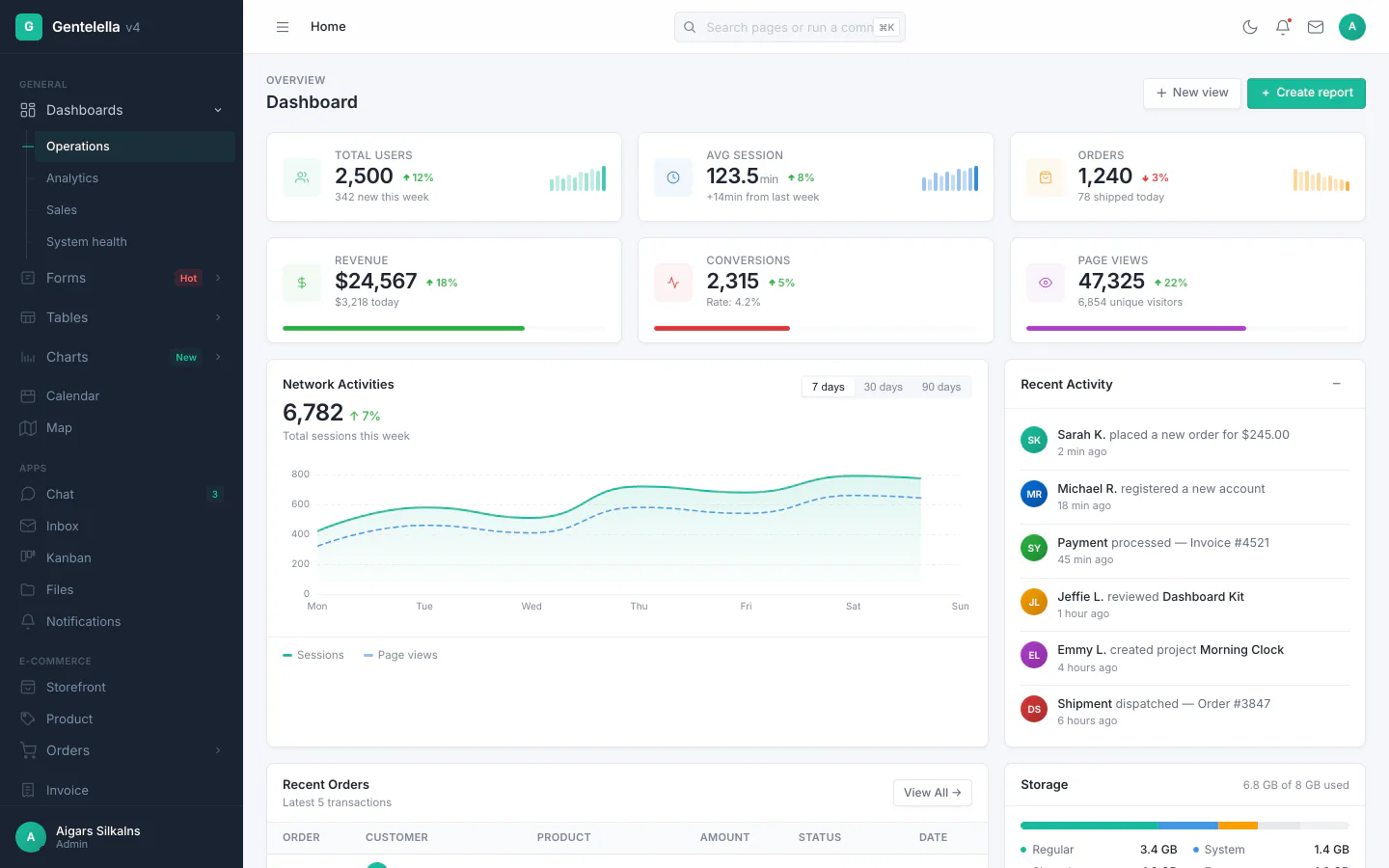
gentelella
Gentelella v4 is a free, open-source admin dashboard template maintained by Colorlib, built with vanilla JavaScript, SCSS, and Vite 8 without Bootstrap or jQuery.
HTML · Admin dashboard
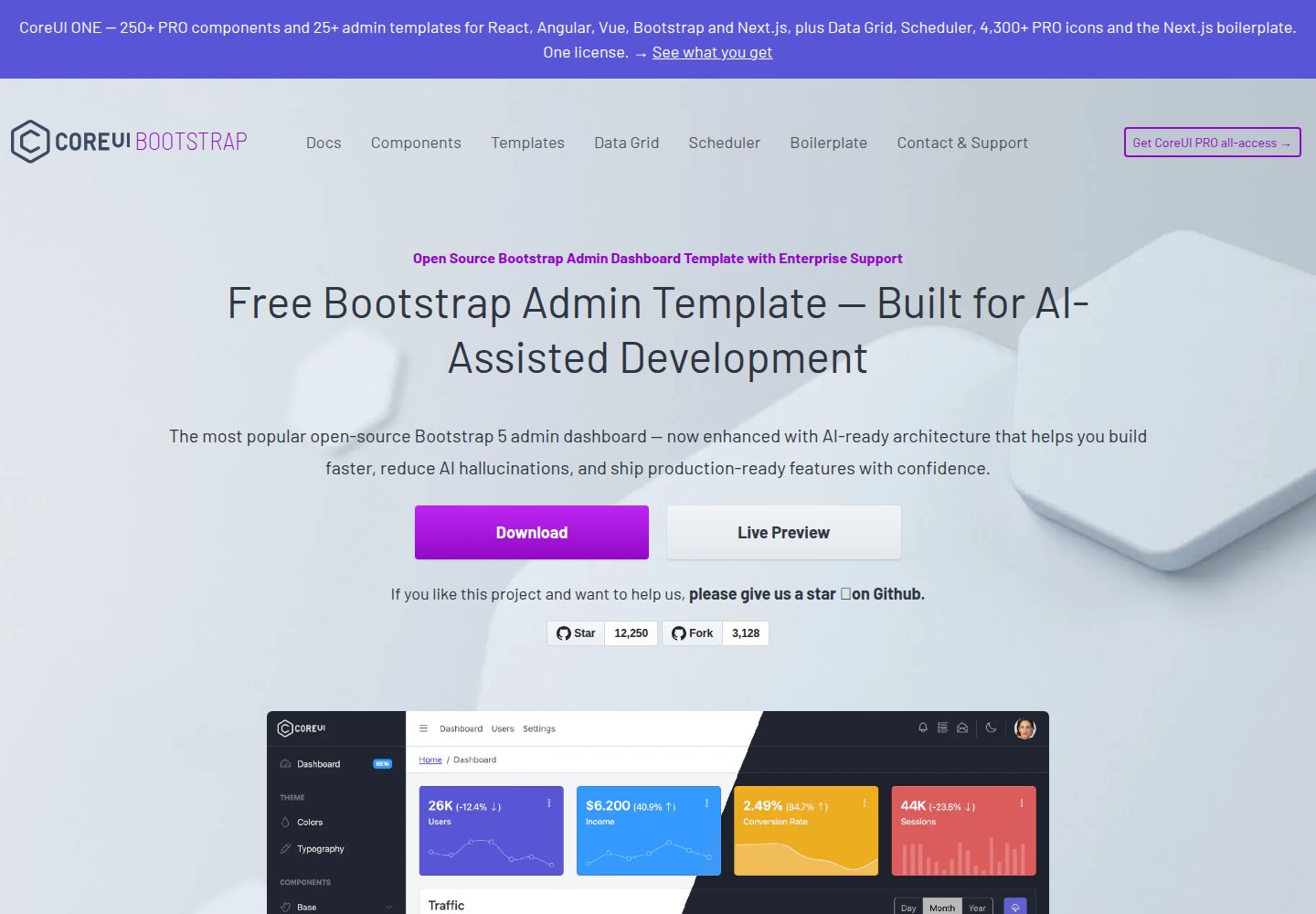
coreui-free-bootstrap-admin-template
A free Bootstrap admin template maintained by CoreUI, built on CoreUI's own UI component library. It provides compiled HTML pages and Pug template source code, covering dashboards, authentication, forms, components, icons, and error pages.
HTML · Admin dashboard
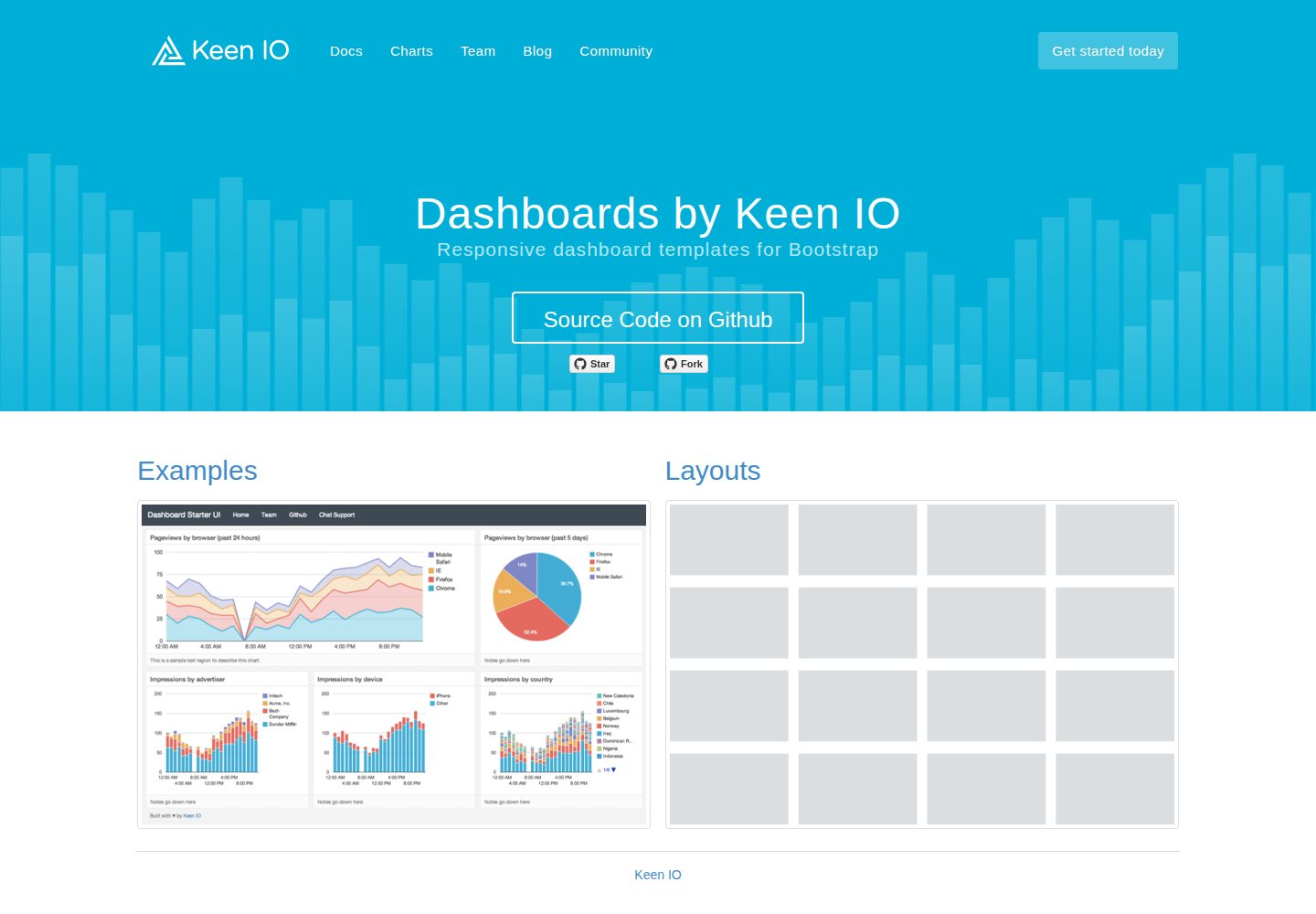
dashboards
A collection of responsive dashboard HTML templates open-sourced by Keen IO, built on CSS Grid, offering multiple prebuilt admin data interface layouts.
HTML · Admin dashboard
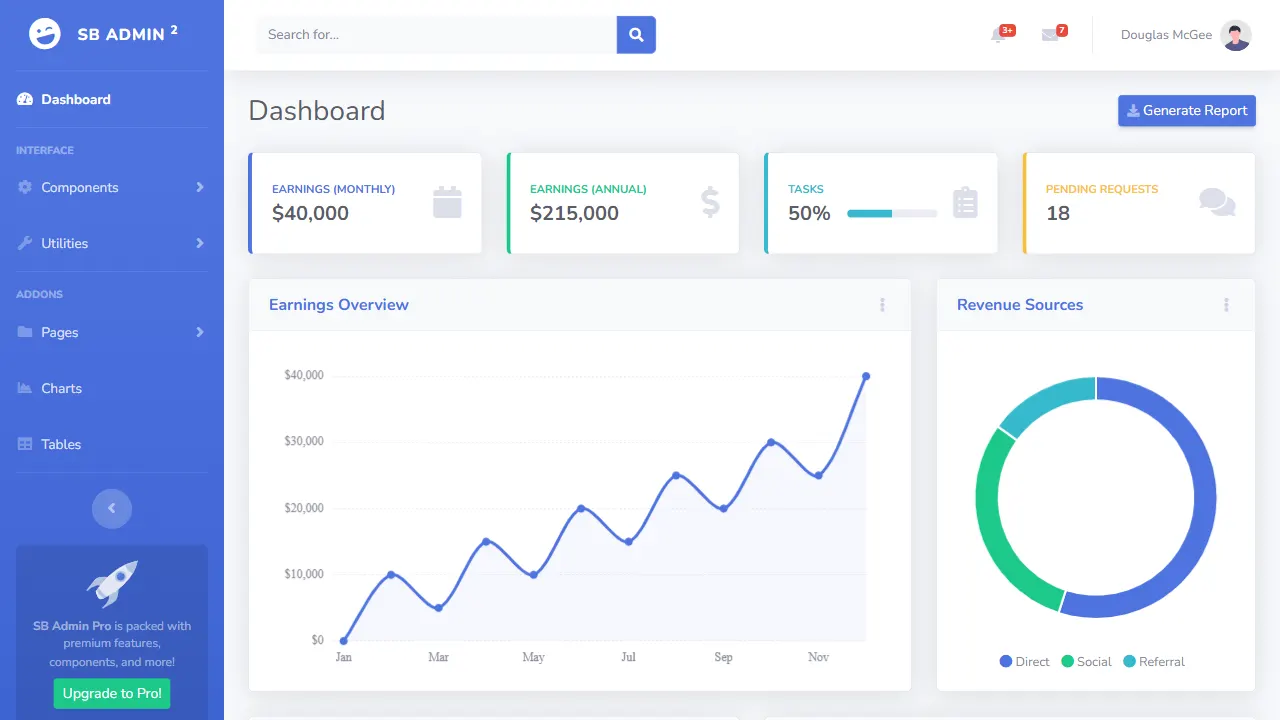
SB Admin 2
SB Admin 2 is a classic Bootstrap admin template from Start Bootstrap, offering dashboards, charts, tables, and common management pages.
HTML · Admin dashboard
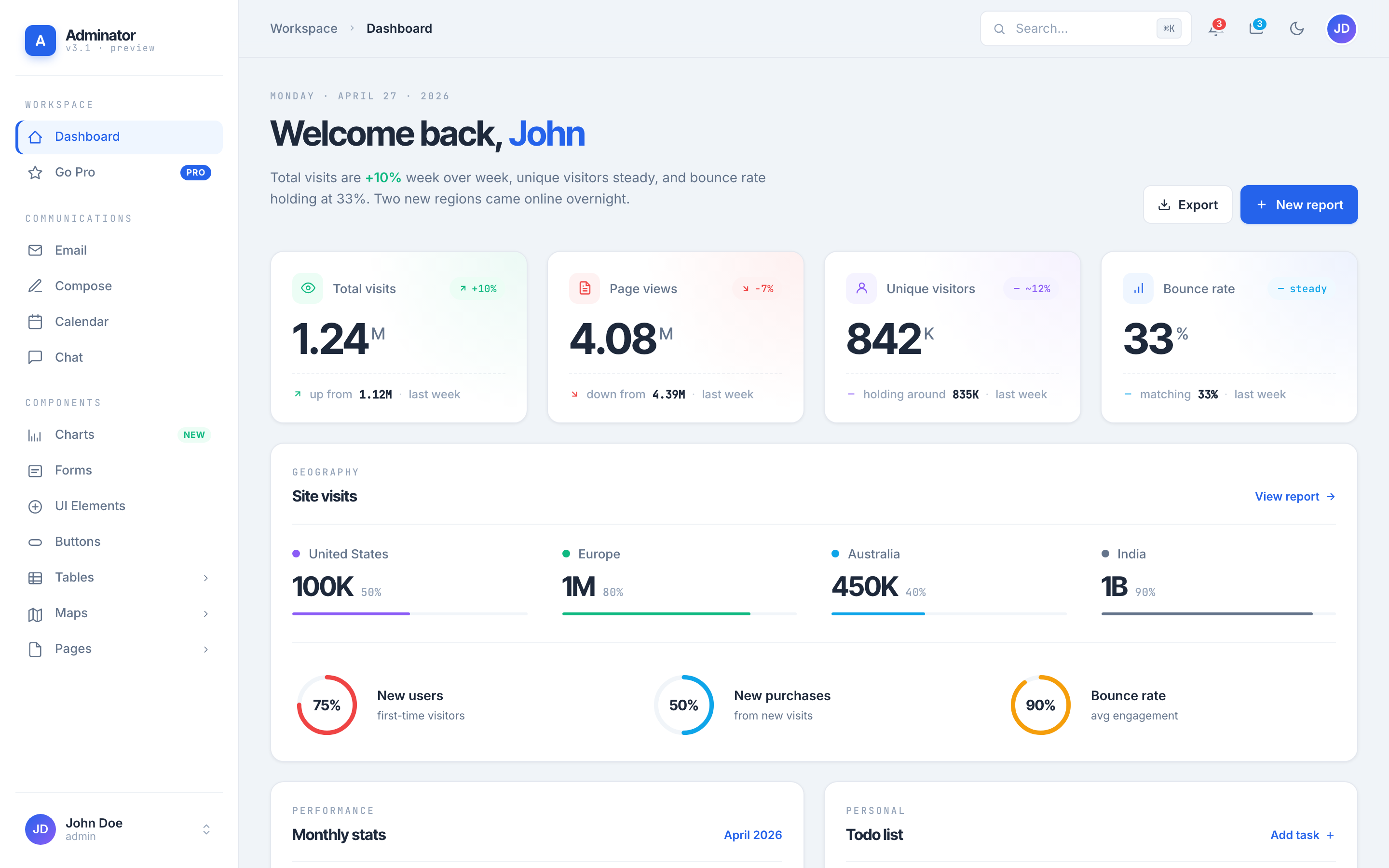
Adminator-admin-dashboard
Adminator 4 is a vanilla HTML, CSS and JavaScript admin dashboard template with a CSS-variable token design system, built-in light and dark themes, no jQuery or Bootstrap dependency, and 18 pages covering dashboards, mail, calendar, charts, forms, tables and error pages.
HTML · Admin dashboard
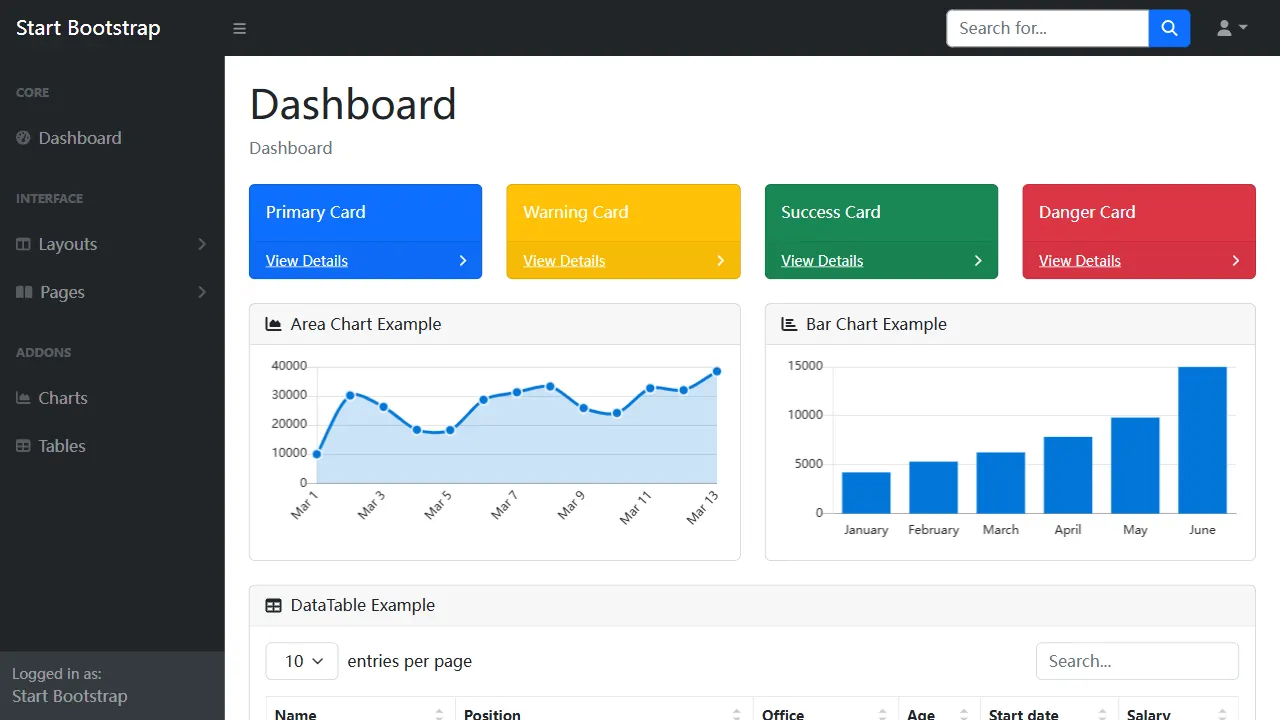
SB Admin
SB Admin is a lightweight, open-source Bootstrap admin template from Start Bootstrap. It offers a sidebar-and-top-bar layout with data tables, forms, and stat cards, plus responsive design.
HTML · Admin dashboard