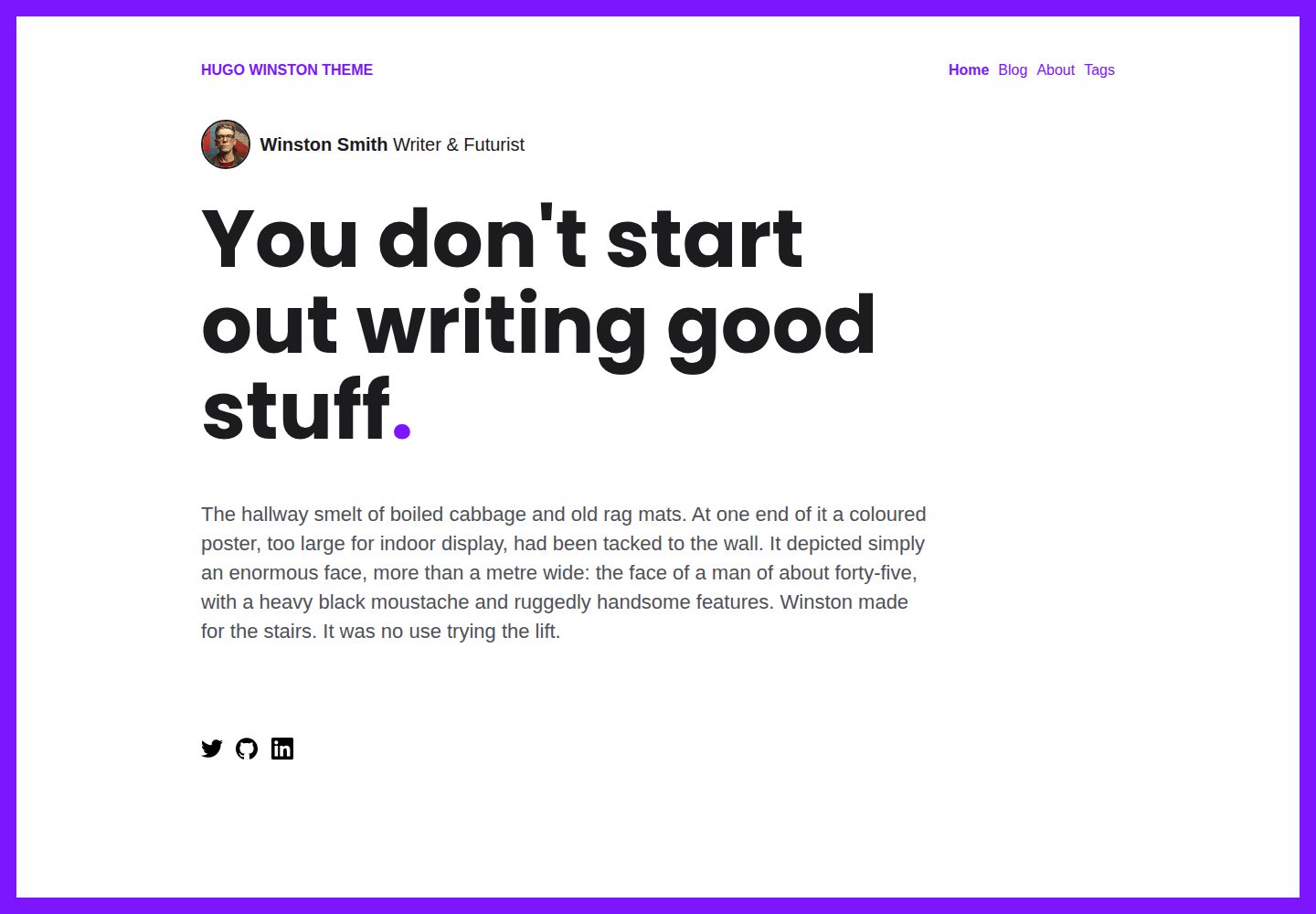
A minimal blog theme for Hugo, with content primarily as Markdown posts and basic pages
HugoBlog
hugo-winston-theme — Hugo Blog Template
By zerostaticthemes
Hugo Winston is a minimal blog theme for Hugo that emphasizes bold typography and a restrained visual style, supporting Markdown posts and basic pages.
Explore the design
Compare the page layouts and mobile experience. Open any screenshot for a closer look.
Desktop homepage1 / 3
Desktop captureTop of page
Actual screenshot captured by the server browser.
All pages & views 3
Screenshots show visual appearance; interactive behavior may differ.
Recorded 2026-09-30View source
What stands out
A quick read of the recorded project description.
Compiles SCSS via Hugo Pipes, requiring the Hugo Extended version
config.toml provides parameters for homepage display, post count and sorting, colors, and fonts
Supports Google Analytics (including the HUGO_GOOGLE_ANALYTICS_ID environment variable) and Plausible Analytics
Automatically generates page titles, meta descriptions, meta tags, and Facebook/Twitter OG metadata
The repository includes exampleSite sample content and Netlify deployment configuration
Template Details
Hugo Winston is a free and open-source Hugo blog theme published by Zerostatic under the MIT license. Positioned as a minimal yet visually bold blog site, content is written in Markdown and includes two content types: Posts and Basic Page. Styles are compiled from SCSS via Hugo Pipes, so the Hugo Extended version is required; otherwise the build will fail.
The theme provides detailed display and color parameters in config.toml, including whether to show the author on the homepage, the intro content and post list, whether homepage posts are paginated, the maximum number of posts when not paginated, post sort direction, and color items such as highlight color, base color, heading color, body text color, and dot color. For fonts, Google Fonts can be enabled and heading, body, and monospace fonts specified separately. The homepage also offers decorative toggles such as addDot and addFrame.
For analytics, the theme supports entering a Google Analytics ID in config.toml or configuring it via the HUGO_GOOGLE_ANALYTICS_ID environment variable, making it easy to inject on platforms like Netlify. It also supports Plausible Analytics, enabled by filling in the data-domain. Each page automatically generates a title, meta description, and meta tags, and outputs OG metadata for Facebook and Twitter, with semantic HTML used for the document structure.
The repository includes exampleSite sample content and netlify.toml; the example site deploys to Netlify with exampleSite as the publish directory. If you install the theme into a new site and copy or delete exampleSite, you should delete that netlify.toml. The perfect Lighthouse scores listed in the README are the author's own claims and were not independently verified in this material.
HugoBlog
Is it right for your project?
Use Cases
- Building a minimal blog with Hugo centered on post lists and post detail pages
- Blog sites that need to adjust visual style via colors, fonts, and homepage module toggles
- Static sites deployed to Netlify that want to build directly from exampleSite
- Blogs that need automatically generated SEO meta and social sharing OG information
Suitable For
- Developers who use Hugo and are familiar with config.toml configuration
- Bloggers who prefer a minimal, bold typography style
- Teams that need a blog theme under the MIT license that can be freely modified and distributed
- Users planning to host a static blog on Netlify
Getting started & customization
Use these recorded setup notes alongside the repository instructions for your chosen version.
- 1
Install Hugo first, and it must be the Extended version (with SCSS compilation capability); confirm with hugo version
- 2
Clone the theme into the site's themes directory, for example themes/hugo-winston-theme
- 3
Copy the contents of the theme's exampleSite to the site root, then run hugo or hugo server for local preview
- 4
You can develop the theme directly from the exampleSite directory with hugo server --source=exampleSite --theme=../..
- 5
If you have installed the theme into a new site and copied or deleted exampleSite, you should delete the repository's bundled netlify.toml
License & source material
Usage conditions & limitations
Free to use · keep license noticeThis entry covers the free version under the MIT license in the public repository; the free scope is the code of that version and does not mean external services or third-party assets are free.
Must comply with when using
- You are allowed to freely use, modify, commercialize, and distribute the code of this version.
- When distributing copies or substantial portions of the code, retain the original author's copyright notice and the full MIT license notice.
- The code is provided as is; warranties and limitations of liability are governed by the original license and applicable law.
Additional costs & items to verify
- Must be built with the Hugo Extended version; standard Hugo cannot compile SCSS and the theme will not work properly.
- Enabling Google Analytics requires you to provide your own GA tracking ID; it is a third-party external service, and you bear the related account and compliance costs.
- Enabling Plausible Analytics requires you to provide your own domain and connect to that third-party analytics service, which may involve external service fees.
- If you install the theme into a new site and copy or delete exampleSite, you must manually delete the repository's bundled netlify.toml; otherwise the deployment configuration may point to the wrong directory.
- Demo images, fonts, icons, and other third-party assets must be checked against their respective licenses; the code's MIT license alone is not sufficient to determine this.
- External services such as domains, hosting, databases, payments, or AI may incur additional charges.
View Original Text Basis
Permission is hereby granted, free of charge
Original License Text
**Hugo Extended** is required!
Original README
Add your google analytics ID to the `config.toml`
Original README
Add your plausible analytics domain to the `config.toml`.
Original README
https://github.com/zerostaticthemes/hugo-winston-theme/blob/master/LICENSEhttps://github.com/zerostaticthemes/hugo-winston-theme/blob/master/README.mdyou should delete the `netlify.toml` file.
Original README
Compiled by DeepSeek based on repository license and README ·2026-10-01. Results only cover the materials read; dependencies, images, fonts, and subsequent term changes are subject to their respective original texts.
Project checks & description sources
Template Information
- Source platforms
- GitHub
- Documentation and maintenance reference score
- More documented · 76 / 100
- Technologies
- Hugo
- Website type
- Blog
How this score is calculated
Our heuristic uses license records (up to 30), a demo link (12), a preview (10), stars (15), recorded maintenance (15), description completeness (8), feature records (5) and classification data (5). It is not a code, security or performance test, or a Google score. A link does not establish tested functionality.
What to verify for this project
- Repository update recorded
- 2024-02-29
- Screenshot last checked
- 2026-10-01
A demo link is listed. Check it with your own content and viewport sizes; its presence does not confirm that forms, authentication or payments work.
The catalog identifies Hugo as the primary stack. Check the actual dependency manifest and lockfile for versions and hosting requirements. These notes use recorded metadata, not a code audit or a deployment test.
Use a selection guide →How this description was prepared
AI-assisted description based on catalog records and repository material. Repository authors are not automatically the reviewers of this description.
Automatically checked against source and license rules; no manual editorial review.
Inspect the recorded source material
SHA-256: ac2b2bf423b25b3d174f23696f3b9340d24dd48733df0f2ffe72fda1a932b5af
2026-10-01T15:13:29.916Z
Source file / repository# Hugo Winston Theme Hugo Winston is a bold minimal blogging theme. [Live Demo](https://hugo-winston.netlify.app/) | [Zerostatic Themes](https://www.zerostatic.io/)  ## Theme features - Posts (Markdown) - Basic Page (Markdown) - SCSS (Hugo Pipelines) - Responsive design - 100/100 Google Lighthouse speed score - 100/100 Google Lighthouse SEO score - 100/100 Google Lighthouse accessibility score - Google analytics configured in `config.toml` - Configure GID using env variable HUGO_GOOGLE_ANALYTICS_ID, compatible with Netlify. - Title, meta description and meta tags automatically generated for every page - OG Meta data for Facebook and Twitter - Semantic HTML document structure ## Installation **1. Install Hugo** To use this theme you will first need to have Hugo installed. Please follow the official [installation guide](https://gohugo.io/getting-started/installing/) > ⚠️ **Note:** Check your Hugo version - **Hugo Extended** is required! This theme uses [Hugo Pipes](https://gohugo.io/hugo-pipes/scss-sass/) to compile SCSS and minify assets which means if you are not using the Hugo extended version this theme will not work. To check your version of Hugo, run `hugo version`. Make sure you see **/extended** after the version number, for example _Hugo Static Site Generator v0.51/extended darwin/amd64 BuildDate: unknown_ You do not need to use version v0.51 specifically, it just needs to have the _/extended_ part. **2. Create a new Hugo site** This will create a fresh Hugo site in the folder `mynewsite`. ``` hugo new site mynewsite ``` **3. Install the theme** Download or git clone this theme into the sites themes folder `mynewsite/themes`. You should end up with the following folder structure `mynewsite/themes/hugo-winston-theme` ``` cd mynewsite git clone https://github.com/zerostaticthemes/hugo-winston-theme.git themes/hugo-winston-theme ``` **4. Copy the example content** Copy the entire contents of the `mynewsite/themes/hugo-winston-theme/exampleSite/` folder to root folder of your Hugo site, ie `mynewsite/`. To copy the files using terminal, make sure you are still in the projects root, ie the `mynewsite` folder. ``` cp -a themes/hugo-winston-theme/exampleSite/. . ``` **6. Run Hugo** After installing the theme for the first time, generate the Hugo site. You run this command from the root folder of your Hugo site ie `mynewsite` ``` hugo ``` For local development run Hugo's built-in local server. ``` hugo server ``` Now enter [`localhost:1313`](http://localhost:1313) in the address bar of your browser. # Localhost inside exampleSite You can run this site without installing it as a hugo theme using the following command. I use this for theme development. ``` hugo server --source=exampleSite --theme=../.. ``` # Configuration ### Config options ```toml # config.toml [params] google_analytics_id = "" twitter_handle = "@zerostaticio" showAuthorOnHomepage = true showAuthorOnPosts = false showIntroContentOnHomepage = true showPostsOnHomepage = true usePaginationOnHomepage = false limitPostsOnHomepage = 3 # only used if usePaginationOnHomepage is false sortPostsByDateOldestFirst = false addDot = true addFrame = true highlightColor = '#7b16ff' baseColor = "#ffffff" baseOffsetColor = "#eaeaea" headingColor = "#1c1b1d" textColor = "#4e5157" dotColor = "#7b16ff" enableGoogleFonts = true googleFontsUrl = "https://fonts.googleapis.com/css2?family=Poppins:wght@400;700&display=swap" fontFamilyHeading = "Poppins" fontFamilyParagraph = "Helvetica" fontFamilyMonospace = "monospace" ``` ### Google Analytics Add your google analytics ID to the `config.toml` ```toml # config.toml [params] google_analytics_id="UA-132398315-1" ``` ### Plausible Analytics Add your plausible analytics domain to the `config.toml`. This is `data-domain` in your [tracking script code](https://plausible.io/docs/plausible-script). ```toml # config.toml [params] plausible_analytics_domain = "example.com" ``` # Deploying to Netlify [](https://app.netlify.com/start/deploy?repository=https://github.com/zerostaticthemes/hugo-winston-theme) This theme includes a `netlify.toml` which is [configured to deploy to Netlify](https://discourse.gohugo.io/t/deploy-your-theme-to-netlify/15508) from the `exampleSite` folder. If you have installed this theme into a new Hugo site and the exampleSite folder was copied or removed, you should delete the `netlify.toml` file. ### More Hugo Themes by Zerostatic - [Hugo Hero](https://github.com/zerostaticthemes/hugo-hero-theme) - Open-source business theme - [Hugo Whisper](https://github.com/zerostaticthemes/hugo-whisper-theme) - Open-source documentation theme - [Hugo Serif](https://github.com/zerostaticthemes/hugo-serif-theme) - Open-source business theme - [Hugo Winston](https://github.com/zerostaticthemes/hugo-winston-theme) - Open-source blog theme - [Hugo Advance](https://www.zerostatic.io/theme/hugo-advance/) - Premium advanced multi page business & marketing theme - [Hugo Paradigm](https://www.zerostatic.io/theme/hugo-paradigm/) - Premium landing page + site builder theme - [Hugo Lever](https://www.zerostatic.io/theme/hugo-lever/) - Premium personal / bio theme - [Hugo Shard](https://www.zerostatic.io/theme/hugo-lever/) - Premium SAAS / landing page theme ### Find hundreds more Hugo themes on Built At Lightspeed [<img alt="Built At Lightspeed Hugo themes directory screenshot" width="400px" src="https://www.zerostatic.io/images/builtatlightspeed-hugo-themes.jpg" />](https://builtatlightspeed.com/category/hugo)
Explore similar templates
Compare previews and descriptions within the same stack and category.

hugo-PaperMod
A fast, clean, responsive Hugo theme for blogs and lightweight portfolios, with three layout modes (Regular, Home-Info, Profile), automatic and manual light/dark themes, Fuse.js client-side search, multilingual support, and built-in Open Graph, Twitter Cards, and Schema.org data.
Hugo · Portfolio

LoveIt
LoveIt is a clean, elegant, and feature-rich Hugo blog theme derived from LeaveIt and KeepIt, MIT-licensed. It offers light/dark modes, responsive layout, multilingual support, and search via Lunr.js or Algolia.
Hugo · Blog

hugo-coder
hugo-coder is a minimalist Hugo blog theme maintained by luizdepra under the MIT license. It provides a clean, text-focused blog appearance, configuration documentation in the docs directory, and a complete exampleSite with hugo.toml.
Hugo · Blog

blowfish
Blowfish is a Hugo personal website and blog theme built with Tailwind CSS 4, focused on lightness, simplicity, and content-first presentation.
Hugo · Blog

hugo-paper
hugo-paper is a simple, clean, and customizable Hugo blog theme configured through config.toml or hugo.toml.
Hugo · Blog

hextra
Hextra is a Hugo theme for documentation and blog sites, built on Hugo and Tailwind CSS with design referencing Nextra.
Hugo · Documentation