使用 Next.js App Router,默认采用 Server Components,并在合适场景使用 Server Actions
Next.jsReactSaaS启动器
nexus-orbit-saas-lite — Next.js SaaS模板
作者 ShuvaMallickPro
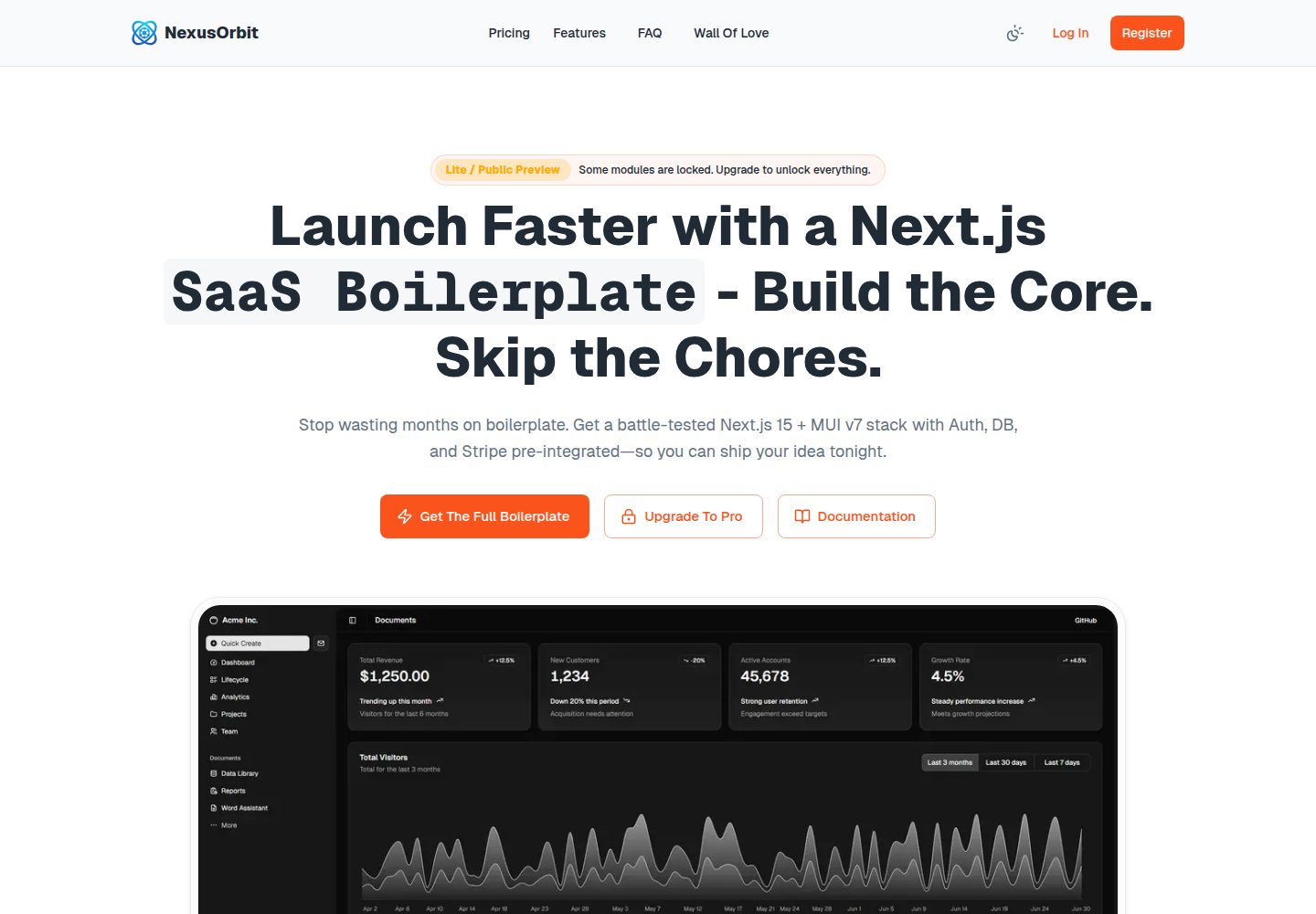
基于 Next.js App Router 与 MUI 的 SaaS 启动器 Lite 版,提供静态营销页面、模拟 UI 与升级入口,完整认证、数据库、支付与存储逻辑保留在 Pro 版本。
看看你的网站会是什么样
浏览真实页面截图,比较内容排版与手机效果。点击下方缩略图切换,放大查看整页细节。
全部页面与视图 2
截图用于了解视觉与布局,交互效果请以实际项目为准。
采集于 2026-10-03查看来源
值得关注的模板亮点
从已有项目资料中,快速了解它的特点。
UI 基于 MUI 与 Emotion,主题配置集中在 src/theme/
Lite 版本提供静态营销区块、模拟 UI 与升级 CTA,适合演示
升级按钮通过 NEXT_PUBLIC_YOUR_PAYMENT_URL 指向外部支付或销售页面
静态区块预览图放在 public/lite/,与 sections 组件路径对齐
采用 TypeScript、ESLint,并约定 src/app、src/actions、src/components、src/lib、src/theme 目录结构
模板详细介绍
NexusOrbit SaaS Lite 是 NexusOrbit 产品线的公开轻量版本,使用 Next.js App Router 与 MUI 构建,定位为面向客户的演示型营销站点。README 明确区分 Lite 与 Pro:Lite 提供静态或模拟的 UI、演示导向的流程与升级 CTA,不包含持久化产品数据路径;Pro 才提供完整的认证、Prisma 数据库、Stripe 支付、S3 存储与仪表盘等生产逻辑。
在 Lite 版本中,认证、数据库、S3 文件存储、Stripe 支付与部署均标注为 Mock / Static UI。升级或结账按钮通过环境变量 NEXT_PUBLIC_YOUR_PAYMENT_URL 指向外部支付或销售页面,代码回退值为 YOUR_PAYMENT_URL,相关配置位于 src/config.ts。静态区块预览图需放在 public/lite/ 下,并与 src/components/sections/*/index.tsx 中的路径对齐。
项目结构按 src/app、src/actions、src/components、src/lib、src/theme 组织,包含 Lite 预览组件目录 src/components/lite/。README 中关于 NextAuth 账户合并、S3 与 Prisma 同步删除、Stripe webhook 签名校验等描述均属于 Pro 版本的架构决策,Lite 仓库不包含这些生产逻辑。
Next.jsSaaS启动器
适合你的项目吗?
适用场景
- 向客户展示 SaaS 产品界面与营销页面结构
- 作为 Next.js + MUI 项目的前端起点,替换静态内容后用于演示
- 在接入真实认证、数据库、支付前,先验证页面布局与升级引导流程
- 需要将结账按钮指向外部支付或销售页面的轻量营销站点
适合人群
- 需要快速搭建 SaaS 营销演示页面的开发者
- 希望以 Next.js 与 MUI 为基础进行二次开发的团队
- 评估 NexusOrbit Pro 完整功能前,先查看 Lite 演示的潜在用户
- 只需要静态或模拟 UI、暂不接入后端服务的项目
上手与定制指南
结合仓库当前版本的说明,按下面的资料检查内容、配置与运行要求。
- 1
需要 Node.js 20+,使用 npm install 安装依赖,npm run dev 启动开发服务器
- 2
在 .env 中设置 NEXT_PUBLIC_YOUR_PAYMENT_URL 以指定升级或结账链接
- 3
静态区块预览图需放入 public/lite/,并与 src/components/sections/*/index.tsx 中的路径保持一致
- 4
Lite 版本不包含认证、数据库、Stripe 与 S3 的生产逻辑,相关环境变量仅在 Pro 工作流中使用
- 5
若修改 Prisma schema,需要运行 npx prisma generate;Lite 版本本身不提供持久化数据路径
授权与来源资料
使用条件与限制
免费使用 · 保留许可声明本次收录的是公开仓库中采用 MIT 许可的免费版本;免费范围为该版本代码,不代表外部服务或第三方素材免费。
使用时需要遵守
- 允许免费使用、修改、商用和分发该版本代码。
- 分发代码副本或实质性部分时,保留原作者版权声明和完整 MIT 许可声明。
- 代码按现状提供;担保与责任限制以原许可证及适用法律为准。
额外费用与待核对事项
- 免费 Lite 版仅提供演示、静态营销区块与升级 CTA;认证、Prisma 数据库、Stripe 支付、S3 存储、仪表盘及生产工作流均属付费 Pro 版,免费版不含这些功能。
- Lite 版支付为模拟/静态 UI,结账按钮仅跳转到外部支付 URL,不含真实计费逻辑;真实 Stripe 集成需 Pro 版。
- 使用前需在 .env 中配置 NEXT_PUBLIC_YOUR_PAYMENT_URL 指向外部支付或销售页面,否则回退为占位值 YOUR_PAYMENT_URL。
- 静态区块预览图需自行放入 public/lite/ 并手动对齐 sections 组件中的路径,仓库未附带这些图片资源。
- Lite 版无持久化产品数据路径,数据库集成为模拟/静态 UI;真实 Prisma 数据库需 Pro 版。
- Lite 版 S3 文件存储为模拟/静态 UI,不含真实上传与存储逻辑;该功能需 Pro 版。
- 项目资料提及可选付费版本或功能;本次仅收录公开免费代码,不包含付费升级。
- 演示图片、字体、图标及其他第三方素材需按各自许可核对,不能仅凭代码的 MIT 许可判断。
- 域名、托管、数据库、支付或 AI 等外部服务可能另外收费。
查看原文依据
Permission is hereby granted, free of charge
许可证原文
**Lite:** demos, static marketing blocks, and upgrade CTAs. **Pro:** full SaaS stack—auth, Prisma, Stripe, S3, dashboards, and production workflows.
README 原文
**Stripe payments** | Mock / Static UI (checkout CTAs routed to your payment URL; no live billing coupling on the lite path)
README 原文
**Upgrade / checkout URL:** set `NEXT_PUBLIC_YOUR_PAYMENT_URL` in `.env` (fallback in code: `YOUR_PAYMENT_URL`).
README 原文
**Static section previews:** place screenshots under `public/lite/` (e.g. feature / value-prop / wall-of-love assets) and align paths in `src/components/sections/*/index.tsx` with your filenames.
README 原文
**Database integration** | Mock / Static UI (no persistent product data path on the lite surface)
README 原文
https://github.com/ShuvaMallickPro/nexus-orbit-saas-lite/blob/main/LICENSEhttps://github.com/ShuvaMallickPro/nexus-orbit-saas-lite/blob/main/README.md**S3 file storage** | Mock / Static UI
README 原文
DeepSeek 根据仓库许可证和 README 整理 ·2026-10-03。结果仅覆盖已读取资料,依赖、图片、字体及后续条款变更以各自原文为准。
项目核对记录与介绍依据
模板资料
- 来源平台
- GitHub
- 资料与维护参考分
- 资料较完整 · 85 / 100
- 技术栈
- Next.js · React
- 网站类型
- SaaS · 启动器
这个分数如何计算
本站按许可资料(最高30分)、演示链接(12分)、预览图(10分)、Star数(15分)、记录的维护时间(15分)、描述完整度(8分)、功能记录(5分)和分类资料(5分)计算。它不是代码、安全或性能测试,也不是 Google 评分;有链接不代表已实测可用。
这个项目需要核对什么
- 记录的仓库更新时间
- 2026-05-09
- 截图检查日期
- 2026-10-03
已收录演示链接。请用你的内容与屏幕尺寸检查;有演示不代表表单、认证或支付已经可用。
目录记录的主要技术栈是 Next.js。请通过依赖清单和锁文件核对实际版本与托管要求。这些说明基于收录资料,不代表代码审计或部署实测。
查看具体选型方法 →介绍的制作与核对状态
介绍由 AI 辅助整理目录与仓库资料。仓库作者不等于这篇介绍的审核者。
已完成服务器许可规则与 AI 来源核对;未经过人工编辑审核。
查看当时使用的来源资料
SHA-256: fa2daa562d3cd5d0ab008748a0948b0fecb830352b6e9035862dafe74cb79071
2026-10-03T02:58:48.795Z
来源文件 / 仓库# NexusOrbit SaaS Lite (Next.js) **NexusOrbit-Lite** is the public, conversion-focused surface of the NexusOrbit product line: a **Next.js App Router** + **React 19** + **MUI v7** shell that mirrors the Pro marketing experience while isolating premium logic behind a clean upgrade path. This repository is engineered to signal **discipline, depth, and delivery**—the same architectural standards that power the full boilerplate. ## Links ### Lite version (this repository) - **Lite version live URL:** [https://nexus-orbit-saas-lite.vercel.app/](https://nexus-orbit-saas-lite.vercel.app/) - **Lite version GitHub repository:** [https://github.com/ShuvaMallickPro/nexus-orbit-saas-lite](https://github.com/ShuvaMallickPro/nexus-orbit-saas-lite) ### Pro product (full boilerplate) - **Live (Pro):** [https://www.nextsaaspilot.com/](https://www.nextsaaspilot.com/) > **Lite:** demos, static marketing blocks, and upgrade CTAs. **Pro:** full SaaS stack—auth, Prisma, Stripe, S3, dashboards, and production workflows. --- ## 1. Comprehensive feature comparison (Pro vs. Lite) | Feature | Lite Version | Pro Version | | ------------------------ | ------------------------------------------------------------------------------------------------------ | ----------------------------------------------------------------------------------------------------- | | **UI Design** | Mock / Static UI (preview imagery, glass overlays, marketing-safe blocks) | Production ready / Full logic (dynamic sections, interactive data surfaces, full component depth) | | **Authentication** | Mock / Static UI (demo-oriented flows where applicable) | Production ready / Full logic (NextAuth, credentials + OAuth, hardened session strategy) | | **Database integration** | Mock / Static UI (no persistent product data path on the lite surface) | Production ready / Full logic (Prisma, migrations, type-safe access patterns) | | **S3 file storage** | Mock / Static UI | Production ready / Full logic (private buckets, presigned URLs, lifecycle-aware object handling) | | **Stripe payments** | Mock / Static UI (checkout CTAs routed to your payment URL; no live billing coupling on the lite path) | Production ready / Full logic (checkout sessions, customer portal, subscription lifecycle) | | **Deployment** | Mock / Static UI (static-friendly marketing build; minimal moving parts) | Production ready / Full logic (environment matrix, secrets, webhooks, observability-ready deployment) | ### Lite-specific configuration - **Upgrade / checkout URL:** set `NEXT_PUBLIC_YOUR_PAYMENT_URL` in `.env` (fallback in code: `YOUR_PAYMENT_URL`). Hero and pricing CTAs use this value—see `src/config.ts` (`YOUR_PAYMENT_URL`, `appConfig.salesLink`). - **Static section previews:** place screenshots under `public/lite/` (e.g. feature / value-prop / wall-of-love assets) and align paths in `src/components/sections/*/index.tsx` with your filenames. --- ## Highlights - **Modern Next.js stack**: App Router, Server Components by default, Server Actions where appropriate - **UI system**: MUI v7 + Emotion, with a consistent theme layer (`src/theme/`) - **Auth (Pro path)**: NextAuth (JWT session strategy), credentials + OAuth providers - **Database (Pro path)**: Prisma ORM (type-safe queries and schema-driven migrations) - **Forms**: React Hook Form + Zod validation - **Uploads (Pro path)**: AWS S3 storage support (recommended: private bucket + presigned URLs) - **DX**: TypeScript, ESLint, strong folder conventions ## Tech stack - **Framework**: Next.js 16+ - **UI**: Material UI (MUI) v7, Emotion - **Auth**: NextAuth - **DB**: Prisma - **Validation**: Zod - **Forms**: React Hook Form - **Payments**: Stripe ## Project structure Key folders (under `src/`): - **`src/app/`** — App Router routes, layouts, and route handlers - **`src/actions/`** — Server Actions (`"use server"`) for mutation workflows - **`src/components/`** — UI components and feature modules (including `src/components/lite/` for Lite previews) - **`src/lib/`** — Shared logic (auth helpers, Prisma client, S3 helpers, utilities) - **`src/theme/`** — Theme configuration and MUI customization --- ## 2. Architectural challenges & decisions The items below are framed as **engineering achievements**—decisions made under real constraints, expressed using the **STAR** method (**Situation**, **Task**, **Action**, **Result**). ### A) Advanced MUI engineering - **Situation:** The Pro product required dense marketing surfaces—an **advanced bento grid**, asymmetric card spans, and **multi-theme hover logic**—without fragmenting the design system or breaking readability across alternating sections. - **Task:** Preserve **visual hierarchy** when backgrounds and elevation shift between light-forward and dark-forward regions, while keeping hover/focus behavior predictable for accessibility and brand consistency. - **Action:** Standardized layout primitives on **MUI theme tokens** (`palette`, `alpha`, spacing, typography ramps) and `styled()` boundaries so elevation, borders, and hover transitions resolve from the theme—not ad hoc hex values. Complex grids were composed from repeatable card contracts rather than one-off CSS overrides. - **Result:** A **single source of truth** for contrast and motion: components read intent from the theme, marketing sections stay coherent across modes, and future palette adjustments propagate without surgical rewrites. ### B) Security & data integrity (NextAuth edge cases) - **Situation:** OAuth (Google) sign-in and manual (email/password) registration can produce **duplicate identity rows** if linking rules are naive—especially when the same human returns through a different front door. - **Task:** Guarantee **one canonical user row** per identity while preserving auditability and preventing credential confusion when a Google-first user later attempts manual registration. - **Action:** Implemented an account **merge/linking policy** that reconciles OAuth identities with existing records using verified email as the stable join key, plus a **passwordless guard** that blocks contradictory manual registration paths for Google-authenticated identities. Session callbacks were tightened to **cache stable session fields** and avoid redundant database round-trips on hot paths. - **Result:** Fewer integrity incidents, cleaner auth graphs, and a session layer that stays **fast without being sloppy**—security rules remain explicit, not accidental. ### C) Synchronous infrastructure (S3 & Prisma) - **Situation:** File metadata can disappear from the database while objects remain in object storage—an **architectural hurdle** that creates **dangling storage** and silent cost leakage over time. - **Task:** Make deletion semantics **economically honest**: when a file record is removed, the object store must not drift into orphaned assets. - **Action:** Designed **cloud–DB sync** semantics where authoritative deletion in Prisma triggers a **synchronous cleanup** in S3 (with explicit error handling and idempotent guards where appropriate), so storage state tracks application truth. - **Result:** A storage posture aligned with production finance: fewer surprises in billing, fewer “ghost assets,” and a clearer operational story for support and compliance reviews. ### D) Payment pipeline & webhook reliability - **Situation:** Stripe integrations often fail in subtle ways—signature mismatches, replay issues, and “works on my machine” webhook behavior when local environments can’t observe real events. - **Task:** Build a **webhook listener** that is deterministic under retries, safe under partial failures, and trustworthy during local iteration. - **Action:** Implemented a robust listener with **signature verification** as a non-negotiable gate, structured event handling, and **Stripe CLI**-driven local forwarding so developers observe **real-time event synchronization** against the same verification rules used in production. - **Result:** An integration posture that converts a common integration hurdle into a **stable payment bridge**: fewer false positives, faster debugging, and a deployment story that scales from laptop to production without rewriting assumptions. --- ## 3. Closing statement These challenges sharpened the same muscle that defines serious SaaS work: **turn ambiguous requirements into explicit contracts**, **treat auth and billing as systems—not features**, and **optimize for operational truth** (storage, sessions, and payments) rather than demo aesthetics alone. NexusOrbit-Lite exists to showcase that mindset in public—**tight UI engineering**, **defensive identity modeling**, **storage integrity**, and **payment plumbing you can trust**—while Pro delivers the full execution stack for teams who ship under real constraints. --- ## Getting started ### Prerequisites - Node.js **20+** (recommended) - npm / pnpm / yarn (examples below use **npm**) ### Install ```bash npm install ``` ### Environment variables Create a `.env` file in the project root. Typical keys include: **Lite / marketing** - `NEXT_PUBLIC_YOUR_PAYMENT_URL` — checkout or sales page for upgrade CTAs - `NEXT_PUBLIC_SALES_LINK` — optional; aligns with sales/upgrade messaging in `appConfig` - `NEXT_PUBLIC_APP_URL` / `AUTH_URL` — app base URL where applicable **Auth** - `NEXTAUTH_SECRET` - `NEXTAUTH_URL` - `GOOGLE_CLIENT_ID`, `GOOGLE_CLIENT_SECRET` (optional) **Database (Prisma) — Pro workflows** - `DATABASE_URL` **Stripe (optional / Pro)** - `STRIPE_SECRET_KEY` - `STRIPE_WEBHOOK_SECRET` **AWS S3 (optional / Pro uploads)** - `AWS_ACCESS_KEY_ID` - `AWS_SECRET_ACCESS_KEY` - `AWS_REGION` - `AWS_S3_BUCKET_NAME` > If you change the Prisma schema, run `npx prisma generate`. ### Run dev server ```bash npm run dev ``` Open [http://localhost:3000](http://localhost:3000). --- ## Common workflows ### Lint ```bash npm run lint ``` ### Build & start ```bash npm run build npm run start ``` --- ## Uploads (S3) — recommended approach (Pro) This project supports storing user-uploaded files in S3. - **Recommended:** keep the S3 bucket **private** and display assets using **presigned GET URLs**. - **Avoid:** making user uploads public unless you fully understand the data exposure trade-off. --- ## Deployment You can deploy on any platform that supports Node + Next.js. For Vercel, see the [Next.js deployment docs](https://nextjs.org/docs/app/building-your-application/deploying). --- ## Contributing Issues and PRs are welcome. Please include: - a short problem statement - screenshots (for UI changes) - steps to reproduce (for bugs) --- ## License See the repository license file (if provided).
看看同类模板
对比同技术栈与用途的模板,找到更适合的视觉与内容结构。

ai-website-cloner-template
Clone any website with one command using AI coding agents
Next.js · 启动器

Next.js SaaS Starter
Next.js SaaS Starter 是 Next.js 官方维护的 SaaS 起点模板,定位介于学习资源和可直接部署的脚手架之间。
Next.js · SaaS

Next.js Commerce
Next.js Commerce 是 Vercel 团队维护的电商启动模板,基于 Next.js App Router 构建,采用服务端渲染、React Server Components、Server Actions …
Next.js · 电商

Next-js-Boilerplate
Next-js-Boilerplate 是一个面向 Next.js 16、Tailwind CSS 4 和 TypeScript 的启动器,核心定位是开发者体验优先。
Next.js · 启动器

tailwind-nextjs-starter-blog
tailwind-nextjs-starter-blog 是一个面向个人技术博客的 Next.js 与 Tailwind CSS 启动模板,其 v2 版本基于 App Router 与 React Server Comp…
Next.js · 博客

next-forge
Production-grade Turborepo template for Next.js apps.
Next.js · 启动器