Uses Next.js App Router, defaults to Server Components, and uses Server Actions where appropriate
Next.jsReactSaaSStarter
nexus-orbit-saas-lite — Next.js SaaS Template
By ShuvaMallickPro
A Lite SaaS starter built on Next.js App Router and MUI, offering static marketing pages, mock UI, and an upgrade entry point. Full authentication, database, payment, and storage logic remain in the Pro version.
Explore the design
Compare the page layouts and mobile experience. Open any screenshot for a closer look.
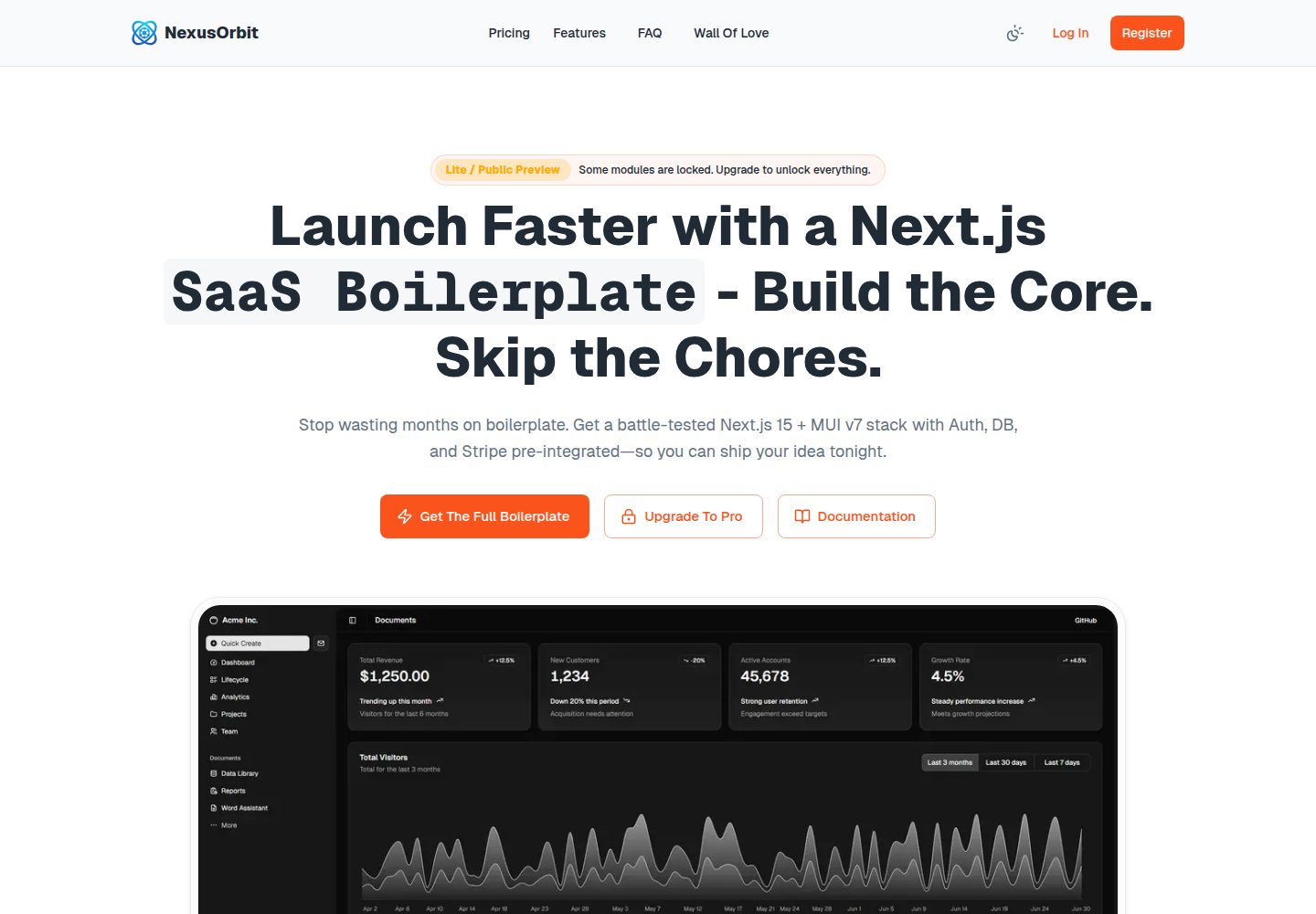
Desktop homepage1 / 2
Desktop captureTop of page
Actual screenshot captured by the server browser.
All pages & views 2
Screenshots show visual appearance; interactive behavior may differ.
Recorded 2026-10-03View source
What stands out
A quick read of the recorded project description.
UI is based on MUI and Emotion, with theme configuration centralized in src/theme/
The Lite version provides static marketing sections, mock UI, and upgrade CTAs, suitable for demos
The upgrade button points to an external payment or sales page via NEXT_PUBLIC_YOUR_PAYMENT_URL
Static section preview images are placed in public/lite/ and aligned with the sections component paths
Uses TypeScript, ESLint, and a conventional directory structure of src/app, src/actions, src/components, src/lib, and src/theme
Template Details
NexusOrbit SaaS Lite is the public lightweight version of the NexusOrbit product line, built with Next.js App Router and MUI, positioned as a client-facing demo marketing site. The README clearly distinguishes Lite from Pro: Lite provides static or mock UI, demo-oriented flows, and upgrade CTAs, and does not include a persistent product data path; only Pro provides full production logic such as authentication, Prisma database, Stripe payments, S3 storage, and dashboards.
In the Lite version, authentication, database, S3 file storage, Stripe payments, and deployment are all labeled as Mock / Static UI. Upgrade or checkout buttons point to an external payment or sales page via the environment variable NEXT_PUBLIC_YOUR_PAYMENT_URL, with a code fallback value of YOUR_PAYMENT_URL, and the relevant configuration is located in src/config.ts. Static section preview images must be placed under public/lite/ and aligned with the paths in src/components/sections/*/index.tsx.
The project structure is organized by src/app, src/actions, src/components, src/lib, and src/theme, and includes a Lite preview component directory at src/components/lite/. Descriptions in the README regarding NextAuth account merging, S3 and Prisma synchronized deletion, and Stripe webhook signature verification are all architectural decisions of the Pro version; the Lite repository does not include these production logic components.
Next.jsSaaSStarter
Is it right for your project?
Use Cases
- Showcasing SaaS product interfaces and marketing page structure to clients
- Serving as a front-end starting point for a Next.js + MUI project, to be used for demos after replacing static content
- Validating page layout and upgrade guidance flow before integrating real authentication, database, and payments
- Lightweight marketing sites that need to point checkout buttons to an external payment or sales page
Suitable For
- Developers who need to quickly build SaaS marketing demo pages
- Teams that want to do secondary development based on Next.js and MUI
- Potential users who want to view the Lite demo before evaluating the full NexusOrbit Pro features
- Projects that only need static or mock UI and do not yet integrate backend services
Getting started & customization
Use these recorded setup notes alongside the repository instructions for your chosen version.
- 1
Requires Node.js 20+, install dependencies with npm install, and start the development server with npm run dev
- 2
Set NEXT_PUBLIC_YOUR_PAYMENT_URL in .env to specify the upgrade or checkout link
- 3
Static section preview images must be placed in public/lite/ and kept consistent with the paths in src/components/sections/*/index.tsx
- 4
The Lite version does not include production logic for authentication, database, Stripe, or S3; the related environment variables are only used in the Pro workflow
- 5
If you modify the Prisma schema, you need to run npx prisma generate; the Lite version itself does not provide a persistent data path
License & source material
Usage conditions & limitations
Free to use · keep license noticeThis entry covers the free version under the MIT license in the public repository; the free scope is the code of this version and does not mean external services or third-party assets are free.
Must comply with when using
- You are allowed to use, modify, commercialize, and distribute the code of this version for free.
- When distributing copies or substantial portions of the code, retain the original author's copyright notice and the full MIT license notice.
- The code is provided as is; warranties and limitations of liability are governed by the original license and applicable law.
Additional costs & items to verify
- The free Lite version only provides demos, static marketing sections, and upgrade CTAs; authentication, Prisma database, Stripe payments, S3 storage, dashboards, and production workflows are all part of the paid Pro version and are not included in the free version.
- Payments in the Lite version are mock/static UI; the checkout button only redirects to an external payment URL and does not include real billing logic; real Stripe integration requires the Pro version.
- Before use, you need to configure NEXT_PUBLIC_YOUR_PAYMENT_URL in .env to point to an external payment or sales page; otherwise it falls back to the placeholder value YOUR_PAYMENT_URL.
- Static section preview images must be placed in public/lite/ by yourself and manually aligned with the paths in the sections components; the repository does not include these image assets.
- The Lite version has no persistent product data path; database integration is mock/static UI; a real Prisma database requires the Pro version.
- S3 file storage in the Lite version is mock/static UI and does not include real upload and storage logic; that feature requires the Pro version.
- The project materials mention optional paid versions or features; this entry only covers the public free code and does not include paid upgrades.
- Demo images, fonts, icons, and other third-party assets must be checked against their respective licenses and cannot be judged solely by the code's MIT license.
- External services such as domains, hosting, databases, payments, or AI may incur additional charges.
View Original Text Basis
Permission is hereby granted, free of charge
Original License Text
**Lite:** demos, static marketing blocks, and upgrade CTAs. **Pro:** full SaaS stack—auth, Prisma, Stripe, S3, dashboards, and production workflows.
Original README
**Stripe payments** | Mock / Static UI (checkout CTAs routed to your payment URL; no live billing coupling on the lite path)
Original README
**Upgrade / checkout URL:** set `NEXT_PUBLIC_YOUR_PAYMENT_URL` in `.env` (fallback in code: `YOUR_PAYMENT_URL`).
Original README
**Static section previews:** place screenshots under `public/lite/` (e.g. feature / value-prop / wall-of-love assets) and align paths in `src/components/sections/*/index.tsx` with your filenames.
Original README
**Database integration** | Mock / Static UI (no persistent product data path on the lite surface)
Original README
https://github.com/ShuvaMallickPro/nexus-orbit-saas-lite/blob/main/LICENSEhttps://github.com/ShuvaMallickPro/nexus-orbit-saas-lite/blob/main/README.md**S3 file storage** | Mock / Static UI
Original README
Compiled by DeepSeek based on repository license and README ·2026-10-03. Results only cover the materials read; dependencies, images, fonts, and subsequent term changes are subject to their respective original texts.
Project checks & description sources
Template Information
- Source platforms
- GitHub
- Documentation and maintenance reference score
- More documented · 85 / 100
- Technologies
- Next.js · React
- Website type
- SaaS · Starter
How this score is calculated
Our heuristic uses license records (up to 30), a demo link (12), a preview (10), stars (15), recorded maintenance (15), description completeness (8), feature records (5) and classification data (5). It is not a code, security or performance test, or a Google score. A link does not establish tested functionality.
What to verify for this project
- Repository update recorded
- 2026-05-09
- Screenshot last checked
- 2026-10-03
A demo link is listed. Check it with your own content and viewport sizes; its presence does not confirm that forms, authentication or payments work.
The catalog identifies Next.js as the primary stack. Check the actual dependency manifest and lockfile for versions and hosting requirements. These notes use recorded metadata, not a code audit or a deployment test.
Use a selection guide →How this description was prepared
AI-assisted description based on catalog records and repository material. Repository authors are not automatically the reviewers of this description.
Automatically checked against source and license rules; no manual editorial review.
Inspect the recorded source material
SHA-256: fa2daa562d3cd5d0ab008748a0948b0fecb830352b6e9035862dafe74cb79071
2026-10-03T02:58:48.795Z
Source file / repository# NexusOrbit SaaS Lite (Next.js) **NexusOrbit-Lite** is the public, conversion-focused surface of the NexusOrbit product line: a **Next.js App Router** + **React 19** + **MUI v7** shell that mirrors the Pro marketing experience while isolating premium logic behind a clean upgrade path. This repository is engineered to signal **discipline, depth, and delivery**—the same architectural standards that power the full boilerplate. ## Links ### Lite version (this repository) - **Lite version live URL:** [https://nexus-orbit-saas-lite.vercel.app/](https://nexus-orbit-saas-lite.vercel.app/) - **Lite version GitHub repository:** [https://github.com/ShuvaMallickPro/nexus-orbit-saas-lite](https://github.com/ShuvaMallickPro/nexus-orbit-saas-lite) ### Pro product (full boilerplate) - **Live (Pro):** [https://www.nextsaaspilot.com/](https://www.nextsaaspilot.com/) > **Lite:** demos, static marketing blocks, and upgrade CTAs. **Pro:** full SaaS stack—auth, Prisma, Stripe, S3, dashboards, and production workflows. --- ## 1. Comprehensive feature comparison (Pro vs. Lite) | Feature | Lite Version | Pro Version | | ------------------------ | ------------------------------------------------------------------------------------------------------ | ----------------------------------------------------------------------------------------------------- | | **UI Design** | Mock / Static UI (preview imagery, glass overlays, marketing-safe blocks) | Production ready / Full logic (dynamic sections, interactive data surfaces, full component depth) | | **Authentication** | Mock / Static UI (demo-oriented flows where applicable) | Production ready / Full logic (NextAuth, credentials + OAuth, hardened session strategy) | | **Database integration** | Mock / Static UI (no persistent product data path on the lite surface) | Production ready / Full logic (Prisma, migrations, type-safe access patterns) | | **S3 file storage** | Mock / Static UI | Production ready / Full logic (private buckets, presigned URLs, lifecycle-aware object handling) | | **Stripe payments** | Mock / Static UI (checkout CTAs routed to your payment URL; no live billing coupling on the lite path) | Production ready / Full logic (checkout sessions, customer portal, subscription lifecycle) | | **Deployment** | Mock / Static UI (static-friendly marketing build; minimal moving parts) | Production ready / Full logic (environment matrix, secrets, webhooks, observability-ready deployment) | ### Lite-specific configuration - **Upgrade / checkout URL:** set `NEXT_PUBLIC_YOUR_PAYMENT_URL` in `.env` (fallback in code: `YOUR_PAYMENT_URL`). Hero and pricing CTAs use this value—see `src/config.ts` (`YOUR_PAYMENT_URL`, `appConfig.salesLink`). - **Static section previews:** place screenshots under `public/lite/` (e.g. feature / value-prop / wall-of-love assets) and align paths in `src/components/sections/*/index.tsx` with your filenames. --- ## Highlights - **Modern Next.js stack**: App Router, Server Components by default, Server Actions where appropriate - **UI system**: MUI v7 + Emotion, with a consistent theme layer (`src/theme/`) - **Auth (Pro path)**: NextAuth (JWT session strategy), credentials + OAuth providers - **Database (Pro path)**: Prisma ORM (type-safe queries and schema-driven migrations) - **Forms**: React Hook Form + Zod validation - **Uploads (Pro path)**: AWS S3 storage support (recommended: private bucket + presigned URLs) - **DX**: TypeScript, ESLint, strong folder conventions ## Tech stack - **Framework**: Next.js 16+ - **UI**: Material UI (MUI) v7, Emotion - **Auth**: NextAuth - **DB**: Prisma - **Validation**: Zod - **Forms**: React Hook Form - **Payments**: Stripe ## Project structure Key folders (under `src/`): - **`src/app/`** — App Router routes, layouts, and route handlers - **`src/actions/`** — Server Actions (`"use server"`) for mutation workflows - **`src/components/`** — UI components and feature modules (including `src/components/lite/` for Lite previews) - **`src/lib/`** — Shared logic (auth helpers, Prisma client, S3 helpers, utilities) - **`src/theme/`** — Theme configuration and MUI customization --- ## 2. Architectural challenges & decisions The items below are framed as **engineering achievements**—decisions made under real constraints, expressed using the **STAR** method (**Situation**, **Task**, **Action**, **Result**). ### A) Advanced MUI engineering - **Situation:** The Pro product required dense marketing surfaces—an **advanced bento grid**, asymmetric card spans, and **multi-theme hover logic**—without fragmenting the design system or breaking readability across alternating sections. - **Task:** Preserve **visual hierarchy** when backgrounds and elevation shift between light-forward and dark-forward regions, while keeping hover/focus behavior predictable for accessibility and brand consistency. - **Action:** Standardized layout primitives on **MUI theme tokens** (`palette`, `alpha`, spacing, typography ramps) and `styled()` boundaries so elevation, borders, and hover transitions resolve from the theme—not ad hoc hex values. Complex grids were composed from repeatable card contracts rather than one-off CSS overrides. - **Result:** A **single source of truth** for contrast and motion: components read intent from the theme, marketing sections stay coherent across modes, and future palette adjustments propagate without surgical rewrites. ### B) Security & data integrity (NextAuth edge cases) - **Situation:** OAuth (Google) sign-in and manual (email/password) registration can produce **duplicate identity rows** if linking rules are naive—especially when the same human returns through a different front door. - **Task:** Guarantee **one canonical user row** per identity while preserving auditability and preventing credential confusion when a Google-first user later attempts manual registration. - **Action:** Implemented an account **merge/linking policy** that reconciles OAuth identities with existing records using verified email as the stable join key, plus a **passwordless guard** that blocks contradictory manual registration paths for Google-authenticated identities. Session callbacks were tightened to **cache stable session fields** and avoid redundant database round-trips on hot paths. - **Result:** Fewer integrity incidents, cleaner auth graphs, and a session layer that stays **fast without being sloppy**—security rules remain explicit, not accidental. ### C) Synchronous infrastructure (S3 & Prisma) - **Situation:** File metadata can disappear from the database while objects remain in object storage—an **architectural hurdle** that creates **dangling storage** and silent cost leakage over time. - **Task:** Make deletion semantics **economically honest**: when a file record is removed, the object store must not drift into orphaned assets. - **Action:** Designed **cloud–DB sync** semantics where authoritative deletion in Prisma triggers a **synchronous cleanup** in S3 (with explicit error handling and idempotent guards where appropriate), so storage state tracks application truth. - **Result:** A storage posture aligned with production finance: fewer surprises in billing, fewer “ghost assets,” and a clearer operational story for support and compliance reviews. ### D) Payment pipeline & webhook reliability - **Situation:** Stripe integrations often fail in subtle ways—signature mismatches, replay issues, and “works on my machine” webhook behavior when local environments can’t observe real events. - **Task:** Build a **webhook listener** that is deterministic under retries, safe under partial failures, and trustworthy during local iteration. - **Action:** Implemented a robust listener with **signature verification** as a non-negotiable gate, structured event handling, and **Stripe CLI**-driven local forwarding so developers observe **real-time event synchronization** against the same verification rules used in production. - **Result:** An integration posture that converts a common integration hurdle into a **stable payment bridge**: fewer false positives, faster debugging, and a deployment story that scales from laptop to production without rewriting assumptions. --- ## 3. Closing statement These challenges sharpened the same muscle that defines serious SaaS work: **turn ambiguous requirements into explicit contracts**, **treat auth and billing as systems—not features**, and **optimize for operational truth** (storage, sessions, and payments) rather than demo aesthetics alone. NexusOrbit-Lite exists to showcase that mindset in public—**tight UI engineering**, **defensive identity modeling**, **storage integrity**, and **payment plumbing you can trust**—while Pro delivers the full execution stack for teams who ship under real constraints. --- ## Getting started ### Prerequisites - Node.js **20+** (recommended) - npm / pnpm / yarn (examples below use **npm**) ### Install ```bash npm install ``` ### Environment variables Create a `.env` file in the project root. Typical keys include: **Lite / marketing** - `NEXT_PUBLIC_YOUR_PAYMENT_URL` — checkout or sales page for upgrade CTAs - `NEXT_PUBLIC_SALES_LINK` — optional; aligns with sales/upgrade messaging in `appConfig` - `NEXT_PUBLIC_APP_URL` / `AUTH_URL` — app base URL where applicable **Auth** - `NEXTAUTH_SECRET` - `NEXTAUTH_URL` - `GOOGLE_CLIENT_ID`, `GOOGLE_CLIENT_SECRET` (optional) **Database (Prisma) — Pro workflows** - `DATABASE_URL` **Stripe (optional / Pro)** - `STRIPE_SECRET_KEY` - `STRIPE_WEBHOOK_SECRET` **AWS S3 (optional / Pro uploads)** - `AWS_ACCESS_KEY_ID` - `AWS_SECRET_ACCESS_KEY` - `AWS_REGION` - `AWS_S3_BUCKET_NAME` > If you change the Prisma schema, run `npx prisma generate`. ### Run dev server ```bash npm run dev ``` Open [http://localhost:3000](http://localhost:3000). --- ## Common workflows ### Lint ```bash npm run lint ``` ### Build & start ```bash npm run build npm run start ``` --- ## Uploads (S3) — recommended approach (Pro) This project supports storing user-uploaded files in S3. - **Recommended:** keep the S3 bucket **private** and display assets using **presigned GET URLs**. - **Avoid:** making user uploads public unless you fully understand the data exposure trade-off. --- ## Deployment You can deploy on any platform that supports Node + Next.js. For Vercel, see the [Next.js deployment docs](https://nextjs.org/docs/app/building-your-application/deploying). --- ## Contributing Issues and PRs are welcome. Please include: - a short problem statement - screenshots (for UI changes) - steps to reproduce (for bugs) --- ## License See the repository license file (if provided).
Explore similar templates
Compare previews and descriptions within the same stack and category.

Next.js SaaS Starter
The official Next.js SaaS starter template, integrating email/password authentication, Stripe Checkout subscriptions, a dashboard with user/team CRUD, basic Owner/Member RBAC, and activity logging.
Next.js · SaaS

Next.js Commerce
Vercel's officially maintained Next.js App Router ecommerce starter with deep Shopify integration, offering a complete product catalog, cart, and checkout flow. Core logic is modular for swapping backends, and community provider versions exist for BigCommerce, Medusa, and Saleor.
Next.js · E-commerce

Next-js-Boilerplate
A developer-first Next.js 16 starter with Tailwind CSS 4 and TypeScript, supporting both App Router and Page Router.
Next.js · Starter

tailwind-nextjs-starter-blog
A Next.js and Tailwind CSS blog starter template using Contentlayer for Markdown/MDX, with built-in SEO, code highlighting, and tags. It targets personal technical blogs and migration from Jekyll/Hugo to React, and supports one-click Vercel deployment.
Next.js · Blog

next-forge
next-forge is a Turborepo-based Next.js template maintained by Vercel, positioned as a starting point for SaaS products.
Next.js · Starter

SaaS-Boilerplate
SaaS-Boilerplate is an open-source SaaS starter template built with Next.js App Router, React 19, TypeScript, Tailwind CSS, and Shadcn UI.
Next.js · SaaS