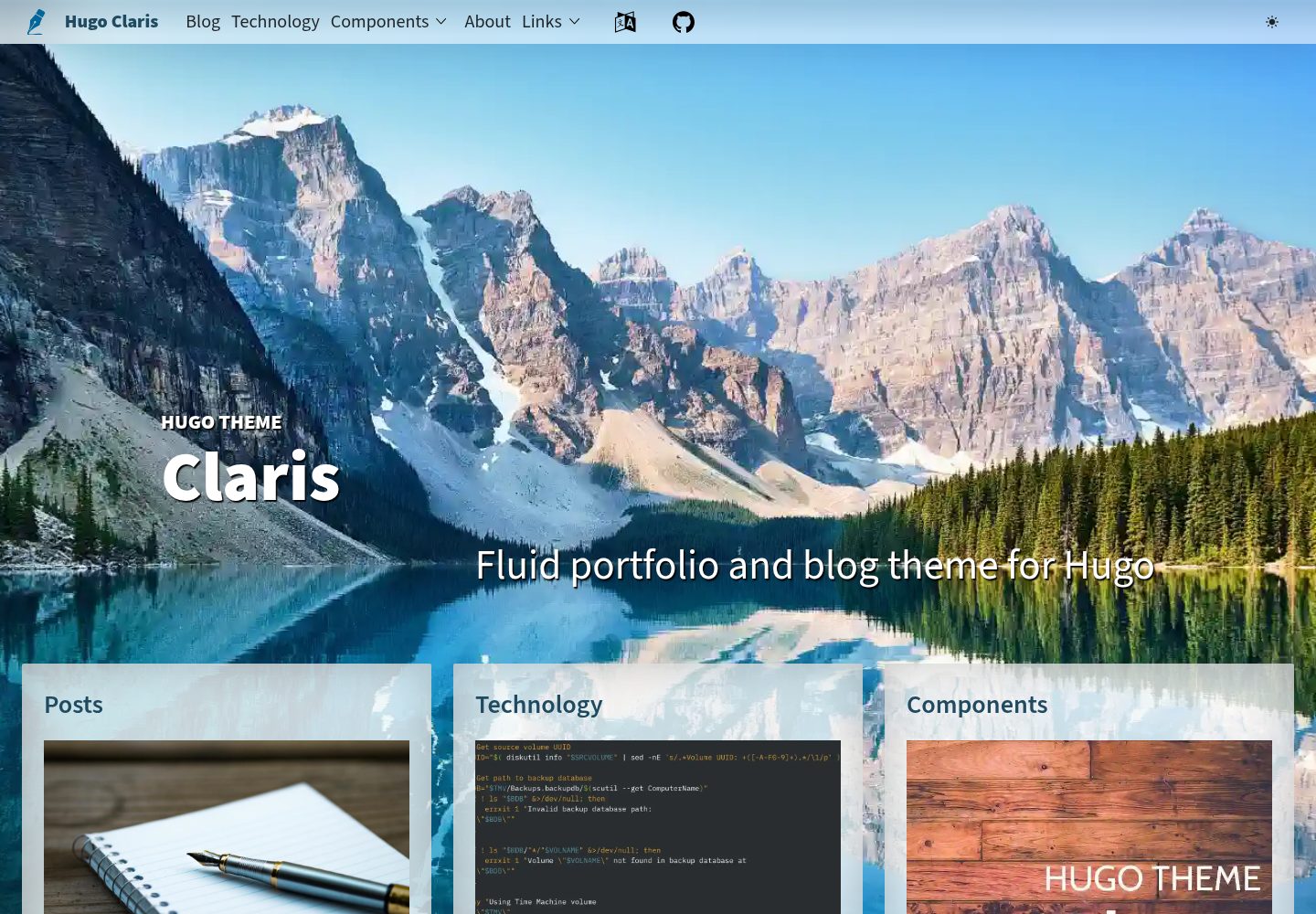
移动优先设计,在手机与桌面设备上均有对应布局
Hugo作品集
hugo-claris — Hugo 作品集模板
作者 simonheimlicher
Hugo Claris 是一个基于 Hugo 的专业作品集网站主题,以移动优先和响应式布局为特点,通过 Hugo Module 方式安装。
看看你的网站会是什么样
浏览真实页面截图,比较内容排版与手机效果。点击下方缩略图切换,放大查看整页细节。
全部页面与视图 3
截图用于了解视觉与布局,交互效果请以实际项目为准。
采集于 2026-10-01查看来源
值得关注的模板亮点
从已有项目资料中,快速了解它的特点。
响应式布局,会随设备与屏幕方向调整
以 Hugo Module(Go module)方式分发和安装
提供桌面端与手机端演示站点截图
采用 MIT 许可发布,允许修改与商用
模板详细介绍
Hugo Claris 是面向专业作品集网站的 Hugo 主题,作者为 simonheimlicher,采用 MIT 许可发布。主题强调移动优先与响应式设计,README 中提供了 iPhone 12 Pro 竖屏(390×844px)与桌面 WXGA(1280×720px)的截图,说明其布局会随设备与屏幕方向调整。
安装方式上,Claris 以 Hugo Module 形式分发,需要先执行 hugo mod init 将站点初始化为 Hugo Module,再在 config/_default 的 hugo.toml 或 hugo.yaml 中通过 module.imports 引入 github.com/simonheimlicher/hugo-claris,随后运行 hugo mod get -u 拉取模块。README 要求使用 Hugo 扩展版,并给出了本地 hugo server 预览与部署到 Cloudflare Pages 的步骤。
限制方面,README 未说明主题包含哪些具体页面类型、组件或配置项,也未提供内容结构、菜单、多语言或 SEO 相关的细节;这些需要以仓库实际代码和示例站点为准。演示站点中的图片、字体、图标等第三方素材的许可需单独核对,不能仅依据代码的 MIT 许可判断。
Hugo作品集
适合你的项目吗?
适用场景
- 为设计师、摄影师或开发者搭建个人作品集网站
- 使用 Hugo 构建静态站点并希望以模块方式引入主题
- 需要移动端与桌面端均有良好展示效果的个人站点
- 计划将 Hugo 站点部署到 Cloudflare Pages 的项目
适合人群
- 熟悉 Hugo 基本命令与配置文件格式的使用者
- 接受以 Hugo Module 方式管理主题的开发者
- 需要响应式作品集主题的个人站点作者
上手与定制指南
结合仓库当前版本的说明,按下面的资料检查内容、配置与运行要求。
- 1
需要安装 Hugo 扩展版(README 要求 0.121.0 或更高版本)。
- 2
需先用 hugo mod init 将站点目录初始化为 Hugo Module,否则引入主题模块会报错。
- 3
在 config/_default 的 hugo.toml 或 hugo.yaml 中通过 module.imports 添加 github.com/simonheimlicher/hugo-claris,并只保留其中一种配置文件。
- 4
运行 hugo mod get -u 拉取模块,再用 hugo server 在本地预览。
- 5
演示图片、字体、图标等第三方素材需按各自许可核对,不能仅依据代码的 MIT 许可判断。
授权与来源资料
使用条件与限制
免费使用 · 保留许可声明本次收录的是公开仓库中采用 MIT 许可的免费版本;免费范围为该版本代码,不代表外部服务或第三方素材免费。
使用时需要遵守
- 允许免费使用、修改、商用和分发该版本代码。
- 分发代码副本或实质性部分时,保留原作者版权声明和完整 MIT 许可声明。
- 代码按现状提供;担保与责任限制以原许可证及适用法律为准。
额外费用与待核对事项
- 使用该主题必须安装 Hugo 扩展版(extended),且版本需为 0.121.0 或更高;普通版 Hugo 无法满足要求。
- 主题以 Hugo Module 形式分发,站点必须先初始化为 Hugo Module(hugo mod init),否则无法引入主题。
- 安装前需用 hugo mod init 将站点目录初始化为 Hugo Module,并需自行确定仓库标识符。
- 若站点根目录未初始化为 Hugo Module,引入主题模块会报错,需先完成模块初始化。
- README 给出的部署流程依赖 Cloudflare Pages 与 GitHub 仓库,属于外部服务,可能涉及账号与平台费用。
- 按 README 部署步骤需将站点推送到 GitHub 仓库,依赖 GitHub 账号与外部托管服务。
- 部署需在 Cloudflare Pages 新建项目并关联 GitHub 仓库,依赖外部平台账号。
- 演示图片、字体、图标及其他第三方素材需按各自许可核对,不能仅凭代码的 MIT 许可判断。
- 域名、托管、数据库、支付或 AI 等外部服务可能另外收费。
查看原文依据
Permission is hereby granted, free of charge
许可证原文
You need Hugo’s extended version (`0.121.0` or later).
README 原文
To use *Claris* as a Hugo module, create and initialize your Hugo site
README 原文
hugo mod init github.com/your-username/your-hugo-site
README 原文
module "github.com/simonheimlicher/hugo-claris" not found in
README 原文
To deploy your Hugo site with the *Claris* theme to Cloudflare Pages:
README 原文
Push your site to a GitHub repository.
README 原文
https://github.com/simonheimlicher/hugo-claris/blob/stage/LICENSEhttps://github.com/simonheimlicher/hugo-claris/blob/stage/README.md[Set up a new project on Cloudflare Pages](https://developers.cloudflare.com/pages/get-started), linking it to your GitHub repository.
README 原文
DeepSeek 根据仓库许可证和 README 整理 ·2026-10-01。结果仅覆盖已读取资料,依赖、图片、字体及后续条款变更以各自原文为准。
项目核对记录与介绍依据
模板资料
- 来源平台
- GitHub
- 资料与维护参考分
- 资料较完整 · 83 / 100
- 技术栈
- Hugo
- 网站类型
- 作品集
这个分数如何计算
本站按许可资料(最高30分)、演示链接(12分)、预览图(10分)、Star数(15分)、记录的维护时间(15分)、描述完整度(8分)、功能记录(5分)和分类资料(5分)计算。它不是代码、安全或性能测试,也不是 Google 评分;有链接不代表已实测可用。
这个项目需要核对什么
- 记录的仓库更新时间
- 2026-08-20
- 截图检查日期
- 2026-10-01
已收录演示链接。请用你的内容与屏幕尺寸检查;有演示不代表表单、认证或支付已经可用。
目录记录的主要技术栈是 Hugo。请通过依赖清单和锁文件核对实际版本与托管要求。这些说明基于收录资料,不代表代码审计或部署实测。
查看具体选型方法 →介绍的制作与核对状态
介绍由 AI 辅助整理目录与仓库资料。仓库作者不等于这篇介绍的审核者。
已完成服务器许可规则与 AI 来源核对;未经过人工编辑审核。
查看当时使用的来源资料
SHA-256: 8a98e3bb9e5f107d0d26f5adec42fe16478704492dcff22766ecc22102ad6982
2026-10-01T01:01:31.164Z
来源文件 / 仓库# **Hugo Claris:** a fluid and responsive theme for a professional portfolio website
<img alt="iPhone 12 Pro landscape" src="./static/images/hugo-claris-demo_home_iPhone_12_Pro-landscape.png" width=844>
### Visit the [*demo website of Hugo Claris*](https://claris.heimlicher.com/)
[](https://github.com/simonheimlicher/hugo-claris/blob/main/LICENSE) ·
[](./CONTRIBUTE.md) ·
[](https://themes.gohugo.io/themes/hugo-claris/) ·
[](https://github.com/simonheimlicher/hugo-claris/blob/main/LICENSE) ·

*Claris* is a theme for [Hugo](https://gohugo.io/), the world’s fastest static website generator.
* **Mobile-first:** *Claris* works great on mobile devices as well as on laptops, iMacs, and desktop PCs.
* **Responsive:** Adapts its layout and design to the device and orientation of the user.
* **Modular:** Implemented as a Hugo module, which is just a Go module.
## Responsive
### Mobile
**iPhone 12 Pro (390x844px)**
<img alt="iPhone 12 Pro portrait" src="./static/images/hugo-claris-demo_home_iPhone_12_Pro-portrait.png" width=390 height=844>
### Desktop
**WXGA 1280x720px**
<img alt="Desktop WXGA 1280x720" src="./static/images/hugo-claris-demo_home_Desktop_1280x720.png" width=1280>
<img alt="WXGA 1280x720" src="./static/images/hugo-claris-demo_footer_Desktop_1280x720.png" width=1280>
## Getting Started with Hugo Claris
Follow these steps to start using *Claris* for your Hugo site.
### 1. Get Hugo
Ensure that you have Hugo installed on your system. You need Hugo’s extended version (`0.121.0` or later). Install it from the [official Hugo website](https://gohugo.io/getting-started/installing/).
### 2. Initialize your Hugo site
To use *Claris* as a Hugo module, create and initialize your Hugo site (if you haven't already) in three steps:
#### 2.a Create a new directory and `cd` into it
> While you could let Hugo initialize the site using `hugo new site your-hugo-site`, this will add only two files, both of which we will need to delete immediately.
```zsh
mkdir your-hugo-site
cd your-hugo-site
```
#### 2.b Initialize your site as a Hugo module
Determine, where you will put the repository of your Hugo site. The URL of the repository minus the scheme (`https://`) will be the identifier of your site's Hugo module.
For example, if you aim to put your site on GitHub and your GitHub user name is `your-username`, you would run:
```zsh
hugo mod init github.com/your-username/your-hugo-site
```
#### 2.c Add Hugo's base directories
```zsh
mkdir -p archetypes assets config content data i18n layouts static themes
```
### 3. Install the Module for Claris
In the following step, we add the Claris theme to the configuration of Hugo. This must only be done after the current directory has been initialized as a Hugo Module using the above command (`hugo mod init`...).
#### 3.a Add a reference to the Claris theme in Hugo's main configuration file
First, we need to add *Claris* as a module to the main config file of Hugo. I highly recommend that you prepare for having separate configuration files for your development and production environments. Hugo supports this via the following directory structure:
```zsh
config/_default # Configuration that applies to all environments
config/development # Configuration for the development environment,
# builds upon `_default`
config/production # Configuration for the production environment,
# builds upon `_default`
```
To configure Hugo to use the Claris theme, you edit its main configuration file to add the Claris theme under `module -> imports`.
If you are not familiar with the file format named `TOML` or, like me, just prefer `YAML`, then now is the perfect time to decide which format your config files shall use. Depending on the format you have chosen (TOML or YAML), add one of the following blocks to your main configuration file.
#### Using TOML for your configuration files
If you will use TOML, add the following block to your `config/_default/hugo.toml` file:
```toml
baseURL = "/"
title = "Hugo theme *Claris* Demo"
[module]
[[module.imports]]
path = "github.com/simonheimlicher/hugo-claris"
```
#### Using YAML for your configuration files
If you will use YAML, add the following block to your `config/_default/hugo.yaml`:
```yaml
baseURL: /
title: Hugo theme *Claris* Demo
module:
imports:
- path: github.com/simonheimlicher/hugo-claris
```
> Make sure you only have one of these two files and you do *not* have a file called `hugo.toml` or `hugo.yaml` in the root of your project.
### 3.b Fetch the Claris module
The module will be fetched by running the following command:
```zsh
hugo mod get -u
```
<details style="cursor:pointer"><summary><strong>If this does not work...</strong></summary>
If you add any module to the Hugo configuration without having initialized the current directory as a `Hugo Module` with `hugo mod init github.com/your-username/your-hugo-site` (see **Step 2.b** above), you will get the following error message:
```zsh
Error: failed to load modules:
module "github.com/simonheimlicher/hugo-claris" not found in
".../your-hugo-site/themes/github.com/simonheimlicher/hugo-claris";
either add it as a Hugo Module or store it in
".../your-hugo-site/themes".: module does not exist
```
This error indicates that you have **correctly configured the module** to be loaded but your site's **root directory itself is not a Hugo Module.**
You can easily verify this by checking if there is a file named `go.mod`:
```zsh
cat go.mod
```
This should yield something along the following lines:
```zsh
module github.com/simonheimlicher/heimlicher.com
go 1.23
require (
github.com/simonheimlicher/claris-resources v0.0.0-20240505124848-a527345b7de9 // indirect
github.com/simonheimlicher/hugo-claris v0.0.0-20241125145343-9821a3e92479 // indirect
github.com/simonheimlicher/hugo-fontawesome v0.0.0-20230505145305-a0afa1d13cf7 // indirect
)
```
Before you try to go back to the above step, you need to temporarily rename your configuration, otherwise initializing the directory as Hugo Module will not work. To rectify the situation, you may proceed along the following lines:
```zsh
mv -i config{,-disabled}
hugo mod init github.com/your-username/your-hugo-site
mv -i config{-disabled,}
```
</details>
#### 3.c Create the file `index.md` for your site's home page
```zsh
hugo new content index.md
```
### 4. Run `hugo server` Locally
Start the Hugo server with:
```zsh
hugo server
```
Your site should now be running locally, accessible at `http://localhost:1313`. You can see *Claris* in action!
### 4. Deploy to Cloudflare Pages
To deploy your Hugo site with the *Claris* theme to Cloudflare Pages:
* Push your site to a GitHub repository.
* [Set up a new project on Cloudflare Pages](https://developers.cloudflare.com/pages/get-started), linking it to your GitHub repository.
* Follow the [framework-specific guide for Hugo](https://developers.cloudflare.com/pages/framework-guides/deploy-a-hugo-site/)
* Cloudflare Pages will build and deploy your site every time you push to your repository.
## Contributing
We welcome contributions to *Claris*! Whether it's bug fixes, feature additions, or improvements to the documentation, your help is appreciated. Please read our [Code of Conduct](./CODE_OF_CONDUCT.md) and [Contributing Guide](./CONTRIBUTE.md) for guidance on how to contribute.
### License
*Claris* is [MIT licensed](./LICENSE).
---
For more detailed information and advanced configuration options, visit the [Hugo Claris repository](https://github.com/simonheimlicher/hugo-claris) on GitHub.
看看同类模板
对比同技术栈与用途的模板,找到更适合的视觉与内容结构。

hugo-PaperMod
PaperMod 是 Hugo 生态里知名度较高的主题之一,定位很明确:给博客和轻量作品集站点提供一套干净、响应式的阅读界面。
Hugo · 作品集

Congo
Congo 是一款为 Hugo 设计的现代内容主题,核心定位是让内容本身成为页面焦点。 它基于 Tailwind CSS 3.0 构建,整体布局完全响应式,视觉风格干净且克制,没有多余装饰。
Hugo · 博客

toha
Toha 是一款面向个人作品集场景的 Hugo 主题,以极简设计和响应式布局为核心,适合用来搭建个人主页、作品展示或技术博客。
Hugo · 作品集

hugo-profile
A highly customizable and mobile first Hugo template for personal portfolio and blog.
Hugo · 作品集

hugo-theme-introduction
Minimal, single page, smooth-scrolling theme for Hugo static site generator.
Hugo · 作品集
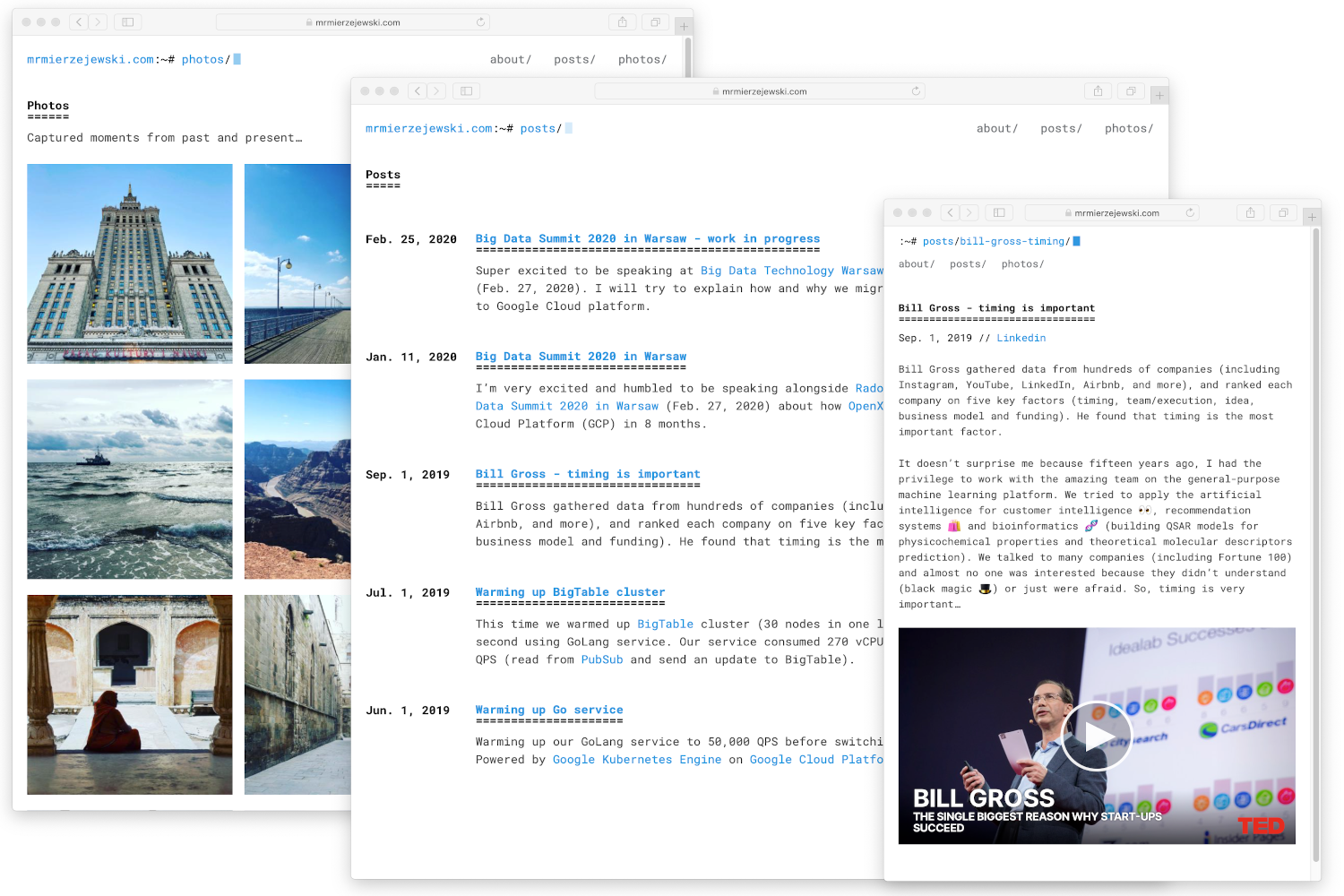
hugo-theme-console
hugo-theme-console 是一款以系统终端为灵感的极简 Hugo 主题,基于 Terminal CSS 构建,整体视觉干净利落,强调快速加载与响应式布局。
Hugo · 作品集