Uses MDX as the post format, allowing Markdown and JSX to be mixed in the body
Next.jsReactBlogStarter
nextjs-mdx-blog-starter — Next.js Blog Template
By iamericdev
A Next.js-based blog starter template that uses MDX for post content, includes a table of contents, layout components, and global styles, and can be deployed to Vercel.
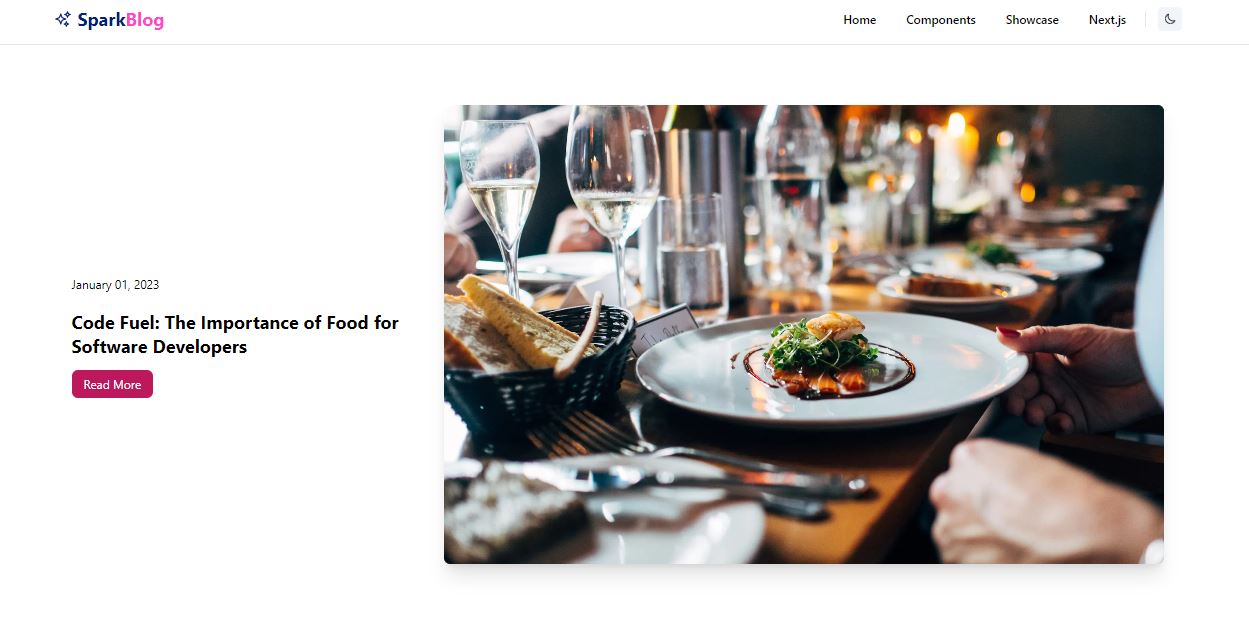
Explore the design
Compare the page layouts and mobile experience. Open any screenshot for a closer look.
Author preview
Author-provided preview
Preview provided in the project README.
One original preview is available. Open the full image to inspect the design.
Screenshots show visual appearance; interactive behavior may differ.
Recorded 2026-10-03View source
What stands out
A quick read of the recorded project description.
Posts are stored in the /posts directory, and the filename directly becomes the post URL
Front matter supports metadata such as title, tags, date, excerpt, and image
Pages and components are separated: pages in /pages, components in /components, main layout in /components/layout
Global styles are centralized in /components/styles/global.css for unified appearance adjustments
Uses the MIT license, allowing free use, modification, commercial use, and distribution of this version of the code
Template Details
This template is for quickly setting up a Next.js blog that uses MDX as its content format. Posts are placed in the /posts directory with the .mdx extension, and the filename becomes the post URL. Each post uses front matter to set metadata such as title, author, date, tags, excerpt, and cover image. The body can use both Markdown and JSX, so React components can be included in posts.
The template's page code is in /pages, components are in /components, the main layout is in /components/layout, and global styles are in /components/styles/global.css. You can adjust the appearance by modifying these files. The README specifies Vercel as the deployment method; after connecting a GitHub repository, it can build and deploy automatically, and it also supports binding a custom domain.
The repository uses the MIT license, so this version of the code can be used, modified, used commercially, and distributed for free, provided the copyright notice and license notice are retained when distributing. Third-party assets such as demo images, fonts, and icons need their licenses checked separately; external services such as domains and hosting may incur additional charges. The template materials do not describe specific capabilities regarding testing, accessibility, SEO, or content scale, so it is advisable to verify dependencies and the current state of the code before use.
Next.jsBlogStarter
Is it right for your project?
Use Cases
- Building a personal technical blog or writing site
- Using it as a reference project for learning how to combine Next.js and MDX
- Writing posts with interactive content based on existing React components
- Deploying the blog to Vercel and binding a custom domain
Suitable For
- Developers who want to manage post content with Markdown/MDX
- People familiar with React and Next.js who want to quickly start a blog project
- Individuals or teams that need code they can freely modify and use commercially
- Users planning to deploy a static or server-rendered blog with Vercel
Getting started & customization
Use these recorded setup notes alongside the repository instructions for your chosen version.
- 1
After cloning the repository, run npm install or yarn to install dependencies
- 2
Run npm run dev or yarn dev to start the development server, with the default address at http://localhost:3000
- 3
Create a new .mdx file in the /posts directory to write a post; the filename will become the post URL
- 4
Fill in metadata such as title, tags, date, excerpt, and image via front matter
- 5
For deployment, connect Vercel with a GitHub repository for automatic builds, and configure a custom domain as needed
License & source material
Usage conditions & limitations
Free to use · keep license noticeThis listing covers the free version under the MIT license in a public repository; the free scope is this version of the code and does not mean external services or third-party assets are free.
Must comply with when using
- This version of the code may be used, modified, used commercially, and distributed for free.
- When distributing copies or substantial portions of the code, retain the original author's copyright notice and the complete MIT license notice.
- The code is provided as is; warranties and limitations of liability are governed by the original license and applicable law.
Additional costs & items to verify
- Deployment depends on external hosting services such as Vercel, requiring you to register an account; such external services may incur fees unrelated to the MIT code license.
- Using Vercel for automatic deployment requires a Vercel account and connecting a GitHub repository, which are external service account requirements.
- Demo images, fonts, icons, and other third-party assets must be checked against their respective licenses and cannot be judged solely by the code's MIT license.
- External services such as domains, hosting, databases, payments, or AI may incur additional charges.
View Original Text Basis
Permission is hereby granted, free of charge
Original License Text
To deploy your blog, you can use a service like [Vercel](https://vercel.com). Vercel makes it easy to deploy Next.js apps with automatic builds and deployments.
Original README
https://github.com/iamericdev/nextjs-mdx-blog-starter/blob/main/LICENSE.txthttps://github.com/iamericdev/nextjs-mdx-blog-starter/blob/main/README.mdOnce you have an account, you can connect your GitHub repository and set up automatic deployments.
Original README
Compiled by DeepSeek based on repository license and README ·2026-10-03. Results only cover the materials read; dependencies, images, fonts, and subsequent term changes are subject to their respective original texts.
Project checks & description sources
Template Information
- Source platforms
- GitHub
- Documentation and maintenance reference score
- More documented · 77 / 100
- Technologies
- Next.js · React
- Website type
- Blog · Starter
How this score is calculated
Our heuristic uses license records (up to 30), a demo link (12), a preview (10), stars (15), recorded maintenance (15), description completeness (8), feature records (5) and classification data (5). It is not a code, security or performance test, or a Google score. A link does not establish tested functionality.
What to verify for this project
- Repository update recorded
- 2023-01-01
- Screenshot last checked
- 2026-10-03
A demo link is listed. Check it with your own content and viewport sizes; its presence does not confirm that forms, authentication or payments work.
The catalog identifies Next.js as the primary stack. Check the actual dependency manifest and lockfile for versions and hosting requirements. These notes use recorded metadata, not a code audit or a deployment test.
Use a selection guide →How this description was prepared
AI-assisted description based on catalog records and repository material. Repository authors are not automatically the reviewers of this description.
Review declaration: [email protected] · 2026-10-04
Inspect the recorded source material
SHA-256: 7288c591997bae9b71356ca18e7d20e1721bfabea9204c1947347a762a51fa9b
2026-10-03T17:01:06.416Z
Source file / repository<div id="top"></div> [![MIT License][license-shield]][license-url] [![LinkedIn][linkedin-shield]][linkedin-url] ## Welcome to Your Next.js + MDX Blog Starter! This starter template is designed to get you up and running with a Next.js-powered blog that uses MDX for content. You can use this as a starting point for your own blog or as a reference for how to use Next.js and MDX together. ![Product Preview][product-preview-light] ![Product Preview][product-preview-dark] ### Getting Started To get started, clone the repository and install the dependencies: ```sh git clone https://github.com/eric-ricky/nextjs-mdx-blog-starter.git cd nextjs-mdx-blog-starter npm install or yarn ``` Once the dependencies are installed, you can start the development server by running: ```sh npm run dev or yarn dev ``` This will start the development server at http://localhost:3000. You can view and edit the source code in the /pages and /components directories. ### Writing Blog Posts Blog posts go in the **/posts** directory. To create a new blog post, create a new file in this directory using the **.mdx** file extension. The file name will be used as the URL for the blog post, so choose a descriptive and meaningful name. In the front matter of the blog post, you can set various metadata such as the title, author, and date: ``` --- title: My First Blog Post tags: - nextjs - reactjs date: 2022-12-30 excerpt: Some excerpt image: '/image-location' --- ``` After the front matter, you can write the body of the blog post using MDX syntax. MDX is a format that allows you to write both Markdown and JSX in the same file, so you can include React components in your blog posts. ### Customizing the Template You can customize the look and feel of the blog by editing the components in the **/components** directory. The main layout of the blog is in /components/layout, and the styles are in /components/styles/global.css. You can also add your own React components and use them in your blog posts. ### Deploying Your Blog To deploy your blog, you can use a service like [Vercel](https://vercel.com). Vercel makes it easy to deploy Next.js apps with automatic builds and deployments. Once you have an account, you can connect your GitHub repository and set up automatic deployments. You can also set up a custom domain if you have one. That's it! You now have a Next.js + MDX blog up and running. Happy blogging! [Demo](https://sparkblog.vercel.app/) <!-- ================== contact ================= --> ## Contact Website - [website](https://erick-otieno-portfolio.vercel.app/) Linked In - [Eric Otieno](https://linkedin.com/in/erick-otieno-7532b01b9) <p align="right">(<a href="#top">back to top</a>)</p> <!-- MARKDOWN LINKS & IMAGES --> [license-shield]: https://img.shields.io/github/license/othneildrew/Best-README-Template.svg?style=for-the-badge [license-url]: LICENSE.txt [linkedin-shield]: https://img.shields.io/badge/-LinkedIn-black.svg?style=for-the-badge&logo=linkedin&colorB=555 [linkedin-url]: https://linkedin.com/in/erick-otieno-7532b01b9 [product-preview-dark]: preview-dark.jpeg [product-preview-light]: preview-light.jpeg
Explore similar templates
Compare previews and descriptions within the same stack and category.

Next.js SaaS Starter
The official Next.js SaaS starter template, integrating email/password authentication, Stripe Checkout subscriptions, a dashboard with user/team CRUD, basic Owner/Member RBAC, and activity logging.
Next.js · SaaS

Next.js Commerce
Vercel's officially maintained Next.js App Router ecommerce starter with deep Shopify integration, offering a complete product catalog, cart, and checkout flow. Core logic is modular for swapping backends, and community provider versions exist for BigCommerce, Medusa, and Saleor.
Next.js · E-commerce

Next-js-Boilerplate
A developer-first Next.js 16 starter with Tailwind CSS 4 and TypeScript, supporting both App Router and Page Router.
Next.js · Starter

tailwind-nextjs-starter-blog
A Next.js and Tailwind CSS blog starter template using Contentlayer for Markdown/MDX, with built-in SEO, code highlighting, and tags. It targets personal technical blogs and migration from Jekyll/Hugo to React, and supports one-click Vercel deployment.
Next.js · Blog

next-forge
next-forge is a Turborepo-based Next.js template maintained by Vercel, positioned as a starting point for SaaS products.
Next.js · Starter

SaaS-Boilerplate
SaaS-Boilerplate is an open-source SaaS starter template built with Next.js App Router, React 19, TypeScript, Tailwind CSS, and Shadcn UI.
Next.js · SaaS