Written in React and TypeScript
Next.jsReactStarter
nextjs-template — Next.js Starter Template
By jsulpis
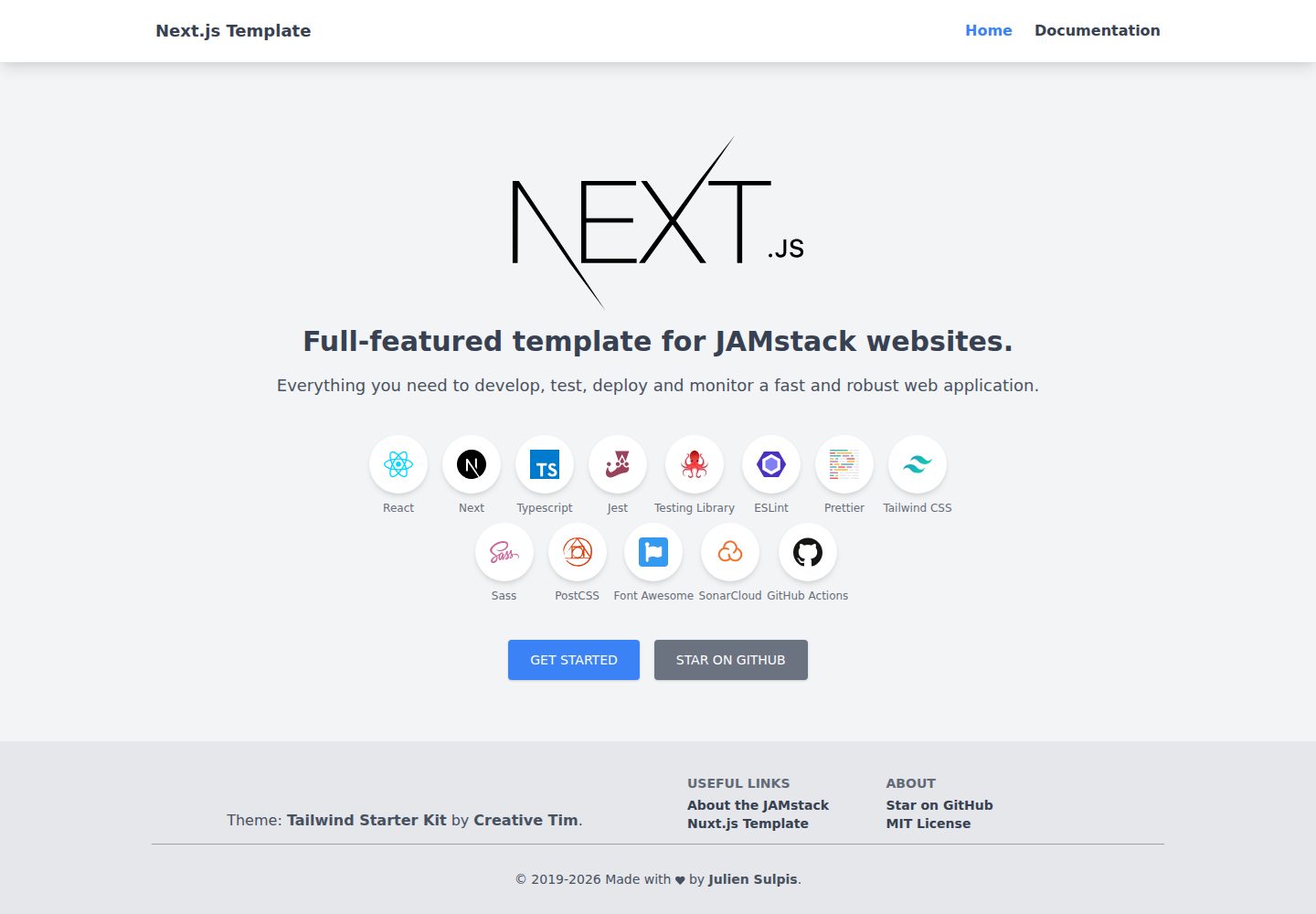
A Next.js starter template for JAMstack websites, integrating TypeScript, ESLint, Prettier, Jest, React Testing Library, and TailwindCSS, with GitHub Actions CI and Vercel deployment configuration.
Explore the design
Compare the page layouts and mobile experience. Open any screenshot for a closer look.
Desktop homepage1 / 2
Desktop captureTop of page
Actual screenshot captured by the server browser.
All pages & views 2
Screenshots show visual appearance; interactive behavior may differ.
Recorded 2026-10-02View source
What stands out
A quick read of the recorded project description.
Integrates ESLint, Prettier, and a pre-commit hook that lints staged files before committing
Sets up a testing environment with Jest and React Testing Library
Defaults to TailwindCSS while supporting Next.js native CSS modules
Allows each page to populate SEO header metadata such as name, description, and images
Provides GitHub Actions CI and supports deployment via Vercel
Template Details
This is a Next.js starter template for JAMstack websites. The author combined the tools they commonly use when developing personal projects, so it carries some personal preferences. The repository is MIT licensed and can be used, modified, commercialized, and distributed for free, but third-party assets such as demo images, fonts, and icons require separate license verification.
The template is written in React and TypeScript, configured with ESLint, Prettier, and a pre-commit hook that lints staged files before committing. For testing, it integrates Jest and React Testing Library to write tests that simulate real user interactions. Styling defaults to TailwindCSS, while Next.js natively supports CSS modules.
The template includes SEO-related configuration, allowing each page to populate header metadata such as name, description, and images. The README mentions that Next.js allows writing APIs in separate directories within the same repository, but the demo project itself does not use this capability. For deployment, it provides GitHub Actions CI and can be deployed directly via Vercel's Git integration or command line.
To use, clone the repository and install dependencies, then run yarn dev to start the development server with hot reload at localhost:3000; yarn build builds the production version, and Next.js will automatically render static HTML pages where possible; yarn start starts the server-side rendering server after building; yarn export generates a fully static, pre-rendered project but loses server-side rendering capability, and this command is usually not needed on Vercel. More configuration details are in the project documentation page.
Next.jsStarter
Is it right for your project?
Use Cases
- Building JAMstack websites primarily based on static generation or server-side rendering
- Next.js projects that need TypeScript, code linting, and testing configurations ready out of the box
- Projects that want to use GitHub Actions for continuous integration and deploy to Vercel
- Sites that need to configure SEO metadata for pages
Suitable For
- Developers familiar with React and TypeScript
- Teams that prefer TailwindCSS as their styling solution
- Projects planning to host on Vercel and deploy via Git integration
- Those who want to reference a Next.js project structure that includes linting, testing, and CI configuration
Getting started & customization
Use these recorded setup notes alongside the repository instructions for your chosen version.
- 1
After cloning the repository, run yarn install to install dependencies
- 2
Run yarn dev to start the development server with hot reload at localhost:3000
- 3
yarn build builds the production version, and yarn start starts the server-side rendering server
- 4
yarn export generates a fully static pre-rendered project but loses server-side rendering capability; it is usually not needed on Vercel
- 5
For configuration details, see the project documentation page; third-party assets such as demo images require independent license verification
License & source material
Usage conditions & limitations
Free to use · keep license noticeThis entry covers the free version under the MIT license from the public repository; the free scope applies to that version's code and does not imply that external services or third-party assets are free.
Must comply with when using
- The code of this version may be used, modified, commercialized, and distributed for free.
- When distributing copies or substantial portions of the code, retain the original author's copyright notice and the full MIT license notice.
- The code is provided as is; warranties and limitations of liability are governed by the original license and applicable law.
Additional costs & items to verify
- The deployment process targets the Vercel platform, using its Git integration or command line; switching to other hosting methods requires adjusting the deployment configuration yourself.
- The demo project itself does not include an API implementation; API capabilities must be added by the developer following Next.js conventions.
- Running yarn export to generate a purely static site loses server-side rendering capability, requiring a trade-off between static export and server-side rendering.
- Demo images, fonts, icons, and other third-party assets must be checked against their respective licenses; they cannot be judged solely by the code's MIT license.
- External services such as domains, hosting, databases, payments, or AI may incur additional charges.
View Original Text Basis
Permission is hereby granted, free of charge
Original License Text
Ready to deploy on Vercel using git integration or the command line
Original README
The demo project does not use it, but with next.js you can have your APIs in a dedicated folder
Original README
https://github.com/jsulpis/nextjs-template/blob/main/LICENSEhttps://github.com/jsulpis/nextjs-template/blob/main/README.mdNote that you lose the possibility to have server-side rendered pages.
Original README
Compiled by DeepSeek based on repository license and README ·2026-10-03. Results only cover the materials read; dependencies, images, fonts, and subsequent term changes are subject to their respective original texts.
Project checks & description sources
Template Information
- Source platforms
- GitHub
- Documentation and maintenance reference score
- Partly documented · 72 / 100
- Technologies
- Next.js · React
- Website type
- Starter
How this score is calculated
Our heuristic uses license records (up to 30), a demo link (12), a preview (10), stars (15), recorded maintenance (15), description completeness (8), feature records (5) and classification data (5). It is not a code, security or performance test, or a Google score. A link does not establish tested functionality.
What to verify for this project
- Repository update recorded
- 2021-12-21
- Screenshot last checked
- 2026-10-03
A demo link is listed. Check it with your own content and viewport sizes; its presence does not confirm that forms, authentication or payments work.
The catalog identifies Next.js as the primary stack. Check the actual dependency manifest and lockfile for versions and hosting requirements. These notes use recorded metadata, not a code audit or a deployment test.
Use a selection guide →How this description was prepared
AI-assisted description based on catalog records and repository material. Repository authors are not automatically the reviewers of this description.
Review declaration: [email protected] · 2026-10-04
Inspect the recorded source material
SHA-256: 369a092bf4f8431dd36bbb886e3c1ebbecb0c45599d160e2f225b2793025845c
2026-10-03T16:18:10.198Z
Source file / repository<h1 align="center">Next.js Template</h1>
<h3 align="center">Full-featured template for JAMstack websites using next.js</h3>
<div align="center">
<a href="https://github.com/jsulpis/nextjs-template/actions/workflows/build.yml">
<img alt="Build Status" src="https://github.com/jsulpis/nextjs-template/actions/workflows/build.yml/badge.svg" />
</a>
<a href="https://sonarcloud.io/dashboard?id=nextjs-template">
<img alt="Quality Gate Status" src="https://sonarcloud.io/api/project_badges/measure?project=nextjs-template&metric=alert_status" />
</a>
<a href="https://sonarcloud.io/dashboard?id=nextjs-template">
<img alt="Coverage" src="https://sonarcloud.io/api/project_badges/measure?project=nextjs-template&metric=coverage" />
</a>
<a href="http://makeapullrequest.com">
<img alt="PRs Welcome" src="https://img.shields.io/badge/PRs-welcome-brightgreen.svg" />
</a>
<a href="https://nextjs-template.juliensulpis.vercel.app">
<img class="repo-preview" src="https://raw.githubusercontent.com/jsulpis/nextjs-template/main/preview.png" alt="Screenshot image"/>
</a>
<p>Picture generated with my <a href="https://website-screenshot.vercel.app/">Website Screenshot</a> app.</p>
</div>
**Deploy your own copy of this project in just a few clicks on Vercel:**
[](https://vercel.com/new/project?template=https://github.com/jsulpis/nextjs-template)
## About
I built this template with all the tools I found useful to develop my own personal projects, so it can be a bit biased. If you find something that you think is not relevant or could be improved, please open an issue or a pull request to fix it.
## Features
**React.js with TypeScript**
- Because I love strongly typed languages
**Lint & format**
- ESLint
- Prettier
- Pre-commit hook included to lint your staged files.
**Testing Setup**
- Jest
- React Testing Library to make tests that mimic real user interactions
**UI**
- TailwindCSS 2
- CSS modules are also supported by default by next.js
**APIs**
- The demo project does not use it, but with next.js you can have your APIs in a dedicated folder in the same repo and deploy them in no time with Vercel.
**SEO**
- Populate each page header metadata with name, description, image, etc.
**Deployment**
- CI with GitHub Actions
- Ready to deploy on Vercel using git integration or the command line (see 'deployment' section below)
## Installation
Clone the repository and install the dependencies:
```shell
git clone https://github.com/jsulpis/nextjs-template.git && cd nextjs-template && yarn install
```
## Usage
### Development
Serve with hot reload at localhost:3000.
```
yarn dev
```
### Build
Build for production: next.js automatically renders static HTML pages when possible. Then if you deploy on Vercel you can have both statically rendered pages and server-side rendered pages (as lambdas functions).
```
yarn build
```
Launch a server for server-side rendering (after building the application):
```
yarn start
```
Generate a fully static project with pre-rendered pages to put directly on a server or any static website hosting platform. Note that you lose the possibility to have server-side rendered pages. With Vercel you should not have to run this command.
```
yarn export
```
## Deployment
This template is ready to be deployed on Vercel:
[](https://vercel.com/new/project?template=https://github.com/jsulpis/nextjs-template)
You can integrate Vercel with your GitHub account, which allows it to deploy each branch and pull request to their own environment, and the main branch in production.
## Configuration
See the [documentation page](https://nextjs-template.juliensulpis.vercel.app/docs)
## What next ?
If you don't find what you are looking for in this template, there is a good chance that one of the [many examples](https://github.com/vercel/next.js/tree/canary/examples) provided by Vercel will make you happy !
## License
Released under the [MIT](https://github.com/jsulpis/nextjs-template/blob/main/LICENSE) license.
Explore similar templates
Compare previews and descriptions within the same stack and category.

Next.js SaaS Starter
The official Next.js SaaS starter template, integrating email/password authentication, Stripe Checkout subscriptions, a dashboard with user/team CRUD, basic Owner/Member RBAC, and activity logging.
Next.js · SaaS

Next.js Commerce
Vercel's officially maintained Next.js App Router ecommerce starter with deep Shopify integration, offering a complete product catalog, cart, and checkout flow. Core logic is modular for swapping backends, and community provider versions exist for BigCommerce, Medusa, and Saleor.
Next.js · E-commerce

Next-js-Boilerplate
A developer-first Next.js 16 starter with Tailwind CSS 4 and TypeScript, supporting both App Router and Page Router.
Next.js · Starter

tailwind-nextjs-starter-blog
A Next.js and Tailwind CSS blog starter template using Contentlayer for Markdown/MDX, with built-in SEO, code highlighting, and tags. It targets personal technical blogs and migration from Jekyll/Hugo to React, and supports one-click Vercel deployment.
Next.js · Blog

next-forge
next-forge is a Turborepo-based Next.js template maintained by Vercel, positioned as a starting point for SaaS products.
Next.js · Starter

SaaS-Boilerplate
SaaS-Boilerplate is an open-source SaaS starter template built with Next.js App Router, React 19, TypeScript, Tailwind CSS, and Shadcn UI.
Next.js · SaaS