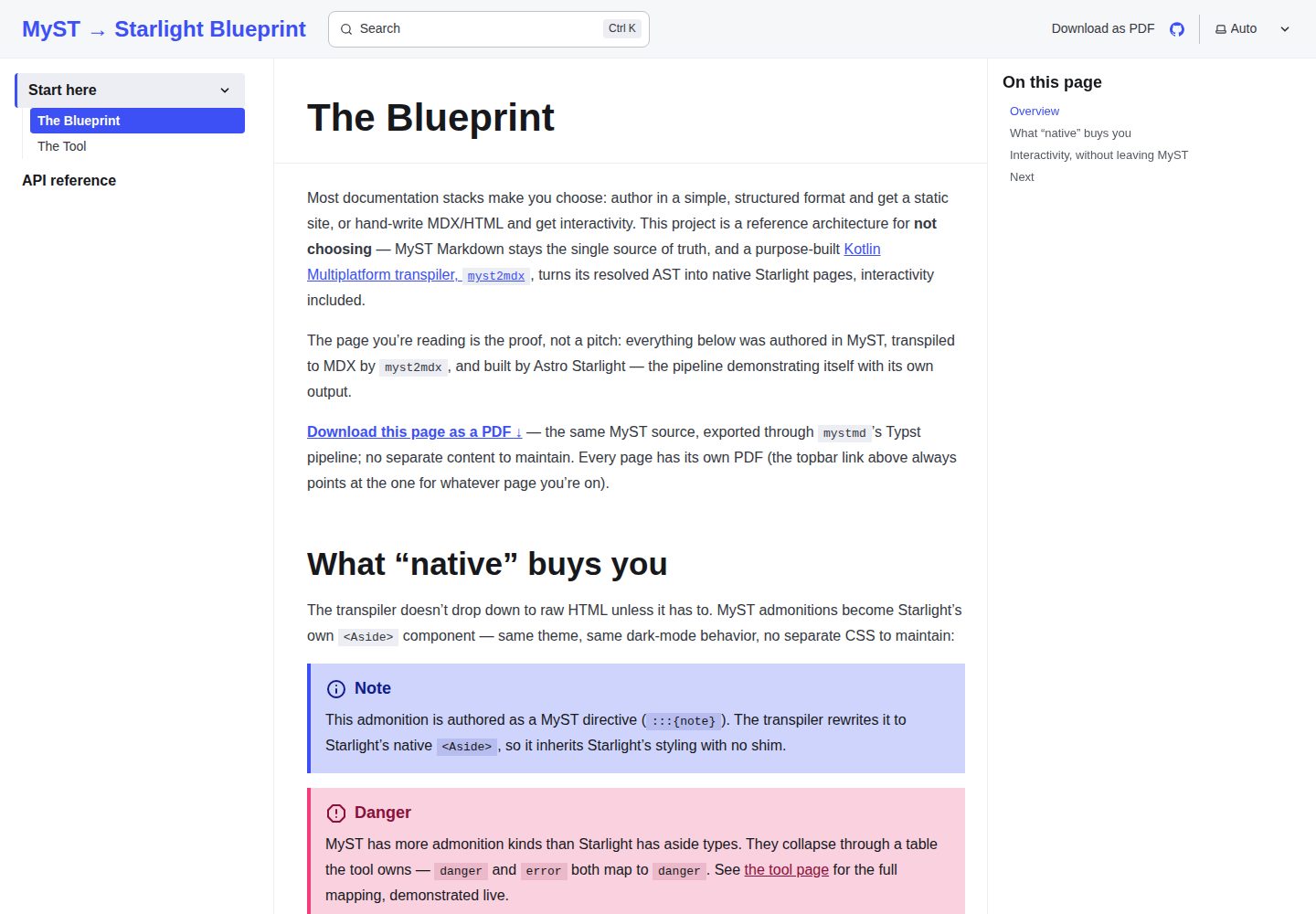
A single MyST source file produces both a Starlight site and per-page Typst PDFs; MDX is a build artifact and is gitignored
AstroDocumentation
myst-starlight-blueprint — Astro Documentation Template
By wstein
A reference architecture that transpiles MyST source files into an Astro Starlight site and PDF; the repository is its own example and can be used as a template.
Explore the design
Compare the page layouts and mobile experience. Open any screenshot for a closer look.
Desktop homepage1 / 2
Desktop captureTop of page
Actual screenshot captured by the server browser.
All pages & views 2
Screenshots show visual appearance; interactive behavior may differ.
Recorded 2026-10-01View source
What stands out
A quick read of the recorded project description.
A myst2mdx transpiler written in Kotlin Multiplatform, with a shared core that compiles both to a JVM CLI and a JS export
Four-channel escaping (body text, code, attributes, JSX-HTML), with astro build used as MDX compilation validation
A CodeMirror 6-based js-eval code block that runs JavaScript in a Web Worker and returns console output
Admonitions and code blocks are preferentially mapped to native Starlight Aside and Expressive Code, reducing the surface for custom styling
The repository is its own example, includes a GitHub Actions workflow, and can be forked as a template
Template Details
This is a documentation site reference architecture built with Astro as the build framework and MyST as the single content source. The repository parses MyST source files into a JSON AST via mystmd, then transpiles them into MDX using myst2mdx written in Kotlin Multiplatform, and finally builds a static site with Astro Starlight and deploys it to GitHub Pages. The repository is simultaneously a blueprint, a template, and a runnable example: all pages are written in MyST, and the generated MDX is gitignored and not edited by hand.
The site contains two pages, one of which embeds a CodeMirror 6-based js-eval code block that allows editing and running JavaScript in the browser, with execution results returned as console output by a Web Worker. Each MyST page can declare a Typst export in its frontmatter; CI generates a PDF per page and copies it under site/public/, with a download link in the top bar pointing to the PDF for the current page.
The transpiler in tool/ is a Kotlin Multiplatform project whose shared core compiles both to a JVM CLI and a JS export; the CLI provides transpile, dokka2typst, and dokka2mdx subcommands, of which the latter two are not wired into any pipeline. The transpiler uses four-channel escaping for text, code, attributes, and JSX-HTML, and preferentially maps admonitions and code blocks to native Starlight components. Known limitations listed in the README include: AST field assumptions may silently fall back to HTML; dependency version upgrades require rerunning the full pipeline; --base must be kept manually consistent with BASE in astro.config.mjs; and the mystmd project-level merged PDF export renders only one page when multiple pages of content are present.
AstroDocumentation
Is it right for your project?
Use Cases
- Documentation projects that want to use MyST as the single content source while outputting both an interactive website and PDFs
- Those needing a reference for transpiling the MyST AST into MDX usable by Astro Starlight
- Those wanting to embed editable and runnable JavaScript examples in a documentation site
- Those needing to generate and download a separate Typst PDF for each documentation page
- Those evaluating the reuse of a Kotlin Multiplatform shared core across a CLI and the browser
Suitable For
- Developers familiar with Astro, MyST, and GitHub Actions
- Teams that need a single content source and accept that build artifacts are not version-controlled
- Documentation projects willing to maintain a Kotlin transpiler and pinned dependency versions
- Those using the repository as a template or architectural reference rather than an out-of-the-box product
Getting started & customization
Use these recorded setup notes alongside the repository instructions for your chosen version.
- 1
Set the Pages source to GitHub Actions in the GitHub repository settings, otherwise the deployment job will fail
- 2
Set SITE and BASE in site/astro.config.mjs; BASE must match the repository name, otherwise CSS and links will break
- 3
Run gradle wrapper once under tool/ and commit the generated wrapper for CI and local use
- 4
Running the full pipeline locally requires JDK 21, Node 22, mystmd, and typst; the environment can be prepared with nix develop from flake.nix or direnv allow
- 5
After upgrading any dependency in site/package.json, rerun the full pipeline; astro check or Kotlin tests alone cannot detect configuration mismatches
License & source material
Usage conditions & limitations
Free to use · keep license noticeThis entry covers the free version of the public repository under the MIT license; the free scope is the code of that version and does not mean that external services or third-party assets are free.
Must comply with when using
- The code of this version may be used, modified, used commercially, and distributed free of charge.
- When distributing copies or substantial portions of the code, retain the original author's copyright notice and the full MIT license notice.
- The code is provided as is; warranties and limitations of liability are governed by the original license and applicable law.
Additional costs & items to verify
- Generating PDFs locally requires the typst CLI; the full pipeline also requires JDK 21, Node 22, and mystmd, and cannot be built if the environment does not meet these requirements.
- The build requires network access to download templates such as lapreprint-typst from github.com/myst-templates/*; PDF export cannot be completed in an offline environment.
- The js-eval Web Worker provides isolation only, not a security sandbox, and must not be used to run untrusted third-party code.
- Only static live evaluation is supported; MyST's executable code blocks and notebook features are intentionally excluded from scope.
- The browser playground for the JS target is not yet implemented, and no component consumes transpileToMdx(); that export is only an available API rather than a delivered feature.
- The dokka2typst and dokka2mdx subcommands are not wired into any pipeline and must be invoked manually.
- PDFs are exported per page; there is no merged single document, and cross-page anchor links are unavailable in PDF exports.
- The CLI's --base must be kept manually consistent with BASE in astro.config.mjs, otherwise internal link prefixes will be wrong.
- Pinned dependency versions are a practical constraint; after upgrading any dependency in site/package.json, the full pipeline must be rerun for verification.
- Using an autogenerate sidebar for root-level pages silently renders it empty; explicit items must be used instead and kept in sync with the toc in myst.yml.
- Demo images, fonts, icons, and other third-party assets must be checked against their respective licenses and cannot be judged solely by the code's MIT license.
- External services such as domains, hosting, databases, payments, or AI may incur separate charges.
View Original Text Basis
Permission is hereby granted, free of charge
Original License Text
Run it locally with `make pdf` (needs `typst` — in `flake.nix`'s devShell).
Original README
The upstream Typst templates fetch over the network at build time and are outside this repo's control.
Original README
**Web Worker is isolation, not a security sandbox.** Fine for trusted docs examples; don't run untrusted third-party code through it.
Original README
**Static live-eval only.** MyST's executable/notebook features are intentionally out of scope; this path renders static output by design.
Original README
**The JS target's browser playground is unbuilt.**
Original README
`dokka2typst`/`dokka2mdx` convert Dokka-generated HTML (`Html2Typst`/`Html2Mdx`, tested against real `gradle dokkaGenerate` output) but aren't called from any pipeline yet
Original README
**PDFs are per-page, deliberately — not one combined document.**
Original README
**`--base` is a second copy of `astro.config.mjs`'s `BASE`, not derived from it.**
Original README
**Pinned versions are load-bearing, not decorative.**
Original README
https://github.com/wstein/myst-starlight-blueprint/blob/main/LICENSEhttps://github.com/wstein/myst-starlight-blueprint/blob/main/README.md**Starlight's `autogenerate` sidebar silently renders empty for root-level pages — use explicit `items` instead.**
Original README
Compiled by DeepSeek based on repository license and README ·2026-10-01. Results only cover the materials read; dependencies, images, fonts, and subsequent term changes are subject to their respective original texts.
Project checks & description sources
Template Information
- Source platforms
- GitHub
- Documentation and maintenance reference score
- More documented · 80 / 100
- Technologies
- Astro
- Website type
- Documentation
How this score is calculated
Our heuristic uses license records (up to 30), a demo link (12), a preview (10), stars (15), recorded maintenance (15), description completeness (8), feature records (5) and classification data (5). It is not a code, security or performance test, or a Google score. A link does not establish tested functionality.
What to verify for this project
- Repository update recorded
- 2026-07-19
- Screenshot last checked
- 2026-10-01
A demo link is listed. Check it with your own content and viewport sizes; its presence does not confirm that forms, authentication or payments work.
The catalog identifies Astro as the primary stack. Check the actual dependency manifest and lockfile for versions and hosting requirements. These notes use recorded metadata, not a code audit or a deployment test.
Use a selection guide →How this description was prepared
AI-assisted description based on catalog records and repository material. Repository authors are not automatically the reviewers of this description.
Automatically checked against source and license rules; no manual editorial review.
Inspect the recorded source material
SHA-256: 02855058311d30745383dea24da73f839b6303a26b78161c551d14d55ccf0bfd
2026-10-01T01:12:06.994Z
Source file / repository# MyST → Starlight Blueprint
> One MyST source → an interactive Starlight site, no duplication. A
> self-rendering docs stack with live code editing, unified search, and a shared
> theme, plus the Kotlin Multiplatform transpiler that wires MyST to Starlight.
> The repo builds itself as the example. Fork it as a template.
**[Live demo →](https://wstein.github.io/myst-starlight-blueprint/)** — the repo
you're reading deployed, live-JS editor included.
This repository is a **tech-stack idea**, not just a tool: a reference
architecture for documentation that has a single source of truth and still ships
an interactive web experience. The custom transpiler in `tool/` exists only to
make the idea cohere — it's the cog, not the point.
The proof is the repo itself: everything here is authored in MyST, transpiled to
MDX by the Kotlin Multiplatform tool, and built by Astro Starlight into the site
you deploy. Blueprint, template, and worked example in one.
## The idea in one picture
```mermaid
flowchart TD
A["<b>site/myst/*.md</b><br/>MyST source — single source of truth<br/><i>you edit only this</i>"]:::source
B["_build/site/content/*.json<br/>resolved MyST AST (mdast-based)"]
C["site/src/content/docs/*.mdx<br/>generated MDX — build artifact, never edited"]:::artifact
D["site/dist/<br/>static site"]
E(["GitHub Pages"])
A -->|"mystmd · myst build --site<br/>resolve xrefs, numbering, TOC"| B
B -->|"KMP transpiler · shared core to JVM CLI<br/>native-first, HTML-fallback"| C
C -->|"astro build (Starlight + MDX)<br/>◄ the MDX compile gate"| D
D --> E
classDef source fill:#dcfce7,stroke:#16a34a,color:#14532d;
classDef artifact fill:#f1f5f9,stroke:#94a3b8,color:#334155,stroke-dasharray:4 3;
```
Everything downstream of the MyST source is regenerated on every build. The MDX
is gitignored on purpose: it is output, not source.
## Why this stack (the load-bearing decisions)
| Decision | Choice | Why |
|---|---|---|
| Web framework | **Astro Starlight** | Static-first, islands, Pagefind search, non-React |
| Structured source | **mystmd** (standalone, not Sphinx) | Semantic authoring; emits a resolved AST as JSON |
| Integration model | **Transpile to MDX**, don't inject HTML | MDX pages become *native* Starlight pages → shared theme, topbar, search, sidebar for free |
| Emit target | **MDX** (not Markdoc) | Human-reviewable output; escaping is solved, not hoped away |
| Tool language | **Kotlin Multiplatform** | One `commonMain` core → JVM **CLI** + JS **export**, from a single codebase |
| Live editor | **CodeMirror 6, vanilla** | Interactive island with **no React**, per the framework decision |
| Live eval | **Web Worker** | Runs example JS off the main thread, no DOM access |
## The custom tool: `myst2mdx` (`tool/`, Kotlin Multiplatform)
A deliberate **orchestrator**, not a documentation engine. It doesn't parse MyST
(mystmd does) or render generic Markdown (MDX/Astro does). It owns exactly the
parts that encode *your policy*. Its CLI is `myst2mdx` (`gradle jvmJar` builds
`myst2mdx-jvm.jar`), and every generated MDX file carries its name in a
provenance banner comment. The CLI is one jar with subcommands, not one flat
command: `myst2mdx transpile --in ... --out ...` is the original,
CI-invoked path; `dokka2typst`/`dokka2mdx` convert Dokka-generated HTML
(`Html2Typst`/`Html2Mdx`, tested against real `gradle dokkaGenerate` output)
but aren't called from any pipeline yet — reachable and correct, not wired up:
```
tool/src/
├── commonMain/…/blueprint/ ← the shared core, compiled to BOTH targets
│ ├── ast/MystNode.kt resolved-AST model (tolerant JSON wrapper)
│ ├── escape/MdxEscaper.kt the FOUR-channel escaper (prose / code / attr / JSX-HTML)
│ ├── emit/NodeMapping.kt native-vs-fallback set + admonition collapse table
│ ├── emit/MdxEmitter.kt native-first emitter (→ <Aside>, Expressive Code, links)
│ └── Transpiler.kt frontmatter + imports + provenance banner
├── jvmMain/…/Cli.kt JVM target → myst2mdx transpile|dokka2typst|dokka2mdx
├── jvmMain/…/dokka/ Html2Typst + Html2Mdx — HTML -> Typst/MDX, jsoup-backed
├── jsMain/…/WebApi.kt JS target → transpileToMdx(), exported (@JsExport)
└── commonTest/…/blueprint/ unit tests for the shared core, incl. a fixtures/
package with a real mystmd AST capture — run via
`gradle jvmTest`, wired into CI before `jvmJar`
```
The same `Transpiler.transpile(...)` runs in CI (a JVM jar walking JSON files)
and is exported for JS (`transpileToMdx()`, `@JsExport`) — "shared code for
CLI and web" satisfied by construction, not copy-paste. No browser UI
consumes the JS export yet; it's a proven API surface, not a shipped
playground (see [Honest caveats](#honest-caveats)).
**Escaping is retired, not risked.** Every character is routed through one of four
channels: prose is neutralised, code fences pass through verbatim, attributes are
entity-escaped, and the raw-HTML fallback emits JSX-valid markup. The build then
runs the real MDX compiler (`astro build`) as a gate, so correctness is verified —
not trusted (see [Honest caveats](#honest-caveats) for the one gap this doesn't close).
**Native where possible, fallback where not.** Admonitions and code are rewritten
to native `<Aside>` and Expressive Code, so they never reach the CSS shim
(`site/src/styles/myst-shim.css`) — which is why the permanent styling surface
stays tiny.
## The signature: live JS evaluation
`site/myst/index.md` contains a `js-eval` code block. The transpiler maps it to
`<CodeMirrorEval>` — a vanilla CodeMirror 6 island whose Run button posts the
editor contents to a sandboxed Web Worker and streams the console output back. No
React, no main-thread eval. [Try it on the live site →](https://wstein.github.io/myst-starlight-blueprint/)
The site itself is two pages: `site/myst/index.md` (this pitch, live) and
[`site/myst/tool.md`](https://wstein.github.io/myst-starlight-blueprint/tool)
(the architecture walkthrough above, authored in MyST and demonstrating its own
admonition-collapse table live rather than just describing it).
## PDF export
Each MyST page declares a Typst export in its own frontmatter
(`exports: [{format: typst, template: lapreprint-typst}]`); CI runs
`myst build --typst <file>` once per page (see [Honest
caveats](#honest-caveats) for why not one multi-file invocation) to render its
own PDF, copied to `site/public/<slug>.pdf` — picked up by `astro build` like
any other static asset. Each page links to *its own* PDF from a topbar
download link (`site/src/components/HeaderWithPdf.astro`), not a single
shared link, since there's no combined PDF to point at.
Typst, not LaTeX: `mystmd`'s `--pdf` flag shells out to `latexmk`, which needs a
full TeX distribution; `--typst` shells out to the `typst` CLI, a single ~40MB
binary with no package manager to provision. Run it locally with `make pdf`
(needs `typst` — in `flake.nix`'s devShell).
mystmd's own project-level "combined book" export (one `exports:` entry in
`myst.yml`, referencing the whole `toc`) looked like the more obvious way to
produce a single multi-page PDF, but only rendered one of the two pages when
tried against this repo's content. Per-page exports sidestepped that bug
entirely — and turned out to be what "download the page you're on" actually
wants anyway, once the topbar link needed to be per-document rather than
site-wide. See [Honest caveats](#honest-caveats) for the one thing per-page
export still costs: no shared front matter or continuous pagination if you
wanted one combined document.
## Use it as a template
1. Click **Use this template** on GitHub (or fork).
2. In `site/astro.config.mjs`, set `SITE = 'https://<you>.github.io'` and
`BASE = '/<your-repo>'`.
3. Write MyST in `site/myst/`, list pages in `site/myst/myst.yml`'s `toc`.
4. Push to `main`. The workflow tests + builds the tool, resolves MyST,
transpiles, builds Starlight, and deploys to Pages.
Locally: `make pipeline` runs the whole chain — tool, MyST, transpile, PDF
export, site build — (needs JDK 21, Node 22, `mystmd`, `typst`).
A `flake.nix` is provided — `nix develop` (or `direnv allow`, via the checked-in
`.envrc`) drops you into a shell with all of those already on `PATH` except
`mystmd` (matching CI apart from the one `npm install -g mystmd` step you still
run yourself).
## First run — do these before watching the Actions tab
Most first-push failures are configuration, not code:
- [ ] **Pages source = GitHub Actions.** Settings → Pages → Source → *GitHub
Actions* (not "deploy from branch"), or the deploy job fails at the end.
- [ ] **Set `SITE` and `BASE`** in `astro.config.mjs` to your Pages URL and repo
name — wrong `BASE` ships a site with broken CSS/links even on a green build.
- [ ] **Commit a Gradle wrapper:** `cd tool && gradle wrapper` once, then commit.
CI's setup-gradle prefers it and it makes `./gradlew` work locally.
- [ ] **Verify the mystmd AST path.** Run `myst build --site` locally and confirm
the JSON lands in `_build/site/content/`; if not, fix `--in` in the workflow
and `Makefile`.
- [ ] **Check the pinned action majors.** Confirm the actions pinned in
`.github/workflows/deploy.yml` are still current majors — GitHub's Security tab
flags outdated actions on the repo once it's live.
The full chain — `myst build --site` → transpile → per-page PDF export →
`astro build` — has been run end-to-end locally against this repo's own
content and produces a working `site/dist/` (search index and per-page
downloadable PDFs included). Three failures only surfaced by actually running
it, all now fixed here: `site/myst/myst.yml`'s `site.template: none`
wasn't a real template — `myst build --site` always resolves and downloads an
actual site template, so it 404'd looking one up literally named "none" (fixed
by pinning `template: book-theme`, which is what it silently falls back to
anyway if no valid template is given); `site/package-lock.json` wasn't
committed, so CI's `npm ci` had nothing to install from; and `astro.config.mjs`'s
`social` option used the array shape from Starlight ≥0.33 while `^0.30.0` (what
`npm install` actually resolves) expects an object keyed by platform name.
## Honest caveats
- **`MystNode` field assumptions are the ongoing risk.** `kind` on admonitions and
`url` on resolved cross-references only fully surface when real content flows
through; a wrong assumption silently falls through to the HTML fallback instead
of failing a build. `tool/src/commonTest/.../RealAstFixtureTest.kt` grounds the
suite in a real `mystmd build --site` capture to catch this class of bug —
extend that fixture (or add new ones) whenever you lean on a new AST field.
- **Pinned versions are load-bearing, not decorative.** `@astrojs/starlight`
changed the shape of the `social` config option between 0.30 and 0.33 — a
caret range and the config calling it are coupled, and only `astro build`
(not `astro check`, not the Kotlin test suite) catches a mismatch. Re-run the
full pipeline after bumping anything in `site/package.json`. This repo hit
the same wall a second time bumping to `astro ^7.0.2` /
`@astrojs/starlight ^0.41.3` (needed for the official Markdoc preset,
itself pinned to `@astrojs/starlight >=0.41.0` as a peer dependency) — the
`social` array-shape fix from the first bump wasn't itself broken again, but
don't assume a caret range survives an upgrade untested just because it did
once before.
- **`--base` is a second copy of `astro.config.mjs`'s `BASE`, not derived from
it.** mystmd resolves internal links/xrefs to root-relative paths with no
knowledge of Astro's subpath deployment, so the CLI's `--base` flag re-prefixes
them at transpile time — but only if it's kept equal to `BASE`. This site had
exactly one page (no internal links) until a second page was added, which is
why this class of bug went undetected until then; forking this template means
updating `--base` in `Makefile`/`package.json`/CI alongside `astro.config.mjs`.
- **PDFs are per-page, deliberately — not one combined document.** Each page
renders through `lapreprint-typst` independently (its own "Open Access"
banner, its own page numbering starting back at 1), and the topbar's
download link always points at whichever page you're on. Cross-page anchor
links (e.g. a link into a specific heading on *another* MyST page) can't be
used in source that feeds the PDF export: each page compiles to Typst
independently, so a fragment that only exists in a different page's document
is an unresolved-label error at compile time, not a build-time warning.
- **The upstream Typst templates fetch over the network at build time and are
outside this repo's control.** `myst build --typst` downloads
`lapreprint-typst` (and any other named template) fresh from
`github.com/myst-templates/*` the same way `myst build --site` downloads
`book-theme` — see the AST-path caveat above. One known cosmetic issue in
that template: an admonition's title bar can land at the bottom of a page
with its body pushed to the next, because the box isn't wrapped in Typst's
`block(breakable: false)`. Fixing it means vendoring a patched local copy of
the template instead of tracking upstream — not done here; left as a known,
accepted limitation.
- **`myst build --typst <a> <b>` races its own first-time template download.**
Passing both pages to one invocation hit `Cannot use invalid template.yml`
reliably on a clean checkout (never on a warm cache) — both pages' export
kicked off the same template fetch concurrently and one process read the
file mid-write. `make pdf` / the CI step instead call `myst build --typst`
once per file, letting the first call's download finish before the second
starts. Since CI always builds from a clean checkout, the multi-file form
would have failed on every run, not intermittently.
- **Starlight's `autogenerate` sidebar silently renders empty for root-level
pages — use explicit `items` instead.** `{ autogenerate: { directory: '.' } }`
(and `''`) both matched zero routes against this site's two top-level pages,
so the sidebar rendered a group with an empty `<ul>` — no build error, no
`astro check` warning, both pages still directly reachable by URL. Only
surfaced by inspecting the built HTML. `astro.config.mjs` now lists pages
explicitly (`items: ['index', 'tool']`), mirroring `myst.yml`'s `toc` — keep
both in sync when adding a page.
- **Web Worker is isolation, not a security sandbox.** Fine for trusted docs
examples; don't run untrusted third-party code through it.
- **Static live-eval only.** MyST's executable/notebook features are intentionally
out of scope; this path renders static output by design.
- **The same MyST source feeds both the interactive site and the static PDF**,
so prose describing the `js-eval` block couldn't just say "press Run" —
that instruction is meaningless in a PDF Typst compiled from source it can't
execute. `index.md` now reads "on the live site... in the PDF you're reading
now, it's necessarily just the source," true in both contexts, rather than
writing format-conditional MyST (which doesn't exist) or pre-computing and
embedding the evaluated output (fragile — would silently go stale if the
sample code ever changed).
- **Starlight inner aside markup.** The emitter targets `<Aside>`; if you ever
bypass it and hand-write aside classes, match Starlight's rendered structure.
- **The JS target's browser playground is unbuilt.** `WebApi.kt`'s own doc
comment describes it — "the docs site can show 'paste MyST AST -> get MDX'
live" — but no component consumes `transpileToMdx()` anywhere in `site/`, and
`gradle jsBrowserProductionWebpack` has never run in CI or `make pipeline`.
Earlier drafts of this README and `tool.md` stated it as built; both now
describe what's actually shipped (a proven, exported JS API) rather than the
aspiration in the source comment that inspired them.
## Suggested repo topics
`myst` · `starlight` · `astro` · `mdx` · `documentation` · `single-source` ·
`kotlin-multiplatform` · `github-pages`
## Layout
```
.
├── README.md ← this blueprint
├── CLAUDE.md ← guidance for Claude Code when working in this repo
├── LICENSE ← MIT
├── Makefile ← `make pipeline`
├── package.json ← npm-script equivalents
├── flake.nix ← `nix develop` — JDK 21 + Node 22 + Gradle + Typst
├── .github/workflows/deploy.yml ← self-render → GitHub Pages (+ MDX compile gate)
├── tool/ ← `myst2mdx`, the Kotlin Multiplatform transpiler + Dokka converters
└── site/ ← Astro Starlight + MyST source + live-eval island
├── myst/ ← MyST source of truth (index.md, tool.md, myst.yml)
├── src/components/ ← CodeMirrorEval.astro, eval-worker.ts, HeaderWithPdf.astro
├── src/styles/myst-shim.css ← orphan-construct shim (Starlight tokens)
├── public/ ← generated: one PDF per page lands here pre-build
└── astro.config.mjs
```
## License
MIT — see [LICENSE](LICENSE).
Explore similar templates
Compare previews and descriptions within the same stack and category.
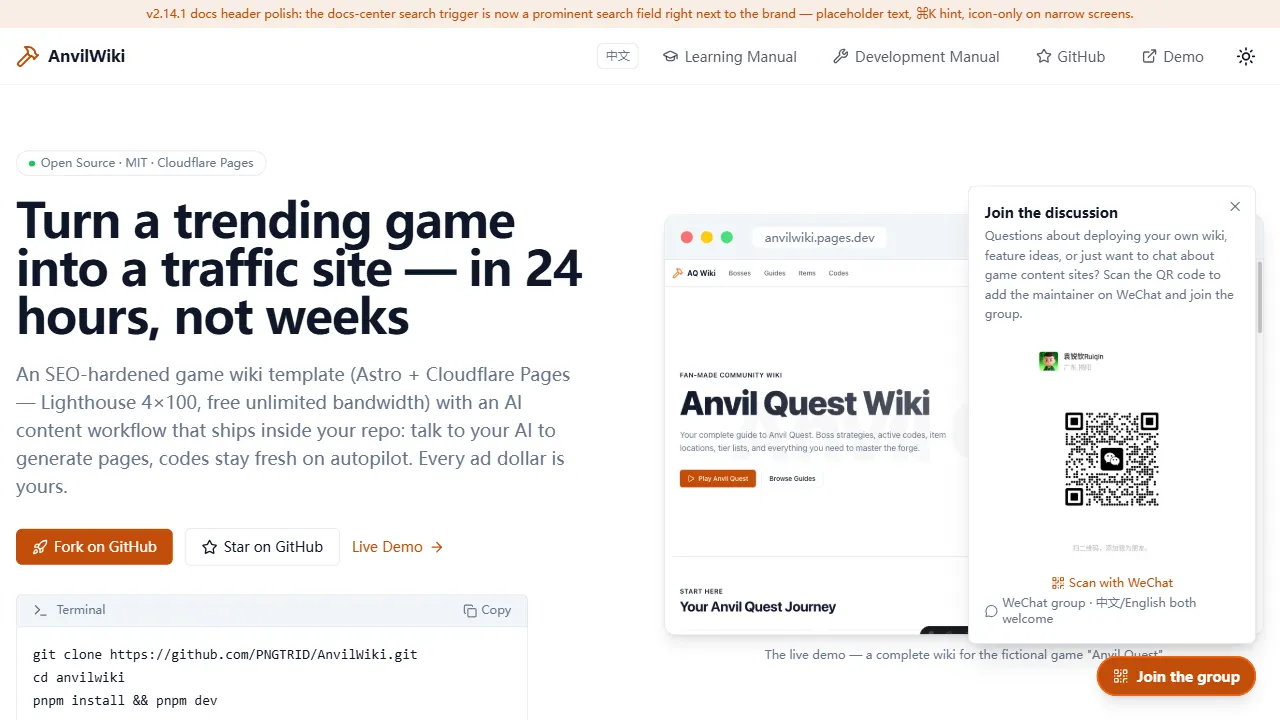
AnvilWiki
AnvilWiki is an Astro static Wiki template for game guide and compendium sites, with a built-in AI content workflow and monetization components. It outputs static pages by default and deploys on Cloudflare Pages, emphasizing zero server cost and out-of-the-box performance.
Astro · Game Site
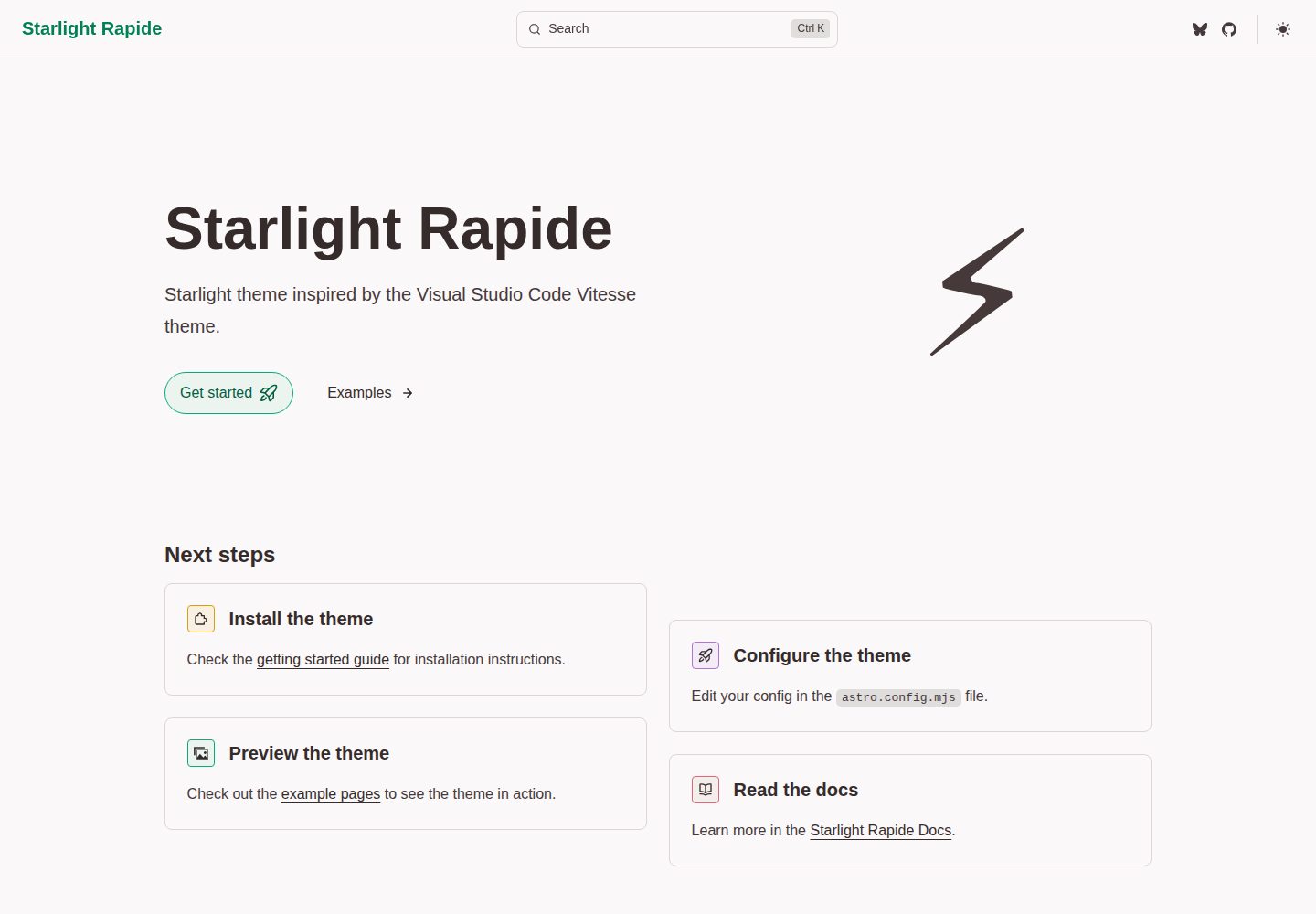
starlight-theme-rapide
starlight-theme-rapide is an Astro Starlight documentation site theme inspired by the Visual Studio Code Vitesse theme, offering dark and light modes and released under the MIT license.
Astro · Documentation
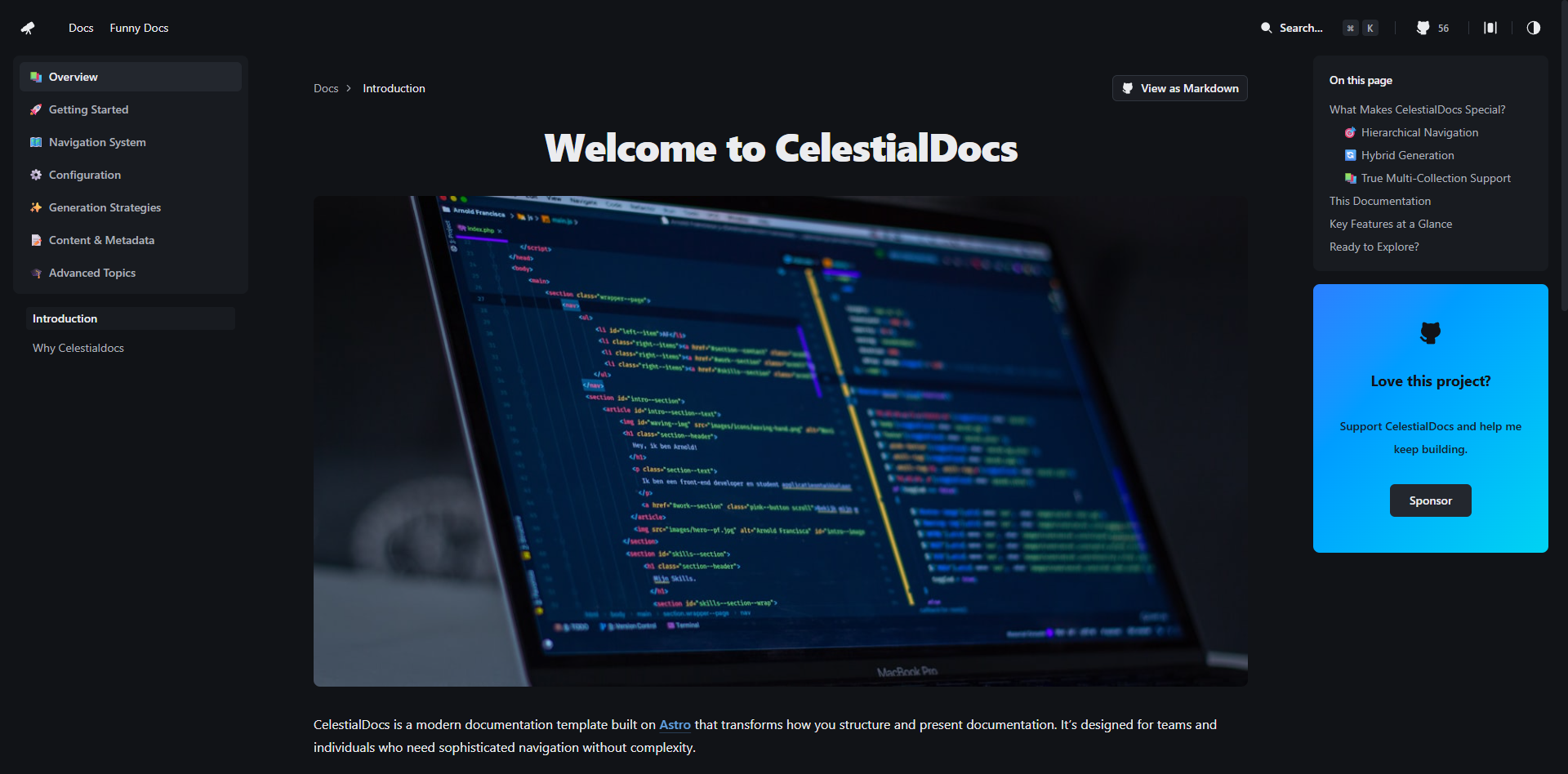
CelestialDocs
CelestialDocs is an Astro-based documentation platform template that maintains documentation, blog, and product pages in a single repository through a multi-collection architecture.
Astro · Documentation
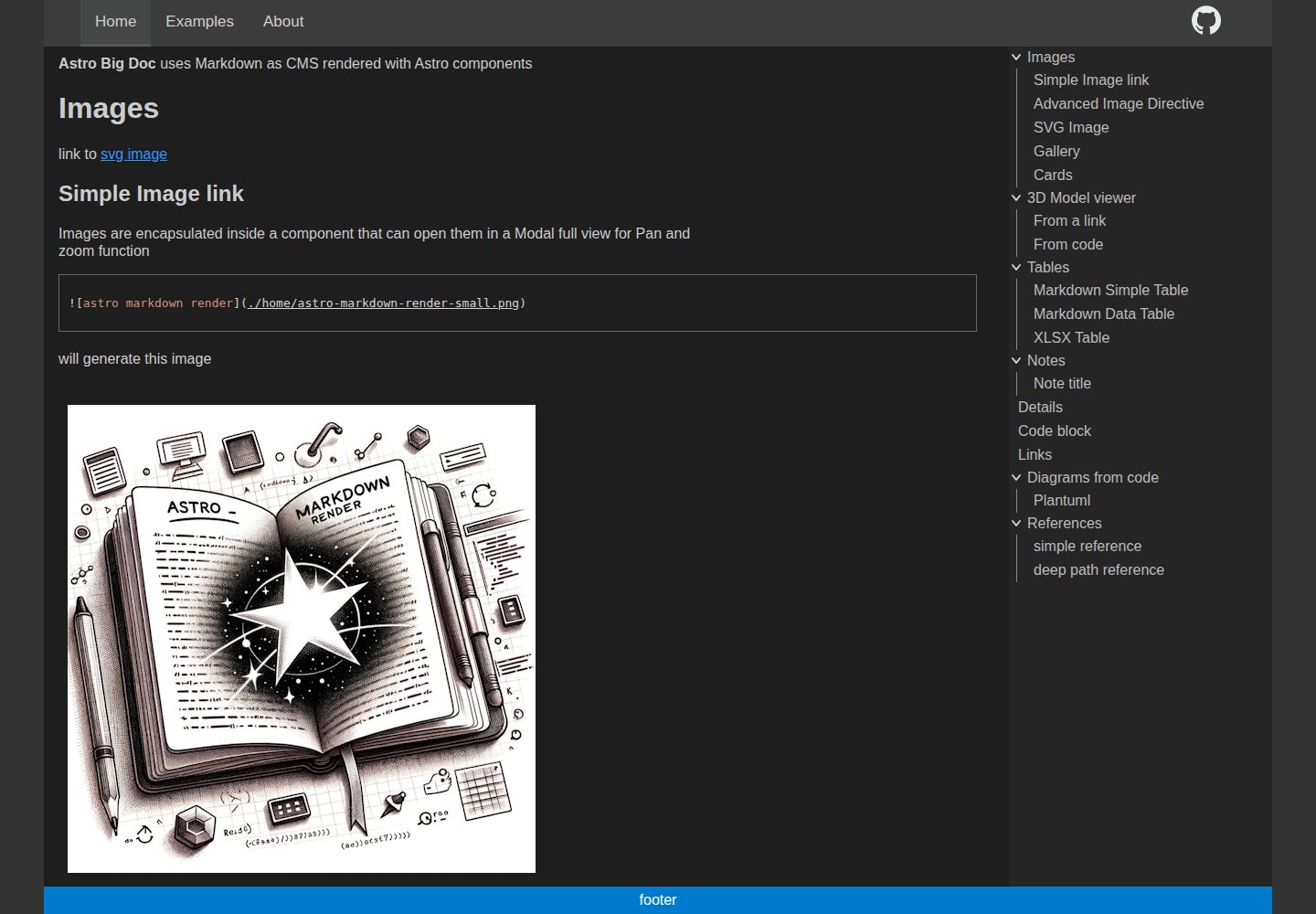
astro-big-doc
astro-big-doc is an Astro-based documentation site theme that renders standard Markdown and automatically generates a hierarchical menu and table of contents from the file directory structure with zero configuration.
Astro · Documentation
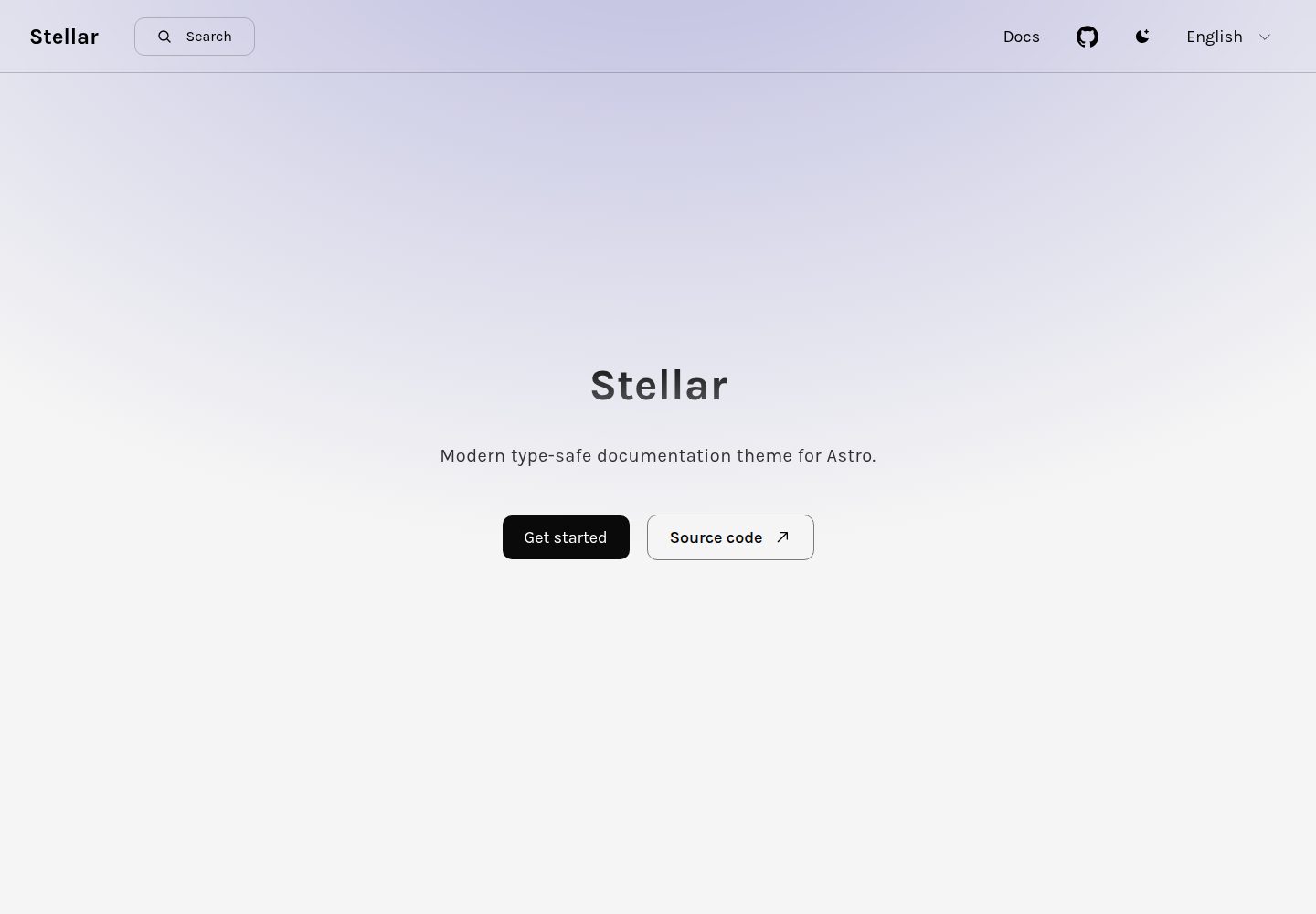
stellar
Stellar is a modern, type-safe documentation theme for Astro, suited for technical documentation sites written in Markdown or MDX. It offers dark mode, type-safe i18n, fuse.js local search, Tailwind styling, the View Transitions API, Shiki code highlighting, and custom import paths.
Astro · Documentation
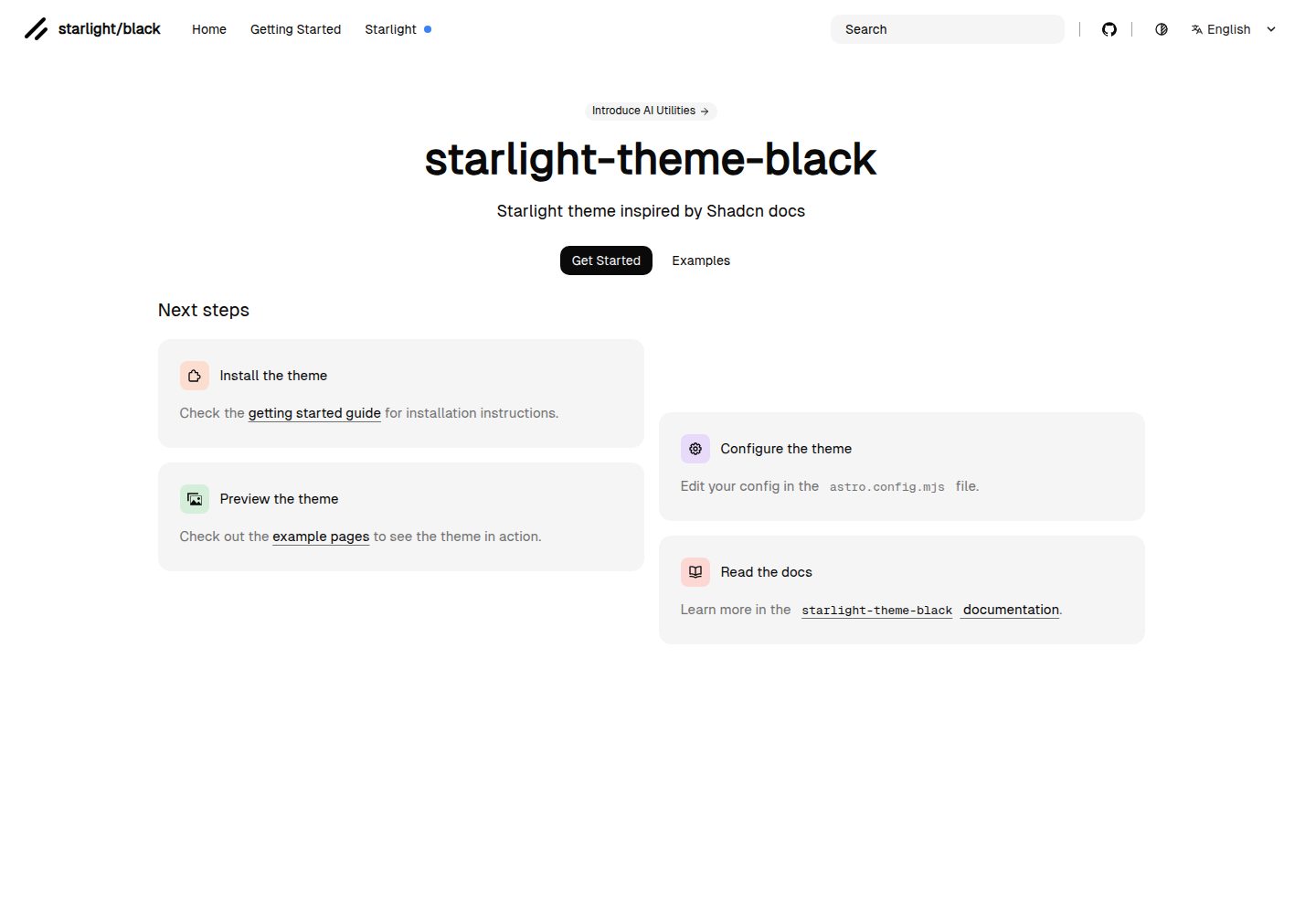
starlight-theme-black
starlight-theme-black is an Astro Starlight theme by adrian-ub that replaces the default look with a black palette, green accent (#22c55e), and editorial layout inspired by shadcn documentation.
Astro · Documentation